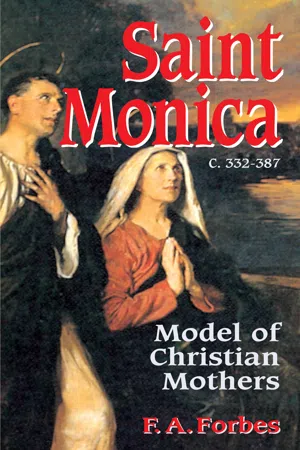
The famous persevering mother whose prayers, patience and good example at last obtained the conversion of her wayward son - the great St. Augustine - as well as her pagan husband and her mother-in-law. Includes her childhood, difficult marriage, anguish over Augustine, constancy and - in the end - her joy at his conversion. A magnificent story of prayer finally answered! Impr. 115 pgs 4 Illus,
- 115 pages
- English
- ePUB (mobile friendly)
- Available on iOS & Android
eBook - ePub
About this book
Information
Topic
Theology & ReligionSubtopic
Christian DenominationsChapter 1
A YOUNG CHRISTIAN GIRL
ON the sunny northern coast of Africa, in the country which we now call Algeria stood, in the early days of Christianity, a city called Tagaste. Not far distant lay the field of Zama, where the glory of Hannibal had perished forever. But Rome had long since avenged the sufferings of her bitter struggle with Carthage. It was the ambition of Roman Africa, as the new colony had been called by its conquerors, to be, if possible, more Roman than Rome. Every town had its baths, its theatre, its circus, its temples, its aqueducts. It was even forbidden to exiles as a place of refuge—too much like home, said the authorities.
It was about the middle of the fourth century. The Church was coming forth from her long imprisonment into the light of day. The successor of Constantine, in name a Christian, sat on the imperial throne. The old struggle with paganism, which had lasted for four hundred years, was nearly at an end, but new dangers assailed the Christian world. Men had found that it was easier to twist the truth than to deny it, and heresy and schism were abroad.
In the atrium or outer court of a villa on the outskirts of Tagaste an old woman and a young girl sat together looking out into the dark shadows of the evening, for the hot African sun had sunk not long since behind the Numidian Mountains, and the day had gone out like a lamp.
“And the holy Bishop Cyprian?” asked the girl.
“They sent him into exile,” said the old woman, “for his father had been a Senator and his family was well known and powerful. At that time they dared not put him to death, though later he, too, shed his blood for Christ. It was God’s will that he should remain for many years to strengthen his flock in the trial.”
“Did you ever see him, Grandmother?” asked the girl.
“No,” said the old woman, “it was before my time, but my mother knew him well. It was when he was a boy in Carthage and still a pagan that the holy martyrs Perpetua and Felicitas suffered with their companions. It was not till years after that he became a Christian, but it may have been their death that sowed the first seed in his heart.”
“Tell me,” said the girl softly. It was an oft-told tale of which she never tired. Her grandmother had lived through those dark days of persecution, and it was the delight of Monica’s girlhood to hear her tell the stories of those who had borne witness to the Faith in their own land of Africa.
“Perpetua was not much older than you,” said the old woman. “She was of noble race and born of a Christian mother, though her father was a pagan. She was married and had a little infant of a few months old. When she was called before the tribunal of Hilarion the Roman Governor, all were touched by her youth and beauty. ‘Sacrifice to the gods,’ they said, ‘and you shall go free.’ ‘I am a Christian,’ she answered, and nothing more would she say, press her as they might.
“Her old father hastened to her side with the baby, and laid it in her arms. ‘Will you leave your infant motherless?’ he asked, ‘and bring your old father’s hairs in sorrow to the grave?’
“ ‘Have pity on the child!’ cried the bystanders. ‘Have pity on your father!’
“Perpetua clasped her baby to her breast and her eyes filled with tears. They thought she had yielded, and brought her the incense.
“ ‘Just one little grain on the brazier,’ they said, ‘and you are free—for the child’s sake and your old father’s.’
“She pushed it from her. ‘I am a Christian,’ she said. ‘God will keep my child.’
“She was condemned with her companions to be thrown to the wild beasts in the amphitheatre, and they were taken away and cast into a dark dungeon. Every day they were tempted with promises of freedom to renounce the Truth. The little babe of Felicitas was born in the prison where they lay awaiting death. A Christian woman took the infant to bring it up in the Faith. The young mother never saw the face of her child in this world. One word, one little motion of the hand, and they would be free, restored again to their happy life of old and the homes that were so dear. There were many, alas! in those cruel days who had not courage for the fight—who sacrificed, and went their way. Not so these weak women.
“Once again they brought Perpetua her little child to try to shake her constancy. ‘The prison was like a palace,’ she said, while its little downy head lay on her breast. Her father wept, and even struck her in his grief and anger. ‘I am a Christian,’ she said, and gave him back the babe.
“They were thrown to the wild beasts. Felicitas and Perpetua, who had been tossed by a wild cow, though horribly gored, were still alive. Gladiators were summoned to behead them. Felicitas died at the first stroke, but the man’s hand trembled, and he struck at Perpetua again and again, wounding her, but not mortally. ‘You are more afraid than I,’ she said gently and, taking the point of the sword, held it to her throat. ‘Strike now,’ she said, and so passed into the presence of her God.”
Monica drew a long breath. “So weak and yet so strong,” she said.
“So it is, my child,” said the old woman. “It is those who are strong and true in the little things of life who are strong and true in the great trials.”
“It is hard to be always strong and true,” said the girl.
“Not if God’s love comes always first,” answered the old woman.
Monica was silent. She was thinking of her own young life, and how, with all the safeguards of a Christian home about her, she had narrowly escaped a great danger. From her babyhood she had been brought up by her father’s old nurse—not over-tenderly, perhaps, but wisely, for the city of Tagaste was largely pagan in its habits, and the faithful old servant knew well what temptations would surround her nursling in later years. Monica, though full of life and spirit, had common sense and judgment beyond her years. She had also a great love of God and of all that belonged to His holy service, and would spend hours kneeling in the church in a quiet corner. It was there she brought all her childish troubles and her childish hopes; it was to the invisible Friend in the sanctuary that she confided all the secrets of her young heart, and, above all, that desire to suffer for Him and for His Church with which the stories of the martyrs had inspired her. When the time slipped away too fast, and she returned home late, she accepted humbly the correction that awaited her, for she knew that she had disobeyed—although unintentionally—her nurse’s orders.
Monica had been willfully disobedient once, and all her life long she would never forget the lesson her disobedience had taught her. It was a rule of her old nurse that she should take nothing to drink between meals, even in the hot days of summer in that sultry climate. If she had not courage to bear so slight a mortification as that, the old woman would argue, it would go ill with her in the greater trials of life. Monica had become used to the habit, but when she was old enough to begin to learn the duties of housekeeping her mother had desired that she should go every day to the cellar to draw the wine for the midday meal. A maid-servant went with her to carry the flagon, and the child, feeling delightfully important, filled and refilled the little cup which was used to draw the wine from the cask and emptied it carefully into the wine jar. When all was finished, a few drops remaining in the cup, a spirit of mischief took sudden possession of Monica and she drained it off, making a wry face as she did so at the strange taste. The maid-servant laughed, and continued to laugh when the performance was repeated the next day and the day after. The strange taste became gradually less strange and less unpleasant to the young girl; daily a few drops were added, until at last, scarcely thinking what she did, she would drink nearly the fill of the little cup, while the servant laughed as of old.
Monica was quick and intelligent and was learning her household duties well. Finding one day that a piece of work which fell to the lot of the maid who went with her to the wine cellar was very badly done, she reproved her severely. The woman turned on her young mistress angrily.
“It is not for a wine-bibber like you to find fault with me!” she retorted.
Monica stood horrified. The woman’s insolent word had torn the veil from her eyes. Whither was she drifting? Into what depths might that one act of disobedience so lightly committed have led her had not God in His mercy intervened? She never touched wine for the rest of her life unless largely diluted with water. God had taught her that “he who despises small things shall fall by little and little,” and Monica had learned the lesson. She had learned to distrust herself, and self-distrust makes one marvellously gentle with others; she had learned, too, to put her trust in God, and trust in God makes one marvellously strong. She had been taught to love the poor and the suffering, and to serve them at her own expense and inconvenience, and the service of others makes one unselfish. God had work for Monica to do in His world, as He has for us all if we will only do it, and He had given her what was needful for her task.
That night on the way to her chamber, as the young girl passed the place where she had sat with her grandmother earlier in the day, she paused a moment and looked out between the tall pillars into the starlit night, where the palm trees stood like dark shadows against the deep, deep blue of the sky. She clasped her hands, and her lips moved in prayer. “O God,” she murmured, “to suffer for Thee and for Thy Faith!” God heard the whispered prayer, and He was to answer it later. There is a living martyrdom as painful and as bitter as death, and Monica was called to taste it.
Chapter 2
WIFE OF A PAGAN
ALTHOUGH there were many Christians in Roman Africa, pagan manners and customs still survived in many of her cities. The people clung to their games in the circus, the cruel and bloody combats of the arena, which, though forbidden by Constantine, were still winked at by provincial governors. They scarcely pretended to believe in their religion, but they held to the old pagan festivals, which enabled them to enjoy themselves without restraint under pretense of honoring the gods. The paganism of the fourth century, with its motto, “Let us eat, drink, and be merry,” imposed no self-denial; it was therefore bound to be popular.
But unrestrained human nature is a dangerous thing. If men are content to live as the beasts that perish, they fall as far below their level as God meant them to rise above it—or rather, far further—and the Roman Empire was falling to pieces through its own corruption. In Africa the worship of the old Punic gods, to whom living children used to be offered in sacrifice, still had its votaries, and priests of Saturn and Astarte, with their long hair and painted faces and scarlet robes, were still to be met dancing madly in procession through the streets of Carthage.
The various heretical sects had their preachers everywhere, proclaiming that there were much easier ways of serving Christ than that taught by the Catholic Church. It was hard for the Christian bishops to keep their flocks untainted, for there were enemies on every side.
When Monica was twenty-two years old her parents gave her in marriage to a citizen of Tagaste called Patricius. He held a good position in the town, for he belonged to a family which, though poor, was noble. Monica knew little of her future husband, save that he was nearly twice her age and a pagan, but it was the custom for parents to arrange all such matters, and she had only to obey.
A little surprise was perhaps felt in Tagaste that such good Christians should choose a pagan husband for their beautiful daughter, but it was found impossible to shake their hopeful views for the future. When it was objected that Patricius was well known for his violent temper even among his own associates, they answered that he would learn gentleness when he became a Christian. That things might go hard with their daughter in the meantime they did not seem to foresee.
Monica took her new trouble where she had been used to take the old. Kneeling in her favorite corner in the church, she asked help and counsel of the Friend who never fails. She had had her girlish ideals of love and marriage. She had dreamed of a strong arm on which she could lean, of a heart and soul that would be at one with her in all that was most dear, of two lives spent together in God’s love and service. And now it seemed that it was she who would have to be strong for both; to strive and to suffer to bring her husband’s soul out of darkness into the light of truth. Would she succeed? And if not, what would be that married life which lay before her? She did not dare to think. She must not fail—and yet … “Thou in me, O Lord,” she prayed again and again through her tears.
It was late when she made her way homeward, and that night, kneeling at her bedside, she laid the ideals of her girlhood at the feet of Him who lets no sacrifice, however small, go unrewarded. She would be true to this new trust, she resolved, cost what it might.
Things certainly did not promise well for the young bride’s happiness. Patricius lived with his mother, a woman of strong passions like himself, and devoted to her son. She was bitterly jealous of the young girl who had stolen his affections and she made up her mind to dislike her. The slaves of the household followed, of course, their mistress’s lead, and tried to please her by inventing stories against Monica.
Patricius, who loved his young wife with the only kind of love of which he was capable, had nothing in common with her, and had no clue to her thoughts or actions. He had neither reverence nor respect for women—indeed, most of the women of his acquaintance were deserving of neither—and he had chosen Monica for her beauty, much as he would have chosen a horse or a dog.
He thought her ways and ideas extraordinary. She took as kindly an interest in the slaves as if they had been of her own flesh and blood, and would even intercede to spare them a beating. She liked the poor, and would gather these dirty and unpleasant people about her, going even so far as to wash and dress their sores. Patricius did not share her attraction and objected strongly to such proceedings, but Monica pleaded so humbly and sweetly that he gave way and let her do what seemed to cause her so much pleasure.
There was “no accounting for tastes,” he remarked. She would spend hours in the church praying, with her great eyes fixed on the altar. True, she was never there at any time when she was likely to be missed by her husband, and never was she so full of tender affection for him as when she came home; but still, it was a strange way of spending one’s time.
There was something about Monica, it is true, that was altogether unlike any other inmate of the house, as she went about her daily duties, always watching for the chance of doing a kind action.
When Patricius was in one of his violent tempers, shouting, abusing and even striking everybody who came in his way, she would look at him with gentle eyes that showed neither fear nor anger. She never answered sharply, even though his rude words wounded her cruelly. He had once raised his hand to strike her, but he had not dared; something—he did not know what—withheld him.
Later, when his anger had subsided, and he was perhaps a little ashamed of his violence, she would meet him with an affectionate smile, forgiving and forgetting all. Only if he spoke himself, and, touched at her generous forbearance, tried shamefacedly to make amends for his treatment of her, would she gently explain her conduct. More often she said nothing, knowing that actions speak more loudly than words. As her greatest biographer says of her: “She spoke little, preached not at all, loved much and prayed unceasingly.”
When the young wives of her acquaintance, married like herself to pagan husbands, complained of the insults and even blows which they had to bear, she would ask them laughingly, “Are you sure your own tongue is not to blame?” And then with ready sympathy she would do all she could to help and comfort and advise. They would ask her secret, for everyone knew that, in spite of the violence of Patricius’ temper, he treated her with something that almost approached respect. Then she would bid them be patient...
Table of contents
- Front Cover
- Half Title Page
- Title Page
- Copyright Page
- Epigraph
- Contents
- 1. A Young Christian Girl
- 2. Wife of a Pagan
- 3. The Young Augustine
- 4. New Joys, New Sorrow
- 5. Son to Carthage, Husband to Eternity
- 6. Augustine at Carthage
- 7. Monica’s Son Struggles in Darkness
- 8. Monica’s Heartbreak
- 9. Augustine’s Great Struggle Comes to a Head
- 10. Monica’s Prayers Answered
- 11. The Death of a Saint
- The Confraternity of Christian Mothers
- Prayers
- Back Cover
- A Collection of Classic Artwork
- Confession Its Fruitful Practice
- Litany of Our Lady of Consolation, Saint Augustine And Saint Monica
- Tan Classics
- Become a Tan Missionary!
- Share the Faith with Tan Books!
- Tan Books
Trusted by 375,005 students
Access to over 1.5 million titles for a fair monthly price.
Study more efficiently using our study tools.
Frequently asked questions
Yes, you can cancel anytime from the Subscription tab in your account settings on the Perlego website. Your subscription will stay active until the end of your current billing period. Learn how to cancel your subscription
No, books cannot be downloaded as external files, such as PDFs, for use outside of Perlego. However, you can download books within the Perlego app for offline reading on mobile or tablet. Learn how to download books offline
Perlego offers two plans: Essential and Complete
- Essential is ideal for learners and professionals who enjoy exploring a wide range of subjects. Access the Essential Library with 800,000+ trusted titles and best-sellers across business, personal growth, and the humanities. Includes unlimited reading time and Standard Read Aloud voice.
- Complete: Perfect for advanced learners and researchers needing full, unrestricted access. Unlock 1.5M+ books across hundreds of subjects, including academic and specialized titles. The Complete Plan also includes advanced features like Premium Read Aloud and Research Assistant.
We are an online textbook subscription service, where you can get access to an entire online library for less than the price of a single book per month. With over 1.5 million books across 990+ topics, we’ve got you covered! Learn about our mission
Look out for the read-aloud symbol on your next book to see if you can listen to it. The read-aloud tool reads text aloud for you, highlighting the text as it is being read. You can pause it, speed it up and slow it down. Learn more about Read Aloud
Yes! You can use the Perlego app on both iOS and Android devices to read anytime, anywhere — even offline. Perfect for commutes or when you’re on the go.
Please note we cannot support devices running on iOS 13 and Android 7 or earlier. Learn more about using the app
Please note we cannot support devices running on iOS 13 and Android 7 or earlier. Learn more about using the app
Yes, you can access Saint Monica by Mother Frances Alice Monica Forbes in PDF and/or ePUB format, as well as other popular books in Theology & Religion & Christian Denominations. We have over 1.5 million books available in our catalogue for you to explore.