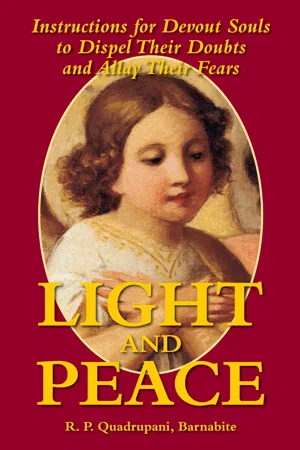
LIGHT AND PEACE is a handbook for getting to Heaven a short and practical course in proper Christian living that covers all the important aspects of our religious duties. By far, the most telling feature of this little book is its immense common sense and good advice. LIGHT AND PEACE shows that perfecting one's self is not a complicated task, but one which requires good, practical thinking and a knowledge of the task at hand in short, Light on the path which is what this book is. Thereafter, the result of one s knowing where he is going spiritually and how best to achieve this end is Peace, that peace which Our Lord promised and which the world cannot give.LIGHT AND PEACE is a classic in Catholic spirituality. First written in 1795 in Italian, this work has passed through innumerable editions in Italian, French, German and English, the present one alone being the tenth in this format. In short, it is a summary of spiritual guidance for earnest Christians in the ordinary duties of life in the world.
eBook - ePub
Light and Peace
Instructions for Devout Souls to Dispel Their Doubts and Allay Their Fears
- 210 pages
- English
- ePUB (mobile friendly)
- Available on iOS & Android
eBook - ePub
Light and Peace
Instructions for Devout Souls to Dispel Their Doubts and Allay Their Fears
About this book
Information
Topic
Theology & ReligionSubtopic
Christian Denominations

Return of the Prodigal Son.
| Nihil Obstat: | William J. Blacet, J.C.L. Censor Librorum | |
| Imprimatur: |  | John P. Cody, S.T.D. Bishop of Kansas City-St. Joseph May 29, 1957 |
Copyright © 2000 by TAN Books and Publishers, Inc.
Originally published by the Benedictine Convent of Perpetual Adoration, Clyde, Missouri.
Revised, expanded and republished in 2000 by TAN Books and Publishers, Inc.
ISBN 978-0-89555-675-2
Library of Congress Catalog Card No.: 00-134503
Printed and bound in the United States of America.
TAN Books
Charlotte, North Carolina
2000
Charlotte, North Carolina
2000
“He said therefore to them again: Peace be to you. As the Father hath sent me, I also send you. When he had said this, he breathed on them; and he said to them: Receive ye the Holy Ghost. Whose sins you shall forgive, they are forgiven them; and whose sins you shall retain, they are retained.”
—John 20:21-23
CONTENTS
1. The Blessings of Confession
2. The Five Things Necessary for a Good Confession
Examination of Conscience
False Consciences and Their Remedies—The Lax Conscience—The Scrupulous Conscience—The Doubtful Conscience—How to Make a Good Examination of Conscience.
Contrition
The Qualities of Contrition—Interior Contrition—Supernatural Contrition—Perfect and Imperfect Contrition—Universal Contrition—Sovereign Contrition—Relapses into Former Sins.
Purpose of Amendment
Occasions of Sin—Purpose of Amendment Must Be Specific.
Confession and Absolution
The Confession of Sins—Qualities of a Good Confession—Confession of Venial Sins—Sacrilegious Confessions—General Confession—Frequent Confession—The Absolution of the Priest.
Satisfaction
The Sacramental Penance—Voluntary Penances—Indulgences.
3. How to Make a Good Confession
The Examination of Conscience
Beginning Prayer—Points for the Examination of Conscience—The Ten Commandments of God—The Six Precepts of the Church—The Seven Capital Sins—Duties of Particular States of Life—Corporal and Spiritual Works of Mercy.
Considerations to Excite Contrition
The Enormity of Sin—God’s Benefits to Me—The Love of Jesus Christ.
Prayers Before Confession
Act of Contrition and Purpose of Amendment—Prayer before a Crucifix—Prayer of St. Gertrude—A Short and Efficacious Act of Contrition.
An Easy Method of Going to Confession
Prayers After Confession
Psalm 102—Prayer of Thanksgiving—Prayer before Performing the Sacramental Penance.

Chapter 1

The Blessings of Confession
“BLESSED are they that wash their robes in the Blood of the Lamb.” (Apoc. 22:14). Catholics truly may be called “blessed” in the means they have of washing the sin-stained robes of their souls in the Precious Blood of the Lamb of God in the Sacrament of Penance! There is no question that Confession—especially frequent Confession—is an inestimable blessing to mankind.
Man can hope for no greater blessing on this earth than true peace of soul. The Sacrament of Penance is a perennial fountain of peace. It is a source of untold consolation to human hearts.
This Sacrament gives any and every member of the Catholic Church who has transgressed the holy laws of God an easy and simple means to obtain full pardon and to be restored to His friendship. This is its first and principal effect. Its second effect is to wipe out the punishment due to sin: eternal punishment entirely, and temporal punishment in whole or in part, according to the penitent’s dispositions.
It closes the gates of Hell, which open to swallow up in the infernal abyss souls who deliberately turn away from God by mortal sin and who sunder the ties binding them to Him by preferring their own wills to His. A good Confession opens anew the portals of Heaven, which are barred to souls so long as they remain in the state of mortal sin.
It clothes souls with the beautiful nuptial garment of Sanctifying Grace, or renders that garment still more beautiful if the soul already possesses it.
It restores past merits, which are lost by even a single mortal sin.
It renders the soul capable again of performing acts meritorious of an eternal reward, which is impossible while it is in the state of mortal sin.
It confers sacramental graces, that is, powerful supernatural helps to avoid sin in the future, and to persevere in the service of God.
It gives a claim to the special graces the soul needs in order to lead a God-pleasing life.
Finally, it checks sinful passions and inclinations to evil.
To partake in fullest measure of these blessings of the Sacrament of Penance, it is necessary for the penitent to know how to make a good Confession. The present booklet is an attempt to help souls in this all-important matter by explaining the five requisites of a good Confession, plus various points which are of vital importance for the fruitful reception of this Sacrament.
Chapter 2
The Five Things Necessary for a Good Confession
AS every well-instructed Catholic knows, the five things necessary for a good Confession are: 1) An Examination of Conscience, 2) Contrition (or sorrow) for sin, 3) A Firm Purpose of Amendment, 4) The Confession of one’s sins to a priest, 5) Acceptance of one’s penance (making satisfaction for sin).
I. EXAMINATION OF CONSCIENCE
“GO, show yourselves to the priests.” (Luke 17:14). This was the command given by Our Lord to the ten lepers He had healed. This is also the command God gives to souls who have contracted the far more loathsome disease of spiritual leprosy—namely, sin. The priest has been appointed by Our Lord as a spiritual physician to heal the diseases of the soul. But to do so, the priest, like any other physician, must know the nature of the disease. In other words, he must know the sins that have been committed. The penitent, therefore, must make known to him the exact state of his soul. To gain this self-knowledge, it is undoubtedly necessary for the penitent to search seriously into his life since the time of his last Confession, reflecting upon his thoughts, words, deeds and omissions. This inward scrutiny of oneself is called the Examination of Conscience. It should be performed with earnestness and care, mindful of the warning of St. Paul: “But if we would judge ourselves, we should not be judged.” (1 Cor. 11:31).
A. FALSE CONSCIENCES AND THEIR REMEDIES
A diligent examination of conscience should bring clearly to the penitent’s mind his sins of thought, word, deed, desire and omission, according to their kind, their number and their relevant circumstances.
In this examination, two faults are to be avoided: 1) Laxity (or remissness) and 2) Scrupulosity.
1. The Lax Conscience
A lax c...
Table of contents
- Front Cover
- Title Page
- Copyright
- Translator Preface
- Introduction
- Contents
- Exterior Practices
- Interior Life
- Social Life
- Additions
- Notes
- Back Cover
- A Collection of Classic Artwork
- Confession Its Frutful Practice
- Tan Classics
- Become a Tan Missionary!
- Share the Faith with Tan Books!
- Tan Books
Trusted by 375,005 students
Access to over 1.5 million titles for a fair monthly price.
Study more efficiently using our study tools.
Frequently asked questions
Yes, you can cancel anytime from the Subscription tab in your account settings on the Perlego website. Your subscription will stay active until the end of your current billing period. Learn how to cancel your subscription
No, books cannot be downloaded as external files, such as PDFs, for use outside of Perlego. However, you can download books within the Perlego app for offline reading on mobile or tablet. Learn how to download books offline
We are an online textbook subscription service, where you can get access to an entire online library for less than the price of a single book per month. With over 1.5 million books across 990+ topics, we’ve got you covered! Learn about our mission
Look out for the read-aloud symbol on your next book to see if you can listen to it. The read-aloud tool reads text aloud for you, highlighting the text as it is being read. You can pause it, speed it up and slow it down. Learn more about Read Aloud
Yes! You can use the Perlego app on both iOS and Android devices to read anytime, anywhere — even offline. Perfect for commutes or when you’re on the go.
Please note we cannot support devices running on iOS 13 and Android 7 or earlier. Learn more about using the app
Please note we cannot support devices running on iOS 13 and Android 7 or earlier. Learn more about using the app
Yes, you can access Light and Peace by Rev. Fr. R. P. Quadrupani in PDF and/or ePUB format, as well as other popular books in Theology & Religion & Christian Denominations. We have over 1.5 million books available in our catalogue for you to explore.