A popular expose of his life and work, based on Protestant historians. Incredible history; fascinating, damning evidence about him that is quite contrary to the popular image. Many quotes from his own mouth. Essential history! 393 pgs,
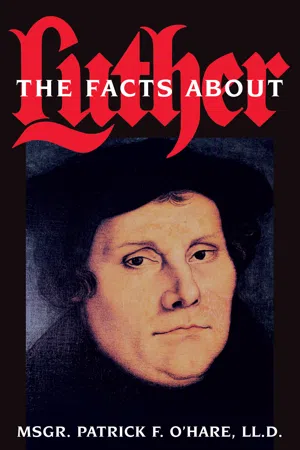
- 393 pages
- English
- ePUB (mobile friendly)
- Available on iOS & Android
eBook - ePub
The Facts about Luther
About this book
Information
Topic
Theology & ReligionSubtopic
Christian DenominationsChapter 1
Luther: His Friends and Opponents
THIS modest volume is issued to present to the public at large some of the most prominent and important features in the life and career of Martin Luther, the founder of Protestantism. We wish to declare in the beginning that this little work makes no pretension to either originality or scholarship; neither does it claim to set forth in its pages anything that is not already well-known and fully authenticated in the life of Luther and the development of the new system of religion he gave to the world. Abler and more competent writers have long since covered the whole ground. Learned and distinguished historians like Janssen, Denifle, Grisar, and many others, have painted with masterly accuracy the real picture of the reformer from material supplied for the most part by his own acknowledged writings. These celebrated authors have practically pronounced the last word on the protagonist and champion of Protestantism, and there seems to be slight justification for the publication of a new work on the old subject.
Whilst we recognize all this to be true, we feel that we may be pardoned for attempting to tell anew, but in greater brevity and directness, the salient and more striking features connected with the apostate monk of Wittenberg and his religious movement, because there is a large number in the community who in the hurry and high pressure of modern life have not the time to examine the ponderous and exhaustive volumes of the authors alluded to above and who moreover have not the means to secure these works, much as they might desire to do so, on account of prohibitive prices. Taking all this into consideration, we believe we will be excused for intruding on a field that has already been well covered and for presenting to the general public a plain but well-authenticated sketch of the man who in the sixteenth century inaugurated a movement which bears the name of “Reformation” and caused a large and fearful defection from the Church of which he was a member and to which the bulk of mankind adhered all through the centuries from its establishment by Jesus Christ. In treating of this historical character whose startling influence was exercised on his own country and on the world at large, we have no intention to wound the convictions and sensibilities of any in the community who may disagree with us. Our aim is to tell the truth about the standard-bearer of the Reformation, and of this no one should be afraid, for truth and virtue triumph by their own inherent beauty and power. The poet aptly sings:
Truth hath such a face and such a mien,
As to be loved needs only to be seen.
As to be loved needs only to be seen.
In dealing with Luther it is well to remember that students of history have given him such attention as has been accorded to few men of any age, and about fewer still have they expressed such widely divergent views. His friends insist that he was a model of virtue and possessed eminent qualities which in every way made him worthy of his position as a religious reformer, while his opponents openly denounce him and insist that in his own day he was known as a “trickster and a cheat,” one whose titanic pride, unrestrained temper and lack of personal dignity utterly unfitted him to reform the Church and the age.
To his followers the name and memory of Luther are objects of religious veneration. They have for the last four centuries surrounded him with such an aura of flattery and pedantry that he is looked upon as one of the glories of Germany, nay, the foremost figure in their Hall of Immortals. By dint of minatory iteration, his admirers have been brought to believe that “he is the precious gift of God to the nation.” Lutheran writers from Mathesius to Köstlin have invariably filled the German mind with all that reverent love could conjure up for their hero’s justification and exaltation. To call into question the powers of the Reformer or deny the divine mission of the Reformation was ever considered blasphemous and unpatriotic.
The opponents of Luther, on the contrary, stoutly maintain that his greatness was taken on trust and that the writers alluded to in the preceding paragraph have invariably, with a fatuous blindness mistaken for patriotism, fed and nourished the German mind, not on the real Luther, but on a Luther glossed over and toned down with respectful admiration and conjured under the influence of partisan-colored traditions intended to prevent him from being catalogued in his proper page in the world’s history. Reverential tenderness keyed to its highest pitch cannot, however, they claim, efface the clearly etched lineaments of the man of flesh and blood, the man of moods and impulses, of angularities and idiosyncrasies which dominated his career and singled him out as a destructive genius unfitted to carry out any kind of reformation, either in Church or State.
In discussing Luther and his religious movement, we feel at liberty to say that many, both in the ranks of his friends and of his opponents, have perhaps at times indulged in too great a display of feeling and exaggeration. It would help considerably to cool down the bitterness aroused among all parties, did they honestly endeavor to discover for themselves the findings and conclusions of non-partisan writers on the delicate but interesting question. Wiser council and juster appreciation would inevitably reward the searchers after truth, the whole truth and nothing but the truth. Of these unbiased writers, many of whom are Protestants, there is no scarcity. They have been delving into the pages of history to find out the real Luther, and they have not been afraid to tell in the interest of truth what sort of a man he actually was. These scholarly and reliable authors assert that Luther unquestionably possessed certain elements of greatness. They admit that he was a tireless worker, a forceful writer, a powerful preacher and an incomparable master of the German language. They credit him with a keen knowledge of human nature and of the trend of the world of his day. They allege, moreover, that he was capable of taking advantage of everything that favored his schemes of yoking to his own chariot all the forces that were then at work to injure and oppose the ancient and time-honored religion of Catholics. But whatever else of praise these writers bestow on the man, it is equally clear and beyond question that they are all agreed in declaring that Luther possessed a violent, despotic and uncontrolled nature. Many of these writers, although Protestants and not friendly to the Catholic Church, have not been afraid to tell their co-religionists that the rights Luther assumed to himself in the matter of liberty of conscience, he unhesitatingly and imperiously denied to all who differed from him, as many specific cases overwhelmingly confirm. His will and his alone, they declare, he dogmatically set up as the only standard he wished to be recognized, followed and obeyed. In their historical investigations they discovered many other shortcomings in the character of the man, unbecoming in one who claimed to be a reformer, and in their love of truth and real scholarship, they have honestly acknowledged that there was something titanic, unnatural and diabolical in the founder of Protestantism.
One of these fearless writers was the Protestant Professor Seeberg of Berlin. He was no friend of the Catholic Church, but his deep study of the man and his movement forced him to say: “Luther strode through his century like a demon crushing under his feet what a thousand years had venerated.” The same author further remarks: “In him dwelt ‘The Superhuman’ or, in Nietzsche’s philosophy, the ‘Übermensch’, who dwells ‘beyond moral good and evil.’”
In November 1883 the English Protestant Bishop Bewick applied to Luther the epithets “foul-mouthed” and “scurrilous.”
In the Century issued in December, 1900, Augustine Birrell, a distinguished English Protestant writer, declared that “Luther was not an ideal sponsor of a new religion; he was a master of billingsgate and the least saintly of men. At times, in reading Luther, one is drawn to say to him what Herrick so frankly says of himself: ‘Luther, thou art too coarse to love.’
“Had Luther been a brave soldier of fortune, his coarseness might have passed for a sign of the times; but one likes leaders of religion to be religious; and it is hard to reconcile coarseness and self-will, two leading notes of Luther’s character, with even rudimentary religion. To want to be your own pope is a sign of the heresiarch, not of the Christian.”
To the testimony of Professor Seeberg and Mr. Birrell we desire to add another illustration of the change which has come over the minds of men regarding the German reformer. Licentiate Braun, in a contribution written for the Evangelische Kirchenzeitung (March 30, 1913, p. 195), tells in all honesty and straightforwardness how, with strips from the skin of his own co-religionists, Protestant theologians have pieced together not a fictitious, but a genuinely reliable account of the life of Luther. This able Protestant theologian writes as follows:
“How small the Reformer has become according to the Luther studies of our own Protestant investigators! How his merits have shrivelled up! We believed that we owed to him the spirit of toleration and liberty of conscience. Not in the least! We recognized in his translation of the Bible a masterpiece stamped with the impress of originality—we may be happy now if it is not plainly called a ‘plagiarism’! We venerated in him the father of the popular school system—a purely ‘fictitious greatness’ which we have no right to claim for him! We imagined that we found in Luther’s words splendid suggestions for a rational treatment of poverty and that a return to him would bring us back to the true principles of charity—but the laurels do not belong to him, they must be conceded to the Catholic Church! We were delighted to be assured that this great man possessed an insight into national economics marvelous for his day—but ‘unbiased’ investigation forces the confession that there were many indications of retrogressive tendencies in his economic views!”
“Did we not conceive of Luther as the founder of the modern State? Yet in all that he said upon this subject there was nothing of any value which was at all new; as for the rest, by making the king an ‘absolute patriarch’ he did not in the least improve upon the coercive measures employed by the theocracy of the Middle Ages.”
“Just think of it, then, all these conclusions come to us from the pen of Protestant theologians! Reliable historians give book and page for them. What is still more amazing, all these Protestant historians continue to speak of Luther in tones of admiration, in spite of the admissions which a ‘love of truth’ compels them to make. Looking upon the ‘results’ of their work thus gathered together, we cannot help asking the question: What, then, remains of Luther?”
The question, remember, is put not by a Catholic, but by an eminent Protestant theologian. It is an important question and deserves serious consideration. Who will answer it? The bigot and the preacher of “The Gospel of Hate” resent the question and, like all enemies of truth, they refuse to give it consideration. They hate the light and close their eyes to its illumination. Many of them hate truth as a business. Their books and their lectures bring them reputation or money. Like Judas they ask, “What will you give me?” For a price the low, the vile, the false feed the fires that burn in the hearts of certain fanatics. Unlike these are the Seebergs, the Birrells and the Brauns. They are not afraid of the truth. They sought it with unbiased minds, and once they discovered it they boldly communicated their findings to the world. Ask them the question who and what Luther really was, and their answer is straightforward, direct and unhesitating. They tell that nothing remains but an unpleasant memory of the man who divided the Church of God and who, destitute of constructive genius, depraved in manners and in speech, falsely posed as a reformer sent by God. The investigations they made in the field of reliable history convinced them that the father of Protestantism appeared to fill the world with light, but it was only the light of a passing meteor consuming and destroying itself in its fall. To the enemies of truth these scholarly researches are most embarrassing and disappointing. As a distinguished writer puts it, “They pluck jewel after jewel from Luther’s crown and make the praises chanted to him by the ranters of all times sound hollow in honest ears attuned to truth.”
All impartial history proclaims that Luther had very few, if any, of the qualifications that men naturally expect to find in one who poses as a religious reformer. The “Man of God,” “the supernatural spirit,” in which role he is represented by partisan writers, Luther was only in romance and myth. He attempted reformation and ended in deformation. Unfitted for the work he had outlined for himself, his ungovernable transports, riotous proceedings, angry conflicts and intemperate controversies frustrated his designs at every turn. His teaching, like his behavior, was full of inconsistencies, and his contempt of all the accepted forms of human right and of all authority, human and divine, could not but result in lamentable disaster. His wild pronouncements wrecked Germany, wrecked her intellectually, morally and politically. The havoc wrought directly or indirectly by him is almost without example in history. The outcome in the century following was that the nation became a mere geographical term and was thrown back two hundred years in development, in culture and in progress.
History presents no apology for the unbridled jealousy, fierce antagonism and unremitting opposition that marked the career of this man toward the Church of his forefathers. He was a revolutionist, not a reformer. The true reformer restores society to its primitive purity; the revolutionist violently upsets the constitution of society, putting something else in its place. While pretending to reform, he wrote and preached not for but against good works, and the novel teaching was eagerly accepted by the unthinking and bore those awful fruits of which the historians of the sixteenth and seventeenth centuries have painted the sorrowful picture. He rent asunder the unity of the Church till, alongside of the one true Church, there have arisen hundreds of warring sects; nay, there are those who extol him as the founder of a religion, forgetting that this is his greatest shame—for if he founded a religion, it is not the Christian religion established by Christ fifteen hundred years before. No wonder he went down in ignominious defeat and that the Church he unnecessarily attacked and relentlessly endeavored to destroy remained as the central figure of all Christendom to proclaim alike to the humblest peasant and the greatest savant its divine mission and heavenly authority to teach men the ways of eternal life.
All this may sound very strange and may shock a great many non-Catholics; but they must kindly remember that they were taught that the subject under consideration had but one side, and that inherited prejudices prevented them from examining the facts and finding the truth they really love. The light they needed was kept from them and they were innocently led to believe that Luther was justified in his defection from the Church he once loved and defended, but which he afterwards disgraced by a notoriously wicked and scandalous life. They heard him praised for what ignorant men called his “robust Christianity,” which was akin to Judas’s betrayal of the Master, and they believed this when they lauded him as an “apostle of liberty” in spite of the fact, as history shows, that he was one of the most intolerant of men. They have heard the anti-Catholic of every shade of character rake up the muck of history, vilify the clergy, hold up nuns as the wickedest of women, exploit the Pope as “Antichrist” and the “Man of Sin”; resort, in a word, to every known means of ridicule and misrepresentation to depict the spotless Spouse of Christ as the “great harlot of the Apocalypse,” “the mother of fornications and the abominations of the earth.” They have heard the wild, monstrous and even impossible statements of the lying and slanderous in the community, whose only aim is to advance the nefarious and diabolical work of inflaming the passions of the rabble and to keep alive the blind, prejudiced and irrational discrimination against everything Catholic. The pity of it all is that, in this day of enlightenment, many who would be ashamed to listen to professional charlatans in any other avocation of life will think that they are doing a “service to God” by giving a willing ear and swallowing down without a qualm the silly, senseless and unwarranted reproaches which unscrupulous haranguers, paid hirelings, and vile calumniators unblushingly and without the vestige of proof urge against the religion which Christ established for all time till the consummation of the world, and which history tells has civilized the peoples and the nations.
But, whilst this is all true, we feel that the most generous allowance must be made for the Church’s enemies and their deluded followers. The fact is they cannot help their antagonism and distrust, for they have been brought up from infancy to loathe the Catholic Church, whose history they were made to believe by their false teachers was distinguished for nothing save bloodshed, crime and fraud. Their anti-Catholic views and prejudices and hostilities had their origin in the so-called Reformation period, and since that time all Protestant “mankind descending by ordinary generation” have come into the world with a mentality biased, perverted and prejudiced. They and their fathers have been steeped and nurtured in opposition, and in most cases without meaning to be unjust they feel instinctively a strong and profound antipathy to everything that savors of Catholicity. Ministers and lecturers and tracts, every channel of propagating error, bigotry and misrepresentation are used to preserve, circulate and keep alive popular hatred and distrust of the one true Church of Christ which, all who have any sense should know, is indestructible. How men in the possession of their wits can engage in the useless and vain task of attempting to displace and destroy a God-founded religion, established for all time and for all peoples, surpasses all understanding. The fact nevertheless remains that many, unfortunately for themselves, are obsessed with an insane hatred of Catholicism and in the exuberance of an enthusiasm akin to that of a Celsus, a Porphyry, and a Julian, they treat the public to a campaign of abuse and vilification of the Church which is a disgrace to themselves and a violation of all Christian teaching. All these and many other influences at work in the world to destroy true Christianity tend to bind the opponents of the Church with iron bonds to their present inherited convictions, and hence they hate the Church because they do not know her in all her beauty and truthfulness. How could it be otherwise with them? Would we ourselves have been any better under the same conditions?
Catholics expect the Church, which Christ established and organized for all time, to be misunderstood, maligned, ill-treated, pursued, persecuted and hated by the world. Her Founder put the mark of the Cross on her when He said: “If they have persecuted me, they will also persecute you.” (Jn. 15:20). In every age the Catholic Church, which is the only one of the vast number of pretending claimants to divine origin of which Christ’s prediction is true, has had to suffer persecution from the enemies of order and truth, who, if they could, would wipe her from the face of the earth. This, however, they have not been able to accomplish—nor will they be able at any future time, for God ordained the Church to remain forever in her integrity, clothed with all the attributes He gave her in the beginning. Divinity stamped indestructibility upon the brow of the Church, and though destined to be assailed always she will never be overcome by her enemies. Catholics know that Christ watches over the survival of the Church, and hence, in this day when the vast army of the ignorant and the rebellious rise up to check her development and stop her progress, they fear not, happen what will, for they are confident that as the sun will rise tomorrow and the next day and so on to the end of the world, so will the Master ever fulfill His promise concerning the Church, preserving her amid storm and sunshine till time is no more. When will the enemy realize that it is too late in the day to overthrow the Church which has stood the test of centuries and which has been accepted, loved and admired by the best minds of all the ages?
Catholics naturally feel indignant at the vilification, abuse and misrepresentation to which their ancient and worldwide religion is constantly subjected, but they are charitable and lenient in their judgment towards all who wage war against them. They are considerate with their opponents and persecutors because they realize that these are victims of a long-standing and inherited prejudice, intensified by a lack of knowledge of what the Catholic Church really upholds and teaches. Even as the Church’s Founder prayed the Heavenly Father to forgive those who nailed Him to the Cross because they knew not what they did...
Table of contents
- Front Cover
- Half Title Page
- Martin Luther
- Title Page
- Copyright Page
- Galatians
- Contents
- Preface
- Chapter 1: Luther—His Friends and Opponents
- Chapter 2: Luther Before his Defection
- Chapter 3: Luther and Indulgences
- Chapter 4: Luther and Justification
- Chapter 5: Luther on the Church and the Pope
- Chapter 6: Luther and the Bible
- Chapter 7: Luther, A Fomenter of Rebellion
- Chapter 8: Luther on Free Will and Liberty of Conscience
- Chapter 9: Luther as a Religious Reformer
- Appendix—The 33 Canons of the Council of Trent Concerning Justification
- Testimonials
- Back Cover
- A Collection of Classic Artwork
- Tan Classics
- Become a Tan Missionary!
- Share the Faith with Tan Books!
- Tan Books
Trusted by 375,005 students
Access to over 1.5 million titles for a fair monthly price.
Study more efficiently using our study tools.
Frequently asked questions
Yes, you can cancel anytime from the Subscription tab in your account settings on the Perlego website. Your subscription will stay active until the end of your current billing period. Learn how to cancel your subscription
No, books cannot be downloaded as external files, such as PDFs, for use outside of Perlego. However, you can download books within the Perlego app for offline reading on mobile or tablet. Learn how to download books offline
Perlego offers two plans: Essential and Complete
- Essential is ideal for learners and professionals who enjoy exploring a wide range of subjects. Access the Essential Library with 800,000+ trusted titles and best-sellers across business, personal growth, and the humanities. Includes unlimited reading time and Standard Read Aloud voice.
- Complete: Perfect for advanced learners and researchers needing full, unrestricted access. Unlock 1.5M+ books across hundreds of subjects, including academic and specialized titles. The Complete Plan also includes advanced features like Premium Read Aloud and Research Assistant.
We are an online textbook subscription service, where you can get access to an entire online library for less than the price of a single book per month. With over 1.5 million books across 990+ topics, we’ve got you covered! Learn about our mission
Look out for the read-aloud symbol on your next book to see if you can listen to it. The read-aloud tool reads text aloud for you, highlighting the text as it is being read. You can pause it, speed it up and slow it down. Learn more about Read Aloud
Yes! You can use the Perlego app on both iOS and Android devices to read anytime, anywhere — even offline. Perfect for commutes or when you’re on the go.
Please note we cannot support devices running on iOS 13 and Android 7 or earlier. Learn more about using the app
Please note we cannot support devices running on iOS 13 and Android 7 or earlier. Learn more about using the app
Yes, you can access The Facts about Luther by Rev. Msgr. Patrick F. O'Hare, LL., D. in PDF and/or ePUB format, as well as other popular books in Theology & Religion & Christian Denominations. We have over 1.5 million books available in our catalogue for you to explore.