Belloc shows that the Crusades were a titanic struggle between Christian civilization and "the Turk, " savage Mongols who had embraced Islam. He explains the practical reasons why the Crusaders initially succeeded and why they ultimately failed then he predicts the re-emergence of Islam, since Christendom failed to destroy it in the 12th century. Makes history come alive and gives a rare, true appreciation of Christendom and of our Catholic forefathers!
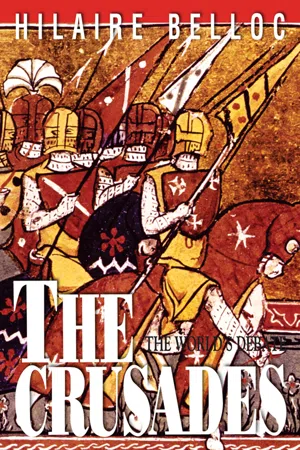
- 250 pages
- English
- ePUB (mobile friendly)
- Available on iOS & Android
eBook - ePub
The Crusades
About this book
Information
Topic
Theology & ReligionSubtopic
Christian DenominationsChapter 1
The World’s Debate
Human affairs are decided through conflict of ideas, which often resolve themselves by conflict under arms. To understand those decisions under arms which determine in succession the fate of the world, three things should occupy the mind: first, the nature of the issue and its launching, that is, the occasion of its coming to battle; second, the military character of the opposing forces; third, the strategy and tactics of the campaigns.
It is proposed in this book to deal with that major conflict under arms between Christendom and Islam which took the form of the First or Great Crusade: its triumph, the exhaustion of the result it had achieved, and the final catastrophe of an episode of victory and defeat covering the very long lifetime of a man—eighty-eight years. Gibbon, in a phrase as concise as any of his packed sentences and far more exact than most of them (for he was ignorant of the religious temper he attempted to judge), called this major episode in our history, “The World’s Debate.”
An effort was made after centuries of peril and invasion, during which civilization had lost half its area, to react and impose upon the Mohammedan world the domination of the Christian; its initial success, which we call the First Crusade, occupied the last years of the eleventh century (from 1095 to 1099). That initial success was gained by great hosts ill-organized but ardent; and in spite of divergent personal ambitions, consequent delays, continual and at last rapid melting away of forces, the goal was attained. The Holy Sepulchre, to rescue which near a million men, first and last, had risen, was carried and held by the last few thousands who had survived and endured till Jerusalem.
The swarm settled; the Western warriors, two thousand miles from home, cut off by such long sea passages and by such months of marching over such burnt, alien land, struck root and might feel that they had permanently grasped the vital belt of the Orient. All seaboard Syria was theirs and nearly all that bridge of fertile land which unites the rivers of the north, the fields of Cilicia, the pastures of the Armenian valleys with the green wealth of Egypt, the Delta and the Nile. That “bridge,” a narrow band pressed in between the desert and the sea, was the all-important central link joining the Moslem East to the Moslem West; giving Mesopotamia, Persia, and the Mohammedan mountaineers beyond, their access to the wealth of Cairo, of Tunis, of all Barbary, and to the wealth also of half-conquered Spain.
Should the link be broken for good by Christian mastery of Syria, all Islam was cut in two and would bleed to death of the wound.
But though the Crusaders had nearly occupied all the narrow band, it was “nearly” and not “quite.” There ran down the edges of the desert a string of cities and their connecting road—Aleppo, Homs, Damascus—which remained wholly in Moslem hands and still threatened the seacoast belt and its Christian garrisons.
Their inability, through lack of numbers, to hold all the corridor between the sand and the waves left all the effect of the Crusades incomplete, and to this must be added the effects of blood.
The Christian, Western host which had seized the “link,” the “Bridge,” in the First or Great Crusade was mainly French. Its fighting corps of armed knights and their followers was mainly Gallic; Norman, Provençal, Angevin, Lorrainers and Picards, with Flemings and some few Rhinelanders as well. National divisions had hardly yet arisen among Christian men, who were all of one strict religion and therefore of one habit of mind. But the blood told, and the Franci (whom the court of Constantinople called the “Gauls”) had the weakness as well as the strength of their race as it has been known throughout history. They had its intense energy, its aptitude for arms, its sudden enthusiasms and, in such moods, exalted unity of aim; they had further its aptitude for interpenetrating the society of the conquered. But they had also its violent personal conflicts, its vice of faction and recurrent civil war: the private ambitions and greed of individual leaders: the sudden distractions and the following of some new thing.
All this would weaken them: but more still the lack of reinforcement in so very distant and isolated an advance guard. Merchants and pilgrims came in numbers, the Italian galleys enlarging Eastern trade. Armed adventurers singly and by bands reached the “Francs of Over-sea”—the men of Outre-mer. But not enough. The harvest garnered by the Great Crusade remained insufficient and precarious; its results were already shaken when within fifty years there came a loss of critical territory, the northern bulwark of the realm the Crusaders had founded—Edessa. The spasmodic attempt to recover from the check was what we call the Second Crusade—a brief and insufficient effort at reinforcement which filled the middle of the twelfth century, 1147-48.
There followed another somewhat briefer period of less than half a century, in which all runs down to ruin, the attempt to hold what had been won grew more and more difficult, and the immediate military objective of the Crusaders was lost through the fall of Jerusalem in 1187 after the overwhelming, in 1187, of the last Christian rally at Hattin.
Hattin was the end.
That disaster did, indeed, rouse the men of our race and religion to a final effort which fills the latter years of the twelfth century, as the First Main Crusade had filled the latter years of the eleventh century; but it was of no avail. The defeat of Hattin had been final.
This belated effort, in which all the strength of Western Christendom rallied to the saving of a lost cause, is known as the Third Crusade.
Its expeditions, led by the three great sovereigns of the West, the French King, the Plantagenet, the German Emperor, set out from a civilization which had grown greatly in stature since the Oriental war began, and so grew through the new life aroused by the Crusades. Europe in the century of the Crusade had become far more learned and more brilliant—also more wealthy.
Therefore this “Third Crusade” is most fully related and stands out most vividly in our history and fiction. It is Saladin and Coeur-de-Lion.
But the picture is out of perspective. The battle was lost before these last crusaders landed. Their belated and unsuccessful effort is but an epilogue, of no great interest to the prime question “Why did the Crusading effort fail?” It had already failed. When the main forces of the newcomers had withdrawn, by the autumn of 1192 all was over.
Points upon the seaboard of the Levant were maintained with difficulty for a hundred years more; sundry efforts against this and that point of Mohammedan territory were continued fitfully, generation after generation, right on till the end of the Middle Ages and the beginning of modern times.
They still bore the name of Crusades, but they were true Crusades no longer. The initial clear attempt to break and master the Mohammedan pressure upon our civilization was in ruins.
Therefore it is the First or Great Crusade which is essential to an understanding of the struggle; it alone was victorious; its success advanced for less than fifty years. Whatever followed on it was but the rear-guard action of a defeat.
* * *
In considering the nature of an armed issue, the military character of the opposing forces, the strategy and tactics of the campaigns, each division of such a statement requires expansion.
The nature of any military issue, even the sharpest and briefest conflict, includes three separate considerations; we have to consider the immediate and conscious motive which led men to engage in the shock; we have also to consider the large underlying instinctive forces at work, of which the conscious and immediate motive is, as it were, but the spearhead; lastly, we have to consider the deflection of both motives and their results—for invariably, in the story of a human struggle, however definite the original aims, however clearly seen the target, something other than the mere reaching of it, or the mere missing of it, results. Two things always breed a third; and the two opposed forces, though as clearly divided as black and white, will never present the mere victory of the one or the mere defeat of the other. Something which neither the attacker nor the defender intended issues from the turmoil.
Then again, the military character of the opposing forces in these great duels of history means much more than the nature of their armament and of the personnel which waged the war on either side. To understand the military character of any large event in war, one must consider race, climate, economic circumstance, and all that properly enters the mind of a competent military leader engaged in battle, short or prolonged, against another. One must consider the ground, the possibility of defense and its nature, and all the circumstances that make for triumph or disaster.
The last title, the strategy and tactics of the particular campaigns, is more definite and narrower than either of the first two; yet that also needs some expansion. The strategy on either side is never fully planned, the part played by accident must be remembered, and the constant sudden surprising alliance between genius and good fortune, as also, for that matter, between good fortune and incompetence.
All this we shall observe during that living story through the course of which our fathers all but re-established the spiritual mastery of Europe over the East: all but recovered the full patrimony of Rome.
That story must not be neglected by any modern, who may think, in error, that the East has finally fallen before the West, that Islam is now enslaved—to our political and economic power at any rate if not to our philosophy. It is not so. Islam essentially survives, and Islam would not have survived had the Crusade made good its hold upon the essential point of Damascus.
Islam survives. Its religion is intact; therefore its material strength may return. Our religion is in peril, and who can be confident in the continued skill, let alone the continued obedience, of those who make and work our machines?
Chapter 2
The Issue and the Occasion
THE ISSUE
The Roman Empire, from which we all derive, stretching from the Scottish mountains to the Euphrates, from the Rhine and Danube to the Sahara, was gradually converted to the Catholic Faith in a period of three centuries: from about A.D. 30 to A.D. 330. By this last date in the fourth century, the New, and first Universal Religion, had become predominant in administration and social life. The emperors, the monarchs of the world, accepted the Creed: their subjects followed them.
Unfortunately that vast creative change came too late to save altogether a society perishing of pagan despair in its old age. The Church saved all that could be saved. Through the Empire’s conversion we have been able to survive. What had been Rome, what became Christendom, though divided in government and sinking lower and lower in crafts and culture, cohered. The western half of our Europe suffered from the chaos of permanent civil wars between various bodies of Roman Federated troops under their chieftains. The Roman army, in which the whole structure of society depended, had been more and more recruited (for their cheapness) from the half-civilized tribes: Slavs and Germans, who lay upon the borders, who were permeated with Graeco-Roman ideas even in religion, but these insufficiently absorbed.
With such a soldiery in power, with central authority broken down, we entered the Dark Ages. We had grown weak. The outer, savage world raided and harried what was left of Europe. But we fought hard to maintain our nearly ruined heritage, and through those phases of constant raids from the outer pagan savagery we still carried on.
After the year 1000 the tide turned. The siege was raised—Western Europe awoke. Building, the arts, learning expanded. Soon we were to arise in the splendor of the Middle Ages after the material decline of the Dark. The Faith had carried us through.
But it had been a close thing. In the Western half of the Empire where the great common act of religion, the Mass, was Latin in form, and where various generals of the barbarized Roman army had taken over local government and the levying of local taxation, society broke into local fragments, from the gradual coalescence of which were to arise, much later, the western European nations. In the Eastern half, where the Liturgy was mainly Greek, but where also the Mass was said in Armenian, in Syriac, in Coptic, etc., the unity of society was maintained by the strength of Monarchy. There was an all-powerful and all-revered Emperor at Constantinople, who was still regarded in a vague way as being the Emperor of the whole of Christendom. But he was only actively powerful, he was only obeyed, within a fluctuating border which included, at its widest, parts of Italy, Greece and the Balkans, Asia Minor, Syria, North Africa, Egypt and Spain.
Half a lifetime after the year 600 this Eastern part of the Empire, the most highly civilized, the wealthiest, and the only united part, was challenged in an unexpected fashion.
Hitherto, its only dangerous enemy had been the Persian power to the east, which had sometimes pushed raids as far as the Mediterranean coast of Syria, taking Antioch and even Jerusalem, but not permanently holding them. The Roman Empire—its most highly organized, Greek-speaking part—held Syria normally and Egypt and Asia Minor, as well as its European mainland, until there came this new, quite unexpected force out of the desert.
One Mohammed had preached in desert Arabia (outside the effective boundaries of the Empire) a powerful new heresy, to which he and his eager followers converted by force and zeal the pagan Arabs and which was to prove violently attractive to great masses of the Eastern population.
This new movement was, on its religious side, an intense simplification of the Catholic body of doctrine, eliminating nearly all that had seemed difficult to the untrained masses: the Trinity, the Incarnation, above all the mysterious Sacrament, and therefore the priesthood. On the political side it got rid of the burden of debt, the shame and suffering of slavery, the toils of an elaborate legal system and the lawyers who battened on it. It also ministered to the jealousy felt by outlying parts for the despotic central power at Constantinople. The message of Mohammed promised easy thinking on the religious side, freedom on the political; freedom not only to the individual but to local groups—the Egyptians, for instance. The individual was relieved from his debts and from legal constraint; the social groups from their domination by a distant imperial government with its arbitrary rule and its heavy weight of taxation.
The new creed came to be called Islam, that is, “The Acceptation,” and has retained that name. Those who followed it were the “True Believers.” We call them also, from the name of the great heresiarch who launched their effort, “Mohammedans.” We also talk of the culture they founded as the “Moslem” world.
Not long after Mohammed’s death, in A.D. 634, his Arab followers broke forth, a swarm of eager desert cavalry sweeping northward and making converts wherever it passed. Those who joined it, if they were slaves or debtors, recovered their freedom and could henceforward boast their independence of the imperial government. They were the more enthusiastic for their new creed because it seemed to them so simple of comprehension after the Christian affair of sacrifice and renunciation and difficult strain: its hierarchy of priests and its mysteries. The new enthusiasm, sweeping the Oriental world much as Communism proposes to sweep the Western world today, enthusiastically preached one God. It revered Jesus Christ as the greatest of the prophets, but rejected the complication of the Trinity. It revered Our Lady highly...
Table of contents
- Front Cover
- Half Title
- Title Page
- Copyright
- Dedication
- Contents
- Author’s Preface
- 1. The World’s Debate
- 2. The Issue and the Occasion
- 3. The Armies
- 4. The Advance
- 5. Antioch
- 6. Jerusalem
- 7. Monarchy
- 8. The Three Kings
- 9. High Tide and Slack Water
- 10. The Crash
- 11. Saladin
- 12. Hattin
- Epilogue
- About the Author
- Notes
- Tan Classics
- Become a Tan Missionary!
- Share the Faith with Tan Books!
- Tan Books
Trusted by 375,005 students
Access to over 1.5 million titles for a fair monthly price.
Study more efficiently using our study tools.
Frequently asked questions
Yes, you can cancel anytime from the Subscription tab in your account settings on the Perlego website. Your subscription will stay active until the end of your current billing period. Learn how to cancel your subscription
No, books cannot be downloaded as external files, such as PDFs, for use outside of Perlego. However, you can download books within the Perlego app for offline reading on mobile or tablet. Learn how to download books offline
Perlego offers two plans: Essential and Complete
- Essential is ideal for learners and professionals who enjoy exploring a wide range of subjects. Access the Essential Library with 800,000+ trusted titles and best-sellers across business, personal growth, and the humanities. Includes unlimited reading time and Standard Read Aloud voice.
- Complete: Perfect for advanced learners and researchers needing full, unrestricted access. Unlock 1.5M+ books across hundreds of subjects, including academic and specialized titles. The Complete Plan also includes advanced features like Premium Read Aloud and Research Assistant.
We are an online textbook subscription service, where you can get access to an entire online library for less than the price of a single book per month. With over 1.5 million books across 990+ topics, we’ve got you covered! Learn about our mission
Look out for the read-aloud symbol on your next book to see if you can listen to it. The read-aloud tool reads text aloud for you, highlighting the text as it is being read. You can pause it, speed it up and slow it down. Learn more about Read Aloud
Yes! You can use the Perlego app on both iOS and Android devices to read anytime, anywhere — even offline. Perfect for commutes or when you’re on the go.
Please note we cannot support devices running on iOS 13 and Android 7 or earlier. Learn more about using the app
Please note we cannot support devices running on iOS 13 and Android 7 or earlier. Learn more about using the app
Yes, you can access The Crusades by Hilaire Belloc in PDF and/or ePUB format, as well as other popular books in Theology & Religion & Christian Denominations. We have over 1.5 million books available in our catalogue for you to explore.