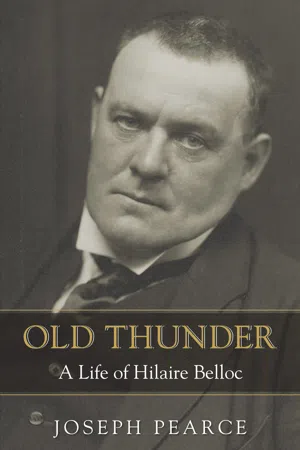
Hilaire Belloc is one of the most important writers of the twentieth century. At turns reviled or revered, depending on the audience, he was a razor sharp social commenter and a master of both poetry and prose, who continues to captivate readers. In Old Thunder, Joseph Pearce examines Belloc's enduring impact on British intellectual life. Along the way, Pearce uncovers Belloc's relationships with Chesterton, Waugh, and Sassoon, among others. Pearce also illuminates another side of Belloc's personality by relaying his long courtship with Elodie Hogan, her brief stint in a convent, and his ultimate grief at her death. In this updated biography, with a new introduction by Dale Alhquist, Joseph Pearce uses previously unpublished letters and photographs to reveal in Belloc a romantic, complex, and solitary man, who is one of the true giants of the Catholic revival in the last century.
- 448 pages
- English
- ePUB (mobile friendly)
- Available on iOS & Android
eBook - ePub
About this book
Information
Subtopic
BiblesIndex
LiteratureONE
Cradle Refugee

STORM CLOUDS GATHERED OMINOUSLY over the village of La Celle Saint Cloud, 12 miles outside Paris, on 27 July 1870. By four o’clock in the afternoon, as Elizabeth Belloc was in the final stages of childbirth, a violent thunderstorm heralded the arrival into the world of her son. Thereafter, whenever his mercurial temperament erupted into anger, she would call him Old Thunder in reminiscence of the tempest which had accompanied his birth.1
The baby’s father, Louis-Marie, recorded the event in his wife’s small engagement book. “Mercredi, 27 Juillet: C’est aujour-d’hui à 4 h. [1/4] qu’est né un beau gros garçon que je nommerai Joseph Hilaire Pierre.” 2 Two days later his intention was formalized when Joseph Hilaire Pierre’s birth was registered in the presence of Jean-Baptiste Thomas Huilier, a local school-master, and Pierre Antoine Lemaire, a doctor.3 Louis-Marie had tried to contact Dr. Lemaire during his wife’s confinement, but the 72-year-old doctor, a former physician to Louis XVIII, was nowhere to be found. Hilaire had been delivered by the midwife, Mercy Baker, who conveyed the news of the birth to one of Elizabeth Belloc’s friends. “I was alone, and I brought the baby into the world. The doctor … did not arrive until the event was quite over, and the baby washed and dressed.”4
The storm clouds that had gathered on the afternoon of 27 July were portentous of more than the birth of the poet. A week earlier, on 19 July, France had declared war on Prussia. On 30 July, in the first serious engagement of the Franco-Prussian War, the French army launched an offensive at Saarbrücken. The town was recaptured by the Germans on 6 August. On the same day the advancing Prussian army inflicted heavy defeats on the French at Wörth and Forbach. The war had begun badly – and worse was to follow. From 9 August, the Prussian army began its relentless advance through France, capturing Reims on 5 September. Within days of her son’s birth, Elizabeth Belloc watched a procession of gun carriages pass by her house on their way to reinforce the retreating French lines.5 Blissfully ignorant, the newborn child could not know that this baptism of fire would leave an indelible mark on his life.
Belloc’s birth also coincided with the culmination of the Vatican Council in Rome which, in July 1870, had declared the doctrine of papal infallibility. Ironically, or perhaps aptly, the proclamation of the Pope’s infallibility in the spiritual sphere coincided with a dramatic confirmation of his vulnerability in the sphere of politics. Following the outbreak of the Franco-Prussian War, the French garrison which had been protecting Rome was withdrawn by Napoleon III. In September the soldiers of Victor Emmanuel entered the Eternal City, crushing the papacy’s temporal power at the very moment in history that its spiritual power had been solemnly asserted.
Paradoxically, the Pope, in being humbled, would be exalted. Until his death in 1878, Pius IX, as the defiant “prisoner of the Vatican,” enjoyed a degree of personal popularity without parallel in the history of the modern papacy. Furthermore, in the midst of tribulation, the aging Pope was consoled by the missionary expansion of Catholicism around the world.
This pivotal moment in the history of Christendom would also leave its mark on the future life of the child being born in its midst. As a champion of the Church Militant in a hostile secular society, Belloc would sometimes exhibit a siege mentality akin to the defiance of Pius IX. In 1864 the Pope had published an encyclical denouncing the principal errors of the age, amongst which was the very suggestion that the Church could or should reconcile itself to “progress,” liberalism, or modern industrial “civilization.” Similarly, the Vatican Council, in its resolute opposition to many aspects of modern life, had effectively declared war on the secular states of the industrialized world. Pro Ecclesia contra mundum appeared to be the battle cry of both Pius IX and the Council he summoned. It was a battle cry with which Belloc would feel entirely at home.
A more obvious and immediate influence on the newborn child was that of his own family. His father’s origins were steeped in romance. Louis Belloc’s maternal grandfather, Colonel Jacques Swanton, was descended from a family of Irish Protestants from County Cork, where the place now known as Ballydehob used to be called Swantonstown. The French connection had begun when Jacques Swanton’s uncle had fled to the continent after killing his opponent in a duel. He later became a Catholic and afterwards a priest. Colonel Swanton was one of the last serving officers of the Berwick (Stuart Irish) Brigade before its dissolution and was a Dean of the Order of St. Louis, described by Hilaire’s sister, Marie Belloc Lowndes, as “one of the greatest orders of chivalry in Europe.”6 He served in the Royalist army prior to the Revolution, but afterwards fought in Napoleon’s early campaigns.
His daughter, Louise, pursued a literary vocation. In 1823 she published a French translation of the Irish Melodies and her life of Byron was published with a preface by Stendhal. She went on to write children’s books and translated contemporary English and American novels into French. One of her books was awarded the Monthyon Prize of the French Academy.7 Against the wishes of her father, Louise married the well-known painter Jean Hilaire Belloc, who would immortalize their love in a memorable portrait of his wife that would be exhibited in the Louvre.
If the newborn child could claim a rich literary and artistic inheritance on his father’s side of the family, his maternal antecedents were equally impressive. His mother Elizabeth Parkes, known to everyone as Bessie, was the great-granddaughter of the scientist Joseph Priestley who, as an early pioneer in the chemistry of gases, was one of the first discoverers of oxygen. Priestley, like his great-great-grandson, was no stranger to controversy. In 1791 his reply to Burke’s Reflections on the French Revolution so incensed public opinion that a mob attacked his house in Birmingham and destroyed its contents.
Bessie’s father, Joseph Parkes, a solicitor by profession, devoted much of his time and energy to the cause of political radicalism. His political and literary contacts were extensive and, through him, his daughter came to know many of the leading lights of Victorian London. He was a friend of Henry Brougham, George Grote, and John Stuart Mill, and was a frequenter of Samuel Rogers’s famous breakfasts, to which Bessie was sometimes invited. Bessie counted both Thackeray and Trollope amongst her friends, the former of whom, relishing the company of Liberal politicians, would often dine at the Parkes’s family home in Wimpole Street. Bessie corresponded with George Sand, and she travelled to Yorkshire with Elizabeth Gaskell when the latter was working on her life of Charlotte Brontë. Bessie’s own love for the Brontës was evident in a letter to a friend in which she declared the superiority of their novels to those of George Eliot. Eliot’s books contained “wisdom, wit, tenderness, an amazing knowledge of human nature, high principle of a very deep kind” – everything “except genius … I consider that her books are conglomerate rocks, not granite or crystal. There is more of the living burning fire of genius in one page of Wuthering Heights than in the whole of Romola or Daniel Deronda.”8
In spite of Bessie’s reservations about Eliot’s work, she counted her as one of her friends. “My father was much attached to her,” Bessie would recall in her memoirs, adding that “whenever any special celebrity was invited to dinner, such as Thackeray,” her father “was never content” unless he could secure Eliot’s attendance also.9 Bessie remembered George Eliot descending the great staircase of the house in Wimpole Street. “She would talk and laugh softly, and look up into my father’s face respectfully, while the light of the bright hall lamp shone on the waving masses of her hair, and the black velvet fell in folds about her feet.”10
It is not clear to what extent Eliot’s agnosticism had undermined the lukewarm Unitarianism of Bessie’s parents. There is little doubt, however, that many of Joseph Parkes’s circle of friends were deeply antithetical towards Christianity. George Grote, John Stuart Mill, and George Eliot were great advocates of the Positivist ideas of the French philosopher Auguste Comte, who claimed, amongst other things, that since the existence of God was unprovable, humanity, idolized in the abstract, should look to itself as the only meaningful guiding force.
Evidently, Bessie Parkes found such a creed unsatisfactory. Inspired by a desire to know more about the history of the Reformation, she visited “Dr. Manning of Bayswater,” the future Cardinal Archbishop of Westminster. Manning was “perfectly polite” and “spoke with the most measured chilly calmness … as if perfectly conscious of the Comtist influence then taking possession of English Society.”11 Bessie felt convinced that Manning was not very impressed with her, a precocious young woman caught up with the heresies of the age, but she, nonetheless, was greatly impressed by him. “I do not think he had any suspicion that I was so impressed and overpowered by his intellect, that when I left the room and the house I ran nearly all the way home, with the sense that I was fleeing from an overmastering brain, and that I dreaded it.”12 Like the protagonist in Francis Thompson’s poem “The Hound of Heaven,” Bessie’s efforts to flee were futile. From that moment on, she became increasingly convinced that Comte, Mill, Grote, and Eliot were no match for the “overmastering brain” that she had encountered in Bayswater. To the surprise of many of her father’s circle, she was received into the Catholic Church in 1864. The impact of this fateful or providential act on the life of her son, as yet unborn, is inestimable. Indeed, it is scarcely conceivable that the figure of Hilaire Belloc, as the following century would know him, could have existed if his mother had not succumbed to the powerful combination of faith and reason that she had discovered in the mind of Manning.
Bessie’s conversion does not appear to have affected any of her old friendships adversely. She continued to move in the same religiously skeptical and politically radical circles, and in the spring of 1867 she travelled to France with Barbara Bodichon, the noted watercolor painter and campaigner for women’s rights who, in the words of Marie Belloc Lowndes, “had come to feel no belief in any form of revealed religion.”13 The two women rented a small chalet in the grounds of the house in La Celle Saint Cloud where the recently widowed Louise Swanton Belloc lived with her son Louis. Bessie and Louis became engaged within weeks of their first meeting and were married on 19 September 1867 in the old church of St. James, Spanish Place in London. The newly married couple settled in the English capital, and it was here, in August of the following year, that their daughter Marie Elizabeth was born.
As much as he was delighted with the birth of his daughter, Louis Belloc earnestly desired a son. He also hoped that his next child would be born in France. Consequently, when he learnt that Bessie was going to have another baby, he made arrangements for a return to his native land. Bessie was aware of her husband’s wishes, and before leaving London she wrote to his mother of her hopes for the future. “Ah, dearest Maman, how happy I should be if I could give my Louis a son, and you another Hilaire Belloc! But if this is not to be, then I shall gladly welcome a second Louise Swanton, who will be, if my prayers are answered, in every way a replica of the beloved grandmother after whom she will be named.”14
The parents’ joy at the birth of “another Hilaire Belloc” five years after the death of his grandparental namesake was tempered by the anxiety caused by further French defeats in the war. “We are very anxious today,” Bessie wrote to her mother on 9 August, “… the bad news came to the village yesterday.” In response to the growing emergency, the young men of France were answering the call to arms. Louis’s two nephews had both joined the army and Bessie informed her mother that heavy artillery had been passing the house all through the morning. “Although the Emperor is said to have taken a hasty pretext to declare war, I believe it was inevitable, and that Bismarck meant it all along … Should France be beaten – which God forbid – the whole balance of Europe will crash into shivers.”15
Even by the most pessimistic estimates, nobody could have predicted the speed of the Prussian advance or the shocking suddenness of the French capitulation. Within weeks of Belloc’s birth his parents were forced to make hasty plans to evacuate their home. They fled to Paris, the 12-mile journey taking five hours in the stifling heat of August, and, following the fall of Reims on 5 September and anxious appeals from Mrs. Parkes and Madame Swanton Belloc, who had already left the country, Louis agreed reluctantly to take his wife and children to England. They caught the last train from Paris to Dieppe. The decision to leave France almost certainly saved the life of the six-week-old baby. During the siege of Paris, which lasted all through the winter until the triumphant entry of the Prussian army into the city on 1 March 1871, almost every child under three years old perished from malnutrition.
The Bellocs moved into the Parkes’s house on Wimpole Street and studied the newspapers for any news of the war. They learned from The Times that the houses in the neighborhood of La Celle Saint Cloud were “fast disappearing” under heavy bombardment from Prussian artillery on the surrounding hills. After the French surrender in the spring of 1871, Bessie and Louis returned to France to survey the damage to their family home. Although the structure of the house was intact, its contents had been vandalized. The German soldiers had taken “great delight in breaking everything that was breakable, including all the kitchen pottery,” and it took four men to clear the filth and rubbish from the lower part of the house. The eighteenth-century portraits hanging in the bedrooms were disfigured or destroyed, daubed in ink with mustaches and beards, or simply torn up. Others had been used for target practice. A portrait of Madame Belloc’s mother, with several bullet holes in the painted breast, was discovered stuffing up a broken window. Paintings of Colonel Swanton and Madame Belloc’s late husband Hilaire had simply disappeared, presumably stolen and sent to Germany.16 Many papers and manuscripts were also lost, including two letters of Lord Byron and several pages of the manuscript of Childe Harold. Madame Belloc was particularly saddened by the disappearance of the letters her husband had written to her on the rare occasions they had been parted.
Devastated at the scale of the damage, Bessie wrote disconsolately to a friend, “I am beginning to wonder if we shall ever be able to live in either of our two houses again. The wreck and devastation baffles description. Do you remember your sister’s wedding present to me? It was a fine old china tray. Various pieces of it were found … yesterday, in what I can only describe as a dunghill.”17
The plunder of his family’s possessions was destined to fall like a shadow across the life of the child who, as a cradle refugee, had so narrowly escaped having his life extinguished scarcely before it had begun. The ghosts of the Franco-Prussian War would haunt Belloc always, fuelling his love for France and his lifelong antipathy to Prussianism. Ironically, he would never be able to forget the devastation that he was too young to remember.
TWO
An Anglo-French Childhood
IN DECEMBER 1871 Louis, Bessie, and their two children moved to 11 Great College Street in Westminster. Bessie had inherited the lease of the house, together with the substantial sum of £20,000, from the estate of her uncle, Josiah Parkes, who had died the previous August. On 5 January 1872, Bessie informed Madame Belloc that the family were settling in well and were “so comfortable and happy in our little house.”1 Her air of optimism was understandable. In the wake of the turmoil and upheaval of the previous 18 months, she m...
Table of contents
- Front Cover
- Title Page
- Copyright Page
- Contents
- Acknowledgments
- Preface
- 1 Cradle Refugee
- 2 An Anglo-French Childhood
- 3 First Love
- 4 “Youth Gave You to Me”
- 5 Editor and Tramp
- 6 Soldier and Scholar
- 7 Survivals and New Arrivals
- 8 Baring and Buchan
- 9 Baring and Chesterton
- 10 Romeward Bound
- 11 The South Country
- 12 The Chesterbelloc
- 13 The Party System
- 14 Friends and Disciples
- 15 Love and Laughter
- 16 Religion and Politics
- 17 Farewell to Parliament
- 18 Eye-Witness to Scandal
- 19 Ghostly Secrets and Mortal Wounds
- 20 “Where Darkness Is …”
- 21 War and Other Diversions
- 22 A Private Friendship
- 23 Popes, Dictators and Jews
- 24 Friends and Family
- 25 War of the Wells
- 26 Reformed Characters
- 27 A Final Flourish
- 28 Farewell to the Chesterbelloc
- 29 The Last Rally
- 30 Decline without Fall
- 31 The Fading
- Notes
- Bibliography
Trusted by 375,005 students
Access to over 1.5 million titles for a fair monthly price.
Study more efficiently using our study tools.
Frequently asked questions
Yes, you can cancel anytime from the Subscription tab in your account settings on the Perlego website. Your subscription will stay active until the end of your current billing period. Learn how to cancel your subscription
No, books cannot be downloaded as external files, such as PDFs, for use outside of Perlego. However, you can download books within the Perlego app for offline reading on mobile or tablet. Learn how to download books offline
Perlego offers two plans: Essential and Complete
- Essential is ideal for learners and professionals who enjoy exploring a wide range of subjects. Access the Essential Library with 800,000+ trusted titles and best-sellers across business, personal growth, and the humanities. Includes unlimited reading time and Standard Read Aloud voice.
- Complete: Perfect for advanced learners and researchers needing full, unrestricted access. Unlock 1.5M+ books across hundreds of subjects, including academic and specialized titles. The Complete Plan also includes advanced features like Premium Read Aloud and Research Assistant.
We are an online textbook subscription service, where you can get access to an entire online library for less than the price of a single book per month. With over 1.5 million books across 990+ topics, we’ve got you covered! Learn about our mission
Look out for the read-aloud symbol on your next book to see if you can listen to it. The read-aloud tool reads text aloud for you, highlighting the text as it is being read. You can pause it, speed it up and slow it down. Learn more about Read Aloud
Yes! You can use the Perlego app on both iOS and Android devices to read anytime, anywhere — even offline. Perfect for commutes or when you’re on the go.
Please note we cannot support devices running on iOS 13 and Android 7 or earlier. Learn more about using the app
Please note we cannot support devices running on iOS 13 and Android 7 or earlier. Learn more about using the app
Yes, you can access Old Thunder by Joseph Pearce in PDF and/or ePUB format, as well as other popular books in Literature & Bibles. We have over 1.5 million books available in our catalogue for you to explore.