Profound, provocative, complete treatment of Purgatory—its sufferings, consolations, duration, etc., plus, how we can assist the poor souls, their gratitude, and God's reward to us for helping them. A very moving book. Impr. 331 pgs,
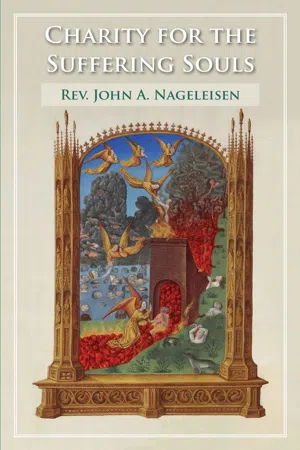
eBook - ePub
Charity for the Suffering Souls
An Explanation of the Catholic Doctrine of Purgatory
- 331 pages
- English
- ePUB (mobile friendly)
- Available on iOS & Android
eBook - ePub
Charity for the Suffering Souls
An Explanation of the Catholic Doctrine of Purgatory
About this book
Information
Topic
Theology & ReligionSubtopic
Christian DenominationsChapter 1
The Existence of Purgatory
Eternity
THERE is no doubt but that the question of our existence after death is the most important and consequential of all questions. It is the fundamental question of life, decisive of our eternal destiny. Therefore it ever was, and must be, the ultimate and essential purpose of Religion to answer this question.
Eternal thanks to Our Divine Redeemer! We Catholics have the reasons of the faith that is in us implanted deeply in our hearts. Christ, “the Way, the Truth and the Life,” who dispels all darkness, lifted the veil that covers the next world and expressed Himself in the most emphatic manner that annihilation is not our destiny, but that we are created for an everlasting life, either of bliss or of torment. “And these shall go into everlasting punishment: but the just, into life everlasting.” (Matt. 25:46).
The body, taken from the earth, returns to dust; but the soul, the spirit breathed into man by his Creator, appears, after death, before God’s tribunal to be judged. The soul is immaterial, invisible, a spirit, created in the likeness of God, and immortal. As a child that resembles its parents is the image of its father or mother, because it has similar features, etc., thus man is the image of God, because he possesses similar (not the same) attributes as God. “And God created man to His own image.” (Gen. 1:27). Like God, man was to be pure, immaculate, an heir of the Kingdom of Heaven; he was to be gifted with great knowledge and to be free from concupiscence, misery, pain, and even from death. Thus was the being, which is by nature an immortal spirit, endowed with reason and free will, gifted by the Creator with supernatural qualities. But sin destroyed the work of God. It dishonored Heaven and thinned out the ranks of the Angels; it destroyed Paradise and man’s eternal happiness, until the former was regained and the latter restored by the Son of God at the price of His Most Precious Blood.
Joseph was the saviour of Egypt from famine: Jesus Christ became the Saviour of mankind from eternal damnation. Joseph was persecuted by his brethren, illtreated by them and sold for twenty pieces of silver: Jesus was betrayed by Judas, denied by Peter, and sold for thirty pieces of silver. After many trials and tribulations Joseph was placed over all Egypt, for Pharao said to him: “Seeing God hath shewn thee all that thou hast said, can I find one wiser and one like unto thee? Thou shalt be over my house, and at the commandment of thy mouth all the people shall obey: only in the kingly throne will I be above thee. And again Pharao said to Joseph: Behold I have appointed thee over the whole land of Egypt. And he took his ring from his own hand, and gave it into his hand: and he put upon him a robe of silk, and put a chain of gold about his neck. And he made him go up into his second chariot, the crier proclaiming that all should bow their knee before him, and that they should know he was made governor over the whole land of Egypt. And the king said to Joseph: I am Pharao; without thy commandment no man shall move hand or foot in all the land of Egypt. And he turned his name, and called him in the Egyptian tongue, the saviour of the world.” (Gen. 41:39-45). Now Joseph had power over life and death in the land of Egypt. To him all had to go that desired to escape the pangs of hunger; even his father and his brethren had to bow before him and accept of him the necessaries of life. Pharao’s order was, “Go to Joseph!” Although Joseph opened the full granaries and provided Egypt with bread, yet those only were saved that made personal application to him and received the gift out of his own hand. Therefore all the people flocked to him; old and young, relatives and strangers, friends and foes, flocked to him from all countries to purchase provisions.
Our Lord Jesus Christ also had to suffer, and His sufferings were greater than those of Joseph in Egypt, because He was to be the Saviour of all mankind from eternal death. But He showed Himself as the “Wonderful,” as the valiant Hero of whom Isaias foretells, “The people that walked in darkness have seen a great light: to them that dwelt in the region of the shadow of death, light is risen.” (Is. 9:2). “For a CHILD IS BORN to us, and a son is given us, and the government is on his shoulder, and his name shall be called Wonderful, Counsellor, God the Mighty, the Father of the world to come, the Prince of peace. His empire shall be multiplied, and there shall be no end of peace: he shall sit upon the throne of David, and upon his kingdom, to establish it and strengthen it with judgment and with justice, from henceforth and forever.” (Is. 9:6, 7)—Jesus “received from God the Father, honour and glory: this voice coming down to Him from the excellent glory: This is my beloved Son, in whom I am well pleased; hear ye Him.” (2 Peter 1:17). Jesus says of Himself: “All power is given to me in heaven and on earth.” (Matt. 28:18)—“For which cause God also hath exalted Him, and hath given Him a name which is above all names: that in the name of Jesus every knee should bow, of those that are in heaven, on earth and under the earth.” (Phil. 2:9, 10). His victory was accomplished in sacrificial death. Redemption was achieved when Jesus, in view of Heaven and earth, exclaimed dying on the Cross, “It is consummated.” (John 19:30).
Then death, man’s eternal ruin caused by sin, was overcome through the victory of Christ, and life was restored by Him “Who was delivered up for our sins, and rose again for our justification.” (Rom. 4:25). The power of darkness was destroyed; mankind was delivered from disgraceful captivity; the abyss of Hell was closed and the gates of paradise were reopened. Christ’s treasury of atonement is superabundant and forever inexhaustible; it is not diminished or depleted even if millions upon millions draw from it grace upon grace, health and strength, light and life. As all the country flocked to Joseph, thus do men “of all nations, and tribes, and peoples” (Apoc. 7:9) come to Jesus Christ, the Saviour of the world, to obtain the eternal heritage of Heaven. Without the command of chaste Joseph “no man shall move hand or foot in all the land of Egypt”; without the will of Jesus Christ no man shall enter paradise recovered for us by Him. To attain salvation all must obey Him; we must personally use the means of grace instituted and ordained by Him; we must, moreover, cooperate with the graces He grants us. On this depends our eternal destiny.
Eternity! Eternity!—Heaven or Hell, one of the two we must choose by our lives. Because “the unjust”—such either by transgression or through unsatisfied justice—“shall not possess the kingdom of God” (1 Cor. 6:9), the ineffable mercy of God, in consideration of the merits of Jesus Christ, created, in the next world, a place of purification for those who, at the time of their death, are not entirely pure: this place is called Purgatory.
Purgatory
Between Heaven, “the place of refreshment, light and peace,” and Hell, the abode of eternal torment, there is, till the day of general judgment, a middle state, called Purgatory, for those souls that depart this life justified, but still in need of final purification. In this place of punishment and purification, of justice and mercy, dwell the souls that have venial sins to expiate, or temporal punishment to undergo, or both. The doctrine of the Catholic Church concerning Purgatory is expressed in the following two sentences:
1) There is, in the next world, a temporary place for the atonement of such venial sins, and temporal punishments of sin, as man is found guilty of on his departure from this world.
2) The faithful can, by prayer and good works, especially by the Holy Sacrifice of the Mass, assist the souls suffering in Purgatory.
Concerning the location of Purgatory, the nature of its torments, the extent of its suffering, etc., the Church has made no official declarations, hence only the two above sentences are dogmas which we must believe under pain of excommunication. Nevertheless we should be guilty of culpable temerity if we were to reject the generally accepted doctrine of the holy Fathers and of notable spiritual writers relative to some other points concerning Purgatory.
In connection with the Catholic doctrine concerning Purgatory it is necessary to bear in mind the doctrine of remission of sins. With the remission of mortal sin there is necessarily connected the remission of its eternal punishment. But the case stands quite differently with regard to the temporal punishment of sin which God permits to remain even after the remission of its guilt. The sinner who committed a mortal sin and thereby became an enemy of God becomes, through the Sacrament of Penance, a friend, a child of God; his eternal punishment is condoned, but a temporal punishment remains. It is, however, the general doctrine of theologians that at least a part of the temporal punishment is remitted, every time, in the tribunal of penance, and that this part is in proportion to the contrition and penitent disposition of the repentant sinner. The remaining part must be atoned for in this world by penance, or in the next by the torments of Purgatory.
Both the temporal punishment yet due to sin remitted, and the stain of venial sin yet unremitted are, in the sight of God, a defilement of the soul. Venial sin, to which man is so prone, is not remitted by merely external works of penance without true contrition; its remission depends on the interior disposition of the penitent soul, on perfect charity, patience and resignation to the Will of God. “Whether remission is obtained gradually by means of repeated acts,” says Deharbe (Explanation of the Catechism, vol. II. p. 409) “or at the parting of the soul from the body through one act of perfect charity, is a question on which theologians do not agree. Suarez defends the latter opinion, because such an act is followed by an increase of charity or sanctifying grace, and may be made so perfectly as to cleanse the soul from every inclination to sin.”
We must not, however, conclude from this that all souls shall be excluded from the beatific vision of God until they shall have passed through the fiery furnace of Purgatory. Such a view is untenable. Unquestionably true as it is that many souls are banished forever from the presence of God immediately after the particular judgment, it cannot, on the other hand, be denied that they that were cleansed from all their faults in this life, soar up, after the particular judgment, into the heavenly Jerusalem, the city of peace, whose inhabitants are blissful in love.
Moreover, from the fact that a soul is sentenced to chastisement in Purgatory the conclusion is not to be drawn that it will be inferior in heavenly glory to souls admitted to Heaven without undergoing purification by fire. The most precious stones and metals sometimes need longer and more thorough purification than less valuable ones. The degree of their value depends on their interior worth and not on the dross and corrosion that surrounds them. Thus also the degree of heavenly glory depends on the merit of each saint. Thus it may happen that souls eminent for works of penance and full of merit, may nevertheless have to remain in Purgatory longer, and yet, after their purification, they may attain to a higher degree of glory than such as were not in need of purification. Each one shall receive his reward according to his merit, after having paid the last farthing of his debt, being “purified as if by fire.”
The religious innovators of the last centuries, by denying the existence of Purgatory, made an attempt indefensible both before the tribunal of religion and of reason. They desire to replace this consoling doctrine by one more pleasing to the “father of lies,” only for the sake of innovation, and instigated by pride, avarice, envy, sensuality, etc. The rebels dare to weigh God’s mercy and judgment in the scales of their darkened reason. By rejecting prayer for the dead and the doctrine of temporal punishment of sin, they disrupt one of the most sacred bonds with which faith has encircled mankind, viz. the communion of saints. The Church Militant, Suffering and Triumphant in its entirety composes the Mystical Body of Christ, who is the Head, while the faithful are the members. The departed, then, who died in the Lord, are an integral part of this great Mystical Body, either as saints in Heaven, or as suffering souls in Purgatory. But the misguided innovators have only the darkness of the grave to place between the human heart and its departed loved ones. Their presumption is condemned by Divine Revelation and the constant Tradition of the Church, by the unaminous belief of all nations, and by non-Catholics themselves, by reason and by sentiment. Leaving these gloomy and rebellious men to deny the Suffering Souls a prayer, we shall seek to prove in the following pages how all nations and all ages concur in the sentiment: “There is a Purgatory; and ‘it is therefore a holy and wholesome thought to pray for the dead, that they may be loosed from sins.’” (2 Mach. 12:46).
Sentiment
Like unto a mourning dove, the beloved Spouse of Christ, the Church, never interrupts her sighs and prayers for the faithful departed until they have arrived in the port of eternal bliss. She renews in Holy Mass our Divine Redeemer’s sacrificial death, offering it up to His Heavenly Father; she invites the Church Triumphant and the Church Militant to join in persevering prayer for the Church Suffering. What a consolation for the dying, what a reassurance for the living to profess a religion so comforting: consoling to the dying who, though cleansed from all mortal sin by the holy Sacraments, yet are uncertain whether they shall be found sufficiently pure, and worthy of Heaven, but rest assured that the Church Triumphant and Militant will come to their aid after death; comforting for their surviving friends, because they continue to show them their affection in case they should stand in need of their assistance in the purifying flames. Hence we can never be sufficiently thankful to God for having called us to a religion whose maternal care, charity and zeal goes beyond the confines of our earthly pilgrimage and follows us even after our eyes have been closed in death.
How sorely we feel the parting from our dear ones! When the dying husband bids farewell to his loving wife, recommending himself to her prayers; when affectionate children stand around the deathbed of a dear mother, listening to her parting words; when the death of a dear friend is announced to us, we are overwhelmed with sorrow; the smart of parting well-nigh breaks our heart. At such moments religion, with its heavenly consolation, comes to our aid, exhorting us to lift up our hands in supplication to our brethren of the Church Triumphant, to distribute with liberal charity among our suffering dear ones our prayers, alms and suffrages. How beautiful is this faith, how consoling this doctrine of the communion of saints!
Therefore, Christian soul, do not abandon yourself to sorrow; follow the advice of St. Paul, “Do not mourn as those who have no hope.” Remember the parting words of St. Monica to her son, St. Augustine, “Remember me at the altar of God!” Glancing at the battlefield of the Machabees, make an act of faith in the existence of Purgatory, saying with the inspired writer, “It is a holy and wholesome thought to pray for the dead that they may be loosed from sins.”
Reason
Reason, when assisted by the higher light of revelation, gives us satisfactory evidence of the existence of a middle state, and, to our consolation, compels us to profess our belief in it. Our dissenting brethren ask: Why is it that souls who departed this life in the state of grace must nevertheless suffer so severely? Why must they, after having devoted their earthly career to true love of God, to the renunciation of all wickedness and worldly aspirations, after living in self-denial, justice and piety, why must they nevertheless suffer, why are they denied entrance into eternal bliss?—Let the inquirer rest assured that if it were not necessary, God would not permit it; for He finds no pleasure in the misfortune and pain of man, but in his salvation and eternal happiness. As a father will not hurt his child except in case of necessity, thus also our Heavenly Father will not hurt us except it be necessary for our true welfare.
God-fearing persons conscientiously avoid mortal sin; yet, either from a want of due vigilance or from human frailty, they commit venial faults which, trifling as they may appear, are punished by God; for Jesus says: “But I say unto you, that every idle word that men shall speak, they shall render an account for it in the day of judgment.” (Matt. 12:36). True, we know that these venial faults are blotted out by an act of contrition, and that they are remitted by voluntary acts of penance, as well as in Confession: but nevertheless, may a person not be overtaken by death before having thus blotted them out, even before thinking of doing so? Then, when appearing before the tribunal of God, the soul is immediately confronted with its unatoned faults, and remembers with sorrow and terror its delinquencies. It acknowledges as supremely just the sentence of God condemning it to the purifying flames of Purgatory. And how will they fare whose faults approach in dangerous proximity to mortal sin? It is related of a poor woman that she sometimes covertly permitted her cow to graze in a neighbor’s field. It was rarely done, for she was very conscientious. The damage caused amounted to, perhaps, twenty cents a year. But as she continued the practice for nearly twenty years, the amount finally reached the sum of four dollars. Simple-minded as she was, she never thought of this. She died and appearing before her Judge, was reminded of her indebtness. She is confused, can scarcely believe that she owes such a sum, but nevertheless it is so. In sorrow and contrition she acknowledges her fault, and goes to Purgatory for it.
We so often have little regard for small matters, and are thereby led to contract bad habits. Many a person is accustomed to complain of his hard lot and to regard h...
Table of contents
- FRONTCOVER
- HALF TITLE
- TITLE
- COPYRIGHT
- COUNCILOFTRENT
- APPROBATIONS
- CONTENTS
- PRAYER
- PREFACE
- PREPARATORYPRAYER
- CHAPTER 1
- CHAPTER 2
- CHAPTER 3
- CHAPTER 4
- CHAPTER 5
- CHAPTER 6
- APPENDIX
Trusted by 375,005 students
Access to over 1.5 million titles for a fair monthly price.
Study more efficiently using our study tools.
Frequently asked questions
Yes, you can cancel anytime from the Subscription tab in your account settings on the Perlego website. Your subscription will stay active until the end of your current billing period. Learn how to cancel your subscription
No, books cannot be downloaded as external files, such as PDFs, for use outside of Perlego. However, you can download books within the Perlego app for offline reading on mobile or tablet. Learn how to download books offline
Perlego offers two plans: Essential and Complete
- Essential is ideal for learners and professionals who enjoy exploring a wide range of subjects. Access the Essential Library with 800,000+ trusted titles and best-sellers across business, personal growth, and the humanities. Includes unlimited reading time and Standard Read Aloud voice.
- Complete: Perfect for advanced learners and researchers needing full, unrestricted access. Unlock 1.5M+ books across hundreds of subjects, including academic and specialized titles. The Complete Plan also includes advanced features like Premium Read Aloud and Research Assistant.
We are an online textbook subscription service, where you can get access to an entire online library for less than the price of a single book per month. With over 1.5 million books across 990+ topics, we’ve got you covered! Learn about our mission
Look out for the read-aloud symbol on your next book to see if you can listen to it. The read-aloud tool reads text aloud for you, highlighting the text as it is being read. You can pause it, speed it up and slow it down. Learn more about Read Aloud
Yes! You can use the Perlego app on both iOS and Android devices to read anytime, anywhere — even offline. Perfect for commutes or when you’re on the go.
Please note we cannot support devices running on iOS 13 and Android 7 or earlier. Learn more about using the app
Please note we cannot support devices running on iOS 13 and Android 7 or earlier. Learn more about using the app
Yes, you can access Charity for the Suffering Souls by Rev. Fr. John A. Nageleisen in PDF and/or ePUB format, as well as other popular books in Theology & Religion & Christian Denominations. We have over 1.5 million books available in our catalogue for you to explore.