Hilaire Belloc was a poet, polemicist, and prose stylist without peer, but above all, an entire generation's mighty champion for the Catholic faith. He was a prolific historian who authored many important works such as How the Reformation Happened, Europe and the Faith, and The Crusades. The Essential Belloc, a timely new compilation of his insights on religion, politics, Western history and culture, is perfect for Catholics struggling against secularism. Included are his lighter musings on the particular charms of towns and peoples throughout the world, the love of good food and drink, and the songs of camaraderie that go with them. This is the perfect book for those who know and love Belloc and for those not yet familiar with the brilliance and humor found in his prose. New from Saint Benedict Press.
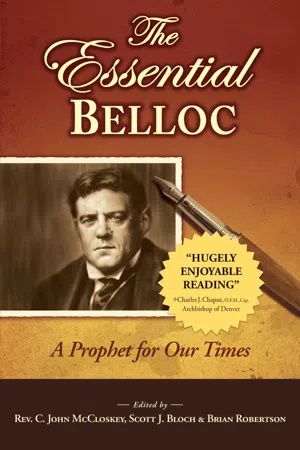
- 317 pages
- English
- ePUB (mobile friendly)
- Available on iOS & Android
eBook - ePub
About this book
Information
Topic
Theology & ReligionSubtopic
Christian Denominations1
Christendom in Crisis

From the Edwardian era in the 1910s until the time of his death in 1953, Belloc was tireless in warning moderns that they were losing their culture, their faith, and the very underpinnings of their great civilization. As the civilization went, he believed, so went the social, familial, faith and economic structures. Then went the interior structure of the person himself. His whole philosophy of Christendom is monumental and unified—and prophetic. He saw that the West would either survive or not as it recaptured its appreciation of and love for its heritage as a Christian corporate whole known as Christendom. For Belloc, Christendom was no sectarian project but one integrated in culture, in what people saw, wore, ate, drank, in where they traveled, in their architecture, political and economic systems, music, agriculture, crafts, art, literature, poetry, drama, technology, and language.
Belloc’s famous adage, “Europe is the Faith,” is not nostalgia for a Europe that once was, but a clarion call to recapture the Incarnational aspect of history: where and how faith and civilization were spread and what this has to do with our identity as Westerners in matters of faith, government, art, music, architecture, poetry, food, wine, modes of living, and happiness. This way of seeing the world is the “Catholic Thing,” where faith is always understood to be integral to all of culture, and religion, not economics, is truly at the heart of historical conflicts.
On the Historic Roots of Christendom and the West

Europe is the Faith, the Faith is Europe.
—EF
One thing in this world is different from all other things. It has a personality and a force. It is recognized and (when recognized) most violently loved or hated. It is the Catholic Church. Within that household the human spirit has roof and hearth. Outside it, is the night.
—CL, “Letter to Dean Inge”
Cultures spring from religions; ultimately the vital force which maintains any culture is its philosophy, its attitude toward the universe; the decay of a religion involves the decay of the culture corresponding to it—we see that most clearly in the breakdown of Christendom today.
—GH
The conversation of the Empire and the consequences thereof form the capital event in the history of the world.
—CC
It was to affirmation that a criminal who had been put to death in a known place and time at Jerusalem, under the Emperor Tiberius, condemned to scourging and to ignominious death by Crucifixion (whereto no Roman citizen was liable) was Divine, spoke with Divine authority, founded a Divine Society, rose from the dead, and could promise to His faithful followers eternal beatitude.
—CC
Tradition as a foundation for history possesses the advantage of sincerity and generality.
—CC
Others, not Catholic, look upon the story of Europe externally as strangers. They have to deal with something which presents itself to them partially and disconnectedly, by its phenomena alone: he sees it all from its center in its essence, and together.
—EF
Men forget that tradition, though it gets warped with time and tends to be diverse and vague, is commonly sincere; whereas a document may be, and, if official, commonly is, deliberately false.
—CC
There is with us a complete chaos in religious doctrine, where religious doctrine is still held, and even in that part of the European population where the united doctrine and definition of Catholicism survives, it survives as something to which the individual is attached rather than the community. . . .
—CR
Over and over again a tradition which learned, depending upon documents alone, have ridiculed turns out upon the discovery of further corroboration to be true.
—CC
You have been told, “Christianity (a word, by the way, quite unhistorical) crept into Rome as she declined, and hastened that decline.” That is bad history. Rather accept this phrase and retain it: “The Faith is that which Rome accepted in her maturity; nor was the Faith the cause of her decline, but rather the conservator of all that could be conserved.”
—EF
We must begin by laying it down, again as an historical fact, not to be removed by affection one way or the other, that the conversion of the Roman Empire was a conversion to what was called by all our ancestry and what is still called by those with any just historical sense, the Catholic Church.
—CC
Europe is the Church, and the Church is Europe.
—EF
On Christendom’s Effects on Culture
It was not the spread of the Faith which undermined the high civilization of pagan antiquity; on the contrary, the Faith saved all that could be saved; and, but for the conversion of the Roman Empire, nothing of our culture would have remained.
—CC
It was the Faith which gradually and indirectly transformed the slave into the serf, and the serf into the free peasant.
—CC
They often said, they always implied, that what ruined the material civilization of the Graeco-Roman Empire, that glorious pagan civilization of the statues and colonnades, the high verse and the high philosophy, was the spread of a superstition, of something degrading: the spread, I repeat, of that which those who do not know the Faith call “Christianity,” but which those who know the Faith call by its right name, the Catholic Church.
—CC
The Catholic Church makes men. . . . Of such she may also someday make soldiers.
—SNA
We must begin by laying it down, again as an historical fact, not to be removed by affection one way or the other, that the conversion of the Roman Empire was a conversion to what was called by all our ancestry and what is still called by those with any just historical sense, the Catholic Church.
—CC
The curious have remarked that one institution alone for now nineteen hundred years has been attacked not by one opposing principle but from every conceivable point.
—SNA
The Catholic Church brought back to the old, dying, despairing Graeco-Roman world the quality of vision.
—CC
On Christendom in Unity
The Catholic Church becoming the religion of Graeco-Roman society did among other things, two capital things for the settlement of Europe on its political side, and for arresting the descent into chaos. It humanized slavery and it strengthened permanent marriage. Very slowly through the centuries those two influences were to produce the stable civilization of the Middle Ages, wherein the slave was no longer a slave but a peasant; and everywhere the family was the well-rooted and established unit of society.
—CC
The conversion of the Graeco-Roman world to Catholicism gave that world a unity which it had never had before and which preserved it.
—CC
The Catholic Church was not an opinion, nor a fashion, nor a philosophy; it was not a theory nor a habit; it was a clearly delineated body corporate based on numerous exact doctrines, extremely jealous of its unity and of its precise definitions, and filled, as was no other body of men at that time, with passionate conviction
—EF
It is Mind which determines the change of Society, and it was because the mind at work was a Catholic mind that the slave became a serf and was on his way to becoming a peasant and a fully free man—a man free economically as well as politically
—CC
Whether the Church told the truth is for philosophy to discuss: What the Church was is plain history. The Church may have taught nonsense. Its organization may have been a clumsy human thing. That would not affect the historical facts.
—EF
The first of these characteristics was a profound underlying sense of Christian unity and particularly of Western unity: the unity of all those bound together by the Latin Mass and by the Western Patriarchate, at the head of which was the Bishop of Rome, the Pope.
—CC
Christian society had become static—but static also means stable. It had become an organized thing the rules of whose life would remain a strong framework preserving the character of the whole and its shape through the coming expansion of energy and knowledge.
—CC
The doctrine of personal immortality is the prime mark of the European and stamps his leadership upon the world.
—EF
On account of this fixity, of...
Table of contents
- Cover
- Title
- Copyright
- Dedication
- Contents
- Acknowledgments
- What Anglo-Saxons Call a Foreword, But Gentlemen a Preface: James V Schall, S.J
- Introduction: Scott J Bloch
- 1 Christendom in Crisis
- 2 Islam—Scourge of the West
- 3 Travels on Land and Sea
- 4 Friendship and the Inn
- 5 Belloc the Essayist
- 6 Economics and the Social Order
- 7 History and Historical Personages
- 8 Science and Truth
- 9 Songs and Verse
- 10 Wit, Witticisms, and Wisdom
- Key to References
- Bibliography
- About the Editors
- Index
Trusted by 375,005 students
Access to over 1.5 million titles for a fair monthly price.
Study more efficiently using our study tools.
Frequently asked questions
Yes, you can cancel anytime from the Subscription tab in your account settings on the Perlego website. Your subscription will stay active until the end of your current billing period. Learn how to cancel your subscription
No, books cannot be downloaded as external files, such as PDFs, for use outside of Perlego. However, you can download books within the Perlego app for offline reading on mobile or tablet. Learn how to download books offline
Perlego offers two plans: Essential and Complete
- Essential is ideal for learners and professionals who enjoy exploring a wide range of subjects. Access the Essential Library with 800,000+ trusted titles and best-sellers across business, personal growth, and the humanities. Includes unlimited reading time and Standard Read Aloud voice.
- Complete: Perfect for advanced learners and researchers needing full, unrestricted access. Unlock 1.5M+ books across hundreds of subjects, including academic and specialized titles. The Complete Plan also includes advanced features like Premium Read Aloud and Research Assistant.
We are an online textbook subscription service, where you can get access to an entire online library for less than the price of a single book per month. With over 1.5 million books across 990+ topics, we’ve got you covered! Learn about our mission
Look out for the read-aloud symbol on your next book to see if you can listen to it. The read-aloud tool reads text aloud for you, highlighting the text as it is being read. You can pause it, speed it up and slow it down. Learn more about Read Aloud
Yes! You can use the Perlego app on both iOS and Android devices to read anytime, anywhere — even offline. Perfect for commutes or when you’re on the go.
Please note we cannot support devices running on iOS 13 and Android 7 or earlier. Learn more about using the app
Please note we cannot support devices running on iOS 13 and Android 7 or earlier. Learn more about using the app
Yes, you can access The Essential Belloc by Hilaire Belloc in PDF and/or ePUB format, as well as other popular books in Theology & Religion & Christian Denominations. We have over 1.5 million books available in our catalogue for you to explore.