"I put before you the one great thing to love on earth: the Blessed Sacrament."-J.R.R. Tolkien Eucharistic adoration according to Fr. Frederick Faber is "the queen of all devotions." Pope St. Pius X taught that it was the devotion "most profitable for our salvation." And St. Gemma Galgani treasured it as "the school of Paradise where one learns how to love." So many popes and saints exhort us to spend time with our Eucharistic Lord. And the Manual for Eucharistic Adoration will enrich your hours with Him. Part One, "Preparing for Eucharistic Adoration, " answers these questions: -What is Eucharistic adoration, and why is it so important? -What does Scripture teach about this devotion? -What are the fruit of Eucharistic adoration? -How should I spend my time with Jesus in the Blessed Sacrament? Part Two, "Aids in Eucharistic Adoration, " provides these essential resources: -Teaching about the Eucharist from Scripture and Church documents -Scripture verses for adoration, wisdom and inspiration from saints especially devoted to our Eucharistic Lord -Prayers, Rosary meditations, reflections and hymns Mother Teresa once said: "The time you spend with Jesus in the Blessed Sacrament is the best time you will spend on earth." Take this great saint's words to heart. Then take the Manual for Eucharistic Adoration when you go to meet Him, and keep it with you Spiritual Communions and other moments of spontaneous adoration throughout the day.
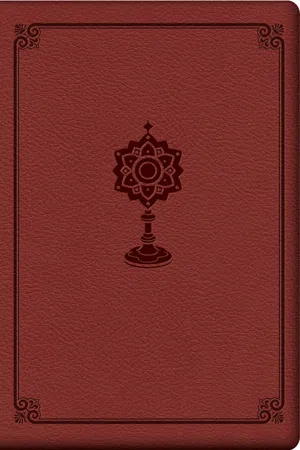
- 336 pages
- English
- ePUB (mobile friendly)
- Available on iOS & Android
eBook - ePub
Manual for Eucharistic Adoration
About this book
Information
Topic
Theology & ReligionSubtopic
ReligionPART ONE
Preparing for Eucharistic Adoration
1
A MATCHLESS MYSTICAL MEDICINE
I put before you the one great thing to love on earth: the Blessed Sacrament. . . . There you will find romance, glory, honor, fidelity, and the true way of all your loves upon earth.
J. R. R. TOLKIEN
What riches, glory, and grace we possess in the treasury of our Catholic faith! How good God is to us, who are so weak and so very much in need of His mercy and His love!
We have been given a priceless gift, a matchless mystical medicine. Yet it is not a thing but a Person: Jesus in the Most Blessed Sacrament. He has promised to remain with us until the end of the world, in order to exhaust every effort in guiding us to heaven, in securing our true peace and our only happiness.
Discovering the True Reality
If we have been baptized into the Catholic faith as infants and have spent our Sundays attending Mass, perhaps we have missed what many converts are so ecstatic about. We are prone to a certain “house-blindness,” going through the motions of the Faith without bothering to scratch the surface. But for those who are brave enough to venture farther than surface-skimming, an entirely new chapter of their lives begins to unfold when the true reality before us is realized: The same Jesus we read about in the Bible, hear about in the readings of Mass, and watch movies about (if they are trendy enough) is the very same Jesus we receive and adore in the Most Blessed Sacrament.
Body, Blood, Soul, and Divinity.
Stop for a moment and spend some time thinking about what this really means. I adore Jesus’ Body in the Sacred Host? At Mass I consume His Sacred Body? I drink His Blood? I receive His Soul into my soul? Somehow I receive His Divinity?
Could this be possible? How could He deign to be so intimate with me, a poor sinner?
An Intimate Presence
It is something far beyond our comprehension, but it is true. Not only are we able to receive Jesus in Holy Communion at each Mass as baptized Catholics in the state of grace, but we also have Him available in another very intimate way. He remains with us so that we may come to Him and gaze upon Him, “Face to face,” in the Most Blessed Sacrament, solemnly exposed for adoration.
St. Paul wrote about the transforming power of gazing upon Our Lord: “And we all, with unveiled face, beholding the glory of the Lord, are being changed into His likeness from one degree of glory to another” (2 Cor 3:18). To spend time with Him is to become more like Him.
We may find it difficult to believe that God has a vested interest in us, but He certainly does! He loves us so much that He died for us. Yet after His resurrection and His glorious ascension to the right hand of the Father, He did not want to leave us as orphans. He has gone before us to prepare a place for us.
Even so, He desires at the same time to be intimately present to us. He desires to show us that He is interested in every detail of our lives. How does He do this? He waits for a visit from us wherever He is present in the Holy Sacrament throughout the world.
2
THE MYSTERY REVEALED
To me, though I am the very least of all the saints, this grace was given, to preach to the Gentiles the unsearchable riches of Christ, and to make all men see what is the plan of the mystery hidden for ages in God who created all things. . . . This was according to the eternal purpose which He has realized in Christ Jesus our Lord, in whom we have boldness and confidence of access through faith in Him.
EPHESIANS 3:8–9, 11–12
He who knew us before time began, who loves us and willed us into being, and who will be waiting for us at the moment of our last breath, is the same One looking upon us from the Sacred Host. Let’s take a look at some passages from Sacred Scripture in order to unpack this mystery further.
The Eucharist Foreshadowed
The wondrous gift of the Eucharist, given by God to man through the Holy Sacrifice of the Mass, is hidden in shadow yet also explicitly shown in the Sacred Scriptures.
If we take a journey to discover the origins of this gift, we find it throughout the Bible. It is foreshadowed in the Old Testament, with hints of what was to come. And it is fulfilled in the New Testament, where the mystery is unveiled.
From Abraham’s sacrifice of Isaac to the institution of the Passover, from the manna in the desert to the ark of the covenant, we see God gradually revealing Himself to man—until the fullness of time, when He sends His only-begotten Son into the world.
The Sacrifice of Isaac, the Promised Son
Near the dawn of salvation history, Genesis recounts the drama of Abraham’s call from God to go in faith to a new land (see Gn 12). There God rewards his trust by promising to give him descendants as countless as the stars. However, Abraham’s belief in God’s word is further tested as he—already an old man—waits many more years before receiving assurance that his wife Sarah will bear a son.
Abraham’s journey of faith is put to the ultimate test when God asks the elderly man to sacrifice his son Isaac, on whom his hope for descendants rests. Scripture recounts no dilemma on Abraham’s part, no wavering in his obedient faith in this seeming contradiction of the original promise: “You shall be the father of a multitude of nations” (Gn 17:4). And yet the Lord most certainly knew what He was asking when He ordered the oblation of this “only son . . . whom you love” (Gn 22:2).
In a striking foreshadowing, God was fashioning Abraham into His own likeness, asking Abraham to do what He Himself would in fact decree for His own “beloved Son” (Mt 3:17). Isaac, the willing son and would-be victim, questions his father about the animal for the holocaust. Not knowing the full significance of his words, Abraham replies with certainty, “God will provide Himself the lamb” (Gn 22:8). Of course, the Lord intervened at the last moment when Abraham was about to complete the sacrifice of Isaac on the altar he had built, and Isaac was spared.
Then, “when the time had fully come” (see Gal 4:4), God gave His own Son as the sacrificial expiation, the true “Lamb of God” (Jn 1:36) in the new covenant of our redemption. The letter to the Hebrews describes Abraham’s willingness to offer up his son in a way that parallels Jesus’ offering of His life with total trust in God as His Father.
“By faith Abraham, when he was tested, offered up Isaac, and he who had received the promises was ready to offer up his only son. . . . He considered that God was able to raise men even from the dead; hence he did receive him back, and this was a symbol” (Heb 11:17, 19). As Abraham had promised Isaac, God Himself truly provided the Lamb, His own Son, offered as a willing sacrifice, raised from the dead, and present daily on the altar at every Holy Mass.
The Passover Lamb: Price of Salvation
Generations later, the foreshadowing of Christ as the saving Lamb of God and Food for our salvation was profoundly imaged in the Passover feast. For generations, Abraham’s descendants, the children of Israel, were slaves to the Egyptians. Out of compassion for their affliction, God sent Moses to lead the people out of bondage so that they might belong to Him and worship Him in freedom (see Ex 3–12).
Pharaoh, the king of Egypt, obstinately refused to let the Israelites leave in spite of the ten plagues sent by God—the disastrous consequences of his emphatic no to God’s word that had been spoken through Moses. Thus God decreed a final plague, the death of every firstborn, in order to change the heart of Pharaoh. Moses’ own people escaped this tragic blow but only through the sacrifice of a lamb.
In the first celebration of Passover, God instructed the Israelites to hold a ritual meal. In preparation for it, a year-old lamb without blemish (a foreshadowing of Christ) was to be slaughtered. Then its blood was to be put on the doorposts and lintel of their houses (see Ex 12).
God promised the Israelites, “The blood shall be a sign for you, upon the houses where you are; and when I see the blood, I will pass over you, and no plague shall fall upon you to destroy you, when I smite the land of Egypt” (Ex 12:13). They were to eat the lamb that was sacrificed for their salvation, and with it unleavened bread, because their haste in their exodus from slavery left them no time to make yeast bread.
This one-time event resulting in the liberation of Israel from the Egyptian tyrant was designated by divine decree to become a perpetual memorial of this saving act of God (see Ex 12:14).
As a dramatic annual feast, Passover held great importance in the history of Israel. And it was during this same feast that Jesus instituted the Holy Eucharist and became the price of our salvation from sin, death, and eternal slavery to the Devil (see Lk 22:14).
The offering of Christ’s body and blood put to death our enmity with God (see Col 1:19–23) and gave us the promise of eternal life with Him (see Jn 6). He is the only “lamb without blemish” (1 Pt 1:19), the true Lamb of God, whose blood was “poured out for many for the forgiveness of sins” (Mt 26:28). When we receive Christ at Holy Mass, we truly enter into the memorial of His saving passion (see 1 Cor 11:23–26) and are given the pledge of eternal salvation.
Manna and the True Bread From Heaven
As they sojourned in the desert wilderness towards Canaan, the Promised Land, the people of Israel became utterly dependent on God for their survival (see Ex 16). He answered their cries of thirst by providing water from a rock. When they complained of hunger, the Lord rained down bread from heaven (see Ex 16:4) and sent quails when they were craving meat (v. 13).
Each morning, as the dew fell, the Lord sent the people manna, their daily bread. They were to gather just what they needed for that day. Thus the children of Abraham learned to rely on God’s daily providence, knowing that it was the food that He sent that was sustaining them on their journey. When they reached the Promised Land and food was available, the miracle of the manna ceased.
Christ is Himself the reality foreshadowed by manna in the desert; He is the Bread of Life (see Jn 6:35), as He tells the crowds in the synagogue of Capernaum: “Truly, truly, I say to you, it was not Moses who gave you the bread from heaven; My Father gives you the true bread from heaven. . . . I am the living bread which came down from heaven; if any one eats of this bread, he will live for ever; and the bread which I shall give for the life of the world is My flesh” (Jn 6:32, 51).
It is the Lord Jesus who has given us His own Flesh and Blood, daily offered on the altar to be the sustenance of our souls. We have tremendous need of such supernatural Food, as we must travel through this vale of tears to the place He has prepared for us in heaven (see Jn 14:2).
The Ark of the Covenant, God’s Resting Place
God continued to manifest His divine presence to the people of Israel during the forty years in the desert and beyond. More treasured than the pillar of cloud and fire that heralded God’s going before them, the tent of meeting and the ark of the covenant were the privileged places where the Lord Almighty dwelt with His chosen ones and spoke with His servant, Moses. Built of precious materials, acacia wood and gold, the ark was fashioned as a box, supported and carried by poles on which was set the “mercy seat,” flanked by two cherubim (see Ex 25:10–22).
Concerning the ark, God told Moses, “There I will meet with you, and from above the mercy seat, from between the two cherubim that are upon the ark of the testimony, I will speak with you of all that I will give you in commandment for the people of Israel” (Ex 25:22). God commanded that the stones engraved with the Ten Commandments, a jar of manna, and the rod of Aaron (who was the first priest of the old covenant) be placed within the ark.
Each of these reminders of God’s covenant, placed within the ark, were themselves foreshadowing Christ. He was the fulfillment of the Law (see Mt 5:17; Rom 10:4), the Bread from Heaven (Jn 6:32–35), and the eternal High Priest (Heb 7:23–26). In Jesus, God has become Man and truly “dwelt among us” (Jn 1:14). And it is the same God-Man who day and night remains in tabernacles around the world, which have become not just a mercy seat but a Eucharistic “throne of grace” (Heb 4:16) where we can meet with Him and speak to Him.
The Eucharist Fulfilled
In the New Testament we are introduced to the first public miracle of Jesus at the wedding feast of Cana. In this nuptial setting, Jesus turns water into wine. A few short years later, He will turn wine into His very own Blood.
John, the beloved disciple (see Jn 13:23), relates that this initial sign performed by Jesus “manifest...
Table of contents
- Cover
- Title Page
- Copyright Page
- Dedication
- Contents
- How to Use This Manual
- Part One: Preparing for Eucharistic Adoration
- Part Two: Aids in Eucharistic Adoration
- Further Reading
Trusted by 375,005 students
Access to over 1.5 million titles for a fair monthly price.
Study more efficiently using our study tools.
Frequently asked questions
Yes, you can cancel anytime from the Subscription tab in your account settings on the Perlego website. Your subscription will stay active until the end of your current billing period. Learn how to cancel your subscription
No, books cannot be downloaded as external files, such as PDFs, for use outside of Perlego. However, you can download books within the Perlego app for offline reading on mobile or tablet. Learn how to download books offline
Perlego offers two plans: Essential and Complete
- Essential is ideal for learners and professionals who enjoy exploring a wide range of subjects. Access the Essential Library with 800,000+ trusted titles and best-sellers across business, personal growth, and the humanities. Includes unlimited reading time and Standard Read Aloud voice.
- Complete: Perfect for advanced learners and researchers needing full, unrestricted access. Unlock 1.5M+ books across hundreds of subjects, including academic and specialized titles. The Complete Plan also includes advanced features like Premium Read Aloud and Research Assistant.
We are an online textbook subscription service, where you can get access to an entire online library for less than the price of a single book per month. With over 1.5 million books across 990+ topics, we’ve got you covered! Learn about our mission
Look out for the read-aloud symbol on your next book to see if you can listen to it. The read-aloud tool reads text aloud for you, highlighting the text as it is being read. You can pause it, speed it up and slow it down. Learn more about Read Aloud
Yes! You can use the Perlego app on both iOS and Android devices to read anytime, anywhere — even offline. Perfect for commutes or when you’re on the go.
Please note we cannot support devices running on iOS 13 and Android 7 or earlier. Learn more about using the app
Please note we cannot support devices running on iOS 13 and Android 7 or earlier. Learn more about using the app
Yes, you can access Manual for Eucharistic Adoration by Paul Thigpen in PDF and/or ePUB format, as well as other popular books in Theology & Religion & Religion. We have over 1.5 million books available in our catalogue for you to explore.