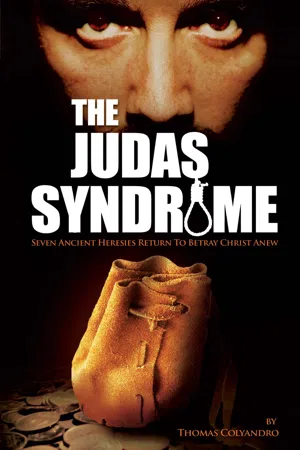
Throughout two millennia of Christian history, the great heresies have tried to destroy the Faith by perverting the truths that Christ taught the apostles. Beginning in Jesus' own time with the betrayal of the arch-heretic Judas, and continuing through the centuries, waves of error have threatened to swamp the Church, only to break and be dashed upon the Rock of Peter. However, though they may be defeated for a time by saints, popes, councils, and even force of arms as long as sin and error remains in our fallen world these heresies can never be truly vanquished. This condition is the Judas Syndrome; it betrayed Christ unto death, and it afflicts His Church and the world unto this day. In these pages, author Tom Colyandro investigates seven of the most harmful, most seductive, heresies in Church history, and reveals that they are indeed with us once more. New from Saint Benedict Press.
- 159 pages
- English
- ePUB (mobile friendly)
- Available on iOS & Android
eBook - ePub
About this book
Information
Topic
Theology & ReligionSubtopic
Christian DenominationsCHAPTER ONE
A Thread of Betrayal

THE MAJOR EVENTS of the gospels were prefigured throughout the Old Testament, and the betrayal of Judas is no exception. For example, in 2 Maccabees 14, Alcimus, a Hellenized Jew, tries to destroy the reputation and ultimately seek the death of Judas Maccabeus, who was credited for the revolt against the Seleucid Empire and the restoration of Jewish worship in the Jerusalem Temple in 165 BC.
[Alcimus] answered: “Those of the Jews who are called Haside’ans, whose leader is Judas Maccabe’us, are keeping up war and stirring up sedition, and will not let the kingdom attain tranquility. Therefore I have laid aside my ancestral glory—I mean the high priesthood— and have now come here, first because I am genuinely concerned for the interests of the king, and second because I have regard also for my fellow citizens. For through the folly of those whom I have mentioned our whole nation is now in no small misfortune. Since you are acquainted, O king, with the details of this matter, deign to take thought for our country and our hard-pressed nation with the gracious kindness which you show to all. For as long as Judas lives, it is impossible for the government to find peace.”1
In this passage, Alcimus, a high priest, tries to convince the king of the Seleucid Empire that Judas Maccabeus is a traitor to the crown and to the people when, in fact, the opposite is true. In other words, Alcimus was a deceitful liar who, in seeking ever-greater closeness with the king, conspired to eliminate the truly righteous, God-loving Judas from a place of honor among the Jews. Alcimus’s attempt to hand over Judas Maccabeus is not very different than what Judas Iscariot did to Jesus.
Elsewhere in the Old Testament, King David is likewise betrayed by his family members, friends and counselors. 2 Samuel 15:12 explains: “And while Ab’salom was offering the sacrifices, he sent for Ahith’ophel the Gi’lonite, David’s counselor, from his city Giloh. And the conspiracy grew strong, and the people with Ab’salom kept increasing.” Upon hearing of the effort against the kingdom, David gathers his officials, who respond with loyalty and bravery in verse 17:15: “And the king’s servants said to the king, ‘Behold, your servants are ready to do whatever my lord the king decides.’” Finally, in 17:23: “When Ahith’ophel saw that his counsel was not followed, he saddled his ass, and went off home to his own city. And he set his house in order, and hanged himself; and he died, and was buried in the tomb of his father.”
The trajectory of this Old Testament story parallels what happened between Jesus and Judas: a close friend and counselor sought his own selfish human ends, betrayed his virtuous king, became disgraced and hanged himself. David laments these betrayals in the Psalms—41:9 is particularly important because this is a recollection where David is saddened by the fact that it was a close confidant who deceived him. “Even my bosom friend in whom I trusted, who ate of my bread, has lifted his heel against me.” This is striking in that it parallels what Judas had done, not only while he was working for the Twelve (recall that Judas was in charge of the common purse), but also in the midst of breaking bread with Christ. This experience of the betrayal of David comes up again in Psalm 55:13-14: “But it is you, my equal, my companion, my familiar friend. We used to hold sweet converse together; within God’s house we walked in fellowship.”
There are other striking similarities in the Old Testament where the betrayal of Jesus is prophesied. For example, the thirty pieces of silver that Judas received is a reference to the thirty pieces paid for a slave in Exodus 21:32, and noted again in Zechariah 11:12: “And they weighed out as my wages thirty shekels of silver.” Finally, Isaiah prophesies the betrayal of Jesus in 28:1: “Woe to the proud crown of the drunkards of E’phraim, and to the fading flower of its glorious beauty, which is on the head of the rich valley of those overcome with wine!” This is important because the crown refers to the arrogance of the Sanhedrin, and the drunkards refer to Judas because he was a descendent of Ephraim.
These Old Testament passages form the bridge that links the betrayals by Lucifer the fallen angel, the serpent in the Garden of Eden, of Adam and Eve to Judas, the early heretics and beyond. In each case, the betrayers exhibited the Judas Syndrome because they betrayed God from within the community of people through which God chose to reveal Himself. By seeking position, profit and power (man’s ends) over salvation (God’s ends), these deceitful souls sought to serve themselves because they could not stand to serve God.
• THE STORY OF JUDAS
Although he shared with the other eleven Apostles a bond around the desire for truth and closeness with God, Judas remained a little too earthly, keeping his eyes on a possible alternative plan just in case life with Jesus didn’t work out.
And when it was evening he came with the twelve. And as they were at table eating, Jesus said, “Truly, I say to you, one of you will betray me, one who is eating with me.” They began to be sorrowful, and to say to Him one after another, “Is it I?” He said to them, “It is one of the twelve, one who is dipping bread in the same dish with me. For the Son of man goes as it is written of Him, but woe to that man by whom the Son of man is betrayed! It would have been better for that man if he had not been born.”2
Woe, indeed, to those who at first proclaim Jesus as Lord, then betray him for political purposes! Worse still is the man who would do such a thing for a pittance, the price of a slave. That is the difference between the above passage and the same one that appears in Matthew 26, where Judas has made already made his deal with the chief priests. The Gospel of Luke expresses the same event, too, but the difference there is that Luke identifies that it was evil that had entered Judas as he conspired with the chief priests to arrest Jesus.
Now the feast of Unleavened Bread drew near, which is called the Passover. And the scribes were seeking how to put Him to death; for they feared the people. The Satan entered into Judas called Iscariot, who was of the number of the twelve; he went away and conferred with the chief priests and captains how he might betray Him to them. And they were glad, and engaged to give him money. So he agreed, and sought an opportunity to betray Him to them in the absence of the multitude.3
Take note of the sense of the growing tension in Judas. At one level, Judas is just being a sinner: acting selfishly and greedily. At another level, Judas is allowing evil to overtake him, increasing in bitterness and anger towards God.
The phenomenally interesting twist in the Gospel of John is that Satan enters Judas right after he receives the bread of life from Jesus.
When Jesus had thus spoken, He was troubled in spirit, and testified, “Truly, truly, I say to you, one of you will betray me.” The disciples looked at one another, uncertain of whom He spoke. One of His disciples, whom Jesus loved, was lying close to the breast of Jesus; so Simon Peter beckoned to him and said, “Tell us who it is of who He speaks.” So lying thus, close to the breast of Jesus, he said to him, “Lord, who is it?.” Jesus answered, It is he to whom I shall give this morsel when I have dipped it.” So when He had dipped the morsel, He gave it to Judas, the son of Simon Iscariot. Then after the morsel, Satan entered into him. Jesus said to him, “What you are going to do, do quickly.” Now no one at the table knew why He said this to him. Some thought that, because Judas had the money box, Jesus was telling him, “Buy what we need for the feast”; or, that he should give something to the poor. So, after receiving the morsel, he immediately went out; and it was night.4
Here again, the gospel accounts move from expressing Judas’s betrayal first as a function of his desire for sociopolitical gain, then about his intimacy with the other eleven Apostles ( Judas betrays Jesus immediately prior to the institution of the Eucharist), and finally concerning his intimacy with Jesus (after he had eaten the bread given to him by Jesus). This same arc of betrayal is what is found in the Old Testament.
Having witnessed this act of betrayal, then, it was vital for the Apostles in the earliest Church—and remains acutely relevant for their successors, the bishops, today—to be able to preserve and protect the truths Jesus revealed. After the Resurrection and Ascension—and especially after the Pentecost—the job of the Apostles was to tend to their flock of believers and to evangelize the nonbelievers. Woven into that mission was their understanding that they were acting on His behalf through the power of the Holy Spirit so that every believer in every age could experience Jesus directly as well. That is why Jesus told them, “Go therefore and make disciples of all nations, baptizing them in the name of the Father and of the Son and of the Holy Spirit, teaching them to observe all that I have commanded you; and lo, I am with you always to the close of the age.”5
Continually calling His flock to Himself, Jesus also commands us to partake of Him: “And He took bread, and when He had given thanks He broke it and gave it to them, saying, ‘This is my body which is given for you. Do this in remembrance of me.’”6
• ANCIENT HERESIES AND MODERN TIMES
Looking at our salvation history with an eye towards the Judas Syndrome presents us with the striking dichotomy of a people who seek the light that comes from true light and the substance that comes from real substance—over and against a people who are disgraced before God because they seek their own ends.
What this means is that understanding the great historical heresies such as Gnosticism-Docetism, Origenism, Arianism, Macedonianism, Pelagianism, Iconoclasm, and Messalianism not as the mere ravings of hermitic lunatics, but as betrayals of God and His Church, is an important key to unlocking the rather confusing and disheartening times in which we live. Learning to root out such betrayals when we encounter them today will strengthen Christ’s Church and will illuminate us with the divine love and wisdom that has been bestowed on us and that urgently ushers us toward our ultimate goal: theosis or union with God for all eternity.
________
1. 2 Mach. 14:6-10.
2. Mark 14:17-21.
3. John 13:21-30.
4 Luke 22:1-3.
5. Matt. 28:19-20.
6. Luke 22:19..
CHAPTER TWO
Gnosticism/Docetism
Denying the Body of Christ
GOD NEVER INTENDED to remain distant from man. Even though the internal life of God (His essence) is truly unknowable by human activity alone, we are able to know God by His external life (His energies or grace). How? God chose to allow His superabundant love and His supernatural wisdom to emanate so as to create the celestial, ecclesiastical1 and natural hierarchies. In so doing, God was communicating to us that He hoped and expected our eventual, eternal return to Him. Therefore, between the time of our own specific creation and our return to Him in death, God gives us Himself, not only in spirit, but in the flesh of Jesus Christ, so that we might find our way through life to Him. In other words, God always intended to manifest Himself to us physically so that we might understand how to know Him, love Him and serve Him as we await our eternal life in Heaven.
There have been some throughout history who could not accept the idea that God is so intimate with mankind that He would enter the world Himself in the flesh. The Gnostics and Docetists were guilty of this heresy, rejecting the goodness of flesh for mankind and the possibility that a true god could be embodied in that same flesh.
Today, Scientologists are a quintessentially Gnostic sect in that they specifically reject bodily existence, claiming that man’s treasure is in his “spirit” and rejecting the idea that God could come in the form of a human person. Gnostic and Docetistic thinking can also be found in the entertainment industry, for example, in science fiction and fantasy movies where the main characters are endowed with the ability to know or to learn something that no one else can know. These characters have a specialized gnosis (knowledge) about what will “save” them or all mankind without also relying on divine revelation. Finally, certain types of Gnostic thinking can be found in modernist spiritualities, largely influenced by non-Christian Eastern religions, that reject the need for specificity in spiritual reflection.
This means that there has been an avalanche of Christian “spiritualities” and spiritual reflection tools over the last four decades that don’t require the user to reflect on the Body of Christ, whether in terms of His humanity or His gift of the Eucharist. These so-called systems of wisdom and reflection ignore the key element of Christian faith: God became man so that man could become more like God (to paraphrase St. Athanasius). We know this is true not only because Jesus the Christ walked the earth, but also because God was revealing Himself to our forefathers in the faith before the Incarnation.
• GOD WAS BEGINNING TO REVEAL THE BODY OF CHRIST IN
THE OLD TESTAMENT
THE OLD TESTAMENT
Almost immediately after creation, God began to reveal Himself to mankind. In word, image and deed, God wanted us to know who He is so th...
Table of contents
- Cover
- Title
- Copyright
- Dedication
- Contents
- Preface
- Introduction : What is the Judas Syndrome ?
- Chapter One : A Thread of Betrayal
- Chapter Two : Gnosticism/Docetism—Denying the Body of Christ
- Chapter Three : Arianism—Reducing Christ to a Prophet
- Chapter Four : Pelagianism—Putting Man at the Center of the Universe
- Chapter Five : Iconoclasm—Destroying the Face of Christ
- Chapter Six : Macedonianism—Minimizing the Holy Spirit
- Chapter Seven : Origenism—Ignoring the Just Judgment
- Chapter Eight : Messalianism—Abandoning the Sacraments
- Conclusion : Liturgy—the Antidote to the Judas Syndrome
Trusted by 375,005 students
Access to over 1.5 million titles for a fair monthly price.
Study more efficiently using our study tools.
Frequently asked questions
Yes, you can cancel anytime from the Subscription tab in your account settings on the Perlego website. Your subscription will stay active until the end of your current billing period. Learn how to cancel your subscription
No, books cannot be downloaded as external files, such as PDFs, for use outside of Perlego. However, you can download books within the Perlego app for offline reading on mobile or tablet. Learn how to download books offline
Perlego offers two plans: Essential and Complete
- Essential is ideal for learners and professionals who enjoy exploring a wide range of subjects. Access the Essential Library with 800,000+ trusted titles and best-sellers across business, personal growth, and the humanities. Includes unlimited reading time and Standard Read Aloud voice.
- Complete: Perfect for advanced learners and researchers needing full, unrestricted access. Unlock 1.5M+ books across hundreds of subjects, including academic and specialized titles. The Complete Plan also includes advanced features like Premium Read Aloud and Research Assistant.
We are an online textbook subscription service, where you can get access to an entire online library for less than the price of a single book per month. With over 1.5 million books across 990+ topics, we’ve got you covered! Learn about our mission
Look out for the read-aloud symbol on your next book to see if you can listen to it. The read-aloud tool reads text aloud for you, highlighting the text as it is being read. You can pause it, speed it up and slow it down. Learn more about Read Aloud
Yes! You can use the Perlego app on both iOS and Android devices to read anytime, anywhere — even offline. Perfect for commutes or when you’re on the go.
Please note we cannot support devices running on iOS 13 and Android 7 or earlier. Learn more about using the app
Please note we cannot support devices running on iOS 13 and Android 7 or earlier. Learn more about using the app
Yes, you can access The Judas Syndrome by Thomas Colyandro in PDF and/or ePUB format, as well as other popular books in Theology & Religion & Christian Denominations. We have over 1.5 million books available in our catalogue for you to explore.