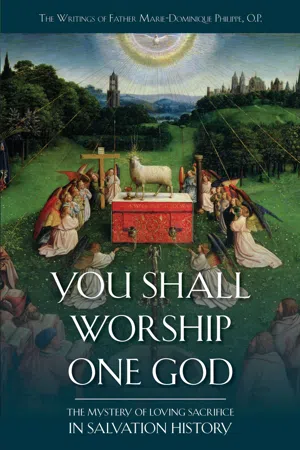
It is by means of worship that man recognizes his absolute dependence upon God, comes into His presence, and gains practical knowledge of His goodness and sovereign majesty. Father Marie-Dominique Philippe, founder of the Congregation of St. John and one of the twentieth century s most profound theological and pastoral minds, takes us back to the First Commandment, back to the primacy of worship, in You Shall Worship One God. For only by recognizing the singular importance of worship, of making ourselves an offering of love before God, can we hope to fulfill the other commandments and develop a deep and lasting spiritual life. Divine revelation, says Father Philippe, presents true worship to us in the form of sacrifice. The Old Testament stories in which goods and lives are offered to God, and the holocausts and oblations of the Jewish Temple, train God's people to express their love and fidelity and penitence through sacrifice. In so doing they also prefigure and prepare us for the Passion of Our Lord on Calvary, the perfect and lasting sacrifice that completes and gives meaning to all the others. Christ s offering of Himself is at root a sacrifice of filial worship, glorifying the Father in the truest way possible and thereby effecting the greatest spiritual fruits. You Shall Worship One God is a fascinating study of the development of sacrificial worship throughout salvation history, a rich meditation on the mystery of the Cross, and a necessary reminder to our busy world that the heart of Christianity is found not in service to our fellow man, but in recognizing the Lord s supreme majesty before all. Such worship is essential to salvation, says Father Philippe, for it makes us die to ourselves in order to proclaim that God is first. New from Saint Benedict Press.
eBook - ePub
You Shall Worship One God
The Mystery of Loving Sacrifice in Salvation History
- 171 pages
- English
- ePUB (mobile friendly)
- Available on iOS & Android
eBook - ePub
You Shall Worship One God
The Mystery of Loving Sacrifice in Salvation History
About this book
Information
Topic
Theology & ReligionSubtopic
Christian DenominationsCHAPTER 1
THE OLD TESTAMENT SACRIFICES:
TYPES OF THE SACRIFICE OF THE CROSS
SACRIFICES BEFORE THE LAW
The Sacrifice of Abel
THE first action of the children of Adam and Eve that Scripture reveals to us is one of offering: “Cain brought to the Lord an offering of the fruit of the ground, and Abel brought of the firstlings of his flock and of their fat portions” (Gen. 4:3-4). That is a most natural action for man to perform: he offers to the Lord the fruit of his labor, thereby recognizing that God is the sovereign master of the fertility of the earth and of animals.
In the case of Abel, this simple action was the expression of a deep conviction, coloring his whole life. For him, this offering was the recognition of God’s absolute right over his goods and over himself, and his sole intention was to proclaim the glory of his God, the one important thing in his eyes. Hence, in making this offering, he looked only to God, without thinking of his brother or his brother’s conduct, and without troubling himself about the way in which he approached God. Abel was a man of absolute sincerity. When he offered the firstborn of his flock to God, this outward action corresponded to the inner intention of his soul, for he recognized the sovereign rights of God over the fertility of life. In sacrificing to God the firstborn of his flock, his soul offered itself to God; it hid itself in the majesty of its God and desired only to concern itself with God’s sovereign greatness. Scripture tells us this in a veiled form, with the greatest simplicity, but plainly enough, when we compare the Lord’s attitude toward Abel with His attitude toward Cain: “And the Lord had regard for Abel and his offering, but for Cain and his offering He had no regard” (Gen. 4:4). In the anthropomorphic language of Scripture, it is easy to see that Abel looked to the Lord beyond the offering he made to God; the offering was a means of coming into the presence of God. Cain, on the other hand, performed only the external action of offering. He did not look to the Lord, but, being jealous of his brother, he spied on him. His heart was turned away from God and turned wholly toward his brother, not out of brotherly care, but out of envy and jealousy. He could not endure that his younger brother should be so attentive to God and so attracted by Him, and this annoyed and grieved him.
In spite of the rebuke addressed to him by the Lord, in spite of his conscience, which told him that such grief was wrong (it was not right for him to grieve at his brother’s happiness, at the care with which God treated younger sons, to be angry with his brother because he had done his duty as he saw it in all sincerity), Cain let himself be carried away with anger and jealousy. The presence of his brother became increasingly unendurable. The only possible means of satisfying his jealousy was to get rid of him, to murder him.
It was jealousy against a brother in a matter of religion that provoked the first murder, the first fratricide. Cain’s jealousy, which led to murder, shows us clearly the absoluteness of Abel’s offering: it affected his whole life. By declaring that God was the master of the fertility of his flocks, he recognized that God had the fullest rights over his life and that he belonged to God. Hence, he put everything in God’s hands and surrendered himself to Him with such simplicity. Such an act of worship has an absolute character, for it binds man to Him who is his Creator and at the same time separates him from all that is not his God.
By attacking Abel, who worshiped his God, Cain made a direct attack on God, for he who worships God is wrapped in God’s sovereign majesty. God is his refuge. Cain, having failed to recognize in his heart God’s absolute rights over him by true worship, was unable to listen to God when He wished to correct him, although he was to be forced to recognize God’s rights and submit to them. The anger of the Lord fell upon him. Cain, having failed to recognize with all sincerity that the fruitfulness of the earth comes from God, had to recognize the curse of the earth: “Till that ground, and it will yield thee its fruit no longer; thou shalt be a wanderer, a fugitive on earth.” Undergoing this punishment, he learned to recognize the absolute authority of God, who is the Creator. This first offering of adoration proclaimed God as master of the fruitfulness of the earth and of living things.
In contradiction to this first act, which sprung from the heart of man and rose toward God, we are shown the devil’s first caricature of worship. Outwardly all was perfect, but the intention in the heart did not correspond with the outward action of offering. Outwardly there was a gift, an offering, but inwardly there was fierce jealousy and desire to rule: we cannot worship God if we do not love our brother, as our Lord emphatically declares (Mt. 5:23-24).
Noah’s Sacrifice After the Flood
The Lord saw that the wickedness of man was great in the earth, and that every imagination of the thoughts of his heart was only evil continually. And the Lord was sorry that he had made man on the earth, and it grieved him to his heart. So the Lord said, “I will blot out man whom I have created from the face of the ground”… . But Noah found favor in the eyes of the Lord (Gen. 6:5-8).
We know how, by means of the flood, God carried out His plan “to blot out mankind from the face of the earth,” and how He protected Noah by commanding him to build an ark. After the flood, God ordered Noah to come out of the ark, and Noah’s first act was to build an altar to the Lord:
Then Noah built an altar to the Lord, and took of every clean animal and of every clean bird, and offered burnt offerings on the altar. And when the Lord smelled the pleasing odor, the Lord said in his heart, “I will never again curse the ground because of man, for the imagination of man’s heart is evil from his youth; neither will I ever again destroy every living creature as I have done. While the earth remains, seedtime and harvest, cold and heat, summer and winter, day and night, shall not cease” (Gen. 8:20-22).
This sacrifice of thanksgiving, made immediately after the flood, although already more well thought out and more religious than the first two (with the construction of the altar and the distinction of clean animals), still appears as a very spontaneous act of man and the head of human society. It was the first answer that Noah gave to his God and Savior when God returned to him the land after having cleansed it. Having escaped the danger of death, man thanked God for His providential assistance, His brotherly help, while also acknowledging the justice of His anger and punishment. Noah’s sacrifice was no longer the simple act of offering, of worship, of the creature who recognizes the sovereign rights of the Creator; it was an act of thanksgiving and reparation, acknowledging that God’s action was to be praised, that it was full of wisdom, justice, and mercy.
The sacrifice of Noah, the new head of the human society, was all-embracing. It was the whole living world, the whole world cleansed by God, that was offered to God and accepted by Him. We see this clearly from the answer God gave: “And when the Lord smelled the pleasing odor, the Lord said in His heart, ‘I will never again curse the ground because of man.’ ”
Gratitude always touches God’s heart profoundly, and God replied to the sacrifice of thanksgiving by a covenant that embraced the whole physical world: “While the earth remains, seed-time and harvest, cold and heat … shall not cease.” It was a covenant of fertility and peace: God blessed Noah and his children and said to them:
Be fruitful and multiply, and fill the earth. The fear of you and the dread of you shall be upon every beast of the earth, and upon every bird of the air, upon everything that creeps on the ground and all the fish of the sea; into your hand they are delivered. Every moving thing that lives shall be food for you; and as I gave you the green plants, I give you everything. Only you shall not eat flesh with its life, that is, its blood. For your lifeblood I will surely require a reckoning; of every beast I will require it and of man; of every man’s brother I will require the life of man. Whoever sheds the blood of man, by man shall his blood be shed; for God made man in his own image (Gen. 9:1-6).
Behold, I establish my covenant with you … Never again shall all flesh be cut off by the waters of a flood … And God said, “This is the sign of the covenant which I make between me and you and every living creature that is with you, for all future generations: I set my bow in the cloud” (Gen. 9:9-13).
By giving to man such universal power over all living beings, God reminded him of the nobility of his nature: he is an image of God. Promising man that he would never repeat the flood, God gave man a sign of peace so that he might not forget the peaceful covenant that God had made with mankind and with the world. This covenant demanded a greater faithfulness from man, for God put more trust in him, leaving him a greater responsibility.
By this sacrifice of thanksgiving, by this adoration of gratitude, God joined man more fully with Himself in His dominion, leaving to man’s care the government of the world, while reminding him that “man’s heart is evil from his youth” (Gen. 8:21).
The Sacrifice of Isaac
The sacrifices of Abel and of Noah were real archetypes, having in some sense a universal application. Their actions expressed a religious attitude, the attitude of a man who is naturally and supernaturally directed toward God and who puts all his trust in God. Abel, cast aside by his brother, found his refuge in God. Noah, worshiping God and thanking Him for His protection, was called by God to live in peace, to make a covenant with Him.
With Abraham, however, the history of the people of Israel begins. Everything starts with the gratuitous summons by God, an imperative call: “Go from your country”; and a summons so full of trust and promise: “I will make of you a great nation” (Gen. 12:1-2). This was a wonderful annunciation on God’s part, and Abraham silently gives his “fiat,” carrying out God’s command.
Having chosen Abraham, God gradually revealed Himself to him, showing Himself to him, blessing him, and making a covenant with him. And Abraham replied by building altars to God, recognizing Him as God, as having full rights over him.
With the perspective we have chosen, one fact stands out in all the personal relationships uniting the Lord with the one whom He had chosen. After the birth of Isaac, which Abraham had looked forward to with such hope and which came about in so wonderful a way, when Abraham was filled with joy and pride, God then wished to try him. “After these things God tested Abraham,” we are told by Scripture. “He said to him, ‘Abraham!’ And he said, ‘Here am I.’ He said, ‘Take your son, your only son Isaac, whom you love, and go to the land of Moriah, and offer him there as a burnt offering upon one of the mountains of which I shall tell you.’ So Abraham rose early in the morning” (Gen. 22:1-3).
This time it is God who takes the first step, who demands this sacrifice to test the fidelity of His servant and friend. It is God who decides the matter for the holocaust and when it shall be carried out. After having filled Abraham with favors and having given him this child and promised him so much, God demands an offering of all he possesses. God insists, with apparent cruelty, “Take your only son, your beloved son Isaac.” God asks this father to sacrifice his beloved son as a holocaust, to show his love, beyond all else, for God the Lord. God asks Abraham to destroy for His sake what He has freely given him, the gift that was the special sign of His love. He demands it in order to probe Abraham’s heart, to see how far his faithfulness reaches.
To human reason, there appears to be a kind of contradiction in God’s conduct, for it is not merely a question of His giving and taking back, but of giving after having intensified the desire by promising, partially fulfilling, promising again, and finally fulfilling by an almost miraculous gift. It is indeed a question of giving with all the generosity of a sovereign God, then of demanding from those who were favored by the gift its total destruction, that they might declare by this destruction the sovereign rights of the giver.
However terrible might be the demands of God, Abraham, as a faithful servant, obeyed at once; he rose up quickly. He set out to fulfill God’s order completely. Such was his faith that he did not hesitate for an instant to accept God’s word. Without discussion, he submitted to the conditions of the sacrifice. He submitted to the worship of God in the way desired by God Himself, acknowledged His sovereign, absolute rights. Scripture describes this with remarkable restraint:
He cut the wood for the burnt offering, and arose and went to the place of which God had told him. On the third day Abraham lifted up his eyes and saw the place afar off. Then Abraham said to his young men, “Stay here with the ass; I and the lad will go yonder and worship, and come again to you.” And Abraham took the wood of the burnt offering, and laid it on Isaac his son; and he took in his hand the fire and the knife. So they went both of them together. And Isaac said to his father Abraham, “My father!” And he said, “Here am I, my son.” He said, “Behold, the fire and the wood; but where is the lamb for a burnt offering?” Abraham said, “God will provide himself the lamb for a burnt offering, my son.” So they went both of them together (Gen. 22:3-8).
We should notice the father’s silence as he climbed the mountain of sacrifice. In the presence of his son, Abraham could only keep silent, a silence hard to bear, and harder still as he came nearer to the place and the time when he was to slay his own son. With the greatest care, Abraham jealously kept secret the order received from God, which struck him to the heart yet also gave him the power to go forward. By keeping this divine secret in faith, he becomes divinely estranged from his son, whom he must sacrifice in a few minutes. He could only do this provided that he became a mere instrument of God in the fullest degree, that God’s command first immolated his father’s heart, transforming him into a “blind servant,” blind to all that did not concern the divine order, blind to his own feelings as a father and the terrible consequences of his act. The sole thought of the consequences of the act, which he was freely performing and living minute after minute, would have repulsed his father’s heart and prevented him from taking another step. All his energy had to be absorbed by this command of God, if he was to accept it without discussion and with heroic faith.
Isaac, the child of laughter and of promise, well beloved, was walking freely and joyfully beside his father, all the time calling him Father, as if nothing was happening, in utter ignorance. With a child’s curiosity, he questioned his father and at once put the dreadful question, the only question possible: ‘Father, where is the lamb we need for a victim?” That was the great question, throughout the Old Testament, to which John the Baptist would give the answer.
The instrument carrying out God’s order, faithfully and promptly, knew only too well where the lamb was. But the father, whose torn heart was suddenly awakened by this tender appeal from his son calling him father, could say nothing; for he knew nothing else and could understand nothing else than utter abandonment to God’s mercy: “My son, God will see to it that there is a lamb to be sacrificed.” He had not chosen the lamb for the sacrifice, but God Himself had.
When they came to the place of which God had told him, Abraham built an altar there, and laid the wood in order, and bound Isaac his son, and laid him on the altar, upon the wood. Then Abraham put forth his hand and took the knife to slay his son. But the angel of the Lord called to him from heaven, and said, “Abraham, Abraham!” And he said, “Here am I.” He said, “Do not lay your hand on the lad or do anything to him; for now I know that you fear God, seeing you have not withheld your son, your only son, from me” (Gen. 22:9-12).
All was ready, everything prepared. Only at the very moment when Abraham began the movement to sacrifice his son, the angel of the Lord intervenes and calls to him, “Do not lay your hand on the lad.” The ram outwardly took the place of the child and was offered as a holocaust.
This sacrifice shows clearly that the outward slaying of the ram was of quite secondary importance. This was not what God valued most highly but rather the intention with which it was done, the inner sacrifice, the worship of the heart. This was essentially the sacrifice of Abraham and not of Isaac. It was an inner testing, a testing of Abraham’s fidelity, of the quality ...
Table of contents
- Cover
- Title
- Copyright
- Contents
- Introduction
- 1. The Old Testament Sacrifices: Types of the Sacrifice of the Cross
- 2. The Sacrifice of Adoration on the Cross
- 3. Christ Crucified, Our Wisdom: The Revelation of God’s Mystery
- Conclusion
- About the Author
Trusted by 375,005 students
Access to over 1.5 million titles for a fair monthly price.
Study more efficiently using our study tools.
Frequently asked questions
Yes, you can cancel anytime from the Subscription tab in your account settings on the Perlego website. Your subscription will stay active until the end of your current billing period. Learn how to cancel your subscription
No, books cannot be downloaded as external files, such as PDFs, for use outside of Perlego. However, you can download books within the Perlego app for offline reading on mobile or tablet. Learn how to download books offline
Perlego offers two plans: Essential and Complete
- Essential is ideal for learners and professionals who enjoy exploring a wide range of subjects. Access the Essential Library with 800,000+ trusted titles and best-sellers across business, personal growth, and the humanities. Includes unlimited reading time and Standard Read Aloud voice.
- Complete: Perfect for advanced learners and researchers needing full, unrestricted access. Unlock 1.5M+ books across hundreds of subjects, including academic and specialized titles. The Complete Plan also includes advanced features like Premium Read Aloud and Research Assistant.
We are an online textbook subscription service, where you can get access to an entire online library for less than the price of a single book per month. With over 1.5 million books across 990+ topics, we’ve got you covered! Learn about our mission
Look out for the read-aloud symbol on your next book to see if you can listen to it. The read-aloud tool reads text aloud for you, highlighting the text as it is being read. You can pause it, speed it up and slow it down. Learn more about Read Aloud
Yes! You can use the Perlego app on both iOS and Android devices to read anytime, anywhere — even offline. Perfect for commutes or when you’re on the go.
Please note we cannot support devices running on iOS 13 and Android 7 or earlier. Learn more about using the app
Please note we cannot support devices running on iOS 13 and Android 7 or earlier. Learn more about using the app
Yes, you can access You Shall Worship One God by Rev. Fr. Marie Dominique Philippe, O.P. in PDF and/or ePUB format, as well as other popular books in Theology & Religion & Christian Denominations. We have over 1.5 million books available in our catalogue for you to explore.