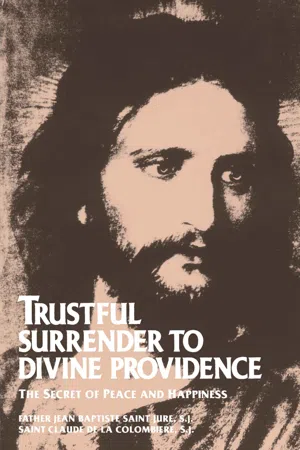
To trust in God's will is the "secret of happiness and content, " the one sure-fire way to attain serenity in this world and salvation in the next. Trustful Surrender simply and clearly answers questions that many Christians have regarding God's will, the existence of evil, and the practice of trustful surrender, such as: ·How can God will or allow evil? (pg. 11) ·Why does God allow bad things to happen to innocent people? (pg. 23) ·Why does God appear not to answer our prayers? (pg. 107) ·What is Trustful Surrender to Divine Providence? (pg. 85) and many more…This enriching classic will lay to rest many doubts and fears, and open the door to peace and acceptance of God's will. TAN's pocket-sized edition helps you to carry it wherever you go, to constantly remind yourself that God is guarding you, and He does not send you any joy too great to bear or any trial too difficult to overcome. (144 pgs, .)
- 144 pages
- English
- ePUB (mobile friendly)
- Available on iOS & Android
eBook - ePub
About this book
Information
Topic
Theology & ReligionSubtopic
Christian DenominationsPART I
by Father Jean Baptiste Saint-Jure
“Can a woman forget her infant, so as not to have pity on the son of her womb? and if she should forget, yet will not I forget thee.”
—Isaias 49:15
Chapter I
The Will of God Made and Governs All Things
Treating of the Will of God St. Thomas, following St. Augustine, teaches that it is the cause of all that exists.1 The Psalmist tells us that “all that the Lord wills he does in heaven and on earth, in the seas and in all the deeps.”2 Again in the Book of the Apocalypse it is written: “Worthy art thou, O Lord our God, to receive glory and honor and power; for thou hast created all things, and because of thy will they existed and were created.”3
Hence it is the Will of God which from nothingness drew out the universe with all its grandeur and all that lives in it, the earth with all that is on it and beneath it, all creatures visible and invisible, living and inanimate, reasonable and without reason, from the highest to the lowest.
If God then has produced all these things, as St. Paul says, according to the purpose of his will,4 is it not supremely right and reasonable as well as absolutely necessary that they should be preserved and governed by Him according to the counsel of His will? And how could a thing remain, unless you willed it; or be preserved, had it not been called forth by you?5
But the works of God are perfect, it is written in the Canticle of Moses.6 They are so well done that God Himself, whose judgment is strict and righteous, found when He had created them that they were good and very good.7 It is quite obvious that He who hath founded the earth by wisdom and hath established the heavens by understanding8 could not show less perfection in governing His works than in creating them. So, as He is careful to remind us, if His Providence continues to have care of all things,9 it is in measure and number and weight,10 it is with justice and mercy.11 Neither can any man say to him, Why dost thou so?12 For if He assigns to His creatures the end that He wills, and chooses the means which seem good to Him to lead them to it, the end He assigns them must be good and wise, nor can He direct them towards their end other than by good and wise means. Therefore do not become foolish,13 the Apostle tells us, but understand what the will of the Lord is, so that doing it you may receive the promise,14 that is to say eternal happiness, for it is written: the world with its lust is passing away, but he who does the will of God abides forever.15
1. God Controls All Events, Whether Good or Bad
Nothing happens in the the universe without God willing and allowing it. This statement must be taken absolutely of everything with the exception of sin. ‘Nothing occurs by chance in the whole course of our lives’ is the unanimous teaching of the Fathers and Doctors of the Church, ‘and God intervenes everywhere.’
I am the Lord, He tells us Himself by the mouth of the prophet Isaias, and there is none else. I formlight and create darkness; I make peace and create evil, I, the Lord, do all these things.16 It is I who bring both death and life, I who inflict wounds and heal them, He said to Moses.17 The Lord killeth and maketh alive, it is written in the Canticle of Anna, the mother of Samuel, He bringeth down to the tomb and He bringeth back again; the Lord maketh poor and maketh rich, he humbleth and he exalteth.18 Shall there be evil (disaster, affliction) in a city which the Lord hath not done?19 asks the prophet Amos: Good things and evil, life and death, poverty and riches are from God Solomon proclaims.20 And so on in numerous other passages of Scripture.
Perhaps you will say that while this is true of certain necessary effects, like sickness, death, cold and heat, and other accidents due to natural causes which have no liberty of action, the same cannot be said in the case of things that result from the free will of man. For if, you will object, someone slanders me, robs me, strikes me, persecutes me, how can I attribute his conduct to the will of God who, far from wishing me to be treated in such a manner, expressly forbids it? So the blame, you will conclude, can only be laid on the will of man, on his ignorance or malice. This is the defense behind which we try to shelter from God and excuse our lack of courage and submission.
It is quite useless for us to try and take advantage of this way of reasoning as an excuse for not surrendering to Providence. God Himself has refuted it and we must believe on His word that in events of this kind as in all others, nothing occurs except by His order and permission.
Let us see what the Scriptures say.
He wishes to punish the murder and adultery committed by David and He expresses Himself as follows by the mouth of the prophet Nathan: Why therefore hast thou despised the word of the Lord, to do evil in my sight? Thou hast killed Urias the Hittite with the sword, and hast taken his wife to be thy wife, and hast slain him with the sword of the children of Ammon. Therefore the sword shall never depart from thy house, because thou hast despised me, and hast taken the wife of Urias the Hittite to be thy wife. Thus saith the Lord: Behold, I will raise up evil against thee out of thy own house, and I will take thy wives before thy eyes and give them to thy neighbor and he shall lie with thy wives in the sight of this sun. For thou didst it secretly, but I will do this thing in the sight of all Israel, and in the sight of the sun.21
Later when the Jews by their iniquities had grievously offended Him and provoked His wrath, He says: The Assyrian is the rod and the staff of my anger, and my indignation is in his hands, I will send him to the deceitful nation, and I will give him charge against the people of my wrath, to take away the spoils, and to lay hold on the prey, and to tread them down like the mire of the streets.22
Could God more openly declare Himself to be responsible for the evils that Absalom caused his father and the King of Assyria the Jews? It would be easy to find other instances but these are enough. Let us conclude then with St. Augustine: “All that happens to us in this world against our will (whether due to men or to other causes) happens to us only by the will of God, by the disposal of Providence, by His orders and under His guidance; and if from the frailty of our understanding we cannot grasp the reason for some event, let us attribute it to divine Providence, show Him respect by accepting it from His hand, believe firmly that He does not send it [to] us without cause.”
Replying to the murmurs and complaints of the Jews who attributed their captivity and sufferings to misfortune and causes other than the will of God, the prophet Jeremias says to them: Who is he that hath commanded a thing to be done, when the Lord commandeth it not? Do not both evil and good proceed out of the mouth of the Highest? Why doth a living man murmur, a man suffering for his sins? Let us search our ways, and seek, and return to the Lord. Let us lift up our hearts with our hands to the Lord in the heavens, saying, We have done wickedly and provoked thee to wrath; therefore thou art inexorable.23
Are not these words clear enough? We should take them to heart for our own good. Let us be careful to attribute everything to the will of God and believe that all is guided by His paternal hand.
How Can God Will or Allow Evil?
However, you will perhaps now say, there is sinfulness in all these actions. How then can God will them and take part in them if He is all-holy and can have nothing in common with sin?
God indeed is not and cannot be the author of sin. But it must be remembered that in every sin there are two parts to be distinguished, one natural and the other moral. Thus, in the action of the man you think you have a grievance against there is, for example, the movement of the arm that strikes you or the tongue that offends you, and the movement of the will that turns aside from right reason and the law of God. The physical action of the arm or the tongue, like all natural things, is quite good in itself and there is nothing to prevent its being produced with and by God’s cooperation. What is evil, what God could not cooperate with, is the sinful intention which the will of man contributes to the act.
When a man walks with a crippled leg the movement he makes comes both from the soul and the leg, but the defect which causes him to walk badly is only in the leg. In the same way all evil actions must be attributed to God and to man insofar as they are natural, physical acts, but they can be attributed only to the will of man insofar as they are sinful and blameworthy.
If then someone strikes you or slanders you, as the movement of the arm or tongue is in no way a sin, God can very well be, and actually is, the author of it; for existence and movement in man not less than in any other creature proceed not from himself but from God, who acts in him and by him. For in Him, says St. Paul, we live and move and have our being.24 As for the malice of the intention, it proceeds entirely from man and in it alone is the sinfulness in which God has no share but which He yet permits in order not to interfere with our freedom of will.
Moreover, when God co-operates with the person who attacks or robs you, He doubtless intends to deprive you of health or goods because you are making a wrong use of them and they will be harmful to your soul. But He does not intend that the attacker or robber should take them from you by a sin. That is the part of human malice, not God’s design.
An example may make the matter clearer. A criminal is condemned to death by fair trial. But the executioner happens to be a personal enemy of his, and instead of carrying out the judge’s sentence as a duty, he does so in a spirit of hate and revenge. Obviously the judge has no share in the executioner’s sin. The will and intention of the judge is not that this sin should be committed, but that justice should take its course and the criminal be punished.
In the same way God has no share at all in the wickedness of the man who strikes or robs you. That is something particular to the man himself. God, as we have said, wishes to make you see your own faults, to humble you, deprive you of what you possess, in order to free you from vice and lead ...
Table of contents
- Front Cover
- Half Title
- Title Page
- Copyright
- Dedication
- Contents
- PART I: by Father Jean Baptiste Saint-Jure
- I. The Will of God Made and Governs All Things
- II. The Great Advantages to Be Gained from Entire Conformity to the DivineWill
- III. The Practice of Conformity to the Will of God
- PART II: by Saint Claude de la Colombière
- IV. Trustful Surrender to Divine Providence
- V. Exercise of Conformity to Divine Providence
- Notes
- SPREAD THE FAITH WITH
- BACK COVER
- A Collection of Classic Artwork
- The Classics Made Simple: Abandoment to Divine Providence
- Tan Classics
- Become a Tan Missionary!
- Share the Faith with Tan Books!
- Tan Books
Trusted by 375,005 students
Access to over 1.5 million titles for a fair monthly price.
Study more efficiently using our study tools.
Frequently asked questions
Yes, you can cancel anytime from the Subscription tab in your account settings on the Perlego website. Your subscription will stay active until the end of your current billing period. Learn how to cancel your subscription
No, books cannot be downloaded as external files, such as PDFs, for use outside of Perlego. However, you can download books within the Perlego app for offline reading on mobile or tablet. Learn how to download books offline
Perlego offers two plans: Essential and Complete
- Essential is ideal for learners and professionals who enjoy exploring a wide range of subjects. Access the Essential Library with 800,000+ trusted titles and best-sellers across business, personal growth, and the humanities. Includes unlimited reading time and Standard Read Aloud voice.
- Complete: Perfect for advanced learners and researchers needing full, unrestricted access. Unlock 1.5M+ books across hundreds of subjects, including academic and specialized titles. The Complete Plan also includes advanced features like Premium Read Aloud and Research Assistant.
We are an online textbook subscription service, where you can get access to an entire online library for less than the price of a single book per month. With over 1.5 million books across 990+ topics, we’ve got you covered! Learn about our mission
Look out for the read-aloud symbol on your next book to see if you can listen to it. The read-aloud tool reads text aloud for you, highlighting the text as it is being read. You can pause it, speed it up and slow it down. Learn more about Read Aloud
Yes! You can use the Perlego app on both iOS and Android devices to read anytime, anywhere — even offline. Perfect for commutes or when you’re on the go.
Please note we cannot support devices running on iOS 13 and Android 7 or earlier. Learn more about using the app
Please note we cannot support devices running on iOS 13 and Android 7 or earlier. Learn more about using the app
Yes, you can access Trustful Surrender to Divine Providence by in PDF and/or ePUB format, as well as other popular books in Theology & Religion & Christian Denominations. We have over 1.5 million books available in our catalogue for you to explore.