Between 1594 and 1598, a preacher named Francois converted 72, 000 Protestants to the Catholic Faith. These are his words. One of the most remarkable and well-documented events in Catholic history began when a young priest, St. Francis de Sales, volunteered to re-evangelize the Calvinists of the Chablais.Finding his preaching forcefully rejected, St. Francis de Sales shrewdly switched tactics and began a written apologetics campaign, posting pamphlets on walls and slipping them beneath doors under the cover of night.His defense of the Faith was so clear and thorough that at the end of four years nearly the entire population of 72, 000 had returned to the Catholic Faith!These powerful little tracts are as relevant today as they were in the late 1500s. St. Francis de Sales draws support from Scripture, the Fathers and Doctors of the Church to address questions still frequently posed by modern Protestants.Revered as some of the most cogent arguments against Protestantism ever penned; they present a defense of the Catholic Faith that has never been equaled.Now with beautiful new cover, easier to read size, updated typesetting, and the original content. 320 pps St. Francis de Sales was one of the most effective Catholic apologists and evangelists of the past five centuries. Undoubtedly, he is the most effective apologist to Protestant Calvinists who has ever lived. Steve Wood (Family Life Center International)
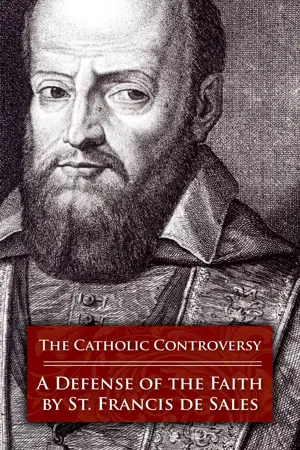
- 376 pages
- English
- ePUB (mobile friendly)
- Available on iOS & Android
eBook - ePub
About this book
Information
Topic
Theology & ReligionSubtopic
Christian DenominationsPART I
MISSION
CHAPTER I
THE LACK OF MISSION IN THE MINISTERS OF THE NEW PRETENDED CHURCH LEAVES BOTH THEM AND THEIR FOLLOWERS WITHOUT EXCUSE.
First, then, your ministers had not the conditions required for the position which they sought to maintain, and the enterprise which they undertook. Wherefore they are inexcusable, and you yourselves also, who knew and still know or ought to know this defect in them, have done very wrong in receiving them under such colors. The office they claimed was that of ambassadors of Jesus Christ Our Lord; the affair they undertook was to declare a formal divorce between Our Lord and the ancient Church his spouse, to arrange and conclude by words of present consent, as lawful procurators, a second and new marriage with this young madam, of better grace, said they, and more seemly than the other. For in effect, to stand up as preacher of God’s Word and pastor of souls—what is it but to call oneself ambassador and legate of Our Lord, according to that of the Apostle:1 We are therefore ambassadors for Christ? And to say that the whole of Christendom has failed, that the whole Church has erred, and all truth disappeared—what is this but to say that Our Lord has abandoned his Church, has broken the sacred tie of marriage he had contracted with her? And to put forward a new Church—is it not to attempt to thrust upon this sacred and holy Husband a second wife? This is what the ministers of the pretended church have undertaken; this is what they boast of having done; this has been the aim of their discourses, their designs, their writings. But what an injustice have you not committed in believing them? How did you come to take their word so simply? How did you so lightly give them credit?
To be legates and ambassadors they should have been sent, they should have had letters of credit from him whom they boasted of being sent by. The affairs were of the greatest importance, for there was question of disturbing the whole Church. The persons who undertook them were extraordinaries of mean quality and private persons, while the ordinary pastors were men of mark, and of most ancient and acknowledged reputation, who contradicted them and protested that these extraordinaries had no charge nor commandment of the Master. Tell me, what business had you to hear them and believe them without having any assurance of their commission and of the approval of Our Lord, whose legates they called themselves? In a word, you have no justification for having quitted that ancient Church in which you were baptized, on the faith of preachers who had no legitimate mission from the Master.
Now you cannot be ignorant that they neither had, nor have, in any way at all, this mission. For if Our Lord had sent them, it would have been either mediately or immediately. We say mission is given mediately when we are sent by one who has from God the power of sending, according to the order which he has appointed in his Church, and such was the mission of S. Denis into France by Clement and of Timothy by S. Paul. Immediate mission is when God himself commands and gives a charge, without the interposition of the ordinary authority which he has placed in the prelates and pastors of the Church: as S. Peter and the Apostles were sent, receiving from Our Lord’s own mouth this commandment: Go ye into the whole world, and preach the Gospel to every creature,2 and as Moses received his mission to Pharao and to the people of Israel. But neither in the one nor in the other way have your ministers any mission. How then have they undertaken to preach? How shall they preach, says the Apostle, unless they be sent?3
CHAPTER II
THAT THE PRETENDED REFORMERS HAD NO MEDIATE MISSION EITHER FROM THE PEOPLE OR THE BISHOPS.
And first, as to ordinary and mediate mission, they have none whatever. For what they can put forward is either that they are sent by the people and secular princes, or else that they are sent by the imposition of the hands of the bishops who made them priests, a dignity to which at last they must have recourse, although they despise it altogether and everywhere.
Now, if they say that the secular magistrates and people have sent them, they will have two proofs to give which they never can give, the one that the seculars have done it, the other that they could do it, for we deny both the fact and the right (factum et jus faciendi).
And that they could not do it the reason is absolute. For (1) they will never find that the people and secular magistrates had the power to establish and institute bishops in the Church.4 They will indeed perhaps find that the people have given testimony and assisted at ordinations; yea, perhaps, that the choice has been given to them, like that of the deacons, as S. Luke tells us (Acts vi), which the whole body of the faithful made, but they will never show that the people or secular princes have authority to give mission or to appoint pastors. How then do they allege a mission by people or princes, which has no foundation in the Scripture? (2) On the contrary, we bring forward the express practice of the whole Church, which from all time has been to ordain the pastors by the imposition of the hands of the other pastors and bishops. Thus was Timothy ordained, and the seven deacons themselves, though proposed by the Christian people, were ordained by the imposition of the Apostles’ hands. Thus have the Apostles appointed in their constitutions and the great Council of Nice (which methinks one will not despise) and that of Carthage—the second, and then immediately the third, and the fourth, at which S. Augustine assisted. If then they have been sent by the laity, they are not sent in Apostolic fashion, nor legitimately, and their mission is null. (3) In fact, the laity have no mission, and how then shall they give it? How shall they communicate the authority which they have not? And therefore S. Paul, speaking of the priesthood and pastoral order, says, Neither doth any man take the honour to himself but he that is called by God, as Aaron was (Heb. v. 4). Now Aaron was consecrated and ordained by the hands of Moses, who was a priest himself, according to the holy word of David (Ps. xcviii. 7), Moses and Aaron among his priests and Samuel among those who call upon his name and, as is indicated in Exodus (xxviii. 1) in this word, Take unto thee also Aaron thy brother, with his sons … that they may minister to me in the priest’s office, with which agree a great army of our Ancients. Whoever then would assert his mission must not assert it as being from the people nor from secular princes. For Aaron was not called in that way, and we cannot be called otherwise than he was. (4) Finally, that which is less is blessed by the better, as S. Paul says (Heb. vii. 7). The people then cannot send the pastors, for the pastors are greater than the people, and mission is not given without blessing.5 For after this magnificent mission the people remain sheep, and the shepherd remains shepherd. (5) I do not insist here, as I will prove it hereafter, that the Church is monarchical, and that therefore the right of sending belongs to the chief pastor, not to the people. I omit the disorder which would arise if the people sent, for they could not send to one another, one people having no authority over the other—and what free play would this give to all sorts of heresies and fancies? It is necessary then that the sheep should receive the shepherd from elsewhere and should not give him to themselves.6
The people therefore were not able to give legitimate mission or commission to these new ambassadors. But I say further that even if they could they did not. For this people were of the true Church or not: if it was of the true Church why did Luther take it therefrom? Would it really have called him in order to be taken out of its place and of the Church? And if it were not of the true Church, how could it have the right of mission and of vocation? Outside the true Church there cannot be such authority. If they say this people was not Catholic, what was it then? It was not Lutheran, for we all know that when Luther began to preach in Germany there were no Lutherans, and it was he who was their origin. Since then such a people did not belong to the true Church, how could it give mission for true preaching? They have then no vocation from that source, unless they have recourse to the invisible mission received from the principalities and powers of the world of this darkness and the spiritual wickednesses against which good Catholics have always waged war. Many therefore of our age, seeing the road cut off on that side, have betaken themselves to the other and say that the first masters and reformers—Luther, Bucer, Œcolampadius—were sent by the bishops who made them priests; then they sent their followers, and so they would go on to blend their rights with those of the Apostles.
In good sooth it is to speak frankly (parler Français) and plainly indeed, thus to confess that mission can only have passed to their ministers from the Apostles by the succession of our bishops and the imposition of their hands. Of course the case is really so: one cannot give this mission so high a fall that from the Apostles it should leap into the hands of the preachers of nowadays without having touched any of our ancients and foregoers: it would have required a very long speaking-tube (sarbacane) in the mouth of the first founders of the Church to call Luther and the rest without being overheard by any of those who were between: or else, as Calvin says on another occasion, not much to the point, these must have had very long ears. It must have been kept sound indeed, if these were to find it. We agree then that mission was possessed by our bishops, and particularly by their head, the Roman Bishop. But we formally deny that your ministers have had any communication of it, to preach what they have preached. Because (1) they preach things contrary to the Church in which they have been ordained priests, therefore either they err or the Church which has sent them errs, and consequently either their church is false or the one from which they have taken mission. If it be that from which they have taken mission, their mission is false, for from a false church there cannot spring a true mission. Whichever way it be, they had no mission to preach what they preached, because, if the Church in which they have been ordained were true, they are heretics for having left it, and for having preached against its belief, and if it were not true it could not give them mission. (2) Besides, though they had had mission in the Roman Church, they had none to leave it, and withdraw her children from her obedience. Truly the commissioner must not exceed the limits of his commission, or his act is null. (3) Luther, Œcolampadius, and Calvin were not bishops: how then could they communicate any mission to their successors on the part of the Roman Church, which protests always and everywhere that it is only the bishops who can send, and that this belongs in no way to simple priests? In which even S. Jerome has placed the difference between the simple priest and the bishop, in the Epistle to Evagrius, and S. Augustine7 and Epiphanius8 reckon Aerius with heretics because he held the contrary.
CHAPTER III
THE PRETENDED REFORMERS HAD NO IMMEDIATE OR EXTRAORDINARY MISSION FROM GOD.
These reasons are so strong that the most solid of your party have taken ground elsewhere than in the ordinary mission and have said that they were sent extraordinarily by God because the ordinary mission had been ruined and abolished, with the true Church itself, under the tyranny of Antichrist. This is their most safe refuge, which, since it is common to all sorts of heretics, is worth attacking in good earnest and overthrowing completely. Let us then place our argument in order, to see if we can force this their last barricade.
First, I say then that no one should allege an extraordinary mission unless he prove it by miracles: for, I pray you, where should we be if this pretext of extraordinary mission was to be accepted without proof? Would it not be a cloak for all sorts of reveries? Arius, Marcion, Montanus, Messalius—could they not be received into this dignity of reformers, by swearing the same oath?
Never was any one extraordinarily sent unless he brought this letter of credit from the divine Majesty. Moses was sent immediately by God to govern the people of Israel. He wished to know his name who sent him; when he had learned the admirable name of God, he asked for signs and patents of his commission: God so far found this request good that he gave him the grace of three sorts of prodigies and marvels, which were, so to speak, three attestations in three different languages, of the charge which he gave him, in order that any one who did not understand one might understand another. If then they allege extraordinary mission, let them show us some extraordinary works, otherwise we are not obliged to believe them. In truth Moses clearly shows the necessity of this proof for him who would speak extraordinarily: for having to beg from God the gift of eloquence, he only asks it after having the power of miracles; showing that it is more necessary to have authority to speak than to have readiness in speaking.
The mission of S. John Baptist, though it was not altogether extraordinary, was it not authenticated by his conception, his nativity and even by that miraculous life of his, to which Our Lord gave such excellent testimony? But as to the Apostles, who does not know the miracles they did and the great number of them? Their handkerchiefs, their shadow, served for the prompt healing of the sick and driving away of the devils: by the hands of the apostles many signs and wonders were done amongst the people (Acts xix v); that this was in confirmation of their preaching S. Mark declares quite explicitly in the last words of his Gospel and S. Paul to the Hebrews (ii. 4). How then shall those who in our age would allege an extraordinary mission excuse and relieve themselves of this proof of their mission? What privilege have they greater than an Apostolic, a Mosaic? What shall I say more. If our sovereign Master, consubstantial with the father, having a mission so authentic that it comprises the communication of the same essence, if he himself, I say, who is the living source of all Ecclesiastical mission, has not chosen to dispense himself from this proof of miracles, what reason is there that these new ministers should be believed on their mere word? Our Lord very often alleges his mission to give credit to his words: As my Father hath sent me I also send you (John xx. 21); My doctrine is not mine, but of him that sent me (ibid. vii. 16); You both know me, and you know whence I am; and I am not come of myself (ibid. 28). But also, to give authority to his mission, he brings forward his miracles and attests that if he had not done among the Jews works which no other man had done, they would not have sinned in not believing him. And elsewhere he says to them, Do you not believe that I am in the Father and the Father in me? Otherwise believe for the works themselves (ibid. xiv. 11, 12). He then, who would be so rash as to boast of extraordinary mission without immediately producing miracles, deserves to be taken for an impostor. Now it is a fact that neither the first nor the last ministers have worked a single miracle: therefore they have no extraordinary mission. Let us proceed.
I say, in the second place, that never must an extraordinary mission be received when disowned by the ordinary authority which is in the Church of Our Lord. For, (1) we are obliged to obey our ordinary pastors under pain of being heathens and publicans (Matt. xviii. 17)—how then can we place ourselves under other discipline than theirs? Extraordinaries would come in vain, since we should be obliged to refuse to listen to them, in the case th...
Table of contents
- Front Cover
- Half Title
- Title Page
- Copyright
- Dedication
- Contents
- Translator’s Preface
- Introduction
- PART I: MISSION
- PART II: The Rule Of Faith
- Article I
- Article II
- Article III
- Article IV
- Article V
- Article VI
- Article VII
- Article VIII
- Part III: Church Doctrines and Institutions
- Article I: Of the Sacraments
- Article II: Purgatory
- Appendix I–On the authority of the Pope. [Annecy autograph]
- Appendix II–Parallel References between the French and English Editions of This Book
- Notes
- A Collection of Classic Artwork
- Made Simple: An Introduction to the Devout Life
- Tan Classics
- Become a Tan Missionary!
- Share the Faith with Tan Books!
- Tan Books
Trusted by 375,005 students
Access to over 1.5 million titles for a fair monthly price.
Study more efficiently using our study tools.
Frequently asked questions
Yes, you can cancel anytime from the Subscription tab in your account settings on the Perlego website. Your subscription will stay active until the end of your current billing period. Learn how to cancel your subscription
No, books cannot be downloaded as external files, such as PDFs, for use outside of Perlego. However, you can download books within the Perlego app for offline reading on mobile or tablet. Learn how to download books offline
Perlego offers two plans: Essential and Complete
- Essential is ideal for learners and professionals who enjoy exploring a wide range of subjects. Access the Essential Library with 800,000+ trusted titles and best-sellers across business, personal growth, and the humanities. Includes unlimited reading time and Standard Read Aloud voice.
- Complete: Perfect for advanced learners and researchers needing full, unrestricted access. Unlock 1.5M+ books across hundreds of subjects, including academic and specialized titles. The Complete Plan also includes advanced features like Premium Read Aloud and Research Assistant.
We are an online textbook subscription service, where you can get access to an entire online library for less than the price of a single book per month. With over 1.5 million books across 990+ topics, we’ve got you covered! Learn about our mission
Look out for the read-aloud symbol on your next book to see if you can listen to it. The read-aloud tool reads text aloud for you, highlighting the text as it is being read. You can pause it, speed it up and slow it down. Learn more about Read Aloud
Yes! You can use the Perlego app on both iOS and Android devices to read anytime, anywhere — even offline. Perfect for commutes or when you’re on the go.
Please note we cannot support devices running on iOS 13 and Android 7 or earlier. Learn more about using the app
Please note we cannot support devices running on iOS 13 and Android 7 or earlier. Learn more about using the app
Yes, you can access The Catholic Controversy by in PDF and/or ePUB format, as well as other popular books in Theology & Religion & Christian Denominations. We have over 1.5 million books available in our catalogue for you to explore.