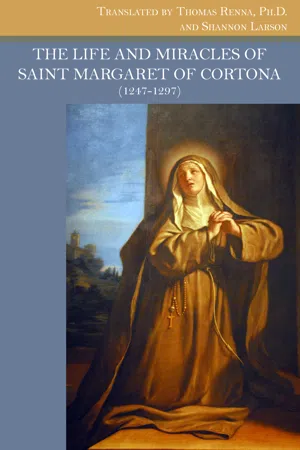
Saint Margaret of Cortona is the light of the Third Order of Fracis. Such is the theme of the most extensive biography of any Franciscan Tertiary in the Middle Ages. Margaret's extraordinary career brings the historian closer to the early development of the Franciscans and the Order of Penance; it tells us much about how women saints were described, and about how civic cults of saints emerged. Another window, although a smaller one, opens to the tensions between the Franciscan Community and the Spiritual Franciscans before the split prior to Pope John XXII. Indeed it could be said that we know more about Margaret of Cortona than about any woman of thirteenth-century Italy, with the exception of Clare of Assisi and Clare of Montefalco. This edition is translated from the critical Latin edition by Fortunato Iozzelli, O.F.M. of The Life of Saint Margaret of Cortona by Fra Giunta Bevegnati. The original translation by Thomas Renna has been edited by Shannon Larson.
eBook - ePub
The Life and Miracles of Saint Margaret of Cortona
- 344 pages
- English
- ePUB (mobile friendly)
- Available on iOS & Android
eBook - ePub
The Life and Miracles of Saint Margaret of Cortona
About this book
Information
Topic
Theology & ReligionSubtopic
Islamic TheologyCHAPTER I
CONCERNING HER WAY OF LIFE IN THE SECULAR HABIT
1a. Devoted to Christ, pure of mind, fervent of heart, Margaret, in the one-thousandth, two-hundredth, and seventy-seventh year from the birth of Christ, in tears, with joined hands and knees bent, with a great insistence of prayers, humbly and freely offered herself in body and soul before Friar Ranaldo of good memory, the guardian of Arezzo, and assumed the garments of the third order of blessed Father Francis.
Once, while devoted in prayer before an image of Christ which now is on the altar of the aforesaid friars, he spoke to her: “What do you wish, my little poor one?” Illumined by the Holy Spirit, she replied at once, “I do not seek and do not wish for anything but you, my Lord Jesus.”
1b. Another time, while she was praying, she heard the Lord reciting and recalling to pleasant memory the phases of her calling, in the following order, in which was included vividly the earliest stage of her life:
“Remember,” he said, “my little poor one, the many graces and illuminations I gave your soul in order that you might return to me.
“Remember that, following the death of the enemy of your salvation, you went back to your father in Laviano, full of sorrows, wet with tears, your face scarred, dressed in black, and deeply distraught.
“Remember how, at the instigation of your stepmother, your father, quite forgetful of his fatherly duty, banished you from the house. Yet like one not knowing what she ought to do, and deprived of every counsel and assistance, sitting and grieving under the fig tree in your father’s garden, you wept humbly over your wretchedness in mind and body, claiming me as your teacher, father, spouse, and lord. Then the ancient serpent, seeing you banished by your father, seized the opportunity of your father’s shame and your distress and with regard to your youthful beauty, induced your heart to presume, suggesting it to be excusable, as you were forsaken, to flourish in sinning, wherever you were or wished to go, to be loved by great men, carnal men, on account of your physical beauty. But I, the framer of your inner beauty which I, being your lover, desired to reframe, stirred your conscience through the inspiration of my light that you should go to Cortona and surrender yourself to the obedience of my Friars Minor. Consorting with spiritual men, without delay you set out for Cortona and in accord with my command presented yourself to the friars, bending with the greatest vigilance to their teachings and corrections.
“Remember that the remedy of your heart for the beginning of your salvation which I fixed in your mind was the reverent filial fear of the Friars Minor in whose care I entrusted you. Having taken it completely, I terrorized the invisible enemy and shattered by my offering grace that audacity that he attempted against you in your misfortune. Did you not tremble all at once? Did not your face redden out of reverence when some friar from the order of your father Francis would appear in church, at home, or in the street, with you fearing to sit or speak with worldly folk in front of them?
“Remember that I arranged in your soul a complete disdain for trappings and then taught your heart that by my love you would separate yourself bit by bit from the company of worldly mistresses.
“Remember that your body was accustomed to delectable dishes, but through grace I assigned abstinence not only of delicacies, but of ordinary food.
“Remember that, made more steadfastly strong by my graces, you wore yourself out with continual fasting and, spurning soft covers, you sweetly chose the hardest bed now of woven sticks, now the bare earth, now laying down with a block of wood or stone for a pillow.
“Remember the many gifts of fear, of sorrow, of constant weeping that I deigned to lavish so fully upon you, that with a flood of tears you would entreat not only the Friars Minor to whom I entrusted you but even worldly folk, imploring them with grief-stricken lamentations. You were moved to abundant weeping with bitter sighs about your condition, if I your father and lord would call you back, you who had been made an exile in iniquities, in mercy to your father’s dominion. But do not cease to recall that having displayed sweetness to you I wonderfully changed your bitter sorrows into tears of joy, while you poured out devoted tears for my birth from the Virgin, for the elegance of the Virgin and the feasts of the other saints. These were acts at the beginning of your conversion, after the death of your deceiver who for nine years incessantly ensnared you against your will in plots against your purity and honor.
“Remember, my little poor one, the trip which you made alone at night across the water, where the ancient enemy tried to drown you because you were going to seek to renew my passion. But I, not unmindful of fatherly mercy, carefully cared for you and delivered you.
“Remember likewise that, with the world still pleasing to you, while you were living in the shadows of the vices, I your true master, the teacher of your accomplishments, gave you maternal compassion for the poor and the afflicted. I gave you such a desire for solitary and remote spots that with burning devotion you would say: ‘O how sweetly may one pray here, and how reverently and lovingly do prayers of praise to God unfold here! How quietly, securely, and methodically may one be able to perform saving penance!’
“Remember that settled in a state of darkness, abiding by yourself in the house or in your room, illuminated by the radiance of my light you wept for your fall. When greeted by nobles or commoners, from city or country, you would contradict them, saying that, knowing your reprehensible life, they ought to retract any sort of greeting or kind word.
“Remember that tearing you away from this earlier state, I placed you in the particular company of noble ladies, namely Marinaria and Raniera.
“Remember the beauty of your face, which until then you were accustomed to maintain, indeed to alter and to augment, as a great injury against me. But then you achieved a horror and hatred for it and you yearned to wipe it out, now by abstinence, now by cutting it with stones, now by covering it with potash, now by frequent blood letting.
“Remember that the fire of my love so transformed you into me that with tears you sought from the guardian of the Friars Minor of Cortona the habit of the brethren of penance; so that with constant tears and more constant prayers you would become a companion to me and pilgrim to the world.”
1c. Why, O reader, did the friars delay to give Margaret the habit? Certainly then it was because they doubted her perseverance, and because she seemed far too pretty and far too young. But afterwards the friars saw her cling inseparably to Christ; they saw her, in a fervent spirit, rise more and more into God; they heard her say, “My fathers, to whom I have been entrusted by the Lord, do not doubt me. Were I to spend my whole life in a vast wilderness, I would still love my God; the Almighty would still comfort my soul. Therefore I would not fear any creature nor any temptation because of the hope which I have placed in God, calling me back to his grace. And you saw that after I fled the world, that I live in the company of religious people and have changed my life for the better through the grace given me by Christ. Why are you afraid? Why do you delay me to assume the habit?”
Therefore the friars, having heard these things, out of the love of him who clothed her with his virtue, clothed Margaret with the habit. Just as she changed into the habit, so also she adorned her spirit in the virtues, as will be made quite clear to readers in the chapters presented below. Unknowingly she foretold this change, while arguing naughtily with her noblewomen companions about her manner of dress. They said, “What will become of you, O Margaret most vain?” And she said, “There shall come a time when you will call me holy, for I will be holy, and you will visit me with a pilgrim’s staff and a pilgrim’s handbag on your shoulder.” Indeed we see this not only among men hastening from everywhere, but also multitudes of women, devotedly coming to visit her body and tomb.
CHAPTER II
CONCERNING HER COMPLETE CONVERSION TO GOD
1a. After Margaret had received the habit of penance from the Friars Minor, she seemed to be a new woman through the infusion of the Holy Spirit. The heavenly fire of love transformed her so that from then on she strove with ardent care to find a solitary place where she could remain hidden and refrain from worldly conversation. In meditating, praying, weeping, and fasting she chose to be joined without mediation to the King of All Ages as a new Magdalene.
Consumed in the fire of love, she deprived herself of everything that could please her soul or body so that crucified to the world she might hold the world in disdain. Desiring to be weak, Margaret cut herself, fasted without ceasing, and chose to lay her weary body on the bare ground instead of on a bed. No one was ever so greedy for gold as Margaret was for denying her body. To facilitate her night vigils she used to lay her head, worn out as it was by fasting and weeping, on a stone or a piece of wood.
Staying awake, she would spend the night from the first watch to the ninth hour in prayer and bitter tears. Out of the severity of grief infused now from the memory of her faults, now from the recollection of Jesus crucified, she was nailed, spiritually, to the cross. So anguished with weeping she would sigh to such a degree that very often she was afraid that she might die, very often losing her voice and her senses, and would remain almost lifeless.
This lover of virtue chose a little cell, set off from the disturbances of the crowd yet close to the homes of noble ladies, in order to stay more hidden and safe. There she would offer herself as a true sacrifice to God with disciplines, by blows and buffets so harsh that her naturally white flesh would appear nearly as livid as that of the one who out of love healed us in his suffering. She would say that she was delighted more in the denial of her body, which she not only sought [the denial] from the Lord but also ardently pursued in every way, than if she had been raised to the imperial dignity.
But since the initiation of converts must be enkindled in gentle steps, for the convert ascends to virtue in degrees, so that the timorous souls of this age may not fear to submit the flesh to the spirit, I shall describe the stages of her fasts. Having set out on the path of salvation, at first Margaret the servant of Christ would flavor her food with bitter herbs, not neglecting the fast even on non-obligatory days, and not eating any meat at all. A little later, being led more sweetly into the divine love, having spurned all fat from meat, she put only oil on the food she was about to eat. And since she had decided to support herself and her son by the work of her hands, Margaret humbly and lovingly began to care for the noble ladies of Cortona as a midwife. Although she would prepare delicious food for them, which was appropriate for their station, she would fast on Lenten fare even outside of the Lenten season. While some would sing for the comfort of the ill, she would stay to one side and sob, which would turn the singers to grieving and weeping with her, putting an end to their songs.
This is the Margaret who spoke so fervently to those present about the mercy of God and the severity of his justice that no heart, however given over to worldly delights, could keep itself from grieving for the sake of the heat of her words. But let the humble discretion of Margaret shine forth for us. Rather than burden the household of the ladies she was serving about cooking food for her in accord with her fast, she abstained from eating meat in the presence of those eating meat, and would prudently eat other common dishes whenever they were placed before her. Without neglecting her service to women in labor, she very diligently recited the canonical hours, along with other devout prayers which she added to the hours. She offered herself completely to our Lord. Margaret was like a lily among thorns, a light in darkness, and gold glittering in dust, fasting and weeping, keeping watch and working, yet in no way would she judge those eating, drinking, singing, and sleeping in their indolence.
She who was preparing baths for ladies would wash herself only in a bath of weeping. Cleansing the bed of her conscience each night with unceasing tears, like the sprinkling of the blood of Jesus Christ, she did not cease in purifying her soul by virtue of the continual sorrow which she bore in her heart. And a woman in labor saw her in the air, praying.
1b. And since on account of the duties of midwifery, Margaret the servant of the Lord could not serve Christ in accordance with her vow regarding masses and sermons, she quickly withdrew herself from ministering to the ladies. Seeking to receive her accustomed consolations for their increase, she soon began to invoke the generous Lord in her prayers. And where did these happen? Certainly in the home of Lady Diabelle, where the Father of mercies and light endowed Margaret with such merciful piety that the lady turned her own home into a hospice of mercy. Margaret put her heart into this house and gave herself to a life of poverty to such a degree that when the time came she completely desired that no sort of possession whatsover be withheld from the assistance to the poor. Being grateful to those who took care of her, Margaret had an infirmary set up in this House of Mercy, to attend to the sick Friars Minor of Cortona.
O true mother of mercy, so dedicated to aiding and consoling the poor, you did not allow even the smallest thing in the house to be set aside for your own use! In that house of mercy the Father filled her with such a gift of mercy that at times he personally would speak words of encouragement and comfort to her; at times he would grant her the solace of angels, at times he would frighten off the ancient enemy when he [the enemy] would try to assault her.
1c. Having devoted everything to Christ, Margaret chose as her advocate John the Baptist, in whose honor she celebrated annually the “feast of the poor.” She fed the poor by the work of her own hands, depriving herself and her son of being filled on the foods she prepared with such care.
With most persistent prayers the fervent Margaret implored her blessed father Francis to obtain, through his merits and as gift of his singular love, a plenary indulgence for her sins.
However ill and weak she might be, Margaret from the earliest days of her conversion, never ate eggs and cheese outside the season of Lent, at which time she avoided even fish. Moreover, she would try to give away whatever food was sent to her; she would try to quickly give it to the poor, shedding tears for them and keeping nothing for her own needs.
O renowned devotion of the devout mother, who attracted the poor and needy to such an extent that, having forsaken the abodes of the wealthy, they [the poor] would gather in throngs at the abode of her little cell where she had practically nothing! And because the neighboring noble ladies grieved for Margaret, against her will they strove to drive away from her cell the poor, whom she loved to the very core of her being, so that she might have the opportunity to hang on to something for herself. Not yet a complete recluse, devotedly going in the morning to the place of the Friars Minor, as was her custom, she would remain there in prayer until the hour of terce, when the people were not fasting, and returning to her cell in silence, having closed the door, she would give herself over to a little bit of work and to much prayer.
That the beginning of wisdom is the fear of Christ so preoccupied her mind that she did not wish to meet anyone face to face, nor hear nor speak about worldly matters. If it happened that during the day she heard or talked about worldly matters to secular people, she did not, during the night, dare to seek her usual comfort in prayer from Christ, but rather she would spend a sleepless night weeping in sorrow. Ablaze with grief, she would beat her breast with her fists, crying out as if she were in labor; waking up her sleeping neighbors, she would make plain her inner sadness by these lamentations. And since bitterness is not ended except in sweetness, nor cold extinguished but in heat, afflicted by so great a grief, she put an end to her unspeakable lamentations by recalling her mind to meditation on the cross and the mockery of the Redeemer, since in the bitter sufferings of Christ every bitterness of her mind was sweetened. But, dear brothers, she so anxiously renewed her meditation on the Passion that sometimes she would tear her clothes in back and front; sometimes strike her cheeks; sometimes she whipped her back with a knotted cord, out of love for him whose back was scourged by sinners.
Pondering with such bitter and painful tears and sighs, now her sins and now the passion of Jesus Christ, she realized that the clearest sign of true love is the proper display of deeds, to put an end to her previous life and the empty honors of the world, she began to go about the region seeking alms, not entering anyone’s house and not looking anyone in the face.
Margaret was so genuine that if a lady wished to give her a whole loaf of bread, she would refuse it, fearing that it was given to her out of some special reverence. However there was so much maternal piety in her for the needy that after a while she would come to accept entire loaves because out of her love for the poor she could refuse them no longer. This is the Margaret who gave a chest and all her cooking utensils to the needy, except for a cracked pot with a stone cover, which she used for storing bread. She is the one who thoroughly fulfilled the Gospel message, when on account of love for her beloved spouse Jesus she expelled her only son, preferring, out of love for Christ, pilgrims, the poor, the notorious; often she lovingly deprived herself of things given to her for her use.
Therefore worldly people feared to come to her, not only because in her cell she rarely spoke, but also because she preferred the eternal Love to the son of her womb—to such a degree that she did not want to cook anything for him lest it interrupt her time for prayer.
In fact she rarely spoke to her son, except to say, “My son, when you return to the cell, take whatever raw food you find and eat it in silence, since I find in you no reason for interrupting the divine praises.” However she treated her son, Margaret continued to prepare meat, fish, and other food for Christ’s poor. She was so caught up in their care that she kept silent in order that she might now lose time, since the spirit and not the flesh proposed this practice.
But when Margaret did not have food for the poor, she managed to get shirts, knives, belts, bowls, glasses, firewood, clothes, and blankets for ...
Table of contents
- Cover Page
- Title page
- Copyright page
- Dedication Page
- Preface
- Table of Contents
- Introduction
- Prologue
- Chapter I: Concerning Her Way of Life in the Secular Habit
- Chapter II: Concerning Her Complete Conversion to God
- Chapter III: Concerning the Austerity of Her Life and Her Zeal for Poverty
- Chapter 4: Her Profound Humility
- Chapter 5: Meditation on the Passion of Christ
- Chapter 6: On Her Devout Prayer
- Chapter 7: Purity of Conscience and Frequent Confession and Communion
- Chapter 8: Her Maternal Piety and Zeal for Souls
- Chapter 9: The Revelation of Secrets
- Chapter 10: Her Indescribable Fear Concerning All That She Bore, and Her Desire for Her Death
- Chapter 11: Miracles
- Appendix
- Bibliography
- Index of Scripture
Trusted by 375,005 students
Access to over 1.5 million titles for a fair monthly price.
Study more efficiently using our study tools.
Frequently asked questions
Yes, you can cancel anytime from the Subscription tab in your account settings on the Perlego website. Your subscription will stay active until the end of your current billing period. Learn how to cancel your subscription
No, books cannot be downloaded as external files, such as PDFs, for use outside of Perlego. However, you can download books within the Perlego app for offline reading on mobile or tablet. Learn how to download books offline
Perlego offers two plans: Essential and Complete
- Essential is ideal for learners and professionals who enjoy exploring a wide range of subjects. Access the Essential Library with 800,000+ trusted titles and best-sellers across business, personal growth, and the humanities. Includes unlimited reading time and Standard Read Aloud voice.
- Complete: Perfect for advanced learners and researchers needing full, unrestricted access. Unlock 1.5M+ books across hundreds of subjects, including academic and specialized titles. The Complete Plan also includes advanced features like Premium Read Aloud and Research Assistant.
We are an online textbook subscription service, where you can get access to an entire online library for less than the price of a single book per month. With over 1.5 million books across 990+ topics, we’ve got you covered! Learn about our mission
Look out for the read-aloud symbol on your next book to see if you can listen to it. The read-aloud tool reads text aloud for you, highlighting the text as it is being read. You can pause it, speed it up and slow it down. Learn more about Read Aloud
Yes! You can use the Perlego app on both iOS and Android devices to read anytime, anywhere — even offline. Perfect for commutes or when you’re on the go.
Please note we cannot support devices running on iOS 13 and Android 7 or earlier. Learn more about using the app
Please note we cannot support devices running on iOS 13 and Android 7 or earlier. Learn more about using the app
Yes, you can access The Life and Miracles of Saint Margaret of Cortona by Shannon Larson, Thomas Renna, Shannon Larson,Thomas Renna in PDF and/or ePUB format, as well as other popular books in Theology & Religion & Islamic Theology. We have over 1.5 million books available in our catalogue for you to explore.