The special focus of this study is the appreciation of beauty in the writing of two great theorists of the tradition, Bonaventure of Bagnoregio and John Duns Scotus.
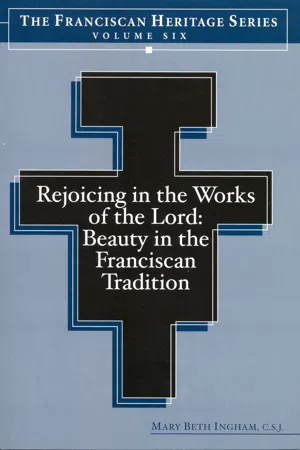
- 88 pages
- English
- ePUB (mobile friendly)
- Available on iOS & Android
eBook - ePub
About this book
Information
Topic
Theology & ReligionSubtopic
Christian TheologyFRANCISCANS AND BEAUTY
“Late have I loved you, O Beauty ever ancient and ever new.”4 With these words, Augustine of Hippo captured his experience of conversion and discovery of God as Love beyond any he had ever known. Throughout his life’s journey, through trials and personal loss, through questioning and doubt, through the discovery of friendship and unselfish love, Augustine finally came to know himself as one loved with a divine Love that, quite simply, turned his life and his world upside down. After this experience, nothing was to be the same again.
Augustine’s story, so beautifully recounted in his Confessions, has marked the history of Christian reflection upon the spiritual life as a journey of transformation into love. His writings have marked spiritual and theological reflections upon the order of love (ordo amoris), upon the divine nature as Beauty, and upon the creation as the harmonic whole that reveals the nature of God. For Augustine and those living within his spiritual tradition, human life is, quite simply, an ongoing pilgrimage. It is a journey back home, back to where we belong, to that loving embrace where at last we shall be surrounded by love and beauty. At that moment we shall take our place within a communion of lovers, where we shall experience our heart’s desire in a banquet of delight and a kingdom of peace.
In this first chapter, we consider the vision of the founders and the legacy of wisdom inherited by the great masters of the intellectual tradition. As we shall see, they build upon the foundation of centuries of reflection by great minds and spiri-tual writers who preceded them. Among the most influential was Augustine of Hippo. Franciscans have a particular affinity for the Augustinian vision of transformation into love. Spiri-tual writers, theologians and philosophers of the tradition are profoundly influenced by Augustinian insights: by his focus on ordered loving, on the importance of self-discovery, on the centrality of divine generosity and creativity, and on the world as a place of exquisite beauty. The created order, itself beautiful, is SIGN of a deeper Beauty: God. Consequently, the tradition itself is overtly affective in its vision of the human person: Franciscans emphasize that the journey toward God is a via pulchritudinis, a pathway of beauty that integrates human emotions as well as human intellectual analysis and reflection.
Franciscans see themselves and all persons as “restless hearts” longing for peace and love. Restless minds also reveal this deep longing, as Augustine’s questioning traced out his own way of pursuing his deepest desires. It is no wonder that Beauty, understood as the goal of all of human longing and the delight of our hearts should continually emerge within the tradition in three specific ways: as a cornerstone of reflection, as a guide to action, and as a medium of transformation.
The vision of the founders
The beauty of the created world and the beauty of God were central spiritual insights for Francis and Clare. Transformed by love, Francis’s life became a song of praise to his Beloved. Indeed, Francis saw beauty everywhere: in the simplest flower, in the poor, suffering Christ, in the leper, in the outcast, and in the stranger. At the end of his life, his Canticle of the Creatures offers a prime and exquisite testimony to his own journey toward the fullness of praise.
Bonaventure’s Life of Francis (Legenda Major) describes the journey of the founder in terms that echo the methodological structure of his spiritual classic, Itinerarium Mentis in Deum (The Journey of the Mind to God).
Aroused by everything to divine love,
he rejoiced in all the works of the Lord’s hands
And through their delightful display
he rose into their life-giving reason and cause.
In beautiful things he contuited Beauty itself
and through his footprints impressed in things
he followed his Beloved everywhere
out of them all making for himself a ladder
through which he could climb up
to lay hold of him who is utterly desirable.5
he rejoiced in all the works of the Lord’s hands
And through their delightful display
he rose into their life-giving reason and cause.
In beautiful things he contuited Beauty itself
and through his footprints impressed in things
he followed his Beloved everywhere
out of them all making for himself a ladder
through which he could climb up
to lay hold of him who is utterly desirable.5
Francis’s experience is emblematic of the human experience: he serves as the guide par excellence. As it did for him, the beauty of creation can guide each person toward the Creator. The lover advances as upon the rungs of a ladder, toward better and deeper experiences of Beauty. The journey itself culminates in an experience beyond our ability to describe.
“In beautiful things he contuited Beauty itself.”6 The key to recognizing and experiencing Beauty lies in the ability to see it where it manifests itself. Such recognition should not be difficult, since beauty is everywhere. And yet, our ordinary human experience seems to suggest just the opposite. We do have difficulty in seeing beauty around us, in others and in ourselves. Too often our hearts are distracted or turned in upon our own concerns. We wear blinders of self-concern and self-protection that keep us from seeing as far and wide as we might. We live in a fog that obstructs our ability to see things clearly. We look at the world around us and at others “through a glass darkly.”
The first step in any spiritual or intellectual journey is to begin to see rightly, to notice what is present to us, to recognize the beauty around us. Once recognized, beauty leads the lover through the visible world to the spiritual realm. The ladder however constitutes a cumulative ascent: earlier stages are brought forward and integrated into later, more insightful phases of the journey. At its goal, the journey culminates in union with ultimate Beauty, principle and cause of all that is beautiful. Here is the entrance into divine embrace: communion with that Beauty “ever ancient, ever new,” the object of our love and desire.
In her fourth letter to Agnes of Prague, Clare of Assisi also expresses this Franciscan predilection for love and beauty as an image of God.
Happy indeed is she to whom it is given to drink at this sacred banquet,
So that she might cling with her whole heart to him
Whose beauty all the blessed hosts of heaven unceasingly admire,
Whose tenderness touches,
Whose contemplation refreshes,
Whose kindness overflows,
Whose delight overwhelms,
Whose remembrance delightfully dawns,
Whose fragrance brings the dead to life again,
Whose glorious vision will bring happiness
to all the citizens of the heavenly Jerusalem.7
Here we see again the image of communion, of the sacred banquet, of clinging “with her whole heart” to that Beauty “whose tenderness touches” and “whose kindness overflows.” Clare’s vision captures the eschatological dynamic: a loving embrace with the divine beauty and with “all the citizens of the heavenly Jerusalem.”
The Franciscan tradition gives witness to a profoundly aesthetic intellectual and spiritual vision.8 A prolonged meditation on the experience of beauty and upon its transformative power in our lives can help to clarify and enhance our own individual ability to take the human journey to God, traced by Augustine, Francis, Clare and all the great saints and scholars of the tradition.
The spiritual journey surrounding beauty involves three distinct moments. There is a preliminary moment when one is “aroused by all things to the love of God, rejoicing in the work of the Lord’s hands.” This is the first moment of awareness and recognition, the moment when we notice something beautiful in the world that is present to us. This object of our attention delights us, and we rejoice in its beauty.
The second moment involves the unfolding of the experience. Here the reflective journey moves from creature to Creator who is Principle and Cause. Key to the journey, this moment involves a shift from exterior to interior: a movement toward the inner person. We recognize that such external beauty cannot be the cause of its own existence, for, sadly, it is ephemeral and fleeting. There must be a greater beauty, a deeper and richer experience of Beauty that both constitutes and explains our experience of joy and delight. Attention to subjective awareness opens to greater interiority: to an awareness of God’s presence within.
The third and final moment lies in the dynamic embrace of Beauty, the ultimate communion with the source of all that is beautiful. This is not an end, but a new beginning. Here one enters into the presence of Beauty itself, the divine Lover. Here interiority and exteriority collapse: the God within becomes the God within whose embrace the human lover is held. Inner/outer, upper/lower, ascending/descending: now all the categories of the journey collapse into one another: there is only Love. From within this communion, the lover is transformed. All is seen to point to the divine Beauty, all beings manifest and reveal that “Beauty ever ancient and ever new.”
We might be tempted to think that such a journey is linear; that it is a passage from this world to the next, from here to there or from now to then, as from one point on a line to another. But for the great saints and scholars of antiquity and the Middle Ages, this was not the case.9 Rather than see the journey as one from this life to the next, they understood the journey as a spiritual pedagogy: as the gradual transformation of the person into beauty in this life. The spiritual master or guide needed to help in the journey is the person who has come to that point in her life where she sees beauty everywhere because she sees divine Beauty everywhere. Beauty, like light, illuminates and transforms all that exists. Such an experience of transformation into beauty anticipates the ultimate communion we will experience at the end of our life. But this experience involves an immanent spiritual transformation: a transcendence that is possible in this world and in this life. For Franciscans, spiritual transformation into beauty cannot involve leaving this world, for it requires the presence of beauty, both spiritual and corporeal.
The age-old tradition centered on Beauty
This three-fold ascent to divine Beauty has an ancient lineage. Great Western thinkers, both philosophers and theologians, influenced the Franciscan Masters. Plato, in his Symposium, presents the figure of Diotima, the woman who taught Socrates how to follow the life of philosophy, the life devoted to wisdom. In her famous speech that marks the center of this dialogue, Diotima explains how desire draws us from visible, tangible beauty beyond individuals to laws and ideas, finally to look upon Beauty itself.10 This journey from change to permanence is also captured as the ascent from the Cave into the light of day, as Plato describes the journey of the philosopher in his Republic (Book VII).11 Within the Platonic tradition, so influential for Augustine and many of the Greek fathers, images of Beauty, Light and ascent beyond change form the spiritual roadmap from this world to the eternal.
Augustine was particularly influenced by Platonic thought in his early years and was himself a Platonist before his conversion. In his theories about divine ideas or exemplars,12 in his description of the human mind as imago Dei,13 in his definition of Beauty,14 and of the soul’s ability to see the Good via a type of abstraction, Augustine set forth the map that would be followed by all Christian Platonists, and particularly by medieval theologians and spiritual masters. We see this method most clearly in the following passage:
Only what is good draws your love. The earth ..., the beautiful and fertile earth ..., a human face with its balanced features, its happy smile, its rich coloring ..., the heart of a friend.... But enough! There is this good, and there is that good. Take away the ‘this’ and ‘that’ and look, if you can, upon the good itself. Then you will behold God, who is not good because he has the good of any other good thing but because he is the good of every good thing.... So, our love should rise to God as the Good itself.15
This passage illustrates key moments in the experience of beauty and goodness in the world. It is highly optimistic. It affirms that human love is drawn toward the good. The goodn...
Table of contents
- Cover
- Title Page
- Copyright
- Table of Contents
- Abbreviations
- Preface
- Introduction
- Chapter I: Franciscans and Beauty
- Chapter II: The Beauty of Creation
- Chapter III: The Beauty of the Human Heart
- Chapter IV: The Franciscan Path of Transformation into Beauty
- Chapter V: Toward a Franciscan Aesthetic
- Selected Bibliography
Trusted by 375,005 students
Access to over 1.5 million titles for a fair monthly price.
Study more efficiently using our study tools.
Frequently asked questions
Yes, you can cancel anytime from the Subscription tab in your account settings on the Perlego website. Your subscription will stay active until the end of your current billing period. Learn how to cancel your subscription
No, books cannot be downloaded as external files, such as PDFs, for use outside of Perlego. However, you can download books within the Perlego app for offline reading on mobile or tablet. Learn how to download books offline
Perlego offers two plans: Essential and Complete
- Essential is ideal for learners and professionals who enjoy exploring a wide range of subjects. Access the Essential Library with 800,000+ trusted titles and best-sellers across business, personal growth, and the humanities. Includes unlimited reading time and Standard Read Aloud voice.
- Complete: Perfect for advanced learners and researchers needing full, unrestricted access. Unlock 1.5M+ books across hundreds of subjects, including academic and specialized titles. The Complete Plan also includes advanced features like Premium Read Aloud and Research Assistant.
We are an online textbook subscription service, where you can get access to an entire online library for less than the price of a single book per month. With over 1.5 million books across 990+ topics, we’ve got you covered! Learn about our mission
Look out for the read-aloud symbol on your next book to see if you can listen to it. The read-aloud tool reads text aloud for you, highlighting the text as it is being read. You can pause it, speed it up and slow it down. Learn more about Read Aloud
Yes! You can use the Perlego app on both iOS and Android devices to read anytime, anywhere — even offline. Perfect for commutes or when you’re on the go.
Please note we cannot support devices running on iOS 13 and Android 7 or earlier. Learn more about using the app
Please note we cannot support devices running on iOS 13 and Android 7 or earlier. Learn more about using the app
Yes, you can access Rejoicing in the Works of the Lord by Mary Beth Ingham in PDF and/or ePUB format, as well as other popular books in Theology & Religion & Christian Theology. We have over 1.5 million books available in our catalogue for you to explore.