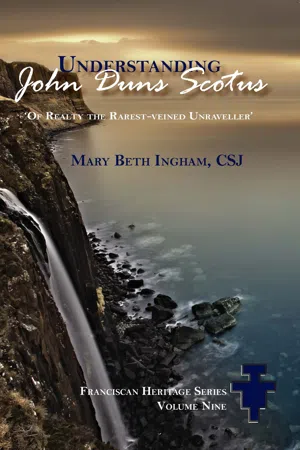
In this ninth volume of the Franciscan Heritage Series, Mary Beth Ingham introduces readers to the Franciscan vision and values of Blessed John Duns Scotus (1266-1308). Framed within the context of Franciscan spiritual values, chapters focus on creation and the dignity of each individual being, on cognition and the powers of human knowing, on the proof for God's existence, on the nature of Theology, on the central role of freedom for conversion and the love of friendship, on moral goodness and beauty, on practical decision making, and on salvation history. In order to highlight the particularly Franciscan approach to these topics, each chapter offers helpful points of comparison and contrast with the thought of Thomas Aquinas. Throughout, the poetry of Scotist-inspired Gerard Manley Hopkins sets the artistic backdrop for a vision of reality informed by Franciscan values and Franciscan optimism. Hopkins praised the hope and intricacy of Scotist thought, naming him 'of realty the rarest-veined unraveller'.
- 178 pages
- English
- ePUB (mobile friendly)
- Available on iOS & Android
eBook - ePub
About this book
Information
Topic
Theology & ReligionSubtopic
History of ReligionDuns Scotus’ Oxford1
Towery city and branchy between towers;
Cuckoo-echoing, bell-swarmèd, lark-charmèd, rook-racked, river-rounded;
The dapple-eared lily below thee; that country and town did
Once encounter in, here coped and poisèd powers;
Thou hast a base and brickish skirt there, sours
That neighbor-nature thy grey beauty is grounded
Best in; graceless growth, thou hast confounded
Rural rural keeping—folk, flocks, and flowers.
Yet, ah! this air I gather and I release
He lived on; these weeds and waters, these walls are what
He haunted who of all men most sways my spirits to peace;
Of realty the rarest-veinèd unraveller; a not
Rivalled insight, be rival Italy or Greece;
Who fired France for Mary without spot.
______________________________
1The Poems of Gerard Manley Hopkins, ed. W.H. Gardner and N.H. MacKenzie, 4th ed. (Oxford: Oxford University Press, 1970): 79. Hereafter cited as Hopkins.
INTRODUCTION: FRANCISCAN COMMITMENTS
In Gerard Manley Hopkins famous poem, Duns Scotus’ Oxford, he identifies the Franciscan Master as a man who was ‘of realty the rarest-veined unraveller’. Few medieval thinkers could match the logical and metaphysical insights of this great thinker, known to history as the ‘Subtle Doctor’. Despite his importance and prominence in the 14th and 15th centuries, very few people today are familiar with his fundamental insights and Franciscan intuitions.
Why is this case? Why is Scotus so unknown? The reason is fairly simple. In the important 19th century encyclical Aeterni Patris, Pope Leo XIII identified Thomas Aquinas as the ‘common doctor of the Catholic church’. This meant that Thomistic thought was to be taught in every seminary, even those that were part of other Catholic spiritual traditions. Seminarians, whether diocesan or religious, were schooled in Thomistic philosophy and theology. Franciscan seminarians, in particular, who studied in the last century frequently knew Thomistic thought better than they knew their own spiritual tradition.
Remarkably, some students and scholars, like the 19th century Jesuit Hopkins, had access to Scotus in their studies. They were deeply transformed by his Franciscan way of viewing the key elements of our Catholic Christian tradition. And, in 1951, the first volume of the Vatican edition of Scotus’ Opera Omnia appeared. Since then, a remarkable renaissance in interest has emerged around the thought of this Scottish friar. Several international conferences have celebrated his thought. The International Scotistic Commission continues to complete the Opera Omnia, and the final volumes are now approaching publication. In the last 25 years, scholars from the Franciscan Institute at St. Bonaventure University and the Catholic University of America have also completed the critical edition of Scotus’ Philosophical works.
Finally, with the 2013 election of Pope Francis, a Jesuit greatly influenced by Francis of Assisi and the Franciscan spiritual tradition, there is renewed interest in the Franciscan Intellectual Tradition and in particular, in the thought of this famous Franciscan philosopher-theologian.
In this present volume, we shall unpack the philosophical and theological vision of this great Franciscan master, Blessed John Duns Scotus. We shall do so for a general audience and for a readership not necessarily familiar with key philosophical insights. Each chapter will include a more technical section whose purpose is to help the reader understand why Scotus’ position has both philosophical and theological significance.
WHO WAS JOHN DUNS SCOTUS?
John Duns Scotus was born in Duns, Scotland, in 1266. He lived and taught in Oxford, Paris and Cologne during the final decades of the thirteenth century and the first decade of the fourteenth. He died at the height of his teaching career (at the age of 42), and is buried in Cologne, Germany, at the Franciscan church, not far from the cathedral. He was beatified by Pope St. John Paul II in 1993.
Scotus’ philosophical vision is extremely important for the Franciscan family today. He captures the vision of St. Francis and casts it in a coherent whole, emphasizing love, beauty, divine generosity and the human journey as pilgrimage. Both a scholar and teacher, Scotus brought to bear the wisdom of the Franciscan spiritual tradition, the insights of Aristotelian philosophy, and the aspirations of the developing science of theology (sacred doctrine). Duns Scotus used all three sources to weave together the tapestry of his thought. The result is an original re-casting of the common medieval project, known to historians as fides quaerens intellectum: faith seeking understanding.
Scotus wrote in a context of his own faith and spiritual tradition. His thought is based on five significant Franciscan commitments that are important to what follows. These five elements help us understand the particular Scotist vision, one voice in the rich and varied Franciscan Intellectual tradition.
SCOTUS’ FRANCISCAN COMMITMENTS
THE DIGNITY OF ALL THAT EXISTS
The Franciscan tradition is deeply committed to the dignity of creation. Each person, each being has inestimable value in the eyes of a Loving Creator. All created beings attest to God’s great love and to divine abundance and generosity. Human dignity holds a central place in this vision, as attested by St. Francis’s Admonition 5:
Attend … to the wondrous state in which the Lord God has placed you, for He created you and formed you to the image of His beloved Son according to the body and to His likeness according to the spirit. And yet all the creatures under heaven, each according to its nature, serve, know and obey their Creator better than you.1
This Admonition reveals three important insights. First, each person is created according to the image of Christ and according to his likeness in the Spirit. Together, image and likeness are present in each human person. The journey from image to likeness is the path for our spiritual and moral development. As Bonaventure held, we are each born with the image and we grow in likeness throughout our lives. The end of this journey is christification, or our transformation into Christ.
Admonition 5 reveals as well how body and soul unite in a single image of the Trinity: Father, Son and Spirit. This dynamic ‘divine indwelling’ gives reason for our respect and awe in the presence of each person. Each one of us carries within a dynamic reflection of divine being and divine life. In imitation of divine life, we are called to live in relationship of love and generous self-gift.
Finally, this admonition reminds us of our fallen and fragile human condition. Indeed, although we carry within us the image of God, we do not choose to serve, know and obey our Creator as well as other, lesser beings. We are gifted with freedom to respond to divine love and divine friendship. This gift of freedom is at once the source of our dignity and the source of our own undoing. We are created to love and serve God freely. Yet we often choose to turn away.
This foundational Franciscan insight on human dignity as grounded in freedom led John Duns Scotus to the affirmation of divine and human rational freedom as a centerpiece to his philosophical and theological vision. In our rational freedom, we uncover both the source of our inestimable dignity and the reason for our foibles and failures. We are free to love God above all things. We are equally free to turn from God. In our realization of this do we find our great joy and our even greater sadness.
THE BEAUTY AND CONTINUITY OF THIS WORLD AND THE NEXT
A second Franciscan commitment relates to the way that this world and our present life is connected to the next life and to eternal bliss. Franciscans capture this insight through the meditation on the centrality of beauty. The path of life is truly a via pulchritudinis, a way of and through the beautiful.2 Quite simply, the world of nature and human interaction is the beautiful path that leads to God.
This Franciscan commitment to beauty reveals the profoundly Augustinian dimension of the tradition, along with the emphasis on affectivity, or emotions, in our journey toward God. No one captures this more clearly than St. Bonaventure in his Life of Francis:
Aroused by all things to the love of God, he rejoiced in all the works of the Lord’s hands and from these joy-producing manifestations he rose to their life-giving principle and cause. In beautiful things he saw Beauty itself and through his vestiges imprinted on creation he followed his Beloved everywhere, making from all things a ladder by which he could climb up and embrace Him who is utterly desirable.3
Creation is the ladder: a continuous path to the divine. By means of our experience of beauty around us, we discover the beauty within us and above us. In God we discover the source of all beauty. Throughout our lives, divine transcendent beauty draws us and attracts our love. We are like homing pigeons; we have an inner sense of the divine. This inner sense is our transcendent compass. We possess it in this life, and will carry it with us into eternity.
For Scotus, such an affirmation of beauty and continuity results in the affirmation that we have, now and in this life, all we need to love God above all things. By this he means that our perfection in heaven will be the perfect fulfillment of our natural human capacities. This commitment to beauty and continuity reaffirms the dignity of the created order and emphasizes its connection to the next life.
Finally, the natural world is connected to the transcendent, divine world by means of an established path of continuity rather than discontinuity. Such an insight is extremely important: it grounds the particular way that grace and nature work together in Scotist texts. Grace is not so much added on to nature, but rather grace is embedded within nature, unfolding and revealing love. This way of seeing the mystery of divine life within us opens to an immanent eschatology: the affirmation that the Reign of God is very close at hand.
ALL HUMAN LIFE IS PILGRIMAGE
If you have ever taken a long journey, you know how important it is to find a welcome, to discover hospitality and feel safe. Franciscans see all life as a journey, a pilgrimage from where we are to our eternal and lasting home. We are always on the way, never perfect, never arrived. This sense of pilgrimage means that we are all travelers on a journey of ongoing conversion into love. Because of this, we depend always on God’s love and on the kindness of one another. Our invitation is to notice one another, to help one another, especially those who carry heavy burdens. Travel lightly, do not take more than you need. Here is the Franciscan sense of poverty.
Francis tells us in his Rule:
The brothers shall not acquire anything as their own, neither a house nor a place nor anything at all. Instead, as pilgrims and strangers in this world who serve the Lord in poverty and humility, let them go begging for alms with full trust (LR 6:1).4
In Scotus’ texts, we see that our human experience is really more about our condition, rather than about our human nature. He explains this by means of three different phases or states. We can think about them through the lens of salvation history:
The state of nature = Adam and Eve before the Fall The present state (status iste) = our present condition The state of glory = our eternal reward
Many times Scotus refers to what he is explaining with the terms pro statu isto. By this he means ‘in our present condition’, ‘according to the way things are at this time’. It also refers to our condition after the Fall of our first parents. The division of history into different states and phases enables him to distinguish our present experience from how God intends us to be. It affirms that nature is not fallen. By this division, Scotus distinguishes between our human nature and our human condition. In this way, Scotus reveals his deep Franciscan optimism about us and about our world.
The division of history also points to the future, echoing Paul’s affirmation: “Now we see as in a mirror. Then we shall see face to face.” (1 Cor. 13:12) Here is the insight o...
Table of contents
- Cover Page
- Halftitle Page
- Copyright Page
- Title Page
- Table of Contents
- A Note from the General Editor
- Foreword: A Cultural Opening
- 1. Introduction: Franciscan Commitments
- 2. Creation: A Metaphysics of the Particular
- 3. Cognition, Language and Reality
- 4. Divine Existence and Perfections
- 5. What is Theology?
- 6. Freedom and the Will
- 7. Moral Goodness and Beauty
- 8. Practical Decision-making and Discernment
- 9. Creation, Incarnation and Divine Desire
- 10. Conclusions
- Bibliography
- Index
Trusted by 375,005 students
Access to over 1.5 million titles for a fair monthly price.
Study more efficiently using our study tools.
Frequently asked questions
Yes, you can cancel anytime from the Subscription tab in your account settings on the Perlego website. Your subscription will stay active until the end of your current billing period. Learn how to cancel your subscription
No, books cannot be downloaded as external files, such as PDFs, for use outside of Perlego. However, you can download books within the Perlego app for offline reading on mobile or tablet. Learn how to download books offline
Perlego offers two plans: Essential and Complete
- Essential is ideal for learners and professionals who enjoy exploring a wide range of subjects. Access the Essential Library with 800,000+ trusted titles and best-sellers across business, personal growth, and the humanities. Includes unlimited reading time and Standard Read Aloud voice.
- Complete: Perfect for advanced learners and researchers needing full, unrestricted access. Unlock 1.5M+ books across hundreds of subjects, including academic and specialized titles. The Complete Plan also includes advanced features like Premium Read Aloud and Research Assistant.
We are an online textbook subscription service, where you can get access to an entire online library for less than the price of a single book per month. With over 1.5 million books across 990+ topics, we’ve got you covered! Learn about our mission
Look out for the read-aloud symbol on your next book to see if you can listen to it. The read-aloud tool reads text aloud for you, highlighting the text as it is being read. You can pause it, speed it up and slow it down. Learn more about Read Aloud
Yes! You can use the Perlego app on both iOS and Android devices to read anytime, anywhere — even offline. Perfect for commutes or when you’re on the go.
Please note we cannot support devices running on iOS 13 and Android 7 or earlier. Learn more about using the app
Please note we cannot support devices running on iOS 13 and Android 7 or earlier. Learn more about using the app
Yes, you can access Understanding John Duns Scotus by Mary Beth Ingham in PDF and/or ePUB format, as well as other popular books in Theology & Religion & History of Religion. We have over 1.5 million books available in our catalogue for you to explore.