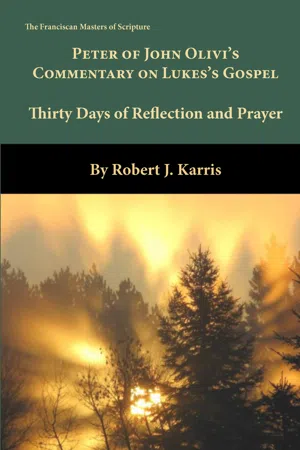
eBook - ePub
Peter of John Olivi’s Commentary on Luke’s Gospel
Thirty Days of Reflection and Prayer
- 72 pages
- English
- ePUB (mobile friendly)
- Available on iOS & Android
eBook - ePub
Peter of John Olivi’s Commentary on Luke’s Gospel
Thirty Days of Reflection and Prayer
About this book
Olivi's commentaries stem mainly from his teaching of Franciscan students in their study houses (studia). Unfortunately only his Commentary on Mark's Gospel has appeared in English translation. Peter of John Olivi's Commentary on Luke is largely focused on its literal sense although his insights are often non-traditional and penetrating. Through this small book, he is presented as a Franciscan biblical interpreter not only to the Franciscan Family, but also to the world at large.
Information
Subtopic
Biblical CommentaryDAY ONE: READ AND MEDITATE ON LUKE 1:26-38
Luke 1:38: “Behold, the handmaid of the Lord.
Be it done to me according to your word.”
Be it done to me according to your word.”
Peter of John Olivi tells us:
The Virgin begins her consent with prompt, humble, and dedicated obedience to God by saying: “Behold, the handmaid of the Lord.” Her consent ends with a devout prayer, regulated by and commensurate to the angel’s annunciation: “Be it done to me according to your word.” By her words she shows that she considers herself small and lowly relative to the high praise heaped upon her. With regard to Christ’s conception which takes place in her by God’s presence and action in her and from her, she shows herself to God as material that is non resistant, docile, and obedient. She is not someone who is in charge, but one who serves. Therefore, she says: “Behold, the handmaid of the Lord,” that is, I present myself to you so that you may do with me whatever pleases you, as a most high lord does with his handmaid. The Virgin presents herself as most open and pleasing to the fecund power and action of the Holy Spirit when she says: “Be it done to me.” With these brief words she encompasses the immensity of the things that are to happen and which a long-winded speech could not explain. Her brevity stems from her deep humility. The rapidity of her consent manifests the alacrity of her desire. Note that by saying “Behold, the handmaid of the Lord,” she intends to humble herself before God. Yet her words give voice to her singular privilege and praise, for she herself is God’s handmaid. Thus, from no creature did God receive or was God to receive so dear, intimate, spontaneous, reverent, loving, precious, and gracious obedience and service, as God did from his mother.
Reflection
Peter of John Olivi had a deep devotion to the Blessed Virgin Mary. He manifested this not only in his inspiring commentary on the Annunciation, but also in his Four Questions of Our Lady. An English translation was privately published in 2000 by Campion Murray, O.F.M. The first question concerns “The Virgin’s Consent to the Annunciation.” I quote in modified form two beautiful passages from this question: “It was impossible for Mary to consent worthily and correctly to be the mother of the Son of God unless she centered, aroused, and opened most fully all the affections of her mind on it…. It meant for her to be deeply rooted in that extraordinary humiliation of Christ which the Son of God wanted to take on, so that by emptying himself, he might become an infant in her womb, subject to pain and about to undergo the most bitter punishments for the sins of all and to show forth to all the model of a crucified life.” “I have no doubt that her consent came from a flaming furnace of love that spilled over into the abyss of divine love.” Peter of John Olivi views Christ’s incarnation largely from Paul’s perspective in Phil 2:5-11: Christ did not grasp miserly his divinity, but humbled himself to become one of us human beings. While early Christian tradition might accentuate Mary as Theotokos, Mother of God, Peter of John Olivi underscores her affections, obedience, love, and humble service.
Prayer
Lord God, how easy it is to recite a Hail Mary and fail to reflect upon the love, courage, openness, and obedience of Mary of Nazareth, who in Luke’s Gospel is the model disciple. Help me to be as open to God’s will as Mary was and to say “Be it done upon me according to your will.”
DAY TWO: READ AND MEDITATE ON LUKE 1:39-45
Luke 1:45: “Blessed is she who has believed that the things
promised her by the Lord will be accomplished.”
promised her by the Lord will be accomplished.”
Peter of John Olivi says:
Elizabeth says: “And blessed is she who has believed,” namely, in God and his messenger who promised ineffable things which were impossible and unbelievable according to nature. “You have believed,” by so extraordinarily great an act and consent that through them you merited to become the mother of God. And therefore, you are “blessed,” since these things will not fail nor will they be prevented from accomplishing their goal. Your Son will obtain the eternal kingdom of God in himself and in his followers. He will be adored and feared as Son of God, almighty God, and Lord of the world. Note how what began with the words from the angel, namely, “blessed are you,” in verse 28 is completed with those same words in verse 45. These words generally and implicitly convey the total sense of the message, openly asserting that the words of this angel were truly and principally from God. Through the evidence of her words Elizabeth clearly demonstrated not only that she knew that the Virgin was the mother of God, but also knew what words the angel had spoken to Mary. Note also that Elizabeth did not say this to the Virgin with the goal of trying to instruct or confirm her in these matters because she undoubtedly knew that the Virgin possessed such knowledge. Rather she said this and the previous things by way of congratulation and commendation. In the Virgin’s canticle of the Magnificat she gives thanks for the gifts given to her which will find final accomplishment and glorify God the giver of all these gifts.
Reflection
Mary’s Visitation of Elizabeth is celebrated liturgically on May 31. Preachers often emphasize that it is a sublime act of kindness by the pregnant Mary towards her elderly pregnant relative Elizabeth. Yet Luke’s account has little to do with the details of the domestic chores from which Mary freed Elizabeth. Rather Luke depicts two women doing theology. In Peter of John Olivi’s commentary theologian Elizabeth gets top billing. She proclaims God’s nature. God has promised ineffable things which were impossible and incredible according to nature. What God has promised will not fail; it will come to completion. God’s kingdom will come in Mary’s son, the Son of God who is almighty God and Lord of the world. Elizabeth congratulates and commends Mary for believing in the promises of her God and for consenting to become the Mother of God. For her part theologian Mary sings her Magnificat, in which she praises and thanks God, the giver of all good gifts. She does not sing her own praises. Rather she points people to the God who characteristically shows mercy, scatters the proud, exalts the lowly, fills the hungry with good things, and sends the rich away empty. God does all this in fidelity to the promises God made to Mary’s and Elizabeth’s ancestors in the faith. Once these theologians have celebrated God’s greatness, Mary leaves. Someone else will take care of the many chores attendant to the actual birth of John the Baptist.
Prayer
Lord God, I marvel at the deep faith of Mary and Elizabeth as they generously respond to your gifts to them. May I be as generous! May I honor all theologians and preachers of your Word! May I ever strive, in word and action, to imitate our God, who exalts the lowly and fills the hungry with good things.
DAY THREE: READ AND MEDITATE ON LUKE 1:67-79
Luke 1:72 says: “He has shown mercy to our ancestors.”
Peter of John Olivi says:
Zechariah’s Benedictus links John’s birth to the promises about Christ that had been made to the patriarchs. God has fulfilled these promises in this birth, and by fulfilling them “he has shown mercy to our ancestors.” Both the promise and its fulfillment stem from the highest grace and mercy of God. Thus he has visited and redeemed us to show mercy to our forebears. By fulfilling these promises, he upheld the covenant of promises entered into and made with them. Thus the text continues: “and mindful.” One uses this verb when one shows by demonstrable action that he has not forgotten the pact previously entered into, but is remembering it. Relative to the oath which he swore to Abraham, our ancestor, God swore that he would give himself to us or he swore that he would give us Christ and salvation. About this latter he will soon add: “so that without fear we might serve him in holiness,” secure from “the hand,” and power, “of our enemies.” Note that in his long prayer Zechariah sets down five things that are necessary for the perfect service and worship of God. The first one deals with enemies or those against us, namely, secure and unimpeded freedom from all hostile impediments. The second deals with worshippers themselves, so that they might show that they themselves are clean and holy for divine worship. The third concerns one’s neighbor, so that they perform no injustice. Rather they render to each one justice or his due. The fourth treats God, so that worship might take place “before him,” that is, not for the sake of human glory, but only for the glory of God. The fifth deals with duration, so that it might be lasting and perpetual, namely, “all our days.”
Reflection
Among contemporary Lukan commentators it is Luke Timothy Johnson who has successfully championed the view that Luke most often does theology via the schema of promise and fulfillment. In Luke 24:44 we find this schema in an abbreviated form as the risen Lord Jesus tells his disciples: “These are the words that I spoke to you while I was yet with you that all things must be fulfilled that are written in the Law of Moses and the Prophets and the Psalms concerning me.” Peter of John Olivi was right on Luke’s wavelength and was famous for seeing how the Old Testament was fulfilled in the New Testament. He often called these relationships “concordances.” But Peter of John Olivi did not waste his time on “concordances” for the sake of speculation and amusement. He realized very early in his life that the God of promises required a life of dedicated worship, justice to one’s fellow men and women, and perseverance, especially when opponents were pounding on his door and forcing him to account for his teachings and life style.
Prayer
Lord God, it is easy to pray to you as the God who fulfills promises when things are sunny and bright. Help me to trust in you when your promises of life, freedom, and loving presence seem mere words and the forces of darkness are assailing me. Open my eyes to see and to live by the example of Abraham, our father in faith, who journeyed with hope in the God who justifies the ungodly. Open my eyes to see Jesus who in his last agony prayed with most profound trust: “Father, into your hands I commend my spirit.”
DAY FOUR: READ AND MEDITATE ON LUKE 2:1-7
Luke 2:1 says: “It came to pass in those days
that a decree went forth from Caesar Augustus
that a census of the entire world should be taken.”
that a decree went forth from Caesar Augustus
that a census of the entire world should be taken.”
Peter of John Olivi says:
Note that the census by imperial edict has a fourfold function. First it shows how all temporal and human matters serve God’s intention. Thus, this census serves God’s will and prophecy that preordained that Christ was to be born in Bethlehem. Second this narrative most certainly fixes the time of Christ’s birth by mentioning the names of the universal emperor and of the first general census of the entire world. Third it was fitting that Christ came at this time when his preaching and that of his disciples could quickly spread throughout the entire world. Fourth this narrative shows the fittingness, nay, the necessity of Christ’s coming at this time. Here are the reasons. The Roman emperor and Roman rule were so deeply subject to idolatry that they not only had their own idols, but also adopted and worshipped the gods of all the peoples they conquered. Thus it was absolutely necessary that the Redeemer come to liberate the elect from such a horrendous dominion. It was also fitting that, according to the prophecy of Daniel 7, the Son of Man should come at this time to obtain the kingdom of God and to subjugate to himself the kingdom of the fourth beast which was stronger than all the other...
Table of contents
- Cover
- Title Page
- Copyright
- Contents
- Introduction
- Day One: Luke 1:26-38
- Day Two: Luke 1:39-45
- Day Three: Luke 1:67-79
- Day Four: Luke 2:1-7
- Day Five: Luke 2:8-20
- Day Six: Luke 2:51 and 2:19
- Day Seven: Luke 3:1-21
- Day Eight: Luke 4:16-30
- Day Nine: Luke 5:27-32
- Day Ten: Luke 6:20-49
- Day Eleven: Luke 7:11-17
- Day Twelve: Luke 9:10-17
- Day Thirteen: Luke 10:1-20
- Day Fourteen: Luke 10:25-37
- Day Fifteen: Luke 10:38-42
- Day Sixteen: Luke 12:13-34
- Day Seventeen: Luke 15:1-31
- Day Eighteen: Luke 16:1-15
- Day Nineteen: Luke 16:19-31
- Day Twenty: Luke 17:11-19
- Day Twenty-one: Luke 18:9-14
- Day Twenty-two: Luke 18:31-19:10
- Day Twenty-three: Luke 19:1-10
- Day Twenty-four: Luke 21:34-36
- Day Twenty-five: Luke 22:7-30
- Day Twenty-six: Luke 23:26-38
- Day Twenty-seven: Luke 23:39-43
- Day Twenty-eight: Luke 23:44-56
- Day Twenty-nine: Luke 24:13-35
- Day Thirty: Luke 24:50-53
- Reference Table
- Footnotes
Trusted by 375,005 students
Access to over 1.5 million titles for a fair monthly price.
Study more efficiently using our study tools.
Frequently asked questions
Yes, you can cancel anytime from the Subscription tab in your account settings on the Perlego website. Your subscription will stay active until the end of your current billing period. Learn how to cancel your subscription
No, books cannot be downloaded as external files, such as PDFs, for use outside of Perlego. However, you can download books within the Perlego app for offline reading on mobile or tablet. Learn how to download books offline
Perlego offers two plans: Essential and Complete
- Essential is ideal for learners and professionals who enjoy exploring a wide range of subjects. Access the Essential Library with 800,000+ trusted titles and best-sellers across business, personal growth, and the humanities. Includes unlimited reading time and Standard Read Aloud voice.
- Complete: Perfect for advanced learners and researchers needing full, unrestricted access. Unlock 1.5M+ books across hundreds of subjects, including academic and specialized titles. The Complete Plan also includes advanced features like Premium Read Aloud and Research Assistant.
We are an online textbook subscription service, where you can get access to an entire online library for less than the price of a single book per month. With over 1.5 million books across 990+ topics, we’ve got you covered! Learn about our mission
Look out for the read-aloud symbol on your next book to see if you can listen to it. The read-aloud tool reads text aloud for you, highlighting the text as it is being read. You can pause it, speed it up and slow it down. Learn more about Read Aloud
Yes! You can use the Perlego app on both iOS and Android devices to read anytime, anywhere — even offline. Perfect for commutes or when you’re on the go.
Please note we cannot support devices running on iOS 13 and Android 7 or earlier. Learn more about using the app
Please note we cannot support devices running on iOS 13 and Android 7 or earlier. Learn more about using the app
Yes, you can access Peter of John Olivi’s Commentary on Luke’s Gospel by Robert J. Karris, Ofm in PDF and/or ePUB format. We have over 1.5 million books available in our catalogue for you to explore.