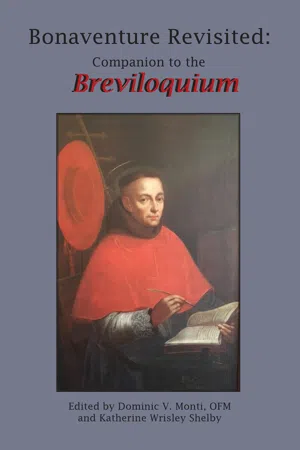
The goal of this collaborative commentary on Bonaventure's Breviloquium is twofold. First, it aims to make the text of the Breviloquium itself more accessible to a wider udience, including those who have had no prior introduction to the Seraphic Doctor's theology. In addition to providing substantive theological commentaries on each of the Breviloquium's seven parts, as well as the text's Prologue, essays also consider the theological and historical contexts that shaped the text with respect to both its composition and reception. Second, in so doing, this Companion to Bonaventure's short theological summa also aims to provide an introductory window into his systematic theology in a more general way, using the topics treated by the Seraphic Doctor within the Breviloquium as an entrée into key aspects of his thought, such as his Trinitarian theology, Christology, and Eschatology, as well as his teachings on creation, sin, grace, and the sacraments. The project is the fruit of an ongoing conversation between a community of emerging and established Bonaventurean scholars, who hope through it to shed light upon the historical significance and enduring theological legacy of the Breviloquium.
eBook - ePub
Bonaventure Revisited
Companion to the Breviloquium
- 334 pages
- English
- ePUB (mobile friendly)
- Available on iOS & Android
eBook - ePub
About this book
Information
Topic
Theology & ReligionSubtopic
TheologyTHE PROLOGUE TO THE BREVILOQUIUM
CATHERINE A. LEVRI
The Prologue to the Breviloquium, alongside Bonaventure’s inaugural sermon Omnium artifex docuit me sapientia, provides his richest and most detailed reflection on the nature of Scripture.1 Scripture is at the center of medieval theology as its inspiration and authority. Not only was it an essential part of the university curriculum and a constant topic of study, but it also formed medieval theologians through the words of the liturgy. Bonaventure says that the mysteries of Scripture can be used to create “a tabernacle in the heart” “within which is placed the Ark, that is, Christ, containing in Himself all the treasures of wisdom and of knowledge, upon whom the Cherubim gaze.”2 As such, because it examines Scripture itself, the Prologue of the Breviloquium offers unique insight into the heart of Bonaventure’s theology.
The Prologue has long been a subject of a debate concerning its relation to the more systematic sections of the Breviloquium.3 At first glance, it seems to be utterly distinct from the rest of the work. First, the Prologue differs in form from the body of the treatise. Parts I-VII each begin with a reference to the primum principium, or the First Principle, while the Prologue begins with a Scriptural citation, Ephesians 3:14-19. The Prologue also differs in content from the rest of the work. It studies the nature of Scripture, while the remainder of the text studies seven topics of theology. Finally, J. Guy Bougerol suggests that the Prologue differs in purpose from the rest of the text. While the body of the Breviloquium was written to “show the masters that the whole of revealed doctrine is contained in Scripture,” the Prologue, Bougerol says, was given to “remind these students of the prime importance of Scripture.”4 Despite these differences, however, the Prologue and body form a unified and coherent work. This chapter will explore the genre and theological themes of the Prologue and, in doing so, attempt to show the unity between the Prologue and the rest of the Breviloquium. Introductory chapters are common in medieval texts, and they differ from the bodies of their texts due, in part, to their genre. The genre dictates both content and style. At least by the mid-thirteenth century, prologues, and the closely related genre of prooemia, could be identified and differentiated from other similar genres (for example, principia and sermons) by a unique set of formal characteristics (although these characteristics were not rigidly fixed).5 Generally, prologues are introductions to non-scholastic texts. They usually explain the reason for the work and what the reader may need to know before approaching the rest of the work. Prologues are often more stylized and rhetorically rich. The content and style of the Prologue to the Breviloquium generally shares those characteristics. As a result, one useful way to approach the Breviloquium’s Prologue is to approach it according to that genre.
I. APPROACHING THE TEXT
THREE FUNCTIONS OF A THEME IN A MEDIEVAL PROLOGUE
One important characteristic of the medieval prologue is the use of a theme, or a Scriptural verse given at the beginning of the prologue. Given the copious and sometimes apparently random use of Scripture in medieval texts, the modern reader may be tempted to disregard these themes as pious platitudes or as a necessity demanded by the form but otherwise meaningless. To do so, however, is to lose an important context for the work. Especially for Bonaventure, these themes are essential to understanding his writings. He chooses them carefully, and they not only inaugurate the reader into a work of theology through the words of God, but they also play a role in the text itself.
These themes perform three important functions for Bonaventure’s texts. First, the theme summarizes the content of the prologue and often the rest of the work. Second, the theme provides the structure or form of the prologue. Third, the theme affectively prepares the reader for the work as a whole. Since themes are so entwined with the text of their prologues, by examining them closely, we may gain a better understanding of the genre of prologues with a minimum of time, effort, and ink. Accordingly, we will examine the three functions of themes in three of Bonaventure’s prologues. We may then profitably consider the Breviloquium’s Prologue and how it should be read.
The theme often summarizes or previews the content of the prologue and the rest of the work.6 The Soliloquium, one of Bonaventure’s longer non-academic texts, is particularly useful to consider because it uses the same theme as the Breviloquium, Ephesians 3:14-19:
For this reason I kneel before the Father of our Lord Jesus Christ, from whom all fatherhood in heaven and on earth is named, that he may grant you in accord with the riches of his glory to be strengthened with power through his Spirit in the innermost self, and that Christ may dwell in your hearts through faith; that you, rooted and grounded in love, may be able to comprehend with all the holy ones, what is the length, breadth, height, and depth, and to know also the love of Christ that surpasses knowledge, so that you may be filled unto all the fullness of God.7
In this verse, Bonaventure says, Paul reveals “the origin, the object, and the fruit of exercising our mental powers [mentalis exercitatio],” or contemplation.8 Bonaventure discusses each of these briefly in his prologue to the Soliloquium. The origin of contemplation is the Blessed Trinity (each person is referenced by name in the theme), the object is the four areas the soul must contemplate (itself; the world; death, judgment, and hell; and heaven, corresponding to Paul’s length, breadth, height, and depth), and the fruit of contemplation is eternal peace in heaven (Paul’s “fullness of God”). Bonaventure concludes his prologue by calling his readers to prayer. The Soliloquium’s theme, then, contains the content of the prologue, which studies the origin, object, and fruit of contemplation. It also summarizes the rest of the text, which follows the four areas of contemplation in order to reach “the heights of contemplation,” as Bonaventure describes it, alongside the apostle and the saints.9
The theme also previews the structure of the prologue and sometimes the entire work. Perhaps the most famous example of this is found in De triplici via, which teaches the soul how to be ordered and so reach perfect charity. Its theme is from Proverbs: “Behold, I have described it [the teaching of the wise man] for you in a threefold way…”10 This prologue is thus divided into three parts, each of which have three elements. Because “all forms of knowledge bear the insignia of the Trinity,”11 the spiritual senses of Scripture are three: moral, allegorical, and anagogical. There are likewise three acts the soul must undergo: purgation, illumination, and perfection. To attain the fruits of these acts, the soul must do three things: meditate, pray, and contemplate. The body of the text follows these last three actions, treating meditation, prayer, and contemplation, usually in a triple pattern.
Perhaps the most important characteristic of prologues is their purpose: to prepare the reader for the rest of the text. We have seen how the theme previews the content and structure of both the prologue and the work as a whole. This is a skilled pedagogical method; students prepared for the material they are about to hear are better able to learn and remember the material. However, the theme not only prepares the reader intellectually, but perhaps more importantly, it also prepares the reader affectively. Because the task of theology for Bonaventure is ultimately a contemplative and moral activity, it demands a proper disposition. By immediately invoking the words of the Holy Spirit in his themes, Bonaventure places the reader in the presence of the object of our contemplation and the source of all goodness. We see this in his short work, On the Perfection of Life, written in response to a request from the abbess of a community of Poor Clares. She wanted Bonaventure to give some spiritual guidance to her community. Bonaventure’s response is contained in his theme, “Blessed is the person whom you will instruct, O Lord, and whom you will teach by your law,” from Psalm 94.12 The verse gives an immediate answer to the abbess: seek guidance not from human instruction but from the Holy Spirit, who gives the law. The letter culminates in a meditation on the eternal blessedness awaiting the soul who has been instructed by God. From the very start, then, Bonaventure exhorts the Poor Clares to seek divine instruction and provides this very instruction in his theme.
Prologues’ themes thus provide the material, formal, and final causes of the prologues they introduce. They prepare the reader intellectually and affectively for the prologue. Additionally, Bonaventure sometimes uses them to preview the body of the work. While the theme of the Prologue to the Breviloquium is not obviously related to the main chapters, a careful study of it suggests that the Prologue and the chapters are not as unrelated as they may seem.
II. INTERPRETING THE TEXT
THE THEME
For this reason I bow my knees before the Father of our Lord Jesus Christ, from whom every fatherhood in heaven and on earth takes its name, that he would grant you, according to the...
Table of contents
- Cover Page
- Title Page
- Copyright Page
- Table of Contents
- Foreword
- Introduction
- The Historical Context of the Breviloquium
- The Text of the Breviloquium
- The Legacy of the Breviloquium
- Notes on Contributors
- Index
Trusted by 375,005 students
Access to over 1.5 million titles for a fair monthly price.
Study more efficiently using our study tools.
Frequently asked questions
Yes, you can cancel anytime from the Subscription tab in your account settings on the Perlego website. Your subscription will stay active until the end of your current billing period. Learn how to cancel your subscription
No, books cannot be downloaded as external files, such as PDFs, for use outside of Perlego. However, you can download books within the Perlego app for offline reading on mobile or tablet. Learn how to download books offline
Perlego offers two plans: Essential and Complete
- Essential is ideal for learners and professionals who enjoy exploring a wide range of subjects. Access the Essential Library with 800,000+ trusted titles and best-sellers across business, personal growth, and the humanities. Includes unlimited reading time and Standard Read Aloud voice.
- Complete: Perfect for advanced learners and researchers needing full, unrestricted access. Unlock 1.5M+ books across hundreds of subjects, including academic and specialized titles. The Complete Plan also includes advanced features like Premium Read Aloud and Research Assistant.
We are an online textbook subscription service, where you can get access to an entire online library for less than the price of a single book per month. With over 1.5 million books across 990+ topics, we’ve got you covered! Learn about our mission
Look out for the read-aloud symbol on your next book to see if you can listen to it. The read-aloud tool reads text aloud for you, highlighting the text as it is being read. You can pause it, speed it up and slow it down. Learn more about Read Aloud
Yes! You can use the Perlego app on both iOS and Android devices to read anytime, anywhere — even offline. Perfect for commutes or when you’re on the go.
Please note we cannot support devices running on iOS 13 and Android 7 or earlier. Learn more about using the app
Please note we cannot support devices running on iOS 13 and Android 7 or earlier. Learn more about using the app
Yes, you can access Bonaventure Revisited by Dominic Monti, OFM,Katherine Wrisley-Shelby in PDF and/or ePUB format, as well as other popular books in Theology & Religion & Theology. We have over 1.5 million books available in our catalogue for you to explore.