Why am I on this planet? How do I lead a meaningful and purposeful life?These might seem like strange questions to ask in a book exploring the Franciscan Intellectual Tradition. In fact, however, these questions are not irrelevant to the Franciscan Intellectual Tradition. You may have asked yourself these or other similar "big questions of life": What happens when we die? Is there a God? If so, how do I find God? What makes something good and something else bad? Why do good people suffer?Humans have been asking these types of questions since humans have existed. In fact, asking these questions of ultimate concern is part of what makes us human. Throughout time, different people have approached these issues differently and come to their own conclusions. Furthermore, people from all different backgrounds continue to wrestle with these important life issues. Many people today are finding that different contemporary worldviews are not offering satisfactory answers to questions of ultimate meaning. In this book, we will examine how the particular approach called the Franciscan Intellectual Tradition has engaged questions of ultimate human concern. This Franciscan Intellectual Tradition is the framework used by those who have been influenced by the life of St. Francis of Assisi (1181-1226) as they have wrestled with the big questions of life. This book will offer a fuller description of the Franciscan Intellectual Tradition as we proceed.
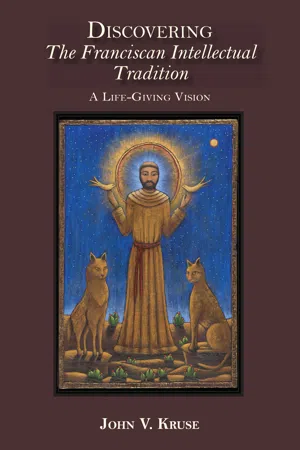
- 90 pages
- English
- ePUB (mobile friendly)
- Available on iOS & Android
eBook - ePub
About this book
Information
Topic
Theology & ReligionSubtopic
Christian TheologyCHAPTER 1 – FOUNDATIONS OF A TRADITION:
THE LIVES OF FRANCIS AND CLARE
You may have heard of St. Francis, you may have seen a statue of him in a garden, and you may have asked yourself what this saint often associated with animals who lived hundreds of years ago could possibly have to do with your own life. This is an important question to ask. In some senses, the world of Francis and his friend Clare was very different from our own. Clearly, the world has changed considerably in 800 years. Yet, in other ways, the world of Francis and Clare was quite similar to our own. Francis and Clare lived in a time in which society was going through substantial changes. Their world was plagued by wars resulting from class tensions, political struggles, and even religious differences. Furthermore, Francis and Clare lived in a world that expected them to fit into certain categories and to fulfill certain preconceived roles without making too many waves within the way things were.
THE LIVES OF FRANCIS AND CLARE
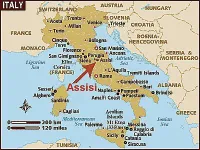
In order to understand the Franciscan Intellectual Tradition (FIT), we have to know about the lives of Francis and Clare, the lives on which the FIT is based. Francis was born in 1181 in Assisi, a small city in central Italy.
Prior to this period, there were basically two social classes: the landowning nobility (the majores) and the working lower class (the minores). Around the time of Francis, a new social class was beginning to emerge from within the minores: the merchant (or business) class. These commoners began to advance their social position through their involvement in the commerce that was rapidly increasing in Europe at the time. Francis was born into such a merchant family. His father was a cloth merchant of considerable wealth. As a young man, Francis was very popular among his peers and seemed to have been somewhat of what we might call a “partier” today. He definitely enjoyed having a good time with his friends and found his greatest pleasures in the material aspects of life.
However, Francis began to undergo a process of conversion that challenged this rather superficial approach to life. When Francis was a young man, a war developed between Assisi, controlled by its merchant class, and the neighboring city of Perugia, controlled by members of the nobility. As was expected of one his age, Francis eagerly took part in the battle. In the course of the war, Francis was captured and taken prisoner of war. During his time of imprisonment, he became quite ill. Sick, imprisoned, and cut off from contact with the outside world, Francis had much time to think about the world in which he lived and the direction of his life. This time of reflection and the experience of being an ill prisoner of war was clearly significant in his personal conversion.
Upon being freed from prison, Francis still had aspirations of becoming a knight, which was the most revered and heroic pursuit a member of his social class could possibly undertake at that time, as it brought him closer to the nobility. Becoming a knight was not cheap. The armor for such a position was expensive and would have to have been paid for by his father. As Francis went off to join the military forces, he is said to have had a dream in which he heard a voice ask him if he would rather serve the servant or the master (i.e., would he rather serve other humans or would he rather serve God). Francis chose serving the master (God) and asked what he should do. The voice in the dream instructed Francis to return to Assisi to follow God’s command. It is said that he gave his expensive military armor to a man who was too poor to afford it and returned to Assisi.2
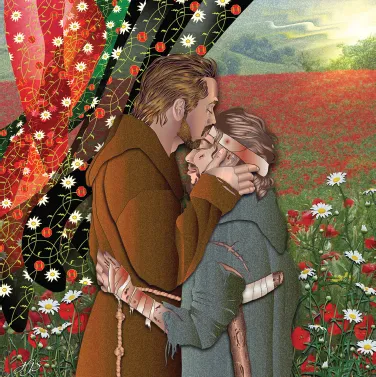
At this time in his life Francis was beginning to withdraw more from his friends and spend more time wandering and thinking in the fields and forests surrounding Assisi. He was not finding as much pleasure and fulfillment in “worldly” things, such as celebrating with his friends, as he once did. He was looking for deeper meaning and purpose in his life. There was one particular event that had special significance in his life and his process of conversion. As has been noted, Francis enjoyed the “good life” of the merchant class and associating with his social peers. There was one group of people, however, that he found to be particularly repulsive: lepers, those who suffered from the disease commonly known as leprosy. Lepers experienced the rotting of their flesh and perhaps even the eventual loss of body parts. The stench associated with leprosy would have been horrific. Lepers, the lowest of the low among the lower-class minores, were ostracized by society and forced to live apart in their own communities; they were required to make noise with bells or wooden clappers to let those without leprosy know that “unclean people” were approaching. In his early life, Francis wanted to have nothing to do with lepers and would go far out of his way to avoid them. At one point, however, he did something startling when he saw a leper. Rather than avoid the leper, Francis descended from his horse to embrace the leper. In his own words, he states, “The Lord gave me, Brother Francis, thus to begin doing penance in this way: for when I was in sin, it seemed too bitter for me to see lepers. And the Lord Himself led me among them and I showed mercy to them. And when I left them, what had seemed bitter to me was turned into sweetness of soul and body.”3 This clearly was a life-changing experience. He found the genuine joy and fulfillment that comes from entering into the suffering of the marginalized and rejected. Francis had found God revealed among the poor and lowly of the world and later often ministered to (or “served”) lepers.
As Francis sought to find deeper meaning in his life through an ever-intensifying relationship with God, he often prayed in churches in and around Assisi. Some of these churches were falling into disrepair. Yet another significant event in his overall process of conversion occurred when he was praying in the church of San Damiano just outside of the walls of Assisi.
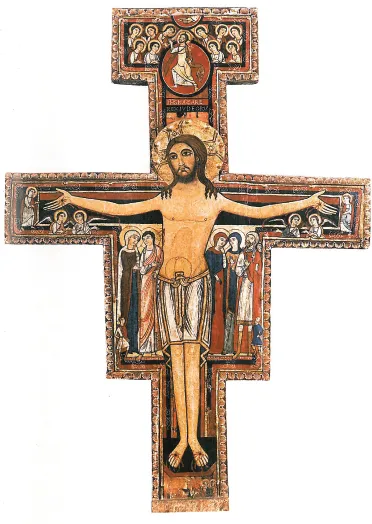
While he was at prayer before a crucifix in the church, he heard Jesus speak, “Francis, don’t you see that my house is being destroyed? Go, then, and rebuild it for me.”4 Francis at first took this command literally to mean that he should work at rebuilding the dilapidated church of San Damiano. It was only later in his life that he realized that Jesus was calling him to rebuild or reform God’s real dwelling place: the People of God. His repair of the church of San Damiano and other churches in and around Assisi, however, required money for building materials. He obtained this “funding” through selling cloth materials that belonged to his father, Pietro di Bernadone. Eventually, Francis’ father could no longer tolerate the behavior of his son who appeared to be growing increasingly irrational and deranged. After bringing Francis before the bishop of Assisi, who was to act as a judge, and before the people of Assisi, Francis’ father demanded that his son return all that he had taken from him. In an act of deep symbolic significance, Francis stripped himself naked and handed his clothing over to his father as he said, “Until now I have called you father here on earth, but now I can say without reservation, ‘Our Father who art in heaven,’ since I have placed all my treasure and hope in him.”5 Francis had completely turned his back on a world of wealth and privilege in order to devote himself entirely to the service of God.
Francis set out to live a life of absolute poverty. He had no actual home but lived in caves or in the countryside. With no possessions that he could call his own, he lived off of the land, working as a day laborer or begging for food and other basic necessities. He wanted nothing that could interfere with his relationship with God. He was open to going wherever God called him and serving God’s people in whatever ways God wished, which at this time mainly involved ministering to the lepers or rebuilding small country chapels. He lived in total recognition of his utter dependence on God. While some people considered Francis a madman because of his radical lifestyle, others were impressed by his complete abandonment to God and, seeking to experience the joy and peace that Francis experienced, began to follow him in his way of life. By 1209 there were twelve of them. Desiring to serve as traveling preachers beyond the immediate area of Assisi, they went to Rome to seek approval of their way of life from the Pope. Francis and his “Lesser Brothers” settled below Assisi, at a chapel near the hospices for lepers called the “little portion” (Portiuncula) that was dedicated to St. Mary of the Angels.
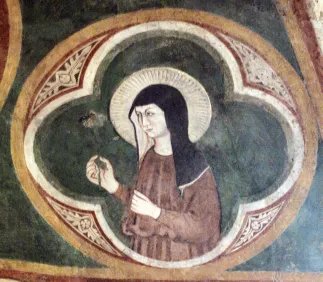
At first Francis’ followers were men, but in 1212 Clare di Favarone (1194-1253), the daughter of a noble family, decided to embrace his life of complete poverty as well. As a noble woman, Clare was expected to marry a member of another noble family so as to increase the power and prestige of her own family or to become a nun in an established form of religious life. However, after conversations with Francis and much to her family’s dismay, on the evening of Palm Sunday, 1212, Clare snuck out of her home in the upper area of Assisi and descended down the slopes of Mount Subasio into the valley below Assisi to the Portiuncula. Here Clare assumed the garment of beggars that was worn by Francis and his brothers. Francis also cut Clare’s hair as a sign of her total surrender to God, renunciation of the values of society, and embrace of Francis’ life of complete poverty. As a woman living in the medieval period, social conventions absolutely prevented Clare from living with Francis and his brothers. Eventually, Clare settled in the church of San Damiano where Francis had originally heard Jesus’ call to go rebuild his house. There she established a monastery for women who chose to follow her in living Franciscan poverty. Clare and her “sisters” owned nothing and did not even have the “luxury” of being able to roam about to beg for food and other needs as Francis and his brothers could. Rather, Clare and her sisters were absolutely dependent on God to provide for them through a small garden that they tended and through the generosity of others, including Francis and his brothers. While Francis and his brothers were actively engaged with the world around them through service to the sick and poor and through preaching, Clare and her sisters expressed a more contemplative6 dimension of Franciscan spirituality through lives dedicated to prayer and service to each other while also responding to the needs of the community outside of the monastery of San Damiano to the degree that they were able.
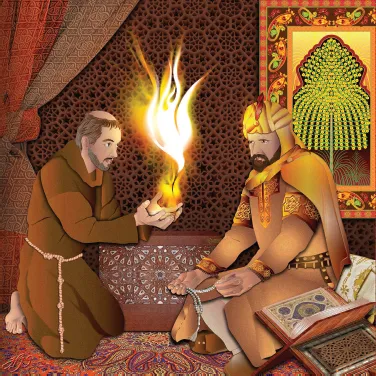
As part of his active engagement with the world, Francis set out to join the Fifth Crusade in Egypt in 1219. The crusades were a long series of wars spearheaded by Christians to retake the Holy Land (the land of the Bible and of Jesus) from Muslims who had occupied it in the 7th century. Francis witnessed the atrocities of war in Egypt and was shocked by the brutality of the crusaders. In a desperate attempt to try to bring an end to the senselessness of the fighting, Francis courageously (or, some might think, foolishly) set out across enemy lines in order to meet with the Sultan of Egypt, Malik-al-Kamil, who led the Muslim forces. Surprisingly, when Francis was apprehended by Muslim soldiers as he crossed enemy lines, they did not kill him on the spot. When Francis asked to see the Sultan, they, perhaps in a state of disbelief, took Francis to see him. Francis explained to the Sultan the reasonableness and what he saw as the rightness of his own Christian faith. The Sultan respectfully listened. The Sultan also explained the reasonableness and what he saw as the rightness of his own Islamic faith. Francis respectfully listened. In short, the two men entered into a respectful dialogue with each other. Each was impressed by the sincerity and genuine goodness of the other. While neither man adopted the faith of the other, they both left forever changed as a result of their meeting and with a new found respect for the faith of the other.
When Francis returned to Assisi from the Fifth Crusade, he was in an increasingly poor state of health. In addition to chronic illness, Francis also suffered deeply personal ...
Table of contents
- Cover Page
- Title Page
- Copyright Page
- Table of Contents
- Acknowledgments
- Introduction: Asking Questions of Ultimate Human Concern
- Chapter 1 – Foundations of a Tradition: The Lives of Francis and Clare
- Chapter 2 – A Tradition Develops: Main Figures and Key Characteristics
- Chapter 3 – So What?: Why the Franciscan Intellectual Tradition Matters
- Conclusion
- Endnotes
- Selected Bibliography
- Photo Credits
Trusted by 375,005 students
Access to over 1.5 million titles for a fair monthly price.
Study more efficiently using our study tools.
Frequently asked questions
Yes, you can cancel anytime from the Subscription tab in your account settings on the Perlego website. Your subscription will stay active until the end of your current billing period. Learn how to cancel your subscription
No, books cannot be downloaded as external files, such as PDFs, for use outside of Perlego. However, you can download books within the Perlego app for offline reading on mobile or tablet. Learn how to download books offline
Perlego offers two plans: Essential and Complete
- Essential is ideal for learners and professionals who enjoy exploring a wide range of subjects. Access the Essential Library with 800,000+ trusted titles and best-sellers across business, personal growth, and the humanities. Includes unlimited reading time and Standard Read Aloud voice.
- Complete: Perfect for advanced learners and researchers needing full, unrestricted access. Unlock 1.5M+ books across hundreds of subjects, including academic and specialized titles. The Complete Plan also includes advanced features like Premium Read Aloud and Research Assistant.
We are an online textbook subscription service, where you can get access to an entire online library for less than the price of a single book per month. With over 1.5 million books across 990+ topics, we’ve got you covered! Learn about our mission
Look out for the read-aloud symbol on your next book to see if you can listen to it. The read-aloud tool reads text aloud for you, highlighting the text as it is being read. You can pause it, speed it up and slow it down. Learn more about Read Aloud
Yes! You can use the Perlego app on both iOS and Android devices to read anytime, anywhere — even offline. Perfect for commutes or when you’re on the go.
Please note we cannot support devices running on iOS 13 and Android 7 or earlier. Learn more about using the app
Please note we cannot support devices running on iOS 13 and Android 7 or earlier. Learn more about using the app
Yes, you can access Discovering the Franciscan Intellectual Tradition by John Kruse in PDF and/or ePUB format, as well as other popular books in Theology & Religion & Christian Theology. We have over 1.5 million books available in our catalogue for you to explore.