This book about Mendicant women outside the cloister is unique in its content. Rose of Viterbo, Angela of Foligno, Margaret of Cortona, and Sancia, Queen of Naples, were all born within the first century of the Franciscan Order. As women who pursued their religious vocation of voluntary poverty, itinerancy, and preaching outside of monastic walls—in the streets and in their homes—they could very well be called the first generation of mendicant women.
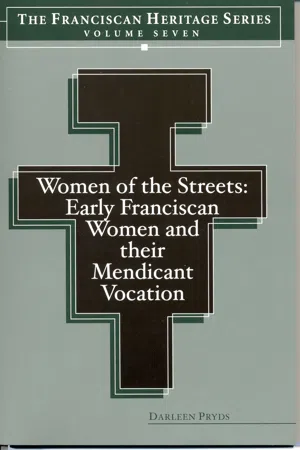
- 96 pages
- English
- ePUB (mobile friendly)
- Available on iOS & Android
eBook - ePub
About this book
Information
Topic
Theology & ReligionSubtopic
ReligionCHAPTER ONE
WOMEN AND THE MENDICANT TRADITION
What do the following women have in common: a willful teenage girl; a married woman in the midst of a mid-life crisis; an unmarried woman, who was left alone and socially alienated after the death of her long-time live-in lover; and a prayerful queen who shunned her “duty” to bear children? They were all laywomen who embraced a religious quest by imitating the life of Francis of Assisi in the frst few generations after the saint’s death in 1226. By following the Franciscan vocation of poverty and itinerancy, these laywomen transgressed their respective social and cultural positions, especially with regard to their gender. Rose of Viterbo (d. 1251), Angela of Foligno (d. 1309), Margaret of Cortona (d. 1297), and Sancia of Naples (d. 1352) stand out among the lay Franciscan women of their time having gained fame for their lifestyles. But how many people have heard about them today? Despite their respective fame among their medieval contemporaries, why have their stories of religious conviction and perseverance been generally neglected and remain largely unknown?
Part of the answer to this question lies in the fact that these women pursued their religious calling within the broader mendicant movement, that is the movement that grew out of the twelfth century tradition of itinerancy, preaching, and voluntary poverty as a way of life.2 Since the beginning of mendicancy as a religious calling, this form of vocation has been deemed daring and admirable for men, but inappropriate for women. While the religious vocation of Francis of Assisi captured the imagination of thousands of men who left their families and followed his lead to become a mendicant friar in the early thirteenth century, women who were similarly moved by Francis’s dedication to apostolic poverty and who experienced the same desire to follow in his footsteps were usually hindered by social, legal, and moral rules forbidding women to live an unsheltered and unprotected life. When women felt a similar call to mendicancy, the choice presented to them looked very different from Francis’s own life of itinerant preaching and intense periods of solitary contemplation. For most early Franciscan women, the desire to follow in Francis’s footsteps as a wandering preacher and beggar led them by cultural default to accept a vocation to follow in Clare’s footsteps into the enclosed world of the convent. Many of these women who were inspired by Francis or by the friars, no doubt, found a satisfying spiritual home within the cloistered walls. But, some women forged ahead and embraced mendicant life not as nuns in habits inside monasteries, but as laywomen in urban streets and homes. These women followed their Franciscan call by embracing poverty, by offering works of charity to their peers, and by preaching and teaching. This book gives a brief introduction to their stories by exploring how four different women took to the streets to live out their religious vocations by embodying Franciscan ideals.3 These women, then, can be seen to represent the embodied theology of the lay Franciscan movement.
CHARISMATIC WOMEN FOLLOWING A CHARISMATIC PATH
Today notions of the Franciscan tradition often zero in on the individual charismatic founder of the movement, Francis of Assisi. Images of Francis commonly emphasize a gentle man talking to birds or an impassioned youth renouncing parental control by stripping off his clothes in the town square as a bold statement of his religious vocation. His charismatic expressions of faith still appeal to us today, so that it is not diffcult for us to imagine how he would have attracted the attention of his contemporaries.4 By the time Francis died in 1226, his followers had grown in numbers to such an extent that it was easy to identify the existence of an established order of friars.5
While Francis was certainly charismatic, and the success his order experienced in recruiting new members can in large part be attributed to his personal magnetism, it would be inaccurate to assume that what Francis and his followers did had been unique or unprecedented. Contemporary admirers found in the growing band of friars a group that modeled the religious idealism of the day: the vita apostolica, or the apostolic life. The vita apostolica was more than a mere fad, but it would be an overstatement to call it an actual “movement,” if one were to mean by that an organization of adherents following some coherently articulated agenda. If one were to have in mind something as nebulous and as broad as “the peace movement” of the 1960s in the United States, one could imagine the same kind of movement made up of various local groups with a broad appeal and general adherence to similar aspirations and ideals, but with no formal or even loose organization. In the case of the vita apostolica, the shared ideal was based on defning and living the Christian life as one in direct imitation of Jesus and his original apostles especially with regard to poverty and itinerancy.6 Such a life implied a religious vocation that was lived out in the streets in public without any of the institutional trappings and political complexities of the contemporary Church. The friars were public fgures, and embodied this new model of religious life – one that was in and part of the world, not separated from the world by a monastery wall.
The very public nature of the friars’ vocation raised immediate problems for women wishing to participate in this new form of religious life. The social norms for thirteenth century western European women allowed for some public roles for women, especially for middle class women in cities where their increasing participation in growing urban businesses was rather common. But public speech and itinerant travel, both of which were part of the friars’ life, were unbecoming and usually forbidden to women of any class or social rank.7 Women who dared to speak in public, even when their speech was religious or pious discourse, were generally assumed to be promiscuous.8
How, then, could devout, faith-filled women adopt the Franciscan life as their own? Traditionally, scholars have answered this question by looking immediately to Clare and her order. Clare, it has been understood, offered the feminine form of the Franciscan life, since she, herself, had been the frst woman to try to follow Francis. When she fed from her family on Palm Sunday in 1212, she made her own religious commitment in front of Francis, who cut her hair and invested her with clothes of poverty.9 Clare embraced her own mendicant call and adapted it to a cloistered model of religious vocation.10 She initially took up residence in a series of Benedictine convents, until she and her own small group of followers could settle at San Damiano, just outside the Assisi, where they developed a form of the Franciscan life within monastic walls.
Traditionally this monasticizing of Clare and her vocation has been interpreted by scholars as the necessary act of recourse required to secure Clare’s safety and to insure the reputation of the friars. Given medieval mores on gender relations, Clare’s presence within Francis’s circle of followers would have caused scandal for the friars and would have created a risky, or even perilous, situation for Clare.11 More recently, scholars have endeavored to show Clare’s self-determination in her vocational choices.12 Regardless of the contextual interpretation one accepts, it remains true that Clare’s life as a Franciscan was a life lived out primarily within monastic walls as a cloistered sister with timely, dramatic forays outside. As Margaret Carney summarizes, “[Clare] dared to synthesize the evangelical ideals of Francis, the new forms of urban female religiosity, and the best wisdom of the monastic tradition to create a new and enduring order in the Church.”13
This monastic form of the feminine expression of the Franciscan charism was not the only way women followed in Francis’s steps, however. In fact, many women were inspired by stories heard about Francis, and thereby sought to follow in his footsteps outside a monastic compound by remaining in their own homes. Both men and women felt called by this lay form of religious vocation, and adopted a Franciscan way of life by remaining with their families in their homes as lay Franciscans who were called “penitentials” by contemporaries.14 This lay movement was not directly founded by Francis nor did it begin as an offcially sanctioned lay alternative to his form of vowed religious life. But as the Franciscan movement expanded, the friars indirectly inspired without actively promoting, the growth of the lay penitential movement. The women discussed here in this book are part of this larger lay penitential movement that included men.
GROUNDBREAKING PRECEDENT:
THE VITA APOSTOLICA AND THE RISE OF MENDICANCY
THE VITA APOSTOLICA AND THE RISE OF MENDICANCY
While there are original aspects to Francis and the order he founded, his dedication to the apostolic life, especially with regard to embracing poverty and taking up an itinerant life were not unprecedented. In the century prior to Francis’s conversion around 1206, there are several documented cases of other middle class and aristocratic men who had abandoned the material comforts of their lives to take up a form of religious life not confned by monastic walls. The most famous of these was Peter Waldo, the founder of the group known as the Waldensians. The vita apostolica, or “apostolic life movement” of the twelfth century developed just as people were moving to cities within Western Europe and long distance trade was contributing to economic prosperity. Along with these economic developments came higher literacy rates among western Europeans, which contributed to an overall fourishing of a cosmopolitan fair to the region.15 In part a spiritual response to this growing prosperity, and in part a widespread call for religious reform, the vita apostolica attracted lay people who tried as best they could to imitate the lives of the apostles. They eagerly sought out Scripture that could be read in the vernacular, and met in groups to talk about faith and to learn more about the lives of the original followers of Christ. They placed secondary importance on material wealth and instead followed a counter-cultural path of material simplicity. Because they sought a life of penance, they were known as “Penitents” and their groups were called “Penitentials.”16
The eventual creation of a Third Order, or an order of lay affliates to the Franciscan Order, grew out of this preceding penitential movement during the thirteenth century, albeit with some reticence on the part of the friars. The important precedent to note is the prior existence of the Penitentials. In fact one could claim that it was the penitential movement that had originally inspired Francis himself, and that it was his creation of a modifed, vowed form of the penitential life that became the order of Friars Minor that eventually furthered the lay movement and ultimately led to its regularization with institutional structures and requirements.17
Not surprising, then, ever since the time of Francis, himself, there were some women who were attracted to his way of religious life and sought ways to adopt the mendicant life for themselves, either as “freelance” female mendicants or, more commonly, by affiliating with the friars as “hangers-on.” But it was precisely this affliation with the friars that caused tensions and problems. Francis had been reticent to accept women followers, as is evidenced by his preference for Clare to create a cloistered form of life for women. While Francis may have appreciated the religious fervor of his lay followers – both men and women – he never demonstrated interest in promoting any offcial affliation of lay people to his order.18
Some friars who followed Francis proved to be colder to and even more wary of lay affliation. An anonymous autor from the late thirteenth century made the case against lay affliation in an academic treatise entitled, “Why the Brothers Should not Promote the Order of Penitents.”19 High on the list of reasons not to get involved with lay people in general but especially with laywomen, was the belief that the friars would lose their freedom if there were an offcial relationship developed with laity and the Order. The friars could become embroiled in legal disputes involving lay affliates that could have fnancial or material repercussions. The author was especially wary of friars involving themselves with women. For example, if a laywoman who affliated with the friars were to become pregnant or were to raise suspicion and gossip for licentious behavior, the friars would immediately be suspected as guilty of the same crimes because of her affliation to the order. The risk of such scandal and the resulting distractions from their true vocations were reason enough for avoiding association with any laywoman, according to the author. Interestingly, the author does not expand on the potential for sexual misconduct among the friars themselves, but instead rests his focus of the potential for temptation on laywomen.
The anonymous author further argues that if friars were to meet regularly with lay affliates, for example in prayer groups or what we might today call faith-sharing groups, they would run the serious risk of being charged with heresy if they were to meet in private. Earlier followers of the vita apostolica in the twelfth century, such as the Waldensians, had faced heresy charges after they had met in private for spiritual and religious purposes.20 The assumption that independent lay people were inclined toward heresy was still widespread in the late thirteenth century. For this reason, the friar-author thought it would be prudent for his order to avoid close affliations with laity, faithful though they may be.
And fnally, the role of laity within the order could not be regulated, the anonymous author argues. While friars took vows of obedience, lay affliates would not be bound in obedience to the Franciscans. Therefore their behavior at work and at home could not be monitored, nor could any code of behavior be enforced upon them by the friars. The author presumes that the risk of temptations in the world and of the fesh would press on the lay affliate and the friars would have no control. The affliates’ behavior would naturally refect on the friars, who could not be expected to risk the potential for such scandal. “Indeed, wouldn’t discipline and justice dissolve under our own hands?” he poignantly asks.21
Therefore, in order to control the vocational focus of the friars and to protect them from the risk of public scandal resulting from possible bad behavior of lay affliates, the friar took a position concerning lay affliates t...
Table of contents
- Cover
- Copyright
- Table of Contents
- General Editor’s Introduction
- Preface
- Chapter One: Women and the Mendicant Tradition
- Chapter Two: Rose of Viterbo (d.1251) A Franciscan Street Preacher
- Chapter Three: Angela of Foligno (d. 1309) Master of Theologians
- Chapter Four: Margaret of Cortona (d. 1297) The Poverella
- Chapter Five: Sancia, Queen of Naples (d. 1345) Protector of the Orders
- Conclusion: Women of the Streets: The Fearless Faith of Lay Franciscan Women
- Select Bibliography
Trusted by 375,005 students
Access to over 1.5 million titles for a fair monthly price.
Study more efficiently using our study tools.
Frequently asked questions
Yes, you can cancel anytime from the Subscription tab in your account settings on the Perlego website. Your subscription will stay active until the end of your current billing period. Learn how to cancel your subscription
No, books cannot be downloaded as external files, such as PDFs, for use outside of Perlego. However, you can download books within the Perlego app for offline reading on mobile or tablet. Learn how to download books offline
Perlego offers two plans: Essential and Complete
- Essential is ideal for learners and professionals who enjoy exploring a wide range of subjects. Access the Essential Library with 800,000+ trusted titles and best-sellers across business, personal growth, and the humanities. Includes unlimited reading time and Standard Read Aloud voice.
- Complete: Perfect for advanced learners and researchers needing full, unrestricted access. Unlock 1.5M+ books across hundreds of subjects, including academic and specialized titles. The Complete Plan also includes advanced features like Premium Read Aloud and Research Assistant.
We are an online textbook subscription service, where you can get access to an entire online library for less than the price of a single book per month. With over 1.5 million books across 990+ topics, we’ve got you covered! Learn about our mission
Look out for the read-aloud symbol on your next book to see if you can listen to it. The read-aloud tool reads text aloud for you, highlighting the text as it is being read. You can pause it, speed it up and slow it down. Learn more about Read Aloud
Yes! You can use the Perlego app on both iOS and Android devices to read anytime, anywhere — even offline. Perfect for commutes or when you’re on the go.
Please note we cannot support devices running on iOS 13 and Android 7 or earlier. Learn more about using the app
Please note we cannot support devices running on iOS 13 and Android 7 or earlier. Learn more about using the app
Yes, you can access Women of the Streets by Darline Pryds in PDF and/or ePUB format, as well as other popular books in Theology & Religion & Religion. We have over 1.5 million books available in our catalogue for you to explore.