Build with Living Stones: Formation of Franciscan Life and Work is based upon the internationally recognized Comprehensive Source on the Franciscan Charism. This updated edition is a valuable resource that gives users a Franciscan view of life and work.The new Build With Living Stones is unique, in that it is genuinely inter-Franciscan. It provides the Franciscan family a creative blend of the best in current theology, Franciscan research and pastoral practice. This new edition also brings together Franciscan experts on Mission and provides resources on Franciscan life and work that are applicable in a North American context.In September of 1996, The Franciscan Institute at St. Bonaventure University became the new center for Build With Living Stones. As such, it provides coordination of various regional programs throughout the United States and Canada, as well as preparatory workshops for teachers and facilitators. In September of 2000, the Build With Living Stones: Formation for Franciscan Life and Work was initiated. In 2010 a Facilitator's Guide was made available online through the Franciscan Institute Publications website. The New Edition was printed in 2015.
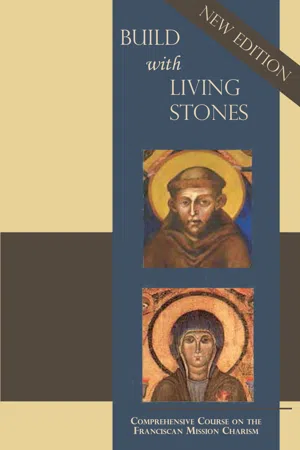
- 120 pages
- English
- ePUB (mobile friendly)
- Available on iOS & Android
eBook - ePub
Build With Living Stones
About this book
Information
Topic
Theology & ReligionSubtopic
Christian DenominationsUNIT EIGHT
FRANCISCAN PRESENCE & DIALOGUE:
LIVING WITH DIVERSITY IN A PLURALIST SOCIETY
CONTENTS
From the Franciscan Sources
A. Introduction
B. Survey
C. Information
D. Questions
E. Bibliography
F. Picture Credits
FROM THE FRANCISCAN SOURCES
Francis used to gather up any piece of writing, whether divine or human, wherever he found it: on the road, in the house, on the floor. He would reverently pick it up and put it in a sacred or decent place because the name of the Lord, or something pertaining to it might be written there.
Once a brother asked why he so carefully gathered bits of writing, even writings of pagans where the name of the Lord does not appear. He replied: “Son, I do this because they have the letters which make the glorious name of the Lord God. And the good that is found there does not belong to the pagans nor to any human beings, but to God alone ‘to whom belongs all good things’” (1C 82).
A. INTRODUCTION
In our earlier units we learned that the Franciscan Movement is fundamentally missionary, meaning that we are sent with a Gospel message for our world. Every Franciscan-inspired person, then, participates in this evangelical dynamic, which has special features and basic attitudes, which can be summarized in the phrase Pax et Bonum, which literally means Peace and Good but by extension signifies Peace and Salvation, salvation being the greatest good that God offers to humankind. Peace will be dealt with in Unit 9. In this Unit we will deal with a Franciscan appreciation of salvation as the foundation for life in a pluralistic society.
B. SURVEY
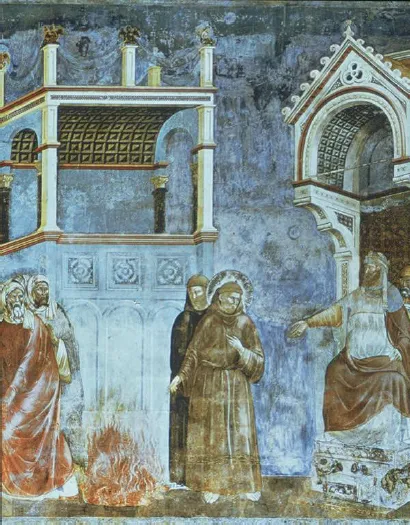
Francis of Assisi, through his life and actions, gave a new initiative to the mission of the Church. Francis himself lived as a missionary among his fellow Christians as well as among the Saracens (medieval term for Muslims). He lived and preached the good news of Peace and Salvation, desiring that everyone embrace Christ and in doing so find salvation, that is, the good (bonum) that comes from living in the Kingdom of God. The person motivated by the mission-mindedness of Francis and Clare does not compel others to become Christians by threats of hell and damnation but shares his or her faith because of its meaningfulness in his or her life.
C. INFORMATION
Before the Second Vatican Council, salvation was generally understood as accepting the faith, receiving the sacraments and hoping for eternal life. However, the Franciscan perspective, which is far more in line with the thoughts of the Second Vatican Council, speaks of integral salvation, which is fundamentally fulfillment of our human needs spiritually, materially, socially, politically and progressively. God’s invitation, then, is, in the words of the Franciscan expert on mission Arnulf Camps, “[a] dialogical invitation [which] stimulates us and incites us to work for the betterment of our total human condition so that the kingdom of God may come…a kingdom of love, justice, unity, and peace.”1 Such a sentiment reiterates the reflection of Pope Paul VI in a document entitled Evangelii Nuntiandi: we are called “to bring the Good News into all areas of humanity, and through its impact, to transform that humanity from within making it new.”2
This perspective is grasped in the Rule of the Secular Franciscan Order, when it states:
Let [the Secular Franciscans] be active by the testimony of their own human life and even with courageous individual and communal initiatives, in the promotion of justice and in particular in the field of public life, committing themselves through concrete choices in harmony with their faith.3
With this outlook, we come to realize that salvation is a much broader term than it was at the time of Francis and Clare and that one of the repercussions of such a viewpoint is that one who is sent into the contemporary world is sent for very different reasons than in the days of Christendom. We are sent to share the Way that has been revealed to us for a better, more human existence in this world, which leads us into our future with God.
The Christian who understands this concept of salvation does not say “If you don’t follow the Christian way, you’ll go to hell” but “Let me share with you what has brought meaning into my life.” A polemical attitude is replaced by a dialogical invitation. This approach is in imitation of the approach that God takes with us: he invites us into His life and Spirit so that we may have “Life and have it abundantly” (Jn 10:10). So dialogue is not a technique. It is a theological method based upon this understanding of God’s invitation with the Lord. Hence the necessity of listening (cf. Units 5, 7).
Now the seemingly simple greeting of Francis, Pax et Bonum, is filled with new meaning, conveying Francis’s response to the other as other, while it is also the warm greeting of a brother meeting a stranger only to discover a long lost and unknown brother or sister.
Before we can discuss the meaning of this dialogue along with its characteristics, it is important to know the basic attitudes we bring to that dialogue. These perspectives include:
• Affirming the Goodness of Life
We live in pessimistic times. Perhaps this is particularly felt by those who lived through John F. Kennedy’s Camelot and Pope John XXIII’s aggiornomento. Neo-conservatives, fundamentalists, and restorationists overwhelm us. Drugs, murder, and domestic violence frighten us. Yet, beneath these ills of civil and ecclesial society, we maintain a Franciscan optimism toward life: it is good because it is a gift from God, misunderstood and misused at times, but a gift nevertheless. It has the potential for goodness and freshness among us. As the friars gathered at the 1971 missionary conference in Medellina observed:
In spite of the darkness, we declare our faith and our undeniable hope…. This is no empty optimism, for our hope is Gospel-based and influenced by the tremendous good will of sincere and hard-working people the world over. Our guarantee is the certainty of the Gospel of Christ. Working together toward a genuine and realistic Franciscan response to the tensions and confusion around us, we turn to ‘“the Light of the World,” Who alone gives us “living hope.”4
• Relating as Brothers and Sisters
Again we turn to the friars gathered at Medellin, who stated that “our mission is not to lands but to people…. We desire to be their brothers [and sisters], their friends, their servants.”5 This has been emphasized repeatedly in past units.
• Respect for Cultures
When the Franciscan-motivated person encounters new cultures, especially those brought to our shores by new immigrants, he or she will “appreciate the cultural values of the people and will sing the Canticle of Creation on seeing love, the sense of community, the dignity and the joy of the people: because it is all created by Him and through Him! With this theological interpretation, the Gospel will more easily be ‘incarnated’ within cultures and be made to take on local forms.”6 This will be further discussed in Unit 10.
• Respect for Religions
There is no clearer articulation of this than in Nostra Aetate, the declaration on the relationship of the Church to non-Christian religions, a brief but significant document from the Second Vatican Council, which states:
The Catholic Church rejects nothing which is true and holy in these religions. She looks with sincere respect upon those ways of conduct and of life, those rules and teachings which, though differing in many particulars from what she holds and sets forth, nevertheless often reflect a ray of that Truth which enlightens everyone…. Prudently and lovingly, through dialogue and collaboration with the followers of other religions, and in witness of Christian faith and life, acknowledge, preserve, and promote the spiritual and moral goods among them, as well as the values in their society and culture.7
• The Common Search for Meaning
When we search for the meaning of life in general and our lives in particular, we can generally summarize the results of this search into three categories: beliefs, practices, and narratives. In other words, we find meaning in life when we are able to base our lives on truths bigger than ourselves, to articulate why we do what we do, and to share the stories that unite and motivate us. All religions must grapple with these concerns and provide an encouraging response to the searches of believers.
For Franciscan-minded people, narrative holds a place of priority not only because the early Franciscan movement is primarily handed down to us through stories but also because stories inspire us. Often enough, while beliefs and practices may differ among world religions, there are extraordinary similarities in their narratives, not in the details but surely in their sweep.
In Pursuit of a Vision, the document on formation from Medellin, encourages the formators of the Order to teach new members to listen:
The candidate should be carefully instructed in the art of dialogue and taught its nature, purpose, principles, conditions, methods, and forms. In the same spirit we must carefully avoid any words, judgments or actions which do not express the true condition of our separated brothers [and sisters]. We must take care to learn their history and mentality, give greater and clearer witness to our own faith, and encourage everyone to collaborate to the extent of his capability and the norms of the Church.8
This concise statement summarizes very well what is expected of any Franciscan-minded person who lives in a pluralistic society. Unlike Francis, Clare and their followers, we do not need to travel to far-off lands to discover people who think differently than we do, who have customs and practices which appear odd to us, and whose narratives are foreign to us. They live on our streets, shop in the same stores as we do, and have the same frustrations and concerns that we have. Sometimes they even pray in the pew next to us. Like us, they are men and women of good will, solid values, and generous spirit. To be argumentative and apologetic in a pluralistic society is simply to contribute to the “hot air” that already comes from our talk shows, adding to prejudice and hatred. To be good Christians today, then, we would be better served by studying The Art of Dialogue rather than The Art of War. The recent documents of the Churc...
Table of contents
- Cover Page
- Halftitle Page
- Copyright Page
- Title Page
- Introduction
- Lesson Units
- Unit One: Francis, Clare, and the Franciscan Family
- Unit Two: Witnesses to the Incarnation
- Unit Three: Traces of Trinity
- Unit Four: The Gospel Way: Moving toward the Reign of God
- Unit Five: The Franciscan Mission
- Unit Six: To be Formed into Christ Jesus
- Unit Seven: The Franciscan Evangelist: Developing a Contemplative Consciousness
- Unit Eight: Franciscan Presence and Dialogue: Living with Diversity in a Pluralistic Society
- Unit Nine: Franciscan Peace-Making in a Culture of Violence
- Unit Ten: Inculturation as a Franciscan Perspective
- Unit Eleven: A Franciscan Perspective on the Economy and the Global Reality
- Unit Twelve: Gender: Realities, Stumbling Blocks and Breakthroughs
- Unit Thirteen: Brother Sun and Sister Moon: A Franciscan View of Creation
- Unit Fourteen: The Franciscan Role in the Church
- Appendix
Trusted by 375,005 students
Access to over 1.5 million titles for a fair monthly price.
Study more efficiently using our study tools.
Frequently asked questions
Yes, you can cancel anytime from the Subscription tab in your account settings on the Perlego website. Your subscription will stay active until the end of your current billing period. Learn how to cancel your subscription
No, books cannot be downloaded as external files, such as PDFs, for use outside of Perlego. However, you can download books within the Perlego app for offline reading on mobile or tablet. Learn how to download books offline
Perlego offers two plans: Essential and Complete
- Essential is ideal for learners and professionals who enjoy exploring a wide range of subjects. Access the Essential Library with 800,000+ trusted titles and best-sellers across business, personal growth, and the humanities. Includes unlimited reading time and Standard Read Aloud voice.
- Complete: Perfect for advanced learners and researchers needing full, unrestricted access. Unlock 1.5M+ books across hundreds of subjects, including academic and specialized titles. The Complete Plan also includes advanced features like Premium Read Aloud and Research Assistant.
We are an online textbook subscription service, where you can get access to an entire online library for less than the price of a single book per month. With over 1.5 million books across 990+ topics, we’ve got you covered! Learn about our mission
Look out for the read-aloud symbol on your next book to see if you can listen to it. The read-aloud tool reads text aloud for you, highlighting the text as it is being read. You can pause it, speed it up and slow it down. Learn more about Read Aloud
Yes! You can use the Perlego app on both iOS and Android devices to read anytime, anywhere — even offline. Perfect for commutes or when you’re on the go.
Please note we cannot support devices running on iOS 13 and Android 7 or earlier. Learn more about using the app
Please note we cannot support devices running on iOS 13 and Android 7 or earlier. Learn more about using the app
Yes, you can access Build With Living Stones by Daria Mitchell in PDF and/or ePUB format, as well as other popular books in Theology & Religion & Christian Denominations. We have over 1.5 million books available in our catalogue for you to explore.