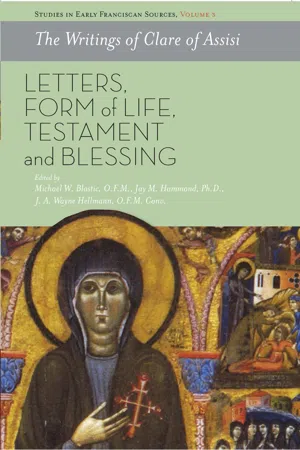
STUDIES IN EARLY FRANCISCAN SOURCES provides commentary on the critical writings of Francis of Assisi and Clare of Assisi which were published as "The Early Documents" in recent years. Three of the world's top scholars in medieval and Franciscan studies are editing this series: Michael J. Blastic, O.F.M., Jay M. Hammond, Ph.D., and Wayne Hellmann, O.F.M. Conv. In addition to their own commentaries, they have assembled an impressive list of commentaries on the Early Documents of Francis and Clare from other top scholars, including Luigi Pellegrini, Jean-François Godet-Calogeras, Michael F. Cusato, Laurent Gallant, William J. Short, Ingrid Peterson and Lezlie Knox. These commentaries will become "must have" reading for any scholar, student or interested layperson in the Early Documents of Francis and of Clare.
eBook - ePub
The Writings of Clare of Assisi
Letters, Form of Life, Testament and Blessings
- 144 pages
- English
- ePUB (mobile friendly)
- Available on iOS & Android
eBook - ePub
The Writings of Clare of Assisi
Letters, Form of Life, Testament and Blessings
About this book
Information
Topic
Theology & ReligionSubtopic
Christian DenominationsCLARE OF ASSISI’S LETTERS TO AGNES OF PRAGUE:
TESTAMENTS OF FIDELITY
INGRID PETERSON
I. ESTABLISHING THE TEXT
Manuscripts
In 1982 the name of Clare of Assisi (1193-1253) emerged onto the front pages of Franciscan scholarship in the English-speaking world with the publication of Francis and Clare: The Complete Works, edited and translated by Regis J. Armstrong and Ignatius Brady in the Pau-list Press Classics of Western Spirituality series.1 I. Omaechevarria’s 1970 Escritos de Santa Clara y Documentos Complentarios collected together and published the Latin texts, as well as a Spanish translation of Clare’s four Letters to Agnes of Prague, a Letter to Ermentrude of Bruges, the Form of Life, Testament, and Blessing.2 In 1976 Giovanni Boccali prepared a critical edition of the Latin texts which included the writings of both Francis and Clare, Textus opusculorum S. Francisci et S. Clarae Assisiensium.3 In 1953 at the time of the seventh centenary of Clare’s death, Damien Vorreux’s French translation of Clare’s writings were published as Sainte Claire d’Assise; Sa Vie par Thomas de Celano; Ses Écrits.4
In 1985, Marie-France Becker, Jean François Godet, and Thaddée Matura edited Claire d’Assise: Écrits which interfaced the Latin texts with the French translations as well as providing an extensive introduction, a full complement of scholarly apparatus, and an index to assist in studying Clare’s writings.5 This volume followed the format of the series, Sources Chrétiennes, a collection of Greek and Latin Christian texts from the patristic and medieval periods. Volume 325 contains Clare’s Four Letters to Agnes of Prague, “Form of Life,” “Testament” and “Blessing.” Soon other language groups produced similar editions of translations of Clare’s writings and essential related texts complete with a variety of appended material.
To date, no critical edition of the Latin texts of the body of Clare’s writings has been produced. While the source texts for Claire d’Assise: Écrits are not from critical editions, the original Latin texts were critically established in that they were based on the most recent manuscript research. The writings of Francis translated from Kajetan Esser’s text had previously been published in 1981 in this same series as volume 285.6 Today Clare of Assisi continues to remain in the foreground of the Franciscan world stage.
Editions and Translations
Until the beginning of the twentieth century, only the Bohemian version of the letters by J. Plachy, printed in 1566 and the Latin text published in 1668 of the Acta Sanctorum were known.7 In addition, in 1491 Nicholas Glassberger made a copy of the Latin text of the First Letter which appears in the manuscript, Cronica XXIV Generalium Ordinis Fratrum Minorum.8 In more than four centuries since the publication of the Latin edition of the letters, translations have appeared by language groups in both the Eastern and Western worlds. In 1915 Walter Seton published a Middle German version of the four letters following a fourteenth-century manuscript found at Bamberg.9 His work led him to conclude that the German text was not a translation of the Latin text of Clare’s first letter, but a re-translation of a German text. This conclusion led him to search for the base text in Latin from which the medieval German translation had been made. Seton discovered that the base text he was attempting to find was preserved in Codex 10 of the Chapter Library of Saint Ambrose of Milan and had been retrieved several years earlier by Achille Ratti, the future Pope Pius XI, who served at that time as the prefect of the library.10 In 1924 Walter Seton in Archivum Franciscanum Historicum published the Latin text of Clare’s letters based upon the Milan manuscript.11
In 1932, J.K. Vyskôcil produced a definitive critical edition of the four letters to Agnes of Prague along with an edition of the life of Blessed Agnes, Vita beatae Agnetis.12 Seton established the authenticity of the letters in determining that the Milan manuscript was copied at Prague between January 18 and November 8, 1332. Seton surmised that it was produced and sent to Rome in an effort to promote the canonization of Agnes.
The first English translation of Clare’s letters, the work of Ignatius Brady, appeared as the Writings of Saint Clare of Assisi to commemorate the 750th anniversary of her birth in 1953.
This was followed in 1982 by Francis and Clare: The Complete Works, edited and translated by Regis J. Armstrong and Brady in the Paulist Press series, Classics of Western Spirituality.
Clare’s writings, and other documents pertaining to the Poor Ladies of San Damiano and Francis’s brothers was published in 1988 as Clare of Assisi: Early Documents, edited and translated by Armstrong. This work was revised and expanded in 1993 for the celebration of Clare’s eighth centenary, published by the Franciscan Institute as Clare of Assisi: Early Documents. The most reliable and complete translation of the letters and additional primary sources for the study of Clare’s Letters is the 2006 updated, reorganized, and enhanced third edition of Clare of Assisi: Early Documents.
Since there is no reliable manuscript of Clare’s two letters to Er-mentrude, the Cologne Beguine who settled in Bruges, but only a summary of their content included in the Annales Minorum, Grau concludes that Wadding’s text cannot be construed to be Clare’s writing.13 Nonetheless, the similarity of its content to Clare’s four letters led to its inclusion as a supplementary text.
CLARE OF ASSISI (1193-1253)
As a noble woman in her early twenties, Clare left her home and began to follow the Gospel way of life undertaken by Francis. Daughter of Favarone d’Offreduccio, at an early age Clare began to pattern her life according to the values of her mother, Ortulana, a faith-filled woman who had made a pilgrimage to Jerusalem. Pregnant and faced with the fear of losing the life of her first child and her own life, she made a pilgrimage across the boot of Italy through the mountainous terrain to the shrine of Saint Michael at Mount Gargano. Sister Cecilia, who came to the monastery of San Damiano three years after Clare, testified that when Ortulana was praying there before the cross, “she heard a voice that told her she would give birth to a great light which would illumine the world” (Proc 6.12).14 As a young girl, Clare showed concern for the poor by saving part of her food for the hungry. Generous of heart, she knew of Francis and contributed some of her resources to help rebuild the Porticuncula, the favorite little plot where his first brothers gathered to live.
More than forty years later, Clare’s youngest sister Beatrice recalled how Francis had come to visit Clare in her family home and how after that they had frequent conversations. According to the Legend of Saint Clare, on Palm Sunday night, Clare and a companion left her home in order to devote her life to penance.15 Clare made a dramatic move, unpopular with her family who had planned for her marriage to a suitor who would add his patrimony and land to the Offreduccio household. Instead, Clare chose to turn her back on the privileges and wealth of her aristocratic status in order to identify more closely with the poor and the teaching of the gospel. Such an interior reversal, or conversion, was confirmed by an outward sign when Francis tonsured Clare’s hair.
When Francis was tonsured, he received the right to preach publi-cally as well as to consecrate women for the enclosed life. Clare and her sister Catherine, known as Agnes in religious life, were both dedicated to religion by Francis and began to live adjacent to the church of San Damiano which Francis had rebuilt in response to the call he heard to repair God’s home. Clare and her sister Agnes were representative of women’s religious movements of the thirteenth century described by the historian David Herlihy as a time of the “feminization of sanctity.”16 Soon other women began to dedicate their lives in the pursuit of holiness along with Clare and Agnes at San Damiano, including her younger sister Beatrice and her mother, Ortulana.
Beyond their personal desire to find a place where they could live in accord with the message of the gospel and to share its good news in word and deed, Clare and her sisters seem to have had only simple intentions. It was a way of life parallel to the one Francis and his brothers were beginning to pursue and it attracted followers in Assisi and its neighboring towns. As the brothers began to travel, stories of the sisters’ life at San Damiano spread throughout Italy and beyond into Eastern Europe.
AGNES OF PRAGUE (1211-1282)
Agnes was raised in a family of royal women publicly known for the holiness of their lives, including her aunt Saint Hedwig of Silesia (1274-1243), and her cousin Elizabeth of Hungary (1207-1231).17 At an early age Agnes, daughter of King Přemsyl Ottakar I and his second wife Queen Constance from the Hungarian Arpad dynasty, was sent to the court of the duke of Silesia to be educated in preparation for marriage to the duke’s son.18 Upon his death when she was still only three years old, she returned to Prague and was placed in a Premonstratentian convent to complete her education. Soon after in an arranged political alliance Agnes was betrothed to Henry, son of Emperor Frederick II, and sent to Austria. When Henry married Leopold’s daughter, Agnes persuaded her father not to retaliate with military force. Later Ottokar received and refused requests for Agnes to marry King Henry of England and the Emperor Frederick II. Throughout this time, Agnes devoted herself to charitable works in Prague. Meanwhile, when Francis’s brothers came to Prague in 1225, Agnes built a church for them. No doubt through her contact with them, Agnes learned of Clare and the foundation of Poor Ladies at San Damiano. She obtained land through her brother and built a hospice for the sick of Prague, a monastery for women to follow the Gospel life in the manner of Clare, and a residence for the brothers who would minister to them. Then Agnes requested Pope Gregory IX’s approval to request sisters from Clare’s foundation at San Damiano in order to establish a similar foundation of Poor Ladies in Prague. In 1234, Agnes, seven other noble women from Bohemia, and five women from Assisi entered the new monastery.
Clare and Agnes both lived fully immersed in the cultural world of their times with its values shifting away from the class structure that, as a member of...
Table of contents
- Cover
- Title Page
- Copyright
- Contents
- Introduction
- Dedication
- Abbreviations
- Contributors
- Chapter One: Clare of Assisi’s Letters to Agnes of Prague: Testaments of Fidelity
- Chapter Two: The Form of Life of the Poor Ladies
- Chapter Three: The Testament of Clare
- Chapter Four: Clare’s Blessing
- Footnotes
Trusted by 375,005 students
Access to over 1.5 million titles for a fair monthly price.
Study more efficiently using our study tools.
Frequently asked questions
Yes, you can cancel anytime from the Subscription tab in your account settings on the Perlego website. Your subscription will stay active until the end of your current billing period. Learn how to cancel your subscription
No, books cannot be downloaded as external files, such as PDFs, for use outside of Perlego. However, you can download books within the Perlego app for offline reading on mobile or tablet. Learn how to download books offline
Perlego offers two plans: Essential and Complete
- Essential is ideal for learners and professionals who enjoy exploring a wide range of subjects. Access the Essential Library with 800,000+ trusted titles and best-sellers across business, personal growth, and the humanities. Includes unlimited reading time and Standard Read Aloud voice.
- Complete: Perfect for advanced learners and researchers needing full, unrestricted access. Unlock 1.5M+ books across hundreds of subjects, including academic and specialized titles. The Complete Plan also includes advanced features like Premium Read Aloud and Research Assistant.
We are an online textbook subscription service, where you can get access to an entire online library for less than the price of a single book per month. With over 1.5 million books across 990+ topics, we’ve got you covered! Learn about our mission
Look out for the read-aloud symbol on your next book to see if you can listen to it. The read-aloud tool reads text aloud for you, highlighting the text as it is being read. You can pause it, speed it up and slow it down. Learn more about Read Aloud
Yes! You can use the Perlego app on both iOS and Android devices to read anytime, anywhere — even offline. Perfect for commutes or when you’re on the go.
Please note we cannot support devices running on iOS 13 and Android 7 or earlier. Learn more about using the app
Please note we cannot support devices running on iOS 13 and Android 7 or earlier. Learn more about using the app
Yes, you can access The Writings of Clare of Assisi by Michael W. Blastic, O.F.M.,Jay M. Hammond, Ph.D.,J. A. Wayne Hellmann, O.F.M. Conv., Michael W. Blastic, O.F.M., Jay M. Hammond, Ph.D., J. A. Wayne Hellmann, O.F.M. Conv. in PDF and/or ePUB format, as well as other popular books in Theology & Religion & Christian Denominations. We have over 1.5 million books available in our catalogue for you to explore.