Infinite Hope and Finite Disappointment details the hopes and promises of the 14th Amendment in the historical, legal and sociological context within which it was framed. Part of the Reconstruction Amendments collectively known as "The Second Founding, " the 14th Amendment fundamentally altered the 1787 Constitution to protect individual right and altered the balance of power between the national government and the states. The work also shows how initial Supreme Court interpretations of the Amendment's reach hindered its applicability. Finally, the contributors investigate the current impact of the 14th Amendment. The book is divided into three parts: "Infinite Hope: The Framers as First Interpreters;" "Finite Disappointment: The Supreme Court as First Interpreter;" and "Never Losing Infinite Hope: The People as First Interpreters."
eBook - ePub
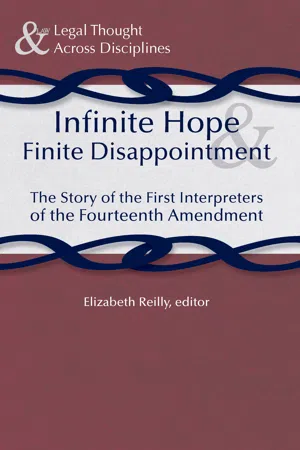
Infinite Hope and Finite Disappointment
The Story of the First Interpreters of the Fourteenth Amendment
- 312 pages
- English
- ePUB (mobile friendly)
- Available on iOS & Android
eBook - ePub
Infinite Hope and Finite Disappointment
The Story of the First Interpreters of the Fourteenth Amendment
About this book
Information

I: Infinite Hope
THE FRAMERS AS
FIRST INTERPRETERS

1 | The Antebellum Political Background of the 14th Amendment |
For the viability of a progressive American constitutionalism, no question of meaning is more important than that of the 14th Amendment. Much of American constitutional law, at least that part of it that concerns individual rights, consists of a series of footnotes to the 14th Amendment.1
The Amendment was the work of a particular group of practical politicians, the Republican congressional majority in the 39th Congress, a group concerned with their own political futures, the future of their party, and the rights and desires of their constituents, as well as the future course of American society.
The 39th Congress that framed the 14th Amendment was not a “Reconstruction Congress,” but one overwhelmingly shaped by the practical concerns of the Civil War. The 39th Congress, which opened its deliberations in December 1865 and the draft Amendment in June 1866, had been elected in late 1864 as part of the same wartime election cycle that reelected President Abraham Lincoln. Though the framers of the 14th Amendment had reacted to specific events in the South after the surrender at Appomattox, their sense of the issues facing the nation was that of the Northern Republican leadership that fought the war.
Specifically, the framers were operating on the assumption that the cause of the Civil War was neither the institution of slavery itself, nor Northern moral disapproval of it, but a complex political institution called the “Slave Power”— a political term that referred not only to Southern whites who owned slaves but to constitutional provisions and political practices that gave them disproportionate power in the federal government. As antebellum free-soil and antislavery politicians saw it, the complexity of the Slave Power meant that the war’s aims could not be realized by merely freeing the slaves and guaranteeing their freedom in the 13th Amendment. Because the chief threats of the Slave Power lay in its negative effect on national politics and the rights of white citizens outside the South, eliminating it would require far-reaching changes in the state–federal balance, the federal separation of powers, and the internal political systems of the individual Southern states.
My contention is that if, in 1856, an antislavery politician had been asked to propose a constitutional amendment to eliminate the dangerous influence of the Slave Power, an amendment very much like the 14th Amendment would have been produced. In this regard, I argue that we should pay close attention to the antebellum political arguments forged by the men who later framed the 14th Amendment. Their ideas are essential to understanding the interpretation given by them to the words and structure of the Amendment they adopted.
In relating the final Amendment to antebellum politics, I do not wish to slight the influence on Northern public opinion of the Civil War itself or of the events of 1865, but I do suggest that it is extremely useful to note that the Republican response to the events of 1861–1865 flowed out of prewar political thought. In that configuration of antislavery ideas, the idea of the Slave Power deserves a more prominent place than most legal and constitutional thinkers (though not necessarily most professional historians of the period) have heretofore given it.2 In fact, I suggest that we grant the theory of the Slave Power the same kind of attention paid to the intellectual background of the framing of the Constitution. The framers of the 14th Amendment were shaped by a background of political history and theory quite different from the eighteenth-century history and philosophy that informed the work of framing in 1787.
The five-section Amendment is by far the longest ever adopted through the amendment process. Much scholarship and caselaw refers to the far-reaching effects on individual rights that resulted from the Citizenship Clause, the Privileges and Immunities Clause, the Due Process Clause, and the Equal Protection Clause. In addition, there is power bestowed upon Congress by Section 5 to interfere with state laws that violate the previous four sections. The middle three sections imposed unprecedented (if now obsolete) federal limitations on state voting laws, qualifications for state offices, and debt-repayment schemes. Section 3 also changed the separation of powers created by the original Constitution, transfer ring from the President to Congress the power to grant “reprieves and pardons for offenses against the United States” to officials who have engaged in “insurrection or rebellion” or have given “aid and comfort” to the nation’s enemies.3
The changes the 14th Amendment wrought in our system were profound, with implications not only for the substance and procedure of state government, but also for the relationship between states and the federal government and among the branches of the national government. In many ways, the totality of the 14th Amendment has shaped American democracy to this day.
Much of the interpretive work on the 14th Amendment has occurred in the courts and, while the reach of the Amendment is quite expansive, its judicial interpretation has often relied on a decidedly crabbed vision of its meaning. American judges maintain an odd dual consciousness about the 14th Amendment. On the one hand, they admit, over and over, that the 14th Amendment changed many details of our legal system. On the other hand, they seem unaware that the number of details, and the direction of the changes they represent, amount to something more than a series of isolated, almost idiosyncratic, results of the amendment process. Even in important decisions construing the 14th Amendment, judges often seem to regard it as a minor editing change to the Founders’ Constitution—interpreting it first and foremost through an assumption that it was not designed to change the structure and workings of the 1787 document.4
For instance, in the first major decision interpreting the 14th Amendment, the Slaughter-House Cases, Justice Miller explained that it was necessary to interpret the Amendment extremely narrowly, because otherwise it might be held to have changed the Constitution:
The argument we admit is not always the most conclusive which is drawn from the consequences urged against the adoption of a particular construction of an instrument. But when, as in the case before us, these consequences are so serious, so far-reaching and pervading, so great a departure from the structure and spirit of our institutions; when the effect is to fetter and degrade the State governments by subjecting them to the control of Congress, in the exercise of powers heretofore universally conceded to them of the most ordinary and fundamental character; when in fact it radically changes the whole theory of the relations of the State and Federal governments to each other and of both these governments to the people; the argument has a force that is irresistible, in the absence of language which expresses such a purpose too clearly to admit of doubt.5
The dismissive tone of the Slaughter-House majority reappears over and over in the United States Reports, the official record of the U.S. Supreme Court, and the current Supreme Court is committed to it. In City of Boerne v. Flores, the Court insisted that Congress lacks the power to set a broad prophylactic rule enforcing the congressional vision of the Free Exercise Clause of the 1st Amendment because the language of Section 5, which appears to empower Congress, is limited by an unwritten requirement that congressional enforcement legislation be “congruen[t] and proportional” to the constitutional violations Congress seeks to remedy. Perhaps, the Court does not realize that the framers of the 14th Amendment may not have reposed the same implicit trust in the wisdom of federal judges that the current justices do.6
The tone of denial is succinctly captured by Chief Justice Rehnquist in an opinion explaining that the 14th Amendment’s Section 5, Enforcement Clause could never be construed to allow Congress to supplement state tort law with a federal tort cause of action against perpetrators of gender-based violence:
[T]he language and purpose of the 14th Amendment place certain limitations on the manner in which Congress may attack discriminatory conduct. These limitations are necessary to prevent the 14th Amendment from obliterating the Framers’ carefully crafted balance of power between the States and the National Government.7
I maintain that the odd tone and almost certainly wrong interpretation of these opinions arises from an impoverished historical understanding of the 14th Amendment. Some misunderstandings arise from the reticent tone of the legislative debates leading up to the Amendment.8 However, some confusion also arises because contemporary interpreters read those legislative debates without a rich sense of the historical background against which the framers of the 14th Amendment based the change they were making to the Constitution.
The Slave Power background of the Amendment gives grounds to argue for a broad interpretation of its terms, one embracing the radicalism of some of its authors, reflected in the dissent in Slaughter-House by Justice Swayne:
These amendments are a new departure, and mark an important epoch in the constitutional history of the country. They trench directly upon the power of the States, and deeply affect those bodies. They are, in this respect, at the opposite pole from the first eleven. Fairly construed these amendments may be said to rise to the dignity of a new Magna Charta.9
In order to put the Amendment into proper context, I will summarize the meaning of the term “Slave Power” as used by the practical politicians who built the Republican Party, brought it to power, and won the war against the South. I go on to demonstrate the ways in which antislavery politicians saw the strength of the Slave Power as flowing directly from flaws in the original Constitution of 1787, and the ways in which the antebellum political system strengthened the slaveowning interests of the South both within Southern politics and in the counsels of the nation. I then discuss the original Republican program for ending Slave Power influence before Southern secession and show its relevance to the political situation faced by the Republican members of the 39th Congress, who would eventually pass the Amendment. In the conclusion, I argue that reading the 14th Amendment against the political background of the Slave Power concept suggests that the somnambulists on the federal bench have misread the Amendment, both in its aim and in its scope.
I. ANALYSIS
A. The “Slave Power”—Conspiracy and Historiography
The Slave Power was a term coined by abolitionists in the 1830s, but it was not taken up and widely used by mainstream politicians until the 1850s. It had two related but not identical meanings. The first referred to a conspiracy of slaveholders and “dough-faced” Northern politicians (Northerners who sought office and influence by cultivating Southern support) to preserve and extend the prerogatives of slaveholders.10 The second (discussed below) referred to the political advantages conferred on slave states by the Constitution and the antebellum political system.
In the conspiratorial sense, the Slave Power fits with other conspiracy theories of the antebellum era—the fears of Freemasonry and Catholicism that spawned the Anti-Masonic and American (or “Know-Nothing”) Parties, respectively, for example. Throughout the period, and throughout history, Americans have shown credulity toward allegations that a secretive, alien, and undemocratic group or elite was conspiring to subvert the promise of American liberty.11 That it seems implausible today does not mean that it was not sincerely believed at the time. For example, no less a figure than Abraham Lincoln accused Stephen A. Douglas of taking part in a conscious conspiracy to nationalize slavery, a conspiracy in which the other participants were Presidents Pierce and Buchanan and Chief Justice Taney. As Lincoln summarized his thoughts in a draft speech for the 1858 senatorial election against Douglas:
I clearly see, as I think, a powerful plot to make slavery universal and perpetual in this nation.… The evidence was circumstantial only; but nevertheless it seemed inconsistent with every hypothesis, save that of the existence of such conspiracy. I believe the facts can be explained to-day on no other hypothesis.
He repeated the charge, in somewhat more measured language, during his famous debates with Douglas, saying, “[T]here was a tendency, if not a conspiracy among those who have engineered this slavery question for the last four or five years, to make slavery perpetual and universal in this nation.”12
Lincoln, a consummate politician, would of course not have made the accusation if he did not think voters would respond to it. But, that does not necessarily mean he did not believe it himself; indeed scholars believe he did. Nor was Lincoln alone; Salmon P. Chase and Joshua Giddings, The New York Times, The New York Tribune, David Wilmot and Benjamin Wade all made similar arguments.13
The idea of the Slave Power is relatively unfamiliar even to most educated Americans, and certainly has been little discussed by legal commentators. But an educated American during the half-century after the Civil War would have understood the antebellum era differently—as a struggle between “free soil, free speech, free men” on the one hand and the aggressive Slave Power on the other.
The Slave Power’s role in bringing on the war was explored in two popular and well regarded histories published after Appomattox—Horace Greeley’s The American Conflict and Hermann van Holst’s magisterial The Constitutional and Political History of the United States. Both authors recognized the effect the idea of the Slave Power had upon Northern leaders and public opinion; beyond that, they both concluded that the term “Slave Power” had a discernible and objective meaning in the structure of American politics.
Horace Greeley’s history of the Civil War era, written during Reconstruction, depicts the story as an assault on civil liberty, black and white, by the forces of the Slave Power. Von Holst, a German academic observer of American civilization, argued that as a result of the hybrid nature of the Union, two civilizations arose. The Southern, or “slavocratic,” civilization was from the beginning inclined toward obtaining its way in national affairs by bullying and threatening Northern politicians into bartering sectional rights for Southern votes. This pattern of bullying South and appeasing North meant “that [the North] was governed, not by the black slaves of the south, but by its own white slaves.” This mastery in national politics ensured that “a majority of the justices of the supreme court of the United States would profess the doctrines relative to slavery which were agreeable to the slave interest, whenever a legal question bearing on slavery arose.” Secession and war was caused by “the doctrine of non-coe...
Table of contents
- Cover Page
- Halftitle Page
- Title Page
- Copyright Page
- Contents
- Constitution of the United States
- Contributors and Acknowledgments
- Introduction
- Part I: Infinite Hope: The Framers as First Interpreters
- Part II: Finite Disappointment: The Supreme Court as First Interpreter
- Part III: Never Losing Infinite Hope: The People as First Interpreters
- Endnotes
- Index
Trusted by 375,005 students
Access to over 1.5 million titles for a fair monthly price.
Study more efficiently using our study tools.
Frequently asked questions
Yes, you can cancel anytime from the Subscription tab in your account settings on the Perlego website. Your subscription will stay active until the end of your current billing period. Learn how to cancel your subscription
No, books cannot be downloaded as external files, such as PDFs, for use outside of Perlego. However, you can download books within the Perlego app for offline reading on mobile or tablet. Learn how to download books offline
Perlego offers two plans: Essential and Complete
- Essential is ideal for learners and professionals who enjoy exploring a wide range of subjects. Access the Essential Library with 800,000+ trusted titles and best-sellers across business, personal growth, and the humanities. Includes unlimited reading time and Standard Read Aloud voice.
- Complete: Perfect for advanced learners and researchers needing full, unrestricted access. Unlock 1.5M+ books across hundreds of subjects, including academic and specialized titles. The Complete Plan also includes advanced features like Premium Read Aloud and Research Assistant.
We are an online textbook subscription service, where you can get access to an entire online library for less than the price of a single book per month. With over 1.5 million books across 990+ topics, we’ve got you covered! Learn about our mission
Look out for the read-aloud symbol on your next book to see if you can listen to it. The read-aloud tool reads text aloud for you, highlighting the text as it is being read. You can pause it, speed it up and slow it down. Learn more about Read Aloud
Yes! You can use the Perlego app on both iOS and Android devices to read anytime, anywhere — even offline. Perfect for commutes or when you’re on the go.
Please note we cannot support devices running on iOS 13 and Android 7 or earlier. Learn more about using the app
Please note we cannot support devices running on iOS 13 and Android 7 or earlier. Learn more about using the app
Yes, you can access Infinite Hope and Finite Disappointment by Elizabeth Reilly in PDF and/or ePUB format, as well as other popular books in Law & North American History. We have over 1.5 million books available in our catalogue for you to explore.