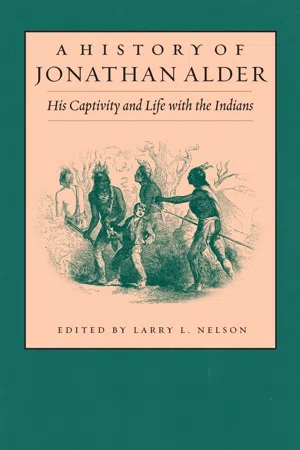
A History of Jonathan Alder: His Captivity and Life with the Indians is one of the most extensive first person accounts to survive from Ohio's pioneer and early settlement eras. Nine year-old Alder was captured and taken to Ohio by Indians in 1782. Adopted by a Mingo warrior and his Shawnee wife, Alder lived as an Indian until 1805. After he left the Indians, Alder became one of the first European settlers to live in central Ohio. Alder composed his memoirs in the 1840s. His account chronicles his life for fifty years, from the time of his capture to 1832. The narrative, therfore, provides a unique perspective on fronteir Ohio and its transformation from wilderness to statehood and the continuing evolution in the relationship between Ohio's Indians and whites from the Revolutionary War-era to a time when many of the state's Native peoples had been removed. Alder's recollection provides an exceptional look at early Ohio. His portrait of his captors is revealing, complex, and sympathetic. The latter part of his narrative in which he describes his experiences in central Ohio is an extraordinary rich account of early pioneer life. Further, Alder was fortunate in that he encountered many of the persons and took part in many of the events that have become touchstones in Ohio's pioneer history, including Simon Kenton, Simon Girty, and Col. William Crawford. He participated in the Battles of Fort Recovery and Fallen Timbers, and his recollection of these actions are among the few extant accounts that describe these events from a Native American perspective.
- 222 pages
- English
- ePUB (mobile friendly)
- Available on iOS & Android
eBook - ePub
About this book
Information
Print ISBN
9781884836985
A HISTORY
of
JONAT HAN
ALDER
A HISTORY OF THE LIFE and captivity by the Indians of Jonathan Alder, who was born the son of Bartholomew and Hanna Alder on September 17, 1775, in the state of Maryland, not far from Philadelphia (in New Jersey, about eight miles from Philadelphia, September 17, 1773. Howe, Beers).36 When I was two years old, my family removed from there to Wythe County in Virginia. About four years afterwards, my father died, leaving a wife and five children. John, he was only a half-brother (my father had been married before then) and was the oldest. My brother David, and myself, and Mark, and Paul constituted the rest of the family. My father had bought a piece of land and had made some improvements before he died, and had some horses and cattle and other stock. ([His father] purchased a small tract of land, erected a plain log cabin and began to make improvements . . . He was possessed of several head of horses, cattle and swine, which fed upon the wild grass, herbage, and nuts of the forest and frequently strayed along the mountain valleys. Hill) We lived near a lead mine. I can still recollect going to the mine and watching the miners dig out the ore. There was also a pure stream of water close by. I used to go there with my brother John to see him swim.
Another incident that I can still recollect is that the Negroes used to pass our house on Saturday evenings going to see their wives and would return Sunday evenings. I recollect several instances in the fall of the year when they would bring pumpkins with them and would get my mother to bake them for them to eat on their way home. There were a great many other things that I could also remember, all of which I related to my mother when I returned home after an absence of twenty-four years. A great many of these things she had entirely forgotten, but after her mind was a little refreshed, she could recollect and tell me of some that I had forgotten.
It was now in the month of May 1781 (March 1782; Howe, Beers) when the leaves were all out and the woods were very thick.37 One pleasant and sunshiny morning, everything looked gay and beautiful and my mother called to my brother David and myself and told us that we must go and hunt a mare and colt that had been missing for several days. My brother did not eat but little breakfast and when the meal was over, he seemed to be very much downcast. All the necessary arrangements were made and we started, but little did we think what our sad fate was to be or who would tell the story.
We struck out into the woods and after wandering around for some time and not finding the horses, we came to a little brook that was full of willows. David gave me his knife and told me to cut some of them around the bank and he would make a basket when we went home, and while I was busy, he would look for the horses. Then he started off and left me. Now I had cut but a few of the willows till a fright came over me, and I went off and sat down on a log until David called to me and I answered. He told me to come to where he was, so we called back and forth several times before I got to him. When I got there, he had found the mare and colt, but the colt was down and could not get up. It had eaten the plant called “stagger wood”38 that grew in that country. He told me to take the colt by the tail and he would take hold by the neck and see if we could raise it, so we lifted several times, but it was so stupid that it would not try to help itself. We stood and looked at it for some time not knowing what to do and he told me to take hold and we would try it once more, and if it did not help itself, we would go and leave it.
We got ready and just as I was in the act of stooping down he hallooed out, “Run, there is Indians!”39 David was about sixteen years old and very quick on foot and he darted off like an arrow with two Indians after him (there were five Indians in all, and one white who had been taken prisoner years before).40 The word “Indian” frightened me so that I was completely paralyzed. I could not move, and by the time I looked around (for they came up behind me), one Indian was right up to me and held out his hand and I took hold of it.41 I have no language to tell you how I felt. Above all creatures in the world, the Indian was dreaded the most, and here I stood whilst one had me tightly gripped by the hand and the next thing may be the scalping knife and the tomahawk.
You may try to imagine my feelings in this perilous condition with my brother out of sight and two Indians after him. You can read the history but you cannot realize it. But I had not long to wait until I saw my brother coming back, one Indian leading him and another holding the handle of a long spear that he had thrown into his body. When he came close to me I asked him if he was hurt and he said he was. (These were the last words that passed between us. Howe, Beers) By this time, one Indian stepped up and grasped him tightly around the body while another took hold of the spear and jerked it out. (I observed some flesh on the end of it, which looked white, which I supposed came from his entrails. Howe, Beers) They then started off in rather a hurry and we had not gone far till I saw my brother turn pale and begin to stagger. I tried several times to look back, but the Indian would give me a jerk by the hand and so I was prevented from seeing him any more. We didn’t go far till they halted on a high piece of ground. We had been there but a few minutes when I saw the Indian that was left with my brother coming with his scalp in his hand, frequently giving it a shake to shake off the blood. Then I knew he was dead and whether they would kill me right there or carry me off, one or the other must be my fate.
After they had talked awhile together, then this white man began to ask me questions. He inquired how many there was in the family. I told him there was but two little brothers and my mother; my father was dead and my brother John was then a grown man and was not living at home. He then asked me where I lived and I pointed off down towards a mill where there was a fort kept.42 He shook his head and told me I lied. Said he, “We have been there two days trying to catch Negroes and there is a heap of people there, and I know you do not live there. But if you will show us where you live, we will take your mother and the other children off with us into a fine country and will take good care of you, and you can live easy and need never to have work.”
I knew that my brothers were both small and that while the Indians might take my mother with me, they would undoubtedly kill the boys for fun. I still insisted that I lived down at the mill and while we yet talked, a rooster crowed not more than half a mile off. Says he, “There is where you live.” I told him it was not, but immediately all the Indians started in that direction. They had not been gone but a little bit until a man commenced chopping on a tree. “Now,” thinks I, “soon I will hear a gun,” and I then begged of that man to let me go, but he told me no. We had not talked long until, sure enough, the gun went off. In about half an hour, here they came with Mrs. Martin and one child about two years old (aged four or five years; Howe). The white man then asked me if that was my mother. I told him it was not, but told him it was Mrs. Martin. She told me that they had killed her husband and her second babe. Mr. Martin was shot down at the tree where he was chopping and the babe they killed in the house.
Now Mrs. Martin was a close neighbor and we were well acquainted, and here we was, both prisoners in the hands of the Indians. I could yet see the blood of my brother on the hands of the Indian and his scalp hanging in his belt whilst Mrs. Martin could look and see the blood of her husband and of her infant upon their hands and their scalps hanging in their belts. How do you suppose we felt?c
The Indians had a little talk among themselves and then we all started off in a considerable hurry as fast as the woman and myself was able to go. My back was now turned upon home and my fate was sealed. Every step was like a dagger to my heart. They tied a buffalo tug43 around our waists while an Indian held the other end and compelled us to follow.
We marched in regular Indian style, one right behind another in order to make as few trails as possible.44 The Indian that had captured the small child had to carry it, and in this condition, we hurried off from about ten o’clock in the morning until after dark. Long before night, two of the Indians stopped awhile back on the trail to watch and see if there was anybody in pursuit of them. The rest went down into a deep ravine and then followed it for a considerable distance. There, among the cliffs and rocks, they pitched their camp for the night with very little preparation. The weather was not cold and they built no fires. They had some dried venison, so we ate all we wanted, but that was little with the prisoners.
They then spread their blankets and ordered us to lie down after tying buffalo tugs around our waists, leaving each end long. After giving the small child to its mother, two of the Indians also lay down, one on each side, and tied the ends of the tug around their bodies. They gave us rope enough so that we could turn ourselves if we wished, and they also had blankets to cover us. In this condition we passed the first night of our captivity with but little sleep.
We now began to despair that Providence would ever intervene for our release. We traveled as before, in single file with two of the Indians a short distance in our rear to guard against any surprise attack. Thus we traveled over hills, rocks, brooks, and vales, across mountain slopes and through forests, a rough and rugged route, one that no set of men could have pursued successfully on horseback. At about noon, the Indians made a halt and laid off their burdens. We all ate lunch and rested but a short time, and then took up our line of march again as usual until night set in. We stopped a way up in a dark ravine and in the mouth of a cave kindled a little fire, ate our supper, rested, and chatted a little. The white man would try to give us great encouragement in regard to our future prospects, but we gave him very little credit for his flatteries. The blankets was again spread and we was made fast with the ropes as before, and we laid down to sleep after putting out all the fire.
We awoke early in the morning and felt somewhat refreshed. We ate our breakfast and all things being ready, we moved off as before. The Indian that laid claim to Mrs. Martin’s child had carried it the last two days and at night he seemed to be very tired. This morning, after we started, he soon fell behind. We traveled on until noon and halted for a short time, ate a bit, and moved on again. Nothing particular transpired through the day except that the Indian with the child had not been seen since he fell behind in the morning. I saw that Mrs. Martin was somewhat uneasy. About sundown they halted for the night and, in the course of half an hour or so, the Indian came up without the child. As soon as Mrs. Martin saw him without her child she noticed the scalp hanging in his belt. She commenced screaming and hallooing and crying, “My child! My child! My child!” (Finding the child of Mrs. Martin burdensome, they soon killed and scalped it. The last member of her family was now destroyed, and she screamed in agony of grief. Howe, Beers) The Indian stepped up to her and bade her hush, but she paid no attention to him whatever, but still screamed and hallooed. He then drew his butcher knife from its scabbard and caught her by the hair and slapped the edge of his knife against her forehead and hallooed out, “Sculp! Sculp!” She paid no attention to him, but held perfectly still as though she was willing that the man might scalp or kill her and kept screaming and crying. If she had not belonged to another Indian, perhaps he would have killed her. I was very much scared, for I expected to see the woman killed. They were then standing under a beech tree, and he let go of her hair and reached up and cut off a limb and trimmed it up and commenced whipping her. She still screamed and hallooed, “My child! My child,” but he whipped her until she had to hush. (But indifferent to life, she continued her screams, when they procured some switches and whipped her until she was silent. Howe, Beers) I saw we was entirely at their mercy. They could kill us any moment they chose.
Mrs. Martin and myself ate but little that night. We suffered our grief as best we could and shed a great many tears. That night, mother and my brothers and home was my great theme of thought until I was overcome with sleep and dropped away and forgot myself till I awoke in the morning.
We was up early in the morning and, after the usual routine, we set out again on our journey. By this time I began to feel very sore and wore down and it was getting very wearisome to me to travel. We halted at noon to rest and eat a bite. We all sat down on a large flat rock and was there perhaps for an hour. When the word was given to rise, I felt so sore and stiff that I didn’t rise immediately. It was a clear sunshiny day and I noticed on the rock right in front of me the shadow of a tomahawk and a man’s arm. My captor was standing right south of me and when I saw the shadow, I turned my face and looked up and saw the Indian let down his arm with the tomahawk drawn. I rose up and the Indian commenced feeling my head, and he and I started on after the others. ([Alder] turned and there stood an Indian, ready for the fatal blow. Upon this, he let down his arm and commenced feeling of his head. He afterward told Alder it had been his intention to have killed him; but as he turned, he looked so smiling and pleasant that he could not strike, and on feeling of his head and noticing that his hair was very black, the thought struck him that if he could only get him to his tribe, he would make a good Indian; but that all that saved his life was the color of his hair. Howe, Beers) (When he felt my head he noticed that my hair was very black and thought I would make a good Indian if he could get me to his tribe. It was from this cause he spared my life and which induced the Indians to treat me with less severity. Hill) We traveled on that evening until night without anything particular transpiring. The Indians now began to kill some wild game and we had plenty of fresh meat to eat, but no salt or bread. It seemed a very strange way of living, but hunger will make a very poor diet palatable.
On the fourth day after our capture, we were getting a considerable distance from our home. Mrs. Martin and I would frequently talk among ourselves about our prospects of getting away, but no opportunity whatever offered itself. This night we were very sad and tired. I couldn’t forget the shadow of the arm and the drawn tomahawk on the rock. I knew that if the Indians tired of us, they would tomahawk us when they pleased. But the white man would frequently talk with us and assure us that we should be taken through safe and alive to a fine country where we could live easy and without work and with a great deal of fine sport in taking wild game.
This night I noticed that there was a great deal of talk amongst the Indians, and what this all meant had a tendency to give us trouble. Afterwards, we watched every move and motion they made, notwithstanding the promises of the white man. We did not feel safe but, overcome with fatigue, we dropped away to sleep and were not conscious of anything that night. We awoke early in the morning. After eating a bite, the Indians packed their blankets and shifted their course more to the northwest and seemed to travel a little slower. Nothing particular took place this day except that they camped a little earlier. With plenty of fresh meat well roasted for supper, we feasted sumptuously and retired for the night. This was our fifth day of travel. We felt a little easier that night and dropped away to sleep quickly and slept very sound. We woke early as usual and, after the necessary preparations, struck out on about the same course, traveling on until night without making any halt and without a bite to eat. This evening, we feasted sumptuously on fresh meat in abundance such as venison and turkey well roasted. The Indians seemed to be more cheerful than usual and sat up until a later hour than common. (They told jokes, laughed, and talked as if there were no longer danger of pursuit. Hill) This night I was not so sleepy as common and was a little more excited than the night before. I got to thinking about my mother, brothers, and home, and didn’t go to sleep until a late hour. I shed a good many tears but finally dropped away to sleep and have no recollection of my dreams.
The next morning (this was our seventh day), the Indians seemed to be very lively. They ate an early breakfast and we was on the move by sun up. They traveled faster than usual but were very kind to me and were very attentive to give me all the assistance they could. (They traveled faster than before but were kind to the prisoners. Their manner was less harsh toward Mrs. Martin. Still, she seemed despondent and in very low spirits. She was the same pitiable, heartbroken creature, and seemed to do as she was told, mechanically but without murmuring, though her eyes were frequently filled with tears. Howe) They killed some game and packed it along. It was very surprising to me to see how much a clever Indian could pack on his back and still make headway while traveling. Soon, we struck the headwaters of the Big Sandy River.45 The river is not very large here, but it was large enough that we needed to build canoes in order to travel down it. As soon as they struck the river, the Indians made a halt. We ate a bite, and then they all went to work peeling the bark from hickory trees and then using the bark to make canoes. They worked on three canoes throughout the afternoon and had them all completed and launched before nightfall. The Indians rowed them into the stream and then informed us that we would travel a long distance by water in these canoes. To keep everything safe, they thought it best not to camp there that night, as they had spent half a day in one place (even though they were making good time, they still always kept a watch back on their trail until night). Everything being ready, they put all of their possessions into the canoes and we all went aboard and sailed down the river. We traveled in this way for several miles with great ease and splendor and at dusk halted upon the opposite side of the river and camped for the night. Nothing worthy of note took place this evening. We ate our meal as usual and retired to sleep with the same rope about our bodies as in the start. I dreamed of home, saw my mother and my brothers, but alas, when I awoke, it was all a dream. (Alas! When I awoke it was all a dream, and I was noth...
Table of contents
- Cover
- Title
- Copyright
- Contents
- Foreword
- Acknowledgments
- Introduction
- A History of Jonathan Alder: His Captivity and Life with the Indians
- Notes
- Bibliography
- Index
Trusted by 375,005 students
Access to over 1.5 million titles for a fair monthly price.
Study more efficiently using our study tools.