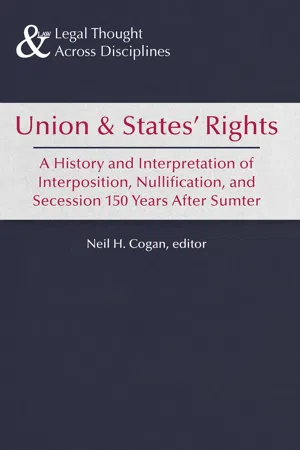
The third book in the &LAW series addresses the perpetual issue of state sovereignty in the federal union-'states' rights.' From the 1770s, through the Confederate states' secession, and continuing until now, a central issue of governance is state power to object to, cancel, or be immune from federal law. The issue is fervently debated in the political arena by Tea Party efforts to limit federal intervention in education and health care; and the nullification movement efforts to prevent federal gun control and marijuana regulations. And it is a linchpin of the Supreme Court's ruling on the Voting Rights Act. This volume provides an intelligent voice in the debate about states' rights-interposition, nullification, secession, constitutional amendment-150 years after Fort Sumter.
eBook - ePub
Union and States' Rights
A History and Interpretation of Interposition, Nullification, and Secession 150 Years After Sumter
- 224 pages
- English
- ePUB (mobile friendly)
- Available on iOS & Android
eBook - ePub
Union and States' Rights
A History and Interpretation of Interposition, Nullification, and Secession 150 Years After Sumter
About this book
Information

I
James Madison’s Views

1 | “A Real Nondescript”James Madison’s Thoughts on States’ Rights and Federalism Jack N. Rakove, Stanford University |
On March 12, 1833, four days before his eighty-second birthday, James Madison wrote Senator William Cabell Rives to commend the speech that his Virginia protégé had just given denouncing the dangerous constitutional theory of nullification emanating from South Carolina. “It seems strange that it should be necessary to disprove this novel and nullifying doctrine,” Madison observed, “and stranger still that those who deny it should be denounced as Innovators, heretics & Apostates.” That was a comment for the crisis of the moment, but Madison used it, as he often did in his writings, to introduce a more sustained analysis of the question at hand. “Our political system is admitted to be a new Creation—a real nondescript,” he observed. “Its character must therefore be sought within itself; not in precedents, because there are none; not in writers whose comments are guided by precedents.” Who could possibly know how writers like “Vattel and others of that class” could make sense of the “Compound & peculiar system” that was the American federal republic?1
“Nondescript” to Madison meant something very different from its colloquial use in American English today. Here it indicated that the object to be examined—the American form of federalism—had never been previously known, much less adequately described. Or as Madison wrote John Tyler, Virginia’s other senator, about the same time as he wrote Rives, “[T]he system was to be a new & compound one—a nondescript without a technical appellation for it.”2 Tyler had taken a position very different from that of Rives in the Senate debates, and Madison’s intention was to correct Tyler’s charge that the purpose of the Virginia Plan of May 1787 “was to render the states nothing more than the provinces of a great Government, to rear upon the ruins of the old Confederacy a Consolidated Government, one and indivisible.”3 Reasoning like this drove Madison to a borderland of intellectual dejection. To analyze the nature of a constitution, he insisted, “let candor decide whether it be not more reasonable & just to interpret the name or title by facts on the face of it, than to torture the facts by a bed of Procrustes into a fitness to the title.”4
This was not a new motif in Madison’s political thinking. In Federalist No. 37, his remarkable meditation on the difficulty of constitution-making, Madison had laid out an epistemological model for the rational discussion of political phenomena. There he emphasized the difficulty of tidily dividing and distinguishing the powers of government either between state and nation or among its departmental institutions. The first application of this approach came only two essays later, in the discussion of the national and federal (that is, state-based) aspects of the proposed Constitution in Federalist No. 39. Some commentators find Madison’s fivefold analysis of this problem frustrating in its detail or perhaps even disingenuous in slighting the decisive advantages that the national government might finally obtain over the states. Yet Madison’s scheme for classifying the different modes in which the system would operate was fully consistent with the principles he had set out in Federalist No. 37. Equally important, it remained the basis upon which Madison continued to reason about federalism for the next four decades and thus a source of his annoyance and concern with the dangerous tendencies he saw in American politics during the final years of his life. Madison understood that the truth of American federalism—that “nondescript,” unprecedented form of government—could be grasped only in its details. Instead, he lived long enough to worry that the discourse of federalism was degenerating into a contraposition of two absolute and simplistic formulas, one based on an appeal to the irreducible primordial sovereignty of the states and the other on the invocation of a national “We the people” that could be read to threaten the residual source of state autonomy he thought needed to be preserved. Nullification was the immediate object of his concern in the early 1830s, but the threat of secession trailed not very far behind. Madison’s intellectual despair for the Union was thus a function of the risks that political leaders were taking by substituting simplistic formulae for the civic duty to understand, and thus work with, the “nondescript” federal system his generation had created.
A conventional piece of American constitutional wisdom holds that the question of secession was definitively settled on the battlefield. Inter arma leges silent, and why cannot that adage apply just as readily to questions of constitutional import as it does to the ordinary violence of war? In July 1863, Gettysburg and Vicksburg rendered the key initial verdicts on the controversy, opening prospects for an ultimate Union victory, and Appomattox ended any possibility for a final appeal. On the other side of the question, one can easily imagine the counterfactual alternative, that a Southern victory at arms could have established a conclusive precedent validating the right of secession. Just as the Northern victory made the idea of secession permanently unconstitutional, so a Southern victory would have confirmed the ultimate conclusion that long lay latent in states’ rights thinking.
Against these suppositions, however, there stands a different premise grounded in the original statement of the promise of American constitutionalism set by Alexander Hamilton in the opening paragraph of The Federalist. “It has been frequently remarked,” Hamilton observed, “that it seems to have been reserved to the people of this country, by their conduct and example, to decide the important question, whether societies of men are really capable or not of establishing good government from reflection and choice, or whether they are forever destined to depend for their political constitutions on accident and force.” A constitutional doctrine either established or disproven by military success would fall closer to the “accident and force” pole of Hamilton’s contrast than to “the reflection and choice” model that The Federalist was written to support. To reduce or equate the validity of secession with the course of war would convert a basic problem of constitutional governance into a matter of military fate.
Equally important, in the absence of an explicit warrant in the text of the Constitution, the idea of either secession or nullification as legitimate constitutional options seems just as problematic. In both cases, the appeal to force is a likely, indeed necessary element in a new equation of governance. Nullification supposes that the physical intervention of state authorities will prevent the execution of national law, and secession is credible only when one can imagine the people of a state or region mobilizing to sustain such a decision. Why would a national government wielding legislative authority under the Supremacy Clause relent in enforcing its law, if the population it would govern had not already expressed its capacity to resort to force against the federal union?
Secession itself was not an issue that came under discussion during the constitutional debates of the late 1780s. If it had, modern scholars would be familiar with an array of relevant quotations, and would not need to speculate so much. Yet the question of the use of force against recalcitrant states had been part of prior discussions of the federal system. Among those most interested in this question was James Madison. As a young member of the Continental Congress, Madison was part of a committee of three appointed just as the Articles of Confederation took effect on March 1, 1781. The committee’s task was to “prepare a plan to invest the United States in Congress assembled with full and explicit powers for carrying into execution in the several states all acts or resolutions passed agreeably to the Articles of Confederation.”5 Its report, written in Madison’s hand, took the radical step of suggesting that Congress should propose a new amendment to the Confederation to deal with states that “shall refuse or neglect” to perform their federal duties under Article 13. Congress would be “fully authorized to employ the force of the United States as well by sea as by land to compel such State or States to fulfill their federal engagements,” particularly by closing off their commerce with other states or foreign nations.6
This proposal did not long survive in the two succeeding committees that took over the original committee’s work.7 Still, the idea of using coercion as the mechanism of federal enforcement retained some appeal in Madison’s thinking. Writing to Governor Thomas Jefferson on April 16, 1781, Madison suggested that the use of coercion would not be such a difficult matter. One method of enforcement might be to dispatch small contingents of Continental troops, “acting under Civil authority,” into the delinquent state. “But there is a still more easy and efficacious mode,” Madison continued. Virtually every state would be subject to naval coercion; park a frigate or two outside its principal port or ports, and it would soon be willing to comply. Over the long run, Madison mused, a navy formed under proper national authority would have further benefits. It “would not only be a guard against aggression & insults from abroad; but without it what is to protect the Southern States for many years to come against the insults & aggressions of their N[orthern] Brethren?”8
The shelling of Fort Sumter began exactly fourscore years (minus four days) after Madison wrote this letter. It was a grim, if perverse, echo of Madison’s 1781 observation. Fort Sumter was built to defend Charleston, not to isolate it, but in 1861 it threatened to become a simple variation of Madison’s notion of naval enforcement. (By contrast, the role of the federal navy in the blockade of the Confederacy is the obverse of what Madison had envisioned in 1781.) Beyond this irony, however, what remains more striking is the constitutional question with which Madison was already wrestling. Was coercion the only or final mechanism for enforcing federal measures, or could there be some other basis for coordinating national governance with the states?
For nearly six years after Madison wrote to Jefferson, that question lay moot. The American victory at Yorktown in October 1781 made the absence of direct congressional authority over the states less urgent. The attention of nationally minded leaders shifted instead to the task of ratifying the various amendments to the Confederation that Congress sent to the states: the impost of 1781; the revenue measures, including a revised impost, proposed in April 1783; and then two amendments relating to foreign commerce recommended a year after that. So long as those amendments set the agenda for reform, the underlying premise was that the essential structure of the Confederation would remain intact, with moderate changes in the authority of Congress.
That agenda shifted, of course, after September 1786, when the rump conference at Annapolis led to the general convention that assembled at Philadelphia in May 1787. Madison played a critical role in these developments, both by attending the Annapolis Convention and then by taking on the task of framing a broad agenda for Philadelphia. As it became clear that this agenda would not be limited to enu...
Table of contents
- Cover Page
- Halftitle Page
- Title Page
- Copyright Page
- Dedication
- Contents
- Contributors
- Acknowledgments
- Introduction
- Part I: James Madison’s Views
- Part II: Antebellum Arguments
- Part III: Impact of the 14th Amendment
- Part IV: Contemporary Views of Interposition, Nullification, and Secession
- Part V: Critical Views of Federalism, States’ Rights, and Memories of Secession
- Index
Trusted by 375,005 students
Access to over 1.5 million titles for a fair monthly price.
Study more efficiently using our study tools.
Frequently asked questions
Yes, you can cancel anytime from the Subscription tab in your account settings on the Perlego website. Your subscription will stay active until the end of your current billing period. Learn how to cancel your subscription
No, books cannot be downloaded as external files, such as PDFs, for use outside of Perlego. However, you can download books within the Perlego app for offline reading on mobile or tablet. Learn how to download books offline
Perlego offers two plans: Essential and Complete
- Essential is ideal for learners and professionals who enjoy exploring a wide range of subjects. Access the Essential Library with 800,000+ trusted titles and best-sellers across business, personal growth, and the humanities. Includes unlimited reading time and Standard Read Aloud voice.
- Complete: Perfect for advanced learners and researchers needing full, unrestricted access. Unlock 1.5M+ books across hundreds of subjects, including academic and specialized titles. The Complete Plan also includes advanced features like Premium Read Aloud and Research Assistant.
We are an online textbook subscription service, where you can get access to an entire online library for less than the price of a single book per month. With over 1.5 million books across 990+ topics, we’ve got you covered! Learn about our mission
Look out for the read-aloud symbol on your next book to see if you can listen to it. The read-aloud tool reads text aloud for you, highlighting the text as it is being read. You can pause it, speed it up and slow it down. Learn more about Read Aloud
Yes! You can use the Perlego app on both iOS and Android devices to read anytime, anywhere — even offline. Perfect for commutes or when you’re on the go.
Please note we cannot support devices running on iOS 13 and Android 7 or earlier. Learn more about using the app
Please note we cannot support devices running on iOS 13 and Android 7 or earlier. Learn more about using the app
Yes, you can access Union and States' Rights by Neil H. Cogan in PDF and/or ePUB format, as well as other popular books in Law & North American History. We have over 1.5 million books available in our catalogue for you to explore.