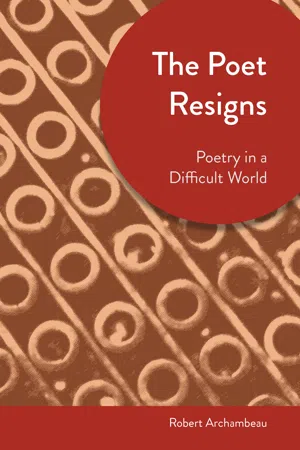
What are we really wishing for when we want poetry to have the prominence it had in the past? Why do American poets overwhelmingly identify with the political left? How do poems communicate? Is there an essential link between formal experimentation and political radicalism? What happens when poetic outsiders become academic insiders? Just what makes a poem a poem? If a poet gives up on her art, what reasons could she find for coming back to poetry? These are the large questions animating the essays of The Poet Resigns: Essays on Poetry in a Difficult Time, a book that sets out to survey not only the state of contemporary poetry, but also the poet's relationship to politics, society, and literary criticism. In addition to pursuing these topics, The Poet Resigns peers into the role of the critic and the manifesto, the nature of wit, the poetics of play, and the persistence of modernism, while providing detailed readings of poets as diverse as Harryette Mullen and Yvor Winters, George Oppen and Robert Pinsky, Pablo Neruda and C.S. Giscombe. Behind it all is a sense of poetry not just as an academic area of study, but also as a lived experience and a way of understanding. Few books of poetry criticism show such range-yet the core questions remain clear: what is this thing we love and call 'poetry, ' and what is its consequence in the world?
- 144 pages
- English
- ePUB (mobile friendly)
- Available on iOS & Android
eBook - ePub
About this book
Information
Topic
LittératureSubtopic
Critique littéraire en poésiePoets and Poetry
A Portrait of Reginald Shepherd as Philoctetes
Philoctetes, sadly, has never been a favorite character of Greek legend. He gets only a brief mention in the Iliad, and missed his chance for greater acclaim when the last manuscript of Proclus’ Little Iliad, where he may have played a greater role, was lost to history. The Greek tragedians liked him—he’s the subject of a play by Aeschylus and another by Euripedes, and two by Sophocles—but their audiences didn’t fall in love with any of these plays, and history has been unkind to the manuscripts: only one full Sophoclean script remains, along with a few lines of the other. The Aeschylus and Euripedes have fared even worse: neither has been preserved, even in fragment. When Edmund Wilson surveyed the history of the Philoctetes story in The Wound and the Bow, he found it left surprisingly little trace in literary history: a bungled seventeenth-century French play by Chateaubrun, a chapter of Fénelon’s Télémaque, an analysis by Lessing, a sonnet by Wordsworth, a John Jay Chapman adaptation, and a version by André Gide. The six decades since Wilson’s survey have added little to this short list: mentions in Derek Walcott’s Omeros and Seamus Heaney’s The Cure at Troy, and a few short poems by Michael Ondaatje, are the only distinguished examples.
This is a shame, in that the Philoctetes story seems remarkably suited to our times. It is, after all, a story of othering, or (to steal one of Reginald Shepherd’s words) of otherhood. An archer equipped with a bow that never missed its mark, Philoctetes suffered a wound to his foot so distasteful to his fellow Greeks that they stranded him on an island en route to Troy. Ten years into their fruitless war, the Greeks learn that without the skills of the man they’ve wronged, they cannot win. They coax the understandably outraged Philoctetes to join them, which he does, distinguishing himself in battle. Edmund Wilson saw the story in a Romantic light, treating it as a myth of the alienated artist whose skill is somehow connected to his isolation. But we can see the story in more contemporary terms, too, as a myth of social disenfranchisement and the damage it causes. Seen this way, the real wounds aren’t physical at all. They are, rather, the social and psychological burdens placed on those othered, and the losses to society caused by its failure to embrace the human potential of all of its members. It is no accident that the three poets to pick up the story after Wilson are all postcolonials.
Reginald Shepherd’s poetic career mirrors the Philoctetes story in both its contemporary and Wilsonian versions. The contemporary version of the story fits in that being born gay, black, and poor in America—as Shepherd was—is to be triply othered, to be shunned and devalued for one’s sexuality, race, and class. It isn’t that gayness, blackness, and poverty are wounds in themselves: it is that America treats these things in a wounding way, much as the Greeks treated Philoctetes. Just as the Greeks’ cause at Troy suffered because of their failure to embrace Philoctetes, America suffers from its othering of people like Shepherd. The Wilsonian version of the myth also applies to Shepherd, in that Shepherd’s poetic genius is intimately connected to his otherness in American society: his work returns, again and again, to the particulars of his outsider status. Shepherd’s poems also return to the same solutions to the dilemma of otherhood, seeking solace in never-quitetrusted yearnings for beauty and interracial erotic fulfillment.
Over thirteen years and five books of poems, from Some are Drowning (1994), and Angel, Interrupted (1996) through Wrong (1999) and Otherhood (2003), and on to his collection of 2007, Fata Morgana, Reginald Shepherd consistently explored the same issues, and tested the same forms of solace. If, as T. S. Eliot maintained, one criterion of a major poet is a career devoted to a “continuous conscious purpose” (43) then Shepherd, who died in his forties, showed tremendous promise of becoming just such a poet. Another of Eliot’s criteria for the major poet is that the parts of the work add up to a whole greater than the sum of the parts, that such a poet “is one the whole of whose work we ought to read, in order to fully appreciate any part of it” (44). If this criterion is taken into account, the case for Shepherd’s majority becomes even stronger. Taken as a whole, the work represents a journey through the predicament of otherness to a new way of being at home in the world.
*
Assessing Shepherd’s achievement from an Eliotic point of view is particularly appropriate given how deeply Eliot influences Shepherd’s poetry, especially the earlier work. Some are Drowning is saturated with Eliotic phrasing and imagery. A poem like “L’Enlèvenment d’Amymoné,” for example, wears its influence on its sleeve, from the Eliotic French of the title to the rendition of birdsong (“Jug jug. Tereu”) proudly lifted from The Waste Land (20). The book is also filled with despoiled landscapes familiar to readers of Eliot: Boston’s Charles River appears as a close cousin of Eliot’s despoiled Thames when Shepherd writes “the Charles is choked with candy wrappers, / and here a single hyacinth / surrenders to a bus’s wheels” (9). Even the book’s recurring images of drowning—Shepherd’s symbol for the loss of self—seem to owe something to The Waste Land’s famous “Death by Water” section. The book’s most profound affinity with Eliot, though, comes in its obsession with that most Eliotic of themes, the fear of a life not fully lived. Shepherd is no Prufrock, though, dying of a severe case of respectability. Rather, Shepherd depicts a world where lives go unfulfilled because of the wounds dealt out for reasons of otherness.
“Brotherhood” provides one of the book’s most direct treatments of the way individual poverty conditions experience in affluent America. The poem begins with a slightly uneasy moment of Romantic consolation, with the poet seeking solitude in nature (a nature even here not unmarked by hints of an Eliotic despoilation):
He wonders how he should standat the public shore where sand and liquid saltimmerse immobile feet as if it were still summer,as if the soothing brine weren’t taintedby the tugs plying the horizon. (13)
The lines that follow show us both how low-wage drudgery generates the need for this kind of Romantic escape to nature and solitude, and how it prevents the realization of such an escape:
He wants to know how to turn back, get on the busand pay the fare; how to allow the head to driftagainst the window towards the scenic reveriepavements repossess (a sheltered suburbshaded with plane trees), and notdrift into thoughtless sleep. He’d like to stealhis life back, hour-per-hour wage, he’d like to rewritethe working week. (13)
He yearns to take back the life that’s been stolen from him by hourly-wage drudgery, but the attempt at a Romantic escape bears the imprint of his economic limitations: his trip to a “tainted” public beach can’t drive away his exhaustion or his consciousness of the fare he has to pay. Everything is haunted by an economic insecurity that sets the speaker apart: the “scenic reverie” is, after all, “repossess[ed]” (13). Poetry seems like a weak tool for transcending class conditions: the poet may yearn to “rewrite / the working week,” but can’t. Life slips away between work and the drifting-off into “thoughtless sleep” (13). It’s rare to find such frankness about class in American writing: the character’s predicament here is more like that of E. M. Forster’s Leonard Bast than it is like any in the American classics.
In “Tantalus in May” Shepherd examines the burden of society’s barely-concealed hostility toward his sexuality. He invokes the Greek myth of a man sentenced to be forever near to the always-unattainable objects of his desire, then shows us “a frat boy who turns too sharply from my stare” with hints of violence and danger (56). Conditioned by hard experience to curb expressions of his desire, the speaker finds himself out of joint with a world blossoming out into open desire and fulfillment. “Everywhere I look,” he says, “it’s suddenly spring. No one asked / if I would like to open up drastically” (56). The predicament is classically Eliotic: life goes unlived, desires go unacted-upon, and there is only cruelty for the speaker in this blossoming April.
Even in environments where his sexuality is dominant, Shepherd frequently finds himself othered, ill-at-ease because of his blackness. “Three A.M. Eternal,” for example, gives us “a small room full of smoke and men, / pale bodies wavering” where the speaker asks “why should it always be such pearled white skin?” He finds the men’s “words / too blonde” and, in a “room so white” he tells us he’d “like to open / a door, someone, or just to breathe” (7). There’s an oddness in that last phrase, in which one of the imagined forms of relief would be to open someone. But the idea of opening out a person is intended, and recurs elsewhere in the book. The image is much like the one we see in “Tantalus in May,” for example, where the speaker can’t open himself out. The recurrence shows us how insistently Shepherd returns to the idea of the life closed-off through the inhibitions of otherness. It also shows us how closely intertwined the poems of this book are, how they build upon shared patterns of images. The “continuous conscious purpose” Eliot found so central to the major poet is definitely at work in these pages.
Shepherd isn’t content merely to log the difficulties of otherness. With tremendous candor, he writes of his yearnings to escape from the burdens America thrusts upon him. Frequently, he imagines transcendent erotic experiences with white men, moments when it seems briefly possible to pass beyond painful history, beyond social division, even beyond individual identity. In “Johnny Minotaur,” for example, Shepherd describes a sleeping lover as a kind of adored blankness:
Sullen boy, sightsullies you; it’s made you what you are. I preferto watch you sleep, your face adorned by lack,your person sacrificed to first light slattedthrough matte blinds. I’m not ready to give that upjust yet…(30)
The speaker knows that the emptiness of the sleeping lover is an illusion, that no person is simply pure beauty free of subjectivity and all its complications. But Shepherd longs for such an impossibility here, as he does in “A Muse,” where he looks at another beautiful man and finds himself “bewildered / by the eden of his body.” The prelapsarian world seems briefly possible through eros. It is a world where physical divisions, linguistic conventions, and individual identities seem to dissolve. “He doesn’t even know his name,” Shepherd writes of the man, “in his body he’s one with air, white as a sky / rinsed with rain” (36).
Such dreams of a paradise beyond identity and otherness may haunt Shepherd, but he never loses himself in them entirely. Often, he finds the longed-for escape from otherness and its burdens collapses into the very history it seeks to transcend. We see this in “The New World,” where Shepherd begins by conflating erotic conquest with the voyages of discovery that initiated the long, sad history of slavery:
This is the paradise of emptiness, I saidand journeyed into faithless terra incognita,the muscles of his stomach on displaywhen he wipes his face with his shirt. (6)
The connection becomes more explicit when we hear of “his stomach, peaks of nipples / briefly glimpsed before the cotton field unfolds”—the cotton of the lifted shirt becomes the cotton fields of the slave plantations. Instead of the Edenic body, we find ourselves in “the semiotic underworld / of palms and discontent” (6). The poem ends with an admission that no escape from history and its legacies of disenfranchisement is possible:
Setting out upon the voyage of the new, one comes uponthe well-mapped coast, Atlantic dripping in noon lightafter the flood, and orichalcum instead of gold.I have already misplaced his name:there is no new world. (6)
Just because something is impossible, of course, doesn’t mean we don’t desire it, even need it. Perhaps the most moving depiction of this predicament in Some are Drowning comes in “Paradise,” where Shepherd describes the “histories of high achievement” that took place while his “great-grandparents were hidden among the cotton, / slaves.” He feels bound to speak for them, but also wishes to be relieved of that burden, and speak only for himself. “Let the lost,” he says, “this once, bury the lost” (10). His conflicting desires—to be true to, but also to transcend, the tragic history of the African-American experience—lead to this astonishing passage:
Swallow, swallow, when shall Ibe like the swallow, singing the rapeof my voice, but singing past the rape, somethingmy own to sing? And not live by white men’smyths (not to reject those too-clear eyes, but notto long for them, or see through their blue distancesall colors but my own) (10)
Here, the desire to escape “white men’s myths” comes couched in the form of a white man’s myth: Ovid’s story of Philomela, who was raped, had her tongue cut out, and was then transformed into a swallow, singing with a new voice. History and the burdens of otherness prove inescapable—even the forms in which Shepherd yearns for escape bind him to them (10). In another poem, “Wide Sargasso Sea,” Shepherd gives us his most powerful image for this state of affairs, in which the sign of healing and the sign of an enduring wound become one. In the midst of a dizzying montage of suffering slaves, sugarcane plantations, and eroticized “blue-eyed / planters’ sons at play,” Shepherd pauses over the image of the “broken skin” of a wounded past and says “I’ll be / the scar” (8).
There’s more to this prodigious first collection than I’ve been able to describe—notably two powerful elegies for the poet’s mother, which frame the book. But it is the concern with the wounds of otherness, and the ambivalence about beauty and eros as paths to healing those wounds, which connect the book to the main body of Shepherd’s work.
*
The arc of Shepherd’s career over his next three books of poetry is one of immersion and transformation: the Reginald Shepherd we meet in Angel, Interrupted has plunged more deeply than ever into desire and the attempt to transcend otherness through eros; in Wrong we see him coming to terms with mortality and the limits of desire; in Otherhood Shepherd begins to develop a myth of death and rebirth that changes his relationship to his own dreams of desire. This journey is important, in that it shows us Shepherd developing even as he builds on his earlier work.
If Angel, Interrupted doesn’t make Shepherd poet laureate of Chicago’s Boystown, the predominantly gay neighborhood south and east of Wrigley Field, there is no justice. Should the neighborhood be destroyed, one could almost rebuild it all, from the Belmont rocks to the clubs on Halstead Street, using the descriptions in Shepherd’s poems. One might expect to find Shepherd at home here, and, indeed, the place does at times seem lik...
Table of contents
- Cover Page
- Halftitle Page
- Title Page
- Copyright Page
- Dedication
- Acknowledgments
- Contents
- Instead of an Introduction: Letter of Resignation
- Situations of Poetry
- To Criticize the Poetry Critic
- Poets and Poetry
- Myself I Sing
Trusted by 375,005 students
Access to over 1.5 million titles for a fair monthly price.
Study more efficiently using our study tools.
Frequently asked questions
Yes, you can cancel anytime from the Subscription tab in your account settings on the Perlego website. Your subscription will stay active until the end of your current billing period. Learn how to cancel your subscription
No, books cannot be downloaded as external files, such as PDFs, for use outside of Perlego. However, you can download books within the Perlego app for offline reading on mobile or tablet. Learn how to download books offline
Perlego offers two plans: Essential and Complete
- Essential is ideal for learners and professionals who enjoy exploring a wide range of subjects. Access the Essential Library with 800,000+ trusted titles and best-sellers across business, personal growth, and the humanities. Includes unlimited reading time and Standard Read Aloud voice.
- Complete: Perfect for advanced learners and researchers needing full, unrestricted access. Unlock 1.5M+ books across hundreds of subjects, including academic and specialized titles. The Complete Plan also includes advanced features like Premium Read Aloud and Research Assistant.
We are an online textbook subscription service, where you can get access to an entire online library for less than the price of a single book per month. With over 1.5 million books across 990+ topics, we’ve got you covered! Learn about our mission
Look out for the read-aloud symbol on your next book to see if you can listen to it. The read-aloud tool reads text aloud for you, highlighting the text as it is being read. You can pause it, speed it up and slow it down. Learn more about Read Aloud
Yes! You can use the Perlego app on both iOS and Android devices to read anytime, anywhere — even offline. Perfect for commutes or when you’re on the go.
Please note we cannot support devices running on iOS 13 and Android 7 or earlier. Learn more about using the app
Please note we cannot support devices running on iOS 13 and Android 7 or earlier. Learn more about using the app
Yes, you can access The Poet Resigns by Robert Archambeau in PDF and/or ePUB format, as well as other popular books in Littérature & Critique littéraire en poésie. We have over 1.5 million books available in our catalogue for you to explore.