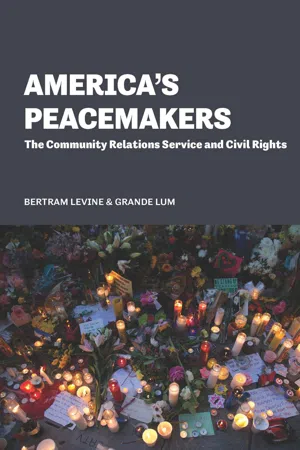
America's Peacemakers: The Community Relations Service and Civil Rights tells the behind-the-scenes story of a small federal agency that made a big difference in civil rights conflicts over the last half century. In this second edition of Resolving Racial Conflict: The Community Relations Service and Civil Rights, 1964–1989, Grande Lum continues Bertram Levine's excellent scholarship, expanding the narrative to consider the history of the Community Relations Service (CRS) of the U.S. Department of Justice over the course of the last three decades. That the Trump administration has sought to eliminate CRS gives this book increased urgency and relevance.
Covered in this expanded edition are the post–9/11 efforts of the CRS to prevent violence and hate crimes against those perceived as Middle Eastern. Also discussed are the cross-border Elián González custody dispute and the notable tragedies of Trayvon Martin and Michael Brown, both of which brought police interaction with communities of color back into the spotlight.
The 2009 Matthew Shepard and James Byrd, Jr., Hate Crimes Prevention Act substantially altered CRS's jurisdiction, which began to focus on gender, gender identity, religion, sexual orientation, and disability in addition to race, color, and national origin. Lum's documentation of this expanded jurisdiction provides insight into the progression of civil rights. The ongoing story of the Community Relations Service is a crucial component of the national narrative on civil rights and conflict resolution. This new edition will be highly informative to all readers and useful to professionals and academics in the civil rights, dispute resolution, domestic and international peacemaking, and law enforcement-community relations fields.
eBook - ePub
America's Peacemakers
The Community Relations Service and Civil Rights
- English
- ePUB (mobile friendly)
- Available on iOS & Android
eBook - ePub
About this book
Information
PART I
ONE
Lyndon Johnson Sets the Stage
IT WAS JULY 2, 1964. After a decade of racial turmoil, after a year of anguished debate, including a record eighty-three-day filibuster in the Senate, Congress—in the face of still solid southern resistance—had passed the most sweeping civil rights legislation since the post–Civil War period. President Lyndon Johnson was about to sign it, and the White House spared no effort to dramatize the moment.
The Civil Rights Act was rushed to the president within hours of final congressional approval. In the East Room the stage had been set for a full-production signing ceremony at which the president’s message would be loud and clear. The media had been alerted so that the word would go forth during prime time. All the leaders of the civil rights movement, the most powerful members of Congress, and the key figures of the Justice Department had been invited to share the moment that would crown their labors and establish the law.
The citizens of a concerned nation were looking on, many with grave doubts and questions. For minorities—particularly Blacks—the question was: would the federal government make sure that the law was obeyed? For southerners, it was: would federal enforcement bring the “police state” that some of their spokesmen had decried? For conservatives, it was: how much federal intrusion would there be in local affairs? For most Americans—and for the president himself—there was one overarching question: would this end the violence, or would defiance of the new law require harsh federal enforcement that would add fuel to the already inflamed passions that had been tearing the country apart?
TO HELP THE MEDICINE GO DOWN
The Civil Rights Act of 1964 was strong medicine. It reached into the fiber and tissue of American society, creating new channels for redress of racial discrimination. It declared job discrimination unlawful and created the Equal Employment Opportunities Commission. It outlawed segregation in all publicly supported facilities and certain establishments serving the general public. It strengthened protections of equality in voting and in education. It required policies of racial equity in every institution that accepted a dollar of federal assistance.
The president’s remarks were a plea for reconciliation. He sounded a call for voluntary compliance. He made little reference to the substance of the new law; he spoke, instead, of how he was going to help the medicine go down. He discussed none of the details of what the legislation contained save for one of its lesser—and little-debated—provisions. This was the establishment in the Department of Commerce of a federal mechanism for the conciliation of racial conflict. The Community Relations Service had been created to help communities voluntarily reduce racial violence and comply with civil rights laws.
The reason for his special emphasis was rooted in his understanding of the times. It also reflected the impact of the previous ten years on Lyndon Johnson the man and Lyndon Johnson the politician.
During this time period, racial conflict born of resistance to the African American thrust for social and economic equity had been searing the American consciousness for a full ten years. It started with the Supreme Court’s landmark school desegregation decision in May 1954, which was followed two months later by the formation in Mississippi of the first fortress of opposition, the White Citizens Council. Similar organizations then mushroomed throughout the South. Massive resistance to school desegregation followed. This was marked by violence, intimidation, school closings, and confrontations between Blacks and whites, between federal law enforcement agents and local communities.
The killing of fourteen-year-old Emmett Till in 1955 had been headlined around the world as symbolic of brutally enforced repression of Blacks in America. Ensuing years were marked by a string of dramatic events. There was the Montgomery bus boycott and the consequent birth of the Southern Christian Leadership Conference (SCLC). There were the sit-ins and freedom rides and the birth of the Student Nonviolent Coordinating Committee (SNCC). There were the torchings and bombings of Black churches and the homes of civil rights leaders. There were the murders of civil rights activists. There was the application of federal force: to enforce school desegregation in Little Rock; to face down Governor George Wallace’s effort to bar the entry of a Black student at the University of Alabama; to assure safe entry of Blacks at the University of Georgia and the University of Mississippi. There were the assaults by law enforcement agencies on peaceful protesters in Birmingham. And there was the 1963 March on Washington by a quarter-million advocates of civil rights legislation.
In June 1964, at the very time that Congress was bringing the Civil Rights Act to its culminating votes, the nation’s headlines reflected a fever of racial violence. Eight hundred whites assaulted a civil rights demonstration in St. Augustine, Florida, hospitalizing nineteen African Americans. The disappearance (and suspected murder) of three civil rights workers in Mississippi alarmed the nation, causing the president to send hundreds of military personnel to help search for the bodies. Thousands of northern college students were recruited and trained for civil rights work in the South that summer. The Justice Department warned that the federal government lacked the jurisdiction and resources to guarantee their safety.1
The disproportionate attention given by Johnson at the signing ceremony to the Community Relations Service and to voluntary compliance reflected his reading of the temper of the times. Millions of whites bitterly resented, and many feared, the imposition of federal law that would wipe away a cherished way of life. Millions of Blacks—and whites as well—were determined that the new law, won after ten years of protest in the face of violent resistance, must be obeyed. Many Americans saw the potential for new violence. As a pragmatist, Johnson believed in the value of persuasion and negotiation. As a politician facing nomination and election challenges later in the year, he knew he had to stand four-square behind the nation’s now highly popular civil rights goals. At the same time, he must, at all cost, avoid circumstances that might require him to order U.S. troops to take action—at gunpoint if necessary—against a resistant South.
LEGISLATIVE HISTORY
Johnson’s advocacy of a federal conflict resolution capability contrasted sharply with the less-than-major priority assigned to that provision by the civil rights bill’s staunchest advocates. Most of them looked upon it as a useful adornment but not critical. LBJ, on the other hand, was personally committed to nurturing it and assuring achievement of its full potential. For the next two years he gave it closer personal attention than he did any other federal agency of such relatively microscopic proportions. He gave it higher priority than did any president who followed him.
Johnson had first envisioned a federal agency to mediate racial conflict seven years earlier, during Senate consideration of the Civil Rights Act of 1957. It reflected his conviction that most conflict could be negotiated. “Let us reason together” was a well-worn phrase in his Senate—and later in his White House—vocabulary. Why not create a racial conflict resolution service similar to the Federal Mediation and Conciliation Service, which mediated labor disputes? He took his idea to Arthur Goldberg, a distinguished labor relations lawyer (later to serve as a Supreme Court justice and as U.S. ambassador to the United Nations). At Johnson’s request Goldberg and Gerald Siegel, counsel to the Senate Policy Committee (which Johnson chaired as majority leader), worked up proposed legislation. But Johnson did not introduce it. Rowland Evans and Robert Novak reported: “Ben Cohen had told Johnson repeatedly that it would never satisfy the liberals. The proposal never left Johnson’s pocket.”2 The civil rights bill that was enacted in 1957 authorized the creation of two other agencies—the independent Civil Rights Commission and the Civil Rights Division of the Department of Justice.
Johnson waited until the next session of Congress to introduce a bill calling for creation of a Community Relations Service. It envisioned a race relations agency with a staff of one hundred working out of regional offices to help local communities when disagreement threatened to disrupt peaceful relations among citizens.
Johnson’s speech introducing that bill—considered by the Senate Judiciary Committee, but never acted upon—reflected an acute understanding of the dynamics of community conflict and a vision of the inevitability of civil rights changes. It was years ahead of what the public would hear from any other high-ranking official.
The idea of a federal conciliation effort in the civil rights field caught on in other quarters. The Civil Rights Commission proposed that a conciliation function, to be focused on school desegregation, be added to the commission’s own responsibilities. Harris Wofford, counsel of the commission (later to be the civil rights flag bearer of the Kennedy White House and still later a U.S. senator from Pennsylvania), reported in his book Of Kennedys and Kings:
The Commission also recommended that it be authorized “to establish an advisory and conciliation service to assist local school officials in developing plans designed to meet constitutional requirements and local conditions and to mediate and conciliate, upon request, disputes as to proposed plans and their implementation.” This was an idea that Lyndon Johnson had been advancing for several years. Civil rights leaders tended to look askance at any such approach that implied mediation instead of enforcement, but the Northern Commissioners joined their Southern colleagues in thinking such a service could be constructive.3
In the Eighty-seventh Congress (1961–62), bills calling for a Community Relations Service were submitted by various liberal representatives and senators. None were reported out of committee.
The comprehensive civil rights bill that the Kennedy administration submitted to the Eighty-eighth Congress on June 19, 1963, did provide, in its original Title IV, for the establishment of a Community Relations Service. It was consistent in form and function with the original Johnson proposal of 1959. It had not been included in the White House staff’s original conception of the bill but had been added as an afterthought.
Even though Vice President Johnson was chairman of the President’s Committee on Equal Employment Opportunity, White House staff had failed to include him in the earliest discussions of the proposed civil rights legislation. Lee White, who served as presidential counsel and civil rights point man under both Kennedy and Johnson, recalls that Johnson brooded about this. “He was a proud and in some ways a sensitive guy. He did not want to insinuate himself. But if President Kennedy asked him to do something, he was delighted.”4 Finally, in the last days before the bill was sent to Congress, President Kennedy directed that LBJ be drawn into the circle, and for the duration of the Kennedy administration he energetically served as a major civil rights strategist.
Theodore C. Sorensen, one of President Kennedy’s closest advisers, recalls Johnson proposing the creation of the Community Relations Service in the course of a long telephone conversation between Sorensen and LBJ on June 3, 1963. Sorensen had called to get the vice president’s input for the civil rights bill then reaching its final stages of refinement. In his book Kennedy, Sorensen notes that the bill, as finally submitted, “was different in several respects from the bill we had first discussed with Justice the previous month. . . . With the backing of the Vice President, a Community Relations Service had been added to work quietly with local communities in search of progress. (Negro congressmen had urged that the words ‘mediation’ and ‘conciliation’ had an ‘Uncle Tom’ air about them and should be stricken from the title.)”5
Burke Marshall, who was Robert Kennedy’s assistant attorney general for civil rights, headed the Justice Department’s effort to draft a bill that would be both effective and passable. He, too, credits Johnson with primary influence in putting the CRS provision into the legislation.6
Johnson’s 1958 advocacy of a Community Relations Service is one of the early bits of data that must be considered in the long-running debate of whether LBJ came to be a civil rights partisan as a result of nurture or nature—of politics or commitment. In the late fifties, Johnson was regarded by the civil rights community as “the enemy.” Starting as a Texas congressman in 1939, and then as senator, he had voted against every civil rights measure that had been proposed. As majority leader of the Senate, he had orchestrated the fight against all efforts to weaken the filibuster—the parliamentary device by which the southern minority had been able to resist all civil rights proposals.
Then Johnson made a 180-degree turn on civil rights, according to his most bitter foes. Arnold Aronson, who for almost three decades had been the executive secretary of the Leadership Conference on Civil Rights, said:
Lyndon Johnson was the one who beat us all the time. So from that point of view we regarded him as the enemy. And in ’57 it was Lyndon Johnson who engineered the act’s passage by removing what we regarded as the most important part, which was Title III, which was injunctive power. So Johnson was the enemy. My own feeling, based on what happened later, was that we were wrong. Lyndon Johnson in the early years really identified primarily with his experience with Hispanics more than with Blacks. And you find in the early period, long before he became prominent, that there were evidences that he really felt something which as a southern politico he couldn’t show. Remember, there were only three southern members of the Senate who didn’t sign the Southern Manifesto.7 One of them was Lyndon Johnson. My feeling is that he did what he could. And as soon as he had the clout of the presidency, he went all the way. I think it was genuine. There’s no question he was the greatest president so far as civil rights is concerned. Whether we could have gotten this bill through in the shape that it is with Kennedy, I doubt very much. Johnson addressed the joint session five days after the assassination. He said, “This is the Kennedy legacy and we are going to pass it.” It was the first priority that he took on. We didn’t have to pressure the White House the way we normally did. He was after us. He’d be calling all the time. Have you done this, have you been in touch with X, have you thought about Y. He used all of his political pressures and leverage and know-how.8
Joseph Rauh, as counsel for the Leadership Conference on Civil Rights, had been at the forefront of those lobbying for congressional action. He saw Johnson as struggling between his dues-paying obligation to his southern constituency and the requirement of his political ambition to win acceptance within the broadest spectrum of both the party and the electorate. To find and focus on “safe” civil rights issues appealed to him as an acceptable risk. One such safe issue was the Civil Rights Commission, whose creation he had supported in the Civil Rights Act of 1957. A second was the Community Relations Service. Both might be defined as procedural rather than substantive. They did not, by their creation, change anything. As Rauh put it:
In ’56, or ’57, a House bill came over that was very strong on civil rights, and Johnson flattened it. He wanted a bill that could be called a civil rights bill that wouldn’t get him in dutch with Texas. So what he did was to say to guys like us—Clarence Mitchell and me, primarily—who were the chief lobbyists for the Leadership Conference, “I’m giving you these things.”
What he “gave” us were largely things for which people couldn’t hit him too hard: a Civil Rights Commission and an assistant attorney general for civil rights. (Which also meant a Civil Rights Division.) He had to fight us on the important things like school desegregation.
In ’59, when he proposed the Community Relations Service—that, too, was of a character that doesn’t get Texas anti–civil ri...
Table of contents
- Cover Page
- Half Title
- Title Page
- Copyright Page
- Dedication
- Contents
- Foreword
- Preface to the New Edition
- Preface to the First Edition
- Acknowledgments
- Introduction
- Part I
- Part II
- Conclusion
- Afterword
- Appendix: CRS Timeline of Cases and Significant Milestones
- Selected Bibliography
- Annotated Table of Contents
- Index
- Permissions
Trusted by 375,005 students
Access to over 1.5 million titles for a fair monthly price.
Study more efficiently using our study tools.
Frequently asked questions
Yes, you can cancel anytime from the Subscription tab in your account settings on the Perlego website. Your subscription will stay active until the end of your current billing period. Learn how to cancel your subscription
No, books cannot be downloaded as external files, such as PDFs, for use outside of Perlego. However, you can download books within the Perlego app for offline reading on mobile or tablet. Learn how to download books offline
Perlego offers two plans: Essential and Complete
- Essential is ideal for learners and professionals who enjoy exploring a wide range of subjects. Access the Essential Library with 800,000+ trusted titles and best-sellers across business, personal growth, and the humanities. Includes unlimited reading time and Standard Read Aloud voice.
- Complete: Perfect for advanced learners and researchers needing full, unrestricted access. Unlock 1.5M+ books across hundreds of subjects, including academic and specialized titles. The Complete Plan also includes advanced features like Premium Read Aloud and Research Assistant.
We are an online textbook subscription service, where you can get access to an entire online library for less than the price of a single book per month. With over 1.5 million books across 990+ topics, we’ve got you covered! Learn about our mission
Look out for the read-aloud symbol on your next book to see if you can listen to it. The read-aloud tool reads text aloud for you, highlighting the text as it is being read. You can pause it, speed it up and slow it down. Learn more about Read Aloud
Yes! You can use the Perlego app on both iOS and Android devices to read anytime, anywhere — even offline. Perfect for commutes or when you’re on the go.
Please note we cannot support devices running on iOS 13 and Android 7 or earlier. Learn more about using the app
Please note we cannot support devices running on iOS 13 and Android 7 or earlier. Learn more about using the app
Yes, you can access America's Peacemakers by Bertram Levine,Grande Lum in PDF and/or ePUB format, as well as other popular books in Social Sciences & North American History. We have over 1.5 million books available in our catalogue for you to explore.