eBook - ePub
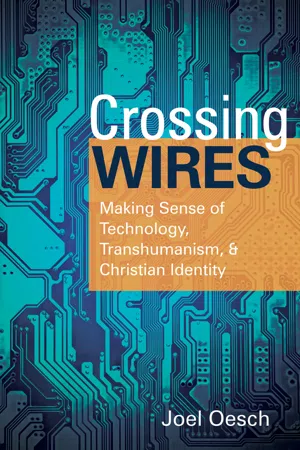
Crossing Wires
Making Sense of Technology, Transhumanism, and Christian Identity
- 170 pages
- English
- ePUB (mobile friendly)
- Available on iOS & Android
eBook - ePub
About this book
The Digital Age has transformed nearly every facet of Western culture. More than ever, people are turning away from face-to-face interactions to spend countless hours mediating life through a screen. Such changes can be felt in the arenas of politics, sexuality, work, and recreation. Some futurists argue for the development of Transhumanism, a commitment to expanding human capacities through the use of applied technologies across a variety of platforms. The proponents promise radically long life, super-intelligence, and extreme bliss. But how does technology shape us at the spiritual level? Do our bodies even matter anymore?
Crossing Wires navigates the complex terrain of digital and robotic technologies with refreshing approachability. The book opens the door for discussions on technology's influence on human identity while laying out a case for embodied, empathetic communities of grace that can serve as a necessary antidote to a society that seems to love and trust devices above all else.
Information
Topic
Theology & ReligionSubtopic
Christian TheologyChapter 1
A Brief Introduction to Transhumanism
Neutral Tools?
Imagine waking up in the morning to a feeling of overwhelming contentedness. Almost instantly, your mind is clear, focused, and creative. You live in a beautiful home filled with art from your own hand, and as you stroll to the kitchen, you hear transcendent music of your own composition. You are a picture of perfect health and everyone knows it, though you do get curious stares from time to time because of your custom violet-colored eyes. Taking a quick bite to eat, you are filled with an indescribable hope for the day’s possibilities, your mind instantly and perfectly cataloguing the day’s schedule: meditation, poetry, and a hike in the nearby wilderness. Even your very muscles bristle with excitement, knowing that today—your three-hundredth birthday—is just the beginning of the rest of your life.
The next twenty years of digital and robotic technologies may usher in this sort of future, a world of almost unbelievable opportunity. Or, perhaps, the future is filled with information and connectivity and yet emptied of empathy and genuine community. Thoughtful people can recognize that technologies have the potential to be put to good or bad uses. Often, it’s not that easy to discern which is which, as one man’s paradise is another man’s prison. Because people are generally uncomfortable with calling things (rather than acts) moral or immoral, the tendency is to draw focus away from the tool and toward the person who uses it, and rightly so. My power drill isn’t evil (at least, I think it’s not). I would have to use it toward an evil end, something that is entirely in my power.
Nevertheless, we want to be careful not to press this too far by saying a seemingly benign phrase like, “All technology is inherently neutral. How you use it makes an innovation good or bad.” I encourage you to consider that not all technologies are equal. Some tools, even when operated as intended, change the user in some fundamental ways. A husband who brings a smartphone on vacation will have a distinctly different experience than his wife who purposely left hers at home. He is more likely to be set at edge, more likely to be a slave to an arbitrary itinerary, and certainly more likely to drive his wife crazy than vice versa. I no longer agree that tools are fundamentally neutral. It’s more of a half-truth. Digital technologies, in particular, shape a person at a far more foundational level than we realize, and as these technologies increase in power and complexity—which they will—the transformations that take place in the user will increase with corresponding power and complexity. Transhumanism favors the ongoing experimentation of life-altering technologies toward the noble ends of life extension and general well-being. The tools required to achieve these audacious goals must be thoroughly scrutinized since the explicit goal of Transhumanism is to change humanity into something else!
Before we confront Transhumanism on its own terms, it’s valuable to note that this is not some trite philosophy existing in the shadows of a few think tanks or rogue academic departments. This is a “now” issue, not a “somewhere down the line” issue. At this very moment, brave futurists surgically insert magnets into their fingertips, effectively giving them a sixth sense. Driverless cars are quickly becoming a ho-hum sight in several American cities. Robots are being used for geriatric care in Japan and as receptionists in Singapore. People are naturally excited about the possibilities in health medicine; they should be. The pace of technological progress in the past decade alone is staggering. Transhumanism simply takes this enthusiasm toward innovation and drives it to its logical conclusion. If the normal human predicament is filled with difficulty, pain, and limitation, why not harness the power of technology to make these hardships obsolete? Why can’t we live with health, happiness, and power? If you have difficulty summoning an objection to this, then perhaps you are already thinking like a Transhumanist! Now, let’s take a look at what Transhumanists believe, where they want to go, and how they plan to get there.
Putting the “Trans” in Transhumanism
Putting the prefix “trans-” in front of anything these days seems to be the politically correct thing to do. The staggering amount of public attention the media paid to Caitlyn Jenner has brought the issue of transgenderism to the forefront of gender studies and cultural life in America. Trans-racialism has hit the scene, as well: a term that suggests that biological race and racial identities are two separate concepts (the latter as a social construct) but no longer inseparably connected. For example, a young woman could have two Caucasian birth parents but still consider herself “black.” Trans- is just another way to say fluid or moving.
Transhumanism (shorthand, “H+”) is the belief that human nature is not a fixed concept; in fact, humanity can use technology and applied reason to break free from the shackles imposed by its organic bodies to live longer, better lives. Said another way, H+ is the belief that human nature is an ever-changing thing, and since it is, humans can and should change it according to their own personal desires using every means at their disposal. If you want robotic arms and legs to lift more and run faster, you have the right to augment and upgrade your body to any degree you deem desirable. If you want a better brain with access to the internet at the speed of thought, H+ will be the way to make that dream a reality. No adjustment is too radical, so long as you don’t stand in the way of another person’s freedom to alter themselves. Transhuman, for true believers, is just another name for superhuman.
The body, in this view, does not contribute anything to our essential human identity. It is the mind that makes us who we are. As you can see, we are asking the “what makes humans, human” question. Transhumanists place an overwhelming emphasis on the mind as the necessary feature of personhood. They lament the fact that our bodies are severely limited by its natural restrictions such as cranial capacity (brain size), muscle ability, eyesight and hearing limitations, and so on. These are just evolution’s arbitrary restrictions. Why not defy evolution, they ask, and give yourself a surgical advantage—say, another eye on the back of your head or a skin graft that allow you to generate photosynthesis?1 Some transhumanists have been quick to say that this desire to “upgrade” should not be confused with a hatred of one’s body. Max More, a leading transhumanist author and founder of the Extropy Institute,2 writes,
In reality, transhumanism doesn’t find the biological human body disgusting or frightening. It does find it to be a marvelous yet flawed piece of engineering. It could hardly be otherwise, given that it was designed by a blind watchmaker, as Richard Dawkins put it. True transhumanism does seek to enable each of us to alter and improve (by our own standards) the human body and champions morphological freedom. Rather than denying the body, transhumanists typically want to choose its form and be able to inhabit different bodies, including virtual ones.3
There is a lot here to sift through. It’s relatively easy to note the evolutionary worldview that H+ must emerge from, and because of that, it shouldn’t surprise you to find that H+ is comfortable with pressing forward into new forms of human life. After all, enhanced humanity is just the next stage in evolution. In addition, the theme of freedom is used to justify a person’s bodily “adjustments.” The ability to choose one’s own form—even choosing what kind of bodies—is a supreme value. The most ambitious transhumanists are researching ways to copy one’s consciousness on to a computer system so that a person could escape his body altogether. As we will see a bit later on, this type of freedom will require some careful consideration.
To be sure, the vast majority of transhumanists are atheists, at least in the traditional sense. They would probably be best categorized as humanists, those who believe in the creative capacity and agency of humanity to form a better world today. Christians, too, maintain a healthy concern for their communities, but to think of the body as a wholly malleable concept, a big pile of play-doh to be molded, seems at odds with how man and woman are understood in the Old and New Testaments. One would think that H+, at first blush, would run counter to the Christian worldview, as it blurs the distinction between Creator and creature. Yet this is not entirely accurate, for reasons we shall soon see. Some Christian thinkers have lent some cautious support the H+ movement, viewing it as a philosophy that the Christian faith already largely embraces.4 After all, they argue, don’t Christians believe that they are moving from the old world to a new creation à la 2 Cor 5:17? From life to eternal life? From sinful creature to sanctified saint? Christians have long taught that the current condition of the body is not in its final state at the resurrection of the dead where disease and death no longer hold sway. Could the Christian understanding of eternal life be fit into a transhumanist’s call for radical drug and gene therapies? We’ll get there soon enough, but for now, keep an open mind as you examine the claims of Transhumanism—you might find yourself in agreement with many of its core principles.
Garden variety Transhumanism is committed to a form of progress (in the form of self-enhancement) that is entirely human-driven. No transcendent or external force (i.e., God) wills humanity into a glorious future; those bright days must be achieved by the few who are brave enough to defy their own nature. And doing such requires a journey of sorts.
Return to the term, “transhumanism.” The prefix “trans-” has more to tell us. It implies moving from one position to another—to go across something. If I were to buy a ticket for a trans-continental flight, I could be sure that I wouldn’t just be ...
Table of contents
- Title Page
- Introduction: The Beginning of the End
- Chapter 1: A Brief Introduction to Transhumanism
- Chapter 2: The Rise of the Social Network
- Chapter 3: Why We Love Shiny New Toys
- Chapter 4: Freedom and the Body
- Chapter 5: Digital Sex
- Chapter 6: Civics, Politics, and the Free Person
- Chapter 7: Work, Play, and Rest
- Chapter 8: The Resurrection Perspective
- Chapter 9: The Christian Person
- Bibliography
Trusted by 375,005 students
Access to over 1.5 million titles for a fair monthly price.
Study more efficiently using our study tools.
Frequently asked questions
Yes, you can cancel anytime from the Subscription tab in your account settings on the Perlego website. Your subscription will stay active until the end of your current billing period. Learn how to cancel your subscription
No, books cannot be downloaded as external files, such as PDFs, for use outside of Perlego. However, you can download books within the Perlego app for offline reading on mobile or tablet. Learn how to download books offline
Perlego offers two plans: Essential and Complete
- Essential is ideal for learners and professionals who enjoy exploring a wide range of subjects. Access the Essential Library with 800,000+ trusted titles and best-sellers across business, personal growth, and the humanities. Includes unlimited reading time and Standard Read Aloud voice.
- Complete: Perfect for advanced learners and researchers needing full, unrestricted access. Unlock 1.5M+ books across hundreds of subjects, including academic and specialized titles. The Complete Plan also includes advanced features like Premium Read Aloud and Research Assistant.
We are an online textbook subscription service, where you can get access to an entire online library for less than the price of a single book per month. With over 1.5 million books across 990+ topics, we’ve got you covered! Learn about our mission
Look out for the read-aloud symbol on your next book to see if you can listen to it. The read-aloud tool reads text aloud for you, highlighting the text as it is being read. You can pause it, speed it up and slow it down. Learn more about Read Aloud
Yes! You can use the Perlego app on both iOS and Android devices to read anytime, anywhere — even offline. Perfect for commutes or when you’re on the go.
Please note we cannot support devices running on iOS 13 and Android 7 or earlier. Learn more about using the app
Please note we cannot support devices running on iOS 13 and Android 7 or earlier. Learn more about using the app
Yes, you can access Crossing Wires by Joel Oesch in PDF and/or ePUB format, as well as other popular books in Theology & Religion & Christian Theology. We have over 1.5 million books available in our catalogue for you to explore.