- 172 pages
- English
- ePUB (mobile friendly)
- Available on iOS & Android
eBook - ePub
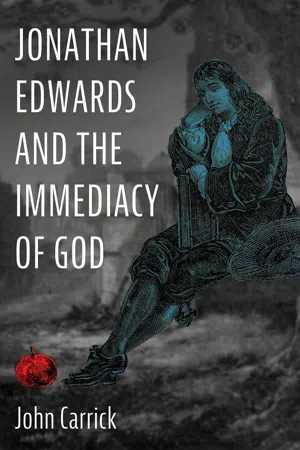
Jonathan Edwards and the Immediacy of God
About this book
Jonathan Edwards is one of the outstanding figures in the history of the Christian church--he was, quite simply, a man of towering intellect and towering spirituality. But it has been noted, even by his friends and admirers, that his thought is also marked at times by certain idiosyncrasies which inevitably introduce certain complexities into his philosophical-theological system.
This study contends that the theme of divine immediacy is the controlling theme and the correlating principle within Edwards's thought. It analyzes the theme of divine immediacy in the thought of Jonathan Edwards under four major heads: creation, the will, ecclesiology, and spiritual experience. Indeed, Dr. Carrick claims that the theme of the immediacy of God is the Ariadne's thread, which runs with consistency through the multiple aspects of Edwards's philosophical, theological, ecclesiological, experiential, and homiletical interests.
But sometimes a man's strength is also his weakness, and it would appear that Edwards's profound commitment to the concept and the reality of the immediacy of God entails significant problems for his entire philosophical-theological system. Edwards's concept of divine immediacy finds its supreme expression, surely, in his doctrine of continuous creation; but is it not the case that this doctrine of continuous creation is in conflict with his determinism, that its tendency is to destroy the moral responsibility of man, and that it makes God both the author and the actor of sin? In short, is it not the case that Edwards's Ariadne's thread is, in fact, also his Achilles' heel?
Information
Topic
Theology & ReligionSubtopic
Christian TheologyGOD AND THE CREATION
Eternity and Time
It is perhaps appropriate to commence an analysis of Jonathan Edwards’s view of God’s relationship to the creation by considering his concept of eternity, and thus his concept of God’s relation to time. In this context, Paul Helm notes that “there have been two broad traditions of thought about God’s relation to time; some have argued that God exists at all times and, since he exists necessarily, he is backwardly and forwardly everlasting.”16 This was the position held, it appears, by William of Ockham (c. 1287–1347) in the medieval period and is the position held by Richard Swinburne and many other modern scholars.17 Thus God is viewed here as without beginning, without end, but not without succession. According to this view, God is characterized by succession—he has a past, a present, and a future. Herman Bavinck explains that this view was the position of the deists:
Deism . . . defines eternity as time extended infinitely in both directions; according to it, the difference between eternity and time is quantitative, not qualitative; gradual, not essential; the distinction is not that eternity excludes a succession of moments, but merely that it excludes a beginning and an end; past, present, and future are terms that should be applied to God as well as to man. The Socinians held this view, and so did many after them.18
This concept of eternity as “everlastingness” necessarily implies that, at a certain point along the infinitely extended line of time, God created the cosmos. Thus the cosmos was, according to this position, created in tempore (in time).
“Others, such as Boethius, and of course Augustine,” notes Helm, “argue that God exists in a timeless eternity. He cannot have a past or future, for such change is incompatible with the divine fullness of being. So according to Augustine God creates the universe not in time, but with time.”19 God is viewed here as without beginning, without end, and without succession. This concept of eternity as “timelessness” or “successionlessness” is captured by Boethius’s celebrated definition: Vitae interminabilis, tota, simul, et perfecta possessio—the total, simultaneous, and perfect comprehension of endless existence. This concept of the atemporality of God necessarily entails the position that, prior to the creation of the cosmos (if we may so speak), time did not exist. Thus the cosmos was, according to this position, created cum tempore (with time).
In his commentary, The Literal Meaning of Genesis, Augustine (354–430 AD) makes this statement concerning time and creation:
With the motion of creatures, time began to run its course. It is idle to look for time before creation, as if time can be found before time. If there were no motion of either a spiritual or corporeal creature, by which the future moving through the present would succeed the past, there would be no time at all. A creature could not move if it did not exist. We should, therefore, say that time began with creation rather than that creation began with time. But both are from God. For from Him and through Him and in Him are all things.20
Augustine’s position here is that time did not exist before creation. “Time began with creation,”21 he insists. “We should, therefore, say that time began with creation rather than that creation began with time.”22 Thus there is a sense in which we might describe Augustine’s position more precisely as that of cum creatione rather than cum tempore. “He made that which gave time its beginning.”23 Thus time is inseparably associated with creation, motion, change, and succession. “Time,” observes Bavinck, “is the concomitant of created existence.”24
It is in his Confessions that Augustine addresses the counterpart of this position; namely, the eternity of God. Creation began cum tempore, or rather time began cum creatione. “O Lord,” Augustine writes, “you are outside time in eternity.”25 “You are the Maker of all time.”26 “It is in eternity, which is supreme over time because it is a never-ending present, that you are at once before all past time and after all future time.”27 “In eternity nothing moves into the past: all is present.”28 This means that God does not exist segment by segment. God is outside of time; he transcends time; he is a timelessly eternal being. God inhabits eternity, and this eternity is likened to “a never-ending present.” “All is present,” insists Augustine. Thus the classic Augustinian-Boethian position insists upon the timeless eternality or successionlessness of God.
God’s Knowledge
It is important to note that in Freedom of the Will (1754) Edwards cites Boethius’s famous dictum, with approval, twice. At the point of his first citation, Edwards is concerned to emphasize that “there is no succession in God’s knowledge,”29 and that “there is no succession in his ideas or judgment.”30 He writes:
The very reason why God’s knowledge is without succession, is, because it is absolutely perfect, to the highest possible degree of clearness and certainty: all things, whether past, present or to come, being viewed with equal evidence and fullness; future things being seen with as much clearness, as if they were present; the view is always in absolute perfection; and absolute constant perfection admits of no alteration, and so no succession.31
Nothing is more impossible than that the...
Table of contents
- Title Page
- Acknowledgments
- INTRODUCTION
- GOD AND THE CREATION
- THE WILL
- ECCLESIOLOGY
- SPIRITUAL EXPERIENCE
- CONCLUSION
- BIBLIOGRAPHY
Trusted by 375,005 students
Access to over 1.5 million titles for a fair monthly price.
Study more efficiently using our study tools.
Frequently asked questions
Yes, you can cancel anytime from the Subscription tab in your account settings on the Perlego website. Your subscription will stay active until the end of your current billing period. Learn how to cancel your subscription
No, books cannot be downloaded as external files, such as PDFs, for use outside of Perlego. However, you can download books within the Perlego app for offline reading on mobile or tablet. Learn how to download books offline
Perlego offers two plans: Essential and Complete
- Essential is ideal for learners and professionals who enjoy exploring a wide range of subjects. Access the Essential Library with 800,000+ trusted titles and best-sellers across business, personal growth, and the humanities. Includes unlimited reading time and Standard Read Aloud voice.
- Complete: Perfect for advanced learners and researchers needing full, unrestricted access. Unlock 1.5M+ books across hundreds of subjects, including academic and specialized titles. The Complete Plan also includes advanced features like Premium Read Aloud and Research Assistant.
We are an online textbook subscription service, where you can get access to an entire online library for less than the price of a single book per month. With over 1.5 million books across 990+ topics, we’ve got you covered! Learn about our mission
Look out for the read-aloud symbol on your next book to see if you can listen to it. The read-aloud tool reads text aloud for you, highlighting the text as it is being read. You can pause it, speed it up and slow it down. Learn more about Read Aloud
Yes! You can use the Perlego app on both iOS and Android devices to read anytime, anywhere — even offline. Perfect for commutes or when you’re on the go.
Please note we cannot support devices running on iOS 13 and Android 7 or earlier. Learn more about using the app
Please note we cannot support devices running on iOS 13 and Android 7 or earlier. Learn more about using the app
Yes, you can access Jonathan Edwards and the Immediacy of God by John Carrick in PDF and/or ePUB format, as well as other popular books in Theology & Religion & Christian Theology. We have over 1.5 million books available in our catalogue for you to explore.