eBook - ePub
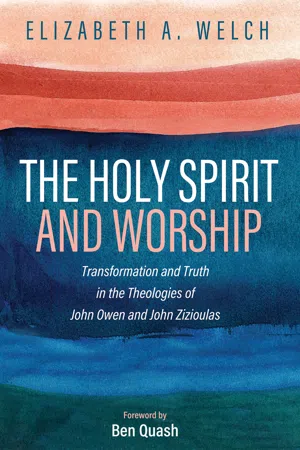
The Holy Spirit and Worship
Transformation and Truth in the Theologies of John Owen and John Zizioulas
- 328 pages
- English
- ePUB (mobile friendly)
- Available on iOS & Android
eBook - ePub
The Holy Spirit and Worship
Transformation and Truth in the Theologies of John Owen and John Zizioulas
About this book
The Holy Spirit has become a greater focus for attention in Trinitarian theology and in the life of the western church since the rise of Pentecostalism at the beginning of the twentieth century. Different understandings of the Holy Spirit have impacted worship in a variety of ways. This book looks at look at surprising overlaps in the thinking about relationship between the Holy Spirit and worship between two radically different traditions of the church, represented by John Owen, from the seventeenth century in England, and John Zizioulas, from the twentieth/twenty-first century in Greece. Four threads of argument are identified, flowing from the unexpected overlap between these two thinkers, that are of value for the church today. The first is the personal and relational nature of the Triune God, drawing the human person into a deeper sense of relational identity. The second is the immediacy of the encounter with God through the Holy Spirit in worship. The third is the way in which the Holy Spirit leads people into truth. The fourth is the transformative nature of the encounter with God in worship, which draws people into sharing God's purpose for the transformation of the world.
Trusted by 375,005 students
Access to over 1.5 million titles for a fair monthly price.
Study more efficiently using our study tools.
Information
Topic
Theology & ReligionSubtopic
Christian Rituals & Practice1
The Holy Spirit and Worship
Setting the Scene
The Holy Spirit and the Renewal of Worship
The purpose of this book is to contribute to a deepening of contemporary ecumenical thinking about the Holy Spirit and the relationship of the Holy Spirit to worship. While much has been written about both the Holy Spirit and worship, this work argues that a theological approach centered on the transformative work of the Holy Spirit, understood in the context of the doctrine of the triune God and drawing together doctrine and experience, deserves to be given more weight in contemporary approaches to the understanding and development of Christian worship.
This chapter introduces the book, starting by looking at contemporary factors with regard to the Holy Spirit and worship which form the setting for the research. The chapter continues by offering a summary of the aim of this work, which is to look at the development of what will be called a “quadrilateral” approach to the nature of the Holy Spirit as manifest in worship. This aim will be pursued by examining the writings of two theologians—John Owen (an English nonconformist Reformed theologian from the seventeenth century) and John Zizioulas (a contemporary Eastern Orthodox theologian)—who offer a particular focus on the Holy Spirit and worship from their radically different contexts.1 The interesting and unexpected congruities between these different theologians form the basis for the arguments that are being developed, within what is being referred to as a “quadrilateral framework”—a fourfold integrated approach to the Holy Spirit and worship.
A summary of this quadrilateral framework is offered in this chapter and at the end of this chapter an outline is offered of the way the argument is taken forward.
Contemporary Contexts Regarding the Holy Spirit and Worship
In order to set the backdrop to the discussion of the nature and work of the Holy Spirit in worship this chapter refers to some contemporary Christian contexts in relation to the understanding and activity of the Holy Spirit, particularly with regard to worship.
Taking a broad ecumenical sweep, it is significant to note that the World Council of Churches, in its themes for its Assembly over the past sixty years, has moved on from what had been suggested verged on a Christo-monist position—“Christ—the Hope of the World” (Evanston, 1954), “Jesus Christ—the Light of the World” (New Delhi, 1961), “Jesus Christ Frees and Unites” (Nairobi, 1975), and “Jesus Christ—the Life of the World” (Vancouver, 1983)—to the pneumatological theme of the Canberra Assembly in 1991, “Come Holy Spirit,” echoed in the eschatological perspective of Harare in 1998, “Turn to God—Rejoice in Hope.” My concluding chapter will return to the ecumenical implications of pursuing the perspective on the Holy Spirit in relation to worship that this volume advances.
Moving to a more local perspective, that of the United Kingdom, a key contemporary factor with regard to worship is the decline in the numbers of people participating in worship in the “historic” churches.2 Much has been written about the changing nature of the Christian faith in Britain and the way in which people in the United Kingdom still hold some form of Christian faith but do not see the need to live out this faith within the context of a worshipping Christian community.3 There is a range of factors involved in this. Worship is not necessarily seen as an encounter with the living, transforming God who changes people’s lives. Even among those who are churchgoers in many of the “historic” churches, there is diffidence about articulating the nature of the presence of God in worship. It is interesting to note that, despite Grace Davie’s influential writing on “Believing but not Belonging” in her helpful analysis of religion in Britain, traditional Christian believing, as associated with regular churchgoing in the historic churches, has also been gently declining, although nowhere near as rapidly as churchgoing.4 As the focus on the self increases, so the need for the development of a stable community life and community events diminishes, especially events in which there is a mutual and ongoing commitment across diverse communities of age, gender, and ethnicity.5 Worship becomes privatized and is an activity that a person can undertake on his or her own. As faith in God diminishes, so the desire to worship diminishes. There is a further issue for the churches in Britain today as to whether the sense of encounter with God through the power of the Holy Spirit has diminished, and whether in fact this has led to a decline in churchgoing.
Reclaiming the Holiness of God in Worship
There has been a range of responses to decline, including the development of initiatives across a spectrum of perspectives, from Fresh Expressions to those who offer a critique of some contemporary expressions of worship. Chapter 4 will offer an analysis of current writings on worship and the range of perspectives from which these come.6
Some contemporary approaches look at worship primarily from a human experiential perspective, often helpfully developing lively, culturally-rooted expressions of worship.7 A growing number of twenty-first-century approaches to worship seek to redress what is perceived to be an empty ritualizing of worship by including a focus on the need for innovation, relevance, and the development of an experiential approach.8 These developments relate well to the intricacies and vagaries of human experience but can neglect the awe and wonder of the reality of the divine. A contemporary American Lutheran liturgical theologian, Gordon Lathrop, comments critically on a range of perspectives, referring at one end of the spectrum to the danger of the over-ritualizing of worship which can lead to a present sense of emptiness of worship and, at the other end of the spectrum, to the search for excitement in worship which neglects the reali...
Table of contents
- Title Page
- Foreword
- Preface
- Acknowledgments
- Chapter 1: The Holy Spirit and Worship
- Chapter 2: Owen’s and Zizioulas’s Trinitarian Foundations
- Chapter 3: The “Dynamic Recovery” of the Holy Spirit in Owen and Zizioulas
- Chapter 4: The Significance of Worship for Owen and Zizioulas
- Chapter 5: The Quadrilateral, Part One
- Chapter 6: The Quadrilateral, Part Two
- Chapter 7: The Quadrilateral, Part Three
- Chapter 8: The Quadrilateral, Part Four
- Chapter 9: The Holy Spirit and Worship
- Appendix
- Bibliography
Frequently asked questions
Yes, you can cancel anytime from the Subscription tab in your account settings on the Perlego website. Your subscription will stay active until the end of your current billing period. Learn how to cancel your subscription
No, books cannot be downloaded as external files, such as PDFs, for use outside of Perlego. However, you can download books within the Perlego app for offline reading on mobile or tablet. Learn how to download books offline
Perlego offers two plans: Essential and Complete
- Essential is ideal for learners and professionals who enjoy exploring a wide range of subjects. Access the Essential Library with 800,000+ trusted titles and best-sellers across business, personal growth, and the humanities. Includes unlimited reading time and Standard Read Aloud voice.
- Complete: Perfect for advanced learners and researchers needing full, unrestricted access. Unlock 1.5M+ books across hundreds of subjects, including academic and specialized titles. The Complete Plan also includes advanced features like Premium Read Aloud and Research Assistant.
We are an online textbook subscription service, where you can get access to an entire online library for less than the price of a single book per month. With over 1.5 million books across 990+ topics, we’ve got you covered! Learn about our mission
Look out for the read-aloud symbol on your next book to see if you can listen to it. The read-aloud tool reads text aloud for you, highlighting the text as it is being read. You can pause it, speed it up and slow it down. Learn more about Read Aloud
Yes! You can use the Perlego app on both iOS and Android devices to read anytime, anywhere — even offline. Perfect for commutes or when you’re on the go.
Please note we cannot support devices running on iOS 13 and Android 7 or earlier. Learn more about using the app
Please note we cannot support devices running on iOS 13 and Android 7 or earlier. Learn more about using the app
Yes, you can access The Holy Spirit and Worship by Elizabeth A. Welch in PDF and/or ePUB format, as well as other popular books in Theology & Religion & Christian Rituals & Practice. We have over 1.5 million books available in our catalogue for you to explore.