eBook - ePub
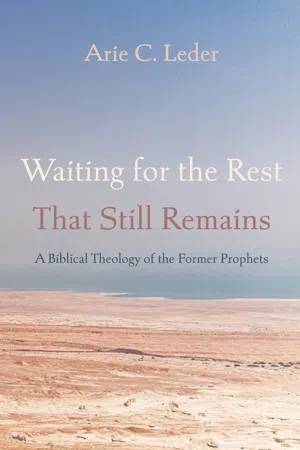
Waiting for the Rest That Still Remains
A Biblical Theology of the Former Prophets
- 244 pages
- English
- ePUB (mobile friendly)
- Available on iOS & Android
eBook - ePub
About this book
Waiting for the Rest That Still Remains. A Biblical Theology of the Former Prophets focuses on Israel's squandering of God's gift of rest from the enemy all around by worshiping at the altars of other gods, and its ultimate consequences: a second exile, this time from the landed presence of the Lord. Where land is the Pentateuch's promised future, the Former Prophets proffer a future tied to the Lord's dynastic covenant with David and Solomon's dedicatory prayer. Pleas that God hear in heaven the prayers his people direct toward the temple in Jerusalem express hope for the good life in the land, but the culmination of Solomon's prayer pleads that upon repentance their captors be compassionate to them in the land of their captivity; there is no plea for return to the land from exile. Outside of God's promise to David Joshua-Kings do not identify an earthly place, like Noah's ark or the land filled with God's presence, to which they might return. Israel awaits the fulfillment of God's promise to David.
Information
1
Approaching the Former Prophets
The Former Prophets, like the Pentateuch, is a narrative; unlike the Pentateuch, they are not considered torah, “instruction.” Rather, Joshua–Kings evaluate Israel’s time in the land through the lens of its compliance with the “instruction” God revealed through Moses. When Scripture uses phrases such as “the Book of the Law of Moses” or “this law” in various translations, the term “law” too easily calls up a disembodied code, not God’s redemptive Sinai voice. To remind us of that voice I use the term “instruction” or the phrase “divine instruction.” The Former Prophets begin with such divine instruction to Joshua, the servant of God who leads Israel from the desert into the land.
Introduction: From the Desert into the Land
The people Moses led out of Egypt received divine instruction in the wilderness between Egypt and Canaan; there it learned that only the Word of God brings life; there it also experienced divine mercy and justice for its whining and rebellion at the waters of Marah, Massah and Meribah. Forty years later, when the second generation arrives on the plains of Moab opposite Jericho, Moses repeats the instructions their parents had received at Sinai (Deut 1–34; esp. 5:2–5) because the first generation had died in the desert for disobeying God’s Word (Num 11–25). Waiting on the plains of Moab, the wilderness behind and the land lying before it, Moses’ instructions catechize the Lord’s army for entry into and life in the land. Unlike the barren desert, the promised land flows with milk and honey;1 the patient waiting for daily manna or the divinely transformed bitter waters to quench their thirst will only be a memory; the land’s abundance will tempt God’s people to believe it earns her daily bread by hard work (Deut 8:17). What will the reader find when the narrative shifts from Israel’s hard-won daily dependence on the Lord in the desert to a life of relative ease in the land? Will the generation that saw its parents die for rebellion against the Lord live righteously in the land? Will their descendants be faithful to divine instruction from generation to generation?
The Pentateuch keeps the desert instructions alive for every generation of God’s people. Close to its center, Lev 18:1–5 summarizes this teaching: neither Egypt, where Israel had lived, nor Canaan, the land which they would enter, has the resources for life in God’s presence, only the Word declared at Sinai provides the bread and water of life. The Former Prophets examine Israel’s stewardship of the land in the light of this ever-normative desert instruction rooted in the Lord’s Sinai presence and transmitted to God’s people by Moses. Even though Moses dies outside the land, his instruction will shape Joshua’s leadership and direct Israel’s conduct in the land (Josh 1:7–8; 16–18; 23:6–13). In this way Moses accompanies Israel into the Promised Land to keep Israel and its leaders (Deut 17:14–20, kings; 16:18–17:13, judges and priests; 18:14–22, prophets) faithful to the Lord’s desert instruction.
The Former Prophets’ review of Israel’s stewardship of divine instruction in the land depicts Joshua’s successful leadership (Joshua); the failure of Israel to imitate Joshua and his generation and the rise of the judges (Judges); the rise of the kingship culminating in David (Samuel); and the consolidation of the kingship under Solomon, its subsequent failings, ultimate ruin and the exile of David’s dynasty from God’s Jerusalem presence (2 Kgs 25:27–30). Ezekiel places the exiles in the “desert of the nations” (Ezek 20:35) where they continue to await the rest from their enemies God had promised Moses (nwḥ, Deut 12:10; 25:19), a rest enjoyed in the days of Joshua (nwḥ, 21:44), but which Israel’s fascination with the other gods spoiled (Judg 2:11–13, cf. Josh 23:6–7; 1 Sam 12:10; 1 Kgs 11:5–6; 2 Kgs 16–17; 2 Kgs 23:26, cf. 21:3–6). Hearing the Former Prophets raises questions for its audience. Those in exile and diaspora ask, “When will we again enjoy the rest they received in his Jerusalem (1 Kgs 8:56)?”; God’s people of every age ask, “What effort is needed to enjoy rest in God’s presence (cf. Heb 4:9–11)?”; today the question is: “What is the relevance of this ancient literature about our ancestors in the faith?”2 We begin our journey through Joshua–Kings with a brief sketch of how OT Scripture has been understood to provide meaning for its readers since the early Church.
Reading the Former Prophets
The following history of interpretation has four parts. First, a description of the OT’s address of its own environment—as in heaven, so on creaturely earth—an address that includes interpretations of earlier texts;3 second, the reading of Scripture shaped by the analogy of faith, the “pre-critical” exegesis thus named by the modern academy; third, the reading of Scripture as a classical religious text shaped by the analogy of human culture, the critical methodologies of the Enlightenment; and, fourth, the reading of Scripture as a non-privileged text in the shadow of suspicion.
OT as Scripture: As in Heaven so on Creaturely Earth
The ancient world understood heaven and earth, the deities and humanity, to share the same substance, to wear the same garment.4 Because it shared this garment of “divine” nature it fell to humanity to discern the will of the gods in nature’s orderliness, for good life on the earth was the product of harmony with heaven. Because discrepancies between heaven and earth would lead to disorder and dissolution as experienced by political or social chaos (invasion of an enemy; rebellious subjects) or unexpected and devastating natural phenomena (rainfall at harvest time; floods, plagues), it was crucial to uncover the authors of the disorder, expunge them and so to restore harmo...
Table of contents
- Title Page
- Acknowledgments
- Introduction
- Abbreviations
- Chapter 1: Approaching the Former Prophets
- Chapter 2: Trajectories in Genesis–Kings
- Chapter 3: Trajectories in Genesis–Kings
- Chapter 4: Hearing the Former Prophets
- Chapter 5: Joshua
- Chapter 6: Judges
- Chapter 7: Ruth
- Chapter 8: Samuel
- Chapter 9: Kings
- Chapter 10: The Burden of Waiting for the Rest That Still Remains Today
- Appendix
- Bibliography
Trusted by 375,005 students
Access to over 1.5 million titles for a fair monthly price.
Study more efficiently using our study tools.
Frequently asked questions
Yes, you can cancel anytime from the Subscription tab in your account settings on the Perlego website. Your subscription will stay active until the end of your current billing period. Learn how to cancel your subscription
No, books cannot be downloaded as external files, such as PDFs, for use outside of Perlego. However, you can download books within the Perlego app for offline reading on mobile or tablet. Learn how to download books offline
Perlego offers two plans: Essential and Complete
- Essential is ideal for learners and professionals who enjoy exploring a wide range of subjects. Access the Essential Library with 800,000+ trusted titles and best-sellers across business, personal growth, and the humanities. Includes unlimited reading time and Standard Read Aloud voice.
- Complete: Perfect for advanced learners and researchers needing full, unrestricted access. Unlock 1.5M+ books across hundreds of subjects, including academic and specialized titles. The Complete Plan also includes advanced features like Premium Read Aloud and Research Assistant.
We are an online textbook subscription service, where you can get access to an entire online library for less than the price of a single book per month. With over 1.5 million books across 990+ topics, we’ve got you covered! Learn about our mission
Look out for the read-aloud symbol on your next book to see if you can listen to it. The read-aloud tool reads text aloud for you, highlighting the text as it is being read. You can pause it, speed it up and slow it down. Learn more about Read Aloud
Yes! You can use the Perlego app on both iOS and Android devices to read anytime, anywhere — even offline. Perfect for commutes or when you’re on the go.
Please note we cannot support devices running on iOS 13 and Android 7 or earlier. Learn more about using the app
Please note we cannot support devices running on iOS 13 and Android 7 or earlier. Learn more about using the app
Yes, you can access Waiting for the Rest That Still Remains by Dr. Arie C. Leder in PDF and/or ePUB format, as well as other popular books in Theology & Religion & Biblical Criticism & Interpretation. We have over 1.5 million books available in our catalogue for you to explore.