- 244 pages
- English
- ePUB (mobile friendly)
- Available on iOS & Android
eBook - ePub
About this book
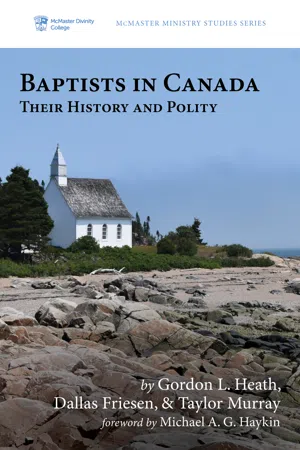
Baptists arrived in what would become Canada in the mid-eighteenth century, and from those early arrivals Baptists from a wide variety of backgrounds planted churches in every region of the vast nation. This book traces that history of Baptists in Canada, and provides historical antecedents and theological rationales for their church polity. Written in a generous spirit, it recognizes what Baptists share with other Christian communities and how they differ among themselves on some matters. It places Baptists in Canada in the larger historical and global context, and concludes with commentary on opportunities and challenges ahead.
Information
Topic
Theology & ReligionSubtopic
North American History1
History of Baptists Around the World
It took a significant amount of courage to be a Baptist in the 1600s. One had to be willing, for example, to spend time in prison for one’s convictions, for the first Baptists had a revolutionary, radical, and illegal vision for the church: they sought a church comprised of believers only. Baptists believed in baptizing adults who made a profession of faith, rather than baptizing infants who could not, and they believed that only such baptized believers were to be members of the church. They also rejected the Church of England’s episcopal hierarchy and instead ran their churches on a congregational model of church governance that left all decisions in the hands of each local congregation. They were groundbreaking and outspoken advocates of religious freedom; while the state was necessary in civil matters, it was to have absolutely no say in the governance of the church. More specifically, it was not to enforce orthodoxy or conformity to the Church of England and it was to remain aloof from the local church’s internal matters. It has sometimes been called a voluntary religion, for a person voluntarily seeks membership in a local church, a local church voluntarily associates with other Baptist churches, and members and churches voluntarily work together on various mission projects.1 Baptist churches in geographical proximity chose to work with one another in an organization called associations, and, in subsequent centuries, a group of associations often formed a union, convention, or fellowship. A Baptist church did not have to join an association, but most did. They were not inherently pacifists like Anabaptists or Quakers, nor did they necessarily have qualms about trying to influence the laws of the land (e.g., Sabbath laws).2
Theories of Origins
But where did Baptists come from? Was it a brand-new movement birthed in the seventeenth century, or was it a more ancient tradition with roots going back to the early church founded by Christ and the apostles? These are not superfluous questions, for there have been a number of novelties in Christian history that were significant departures from apostolic teaching and tradition, and it is important to weigh any new movement carefully. In general, Baptists have been quite aware of the fact that their movement arose in the early 1600s, and have sought by various means and degrees of success to address the issue of origins. The following briefly outlines the three most common ways in which Baptists have sought to do just that.3
Unbroken Line to the Apostles (or Successionism)
A variety of attempts have been made to trace Baptist origins back to the New Testament by claiming kinship with an array of sectarian and persecuted groups such as Montanists, Waldensians, and Albigensians, maintaining that such groups were proto-Baptists of sorts. The oft-referenced booklet The Trail of Blood (1931) by James Milton Carroll is an example of one of the most popular attempts to trace this supposed ancient lineage; in it, a timeline chart with bright red dots through the centuries portraying a striking and continuous connection with the past, which shows readers that Baptists were indeed an ancient and legitimate—and superior—form of Christianity.4 Another example of making links to the past through martyrs is visible in the front pages of Henry Vedder’s A Short History of the Baptists (1907). One page in particular is dedicated to a beautiful colour image of the early church martyr Perpetua; of course, setting the stage for a narrative of Baptist continuity with a long illustrious pedigree of martyrs. The need for such links was to bolster the legitimacy of a relatively new movement, and to buttress claims of being the New Testament church. The weakness of such an argument was that the individuals and groups identified as “Baptist” had little, if anything, in common with seventeenth-century Baptists except for their being persecuted.
The Influence of Anabaptists
Others identify Baptist origins with the Anabaptists of the sixteenth century. In the maelstrom of the sixteenth-century Reformation(s) there arose a group of leaders quite unlike Lutheran, Calvinist, and Church of England reformers.5 Those leaders believed that iconic figures such as Martin Luther, Ulrich Zwingli, John Calvin, and John Knox had done commendable work in purging the church of much of medieval Catholicism, but their criticism was that Protestantism had not gone far enough. Their call was for a further purging of the church of any remaining medieval corruptions. Two of the most significant reforms of Anabaptists were their calls to practice believers’ baptism and pacifism, two convictions they deemed to be the position of Jesus and the earliest Christians. Anabaptists were called many things in their day, mostly derogatory. Walter Klaassen has stated that “By its enemies Anabaptism was regarded as a dangerous movement—a program for the violent destruction of Europe’s religious and social institutions. Its practices were regarded as odd and anti-social, its beliefs as devil-inspired heresy.”6 Heinrich Bullinger called them “devilish enemies and destroyers of the church of God,” and Calvin called them “fanatics,” “deluded,” “scatterbrains,” “asses,” “scoundrels,” and “mad dogs.”7 More kindly, that trajectory of reform is often called the “Radical” stream of the Reformation, and the movement “Anabaptists.”8
The pertinent question for researchers today is just how much or to what degree English Baptists drew upon Anabaptist theology and polity—especially notions of baptism and church governance.9 It is clear that Baptists rejected much of what the Anabaptists rejected, and embraced much of what they embraced. This alone has led some historians and theol...
Table of contents
- Title Page
- Foreword
- Introduction
- Chapter 1: History of Baptists Around the World
- Chapter 2: The Arrival and Growth of Baptists in Canada
- Chapter 3: Baptists and Others
- Chapter 4: Church Membership
- Chapter 5: Church Ordinances
- Chapter 6: Church Governance and Issues of Authority
- Chapter 7: Religious Liberty
- Chapter 8: Baptists and the Future
- Appendix A: Baptist Landscape in Canada in 2020
- Appendix B: Writing Your Local Church’s History
- Appendix C: Baptist Distinctives in Canada Comparison10
- Appendix D: Photographs
- Bibliography
Trusted by 375,005 students
Access to over 1.5 million titles for a fair monthly price.
Study more efficiently using our study tools.
Frequently asked questions
Yes, you can cancel anytime from the Subscription tab in your account settings on the Perlego website. Your subscription will stay active until the end of your current billing period. Learn how to cancel your subscription
No, books cannot be downloaded as external files, such as PDFs, for use outside of Perlego. However, you can download books within the Perlego app for offline reading on mobile or tablet. Learn how to download books offline
Perlego offers two plans: Essential and Complete
- Essential is ideal for learners and professionals who enjoy exploring a wide range of subjects. Access the Essential Library with 800,000+ trusted titles and best-sellers across business, personal growth, and the humanities. Includes unlimited reading time and Standard Read Aloud voice.
- Complete: Perfect for advanced learners and researchers needing full, unrestricted access. Unlock 1.5M+ books across hundreds of subjects, including academic and specialized titles. The Complete Plan also includes advanced features like Premium Read Aloud and Research Assistant.
We are an online textbook subscription service, where you can get access to an entire online library for less than the price of a single book per month. With over 1.5 million books across 990+ topics, we’ve got you covered! Learn about our mission
Look out for the read-aloud symbol on your next book to see if you can listen to it. The read-aloud tool reads text aloud for you, highlighting the text as it is being read. You can pause it, speed it up and slow it down. Learn more about Read Aloud
Yes! You can use the Perlego app on both iOS and Android devices to read anytime, anywhere — even offline. Perfect for commutes or when you’re on the go.
Please note we cannot support devices running on iOS 13 and Android 7 or earlier. Learn more about using the app
Please note we cannot support devices running on iOS 13 and Android 7 or earlier. Learn more about using the app
Yes, you can access Baptists in Canada by Gordon L. Heath,Dallas Friesen,Taylor Murray in PDF and/or ePUB format, as well as other popular books in Theology & Religion & North American History. We have over 1.5 million books available in our catalogue for you to explore.