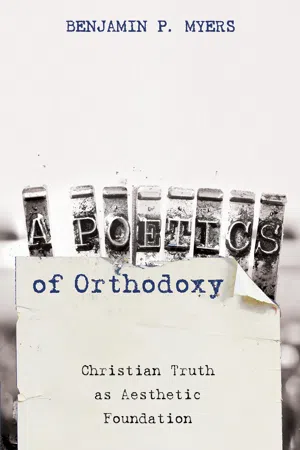
- 140 pages
- English
- ePUB (mobile friendly)
- Available on iOS & Android
eBook - ePub
About this book
What makes one poem better than another? Do Christians have an obligation to strive for excellence in the arts? While orthodox Christians are generally quick to affirm the existence of absolute truth and absolute goodness, even many within the church fall prey to the postmodern delusion that "beauty is in the eye of the beholder." This book argues that Christian doctrine in fact gives us a solid basis on which to make aesthetic judgments about poetry in particular and about the arts more generally. The faith once and for all delivered unto the saints is remarkable in its combined emphasis on embodied particularity and meaningful transcendence. This unique combination makes it the perfect starting place for art that speaks to who we are as creatures made for eternity.
Information
1
Image
What We Learn from Imagism
Image is a loaded word in Christian circles. The second commandment instructs us not to make any “graven images,” and the very word image brings to mind the long conflict in Christianity between icon and iconoclasm. One thinks of the sixteenth-century Puritans whitewashing over frescoes in country churches and smashing stained glass windows in cathedrals. I belong to a denomination in that radical reformation tradition that has long been especially skeptical of religious images, and the sanctuary I worship in several times a week is devoid of anything like representational art. Yet, not only am I strongly drawn to the artistic traditions of Christendom—to Carvaggio’s The Entombment of Christ (1602–1603) and to Eugène Burnand’s The Disciples Peter and John Running to the Sepulcher on the Morning of the Resurrection (c. 1898), for instance—but I also can’t help but think that any poem that fails to make concrete, particular imagery an integral part of the poem is an artistic failure. I don’t think this is a contradiction. Our faith clearly demands we never elevate the things of this world to the status of God, and thus we are prohibited from making “images” in that sense. Yet our faith also demands we recognize both the goodness of creation and our inherent nature as embodied beings, a recognition greatly aided by the making of images in a very different, artistic, sense.
Certainly I’m not the first to feel that clear, definite imagery is an indispensable part of poetry. In the early twentieth century, the poetic movement known as “Imagism” sought to focus modern poetry on the task of clearly presenting a series of images—or even one image, such as in William Carlos Williams’s “The Red Wheelbarrow”—with absolute clarity. Ezra Pound, the major force behind the movement, insisted that the goal of poetry ought to be “Direct treatment of the ‘thing,’ whether subjective or objective.”16 Perhaps the imagists were driven by a need to find a new core for defining poetry as the new free verse blurred once clear distinctions between poetry and prose. Certainly, they saw themselves as reacting against the rhetorical excesses of Victorian and Romantic poetry.
They were not, however, merely destructive modernists. Pound found inspiration for his poetics in Homer, Dante, and perhaps most of all the classical Chinese poets who had made clarity of image a chief poetic virtue. That is to say, “Imagism” was a reform movement, not a revolution. It sought to return poetry to its essential elements and took clarity of image, concreteness, to be perhaps the most essential thing in a poem. The imagists saw clearly that the focused, specific image has always been an integral part of the best poems. When Pound declaimed that the poet should “Go in fear of abstractions,” he was not abolishing the poetic law but fulfilling it.17
Though Pound and his fellow Imagistes could be doctrinaire at times —Hugh Kenner described Imagism as “a technical hygiene”—they call our attention to the central role of the particular, concrete image in the making of good poetry.18 Like the Japanese haiku masters, they remind us that particularity is at the heart of great poems.
In his justly famous “In a Station of the Metro,” Pound, inspired by the Japanese haiku tradition, whittled what was originally a thirty-line poem down to create a minimalist masterpiece.19 The powerful emotion of the poem is conveyed entirely in the concentrated images:
The apparition of these faces in the crowd;
Petals on a wet, black bough.20
The emotion of the poem is inherent in our visualization of the blossoms of a flowering tree in wet weather: at no point are we directly told how to feel. Yet the emotional tone, the pathos, of the poem is unmistakable. Pound says that “An ‘Image’ is that which presents an intellectual and emotional complex in an instant of time.”21 In this great poem, the emotion is nuanced, complex, unparaphraseable, yet apparent.
Consider how much less effective, and affecting, “In a Station of the Metro” would be if Pound had written something like this, instead:
I’m all alone in the crowd.
The people move by so separate from me,
So distant and so beautiful.
I feel alone,
I feel so alone.
Why can’t I reach their beautiful inner selves?
Why do I ache with pain
And with joy?
Not only is the bad version more than twice as long as Pound’s poem, but also it says not even half as much. I doubt the poem above has the ability to make anyone actually sad. It attempts only to “convey” how the author feels. The original version, rather, conveys the reader into the experience of the poet. One can’t affect the reader’s emotions through direct emotional instructions like “feel sad.” One has to conjure sadness as it is experienced by embodied human beings. This is why “show; don’t tell” is classic advice in all forms of writing.
The Word Became Flesh
Why does the pale imitation of Pound’s poem, an imitation wholly and overtly concerned with an emotion that is only implied in Pound’s minimalist masterpiece, carry so much less emotional power than Pound’s poem, which says nothing directly about the feelings of the poet? The answer lies in the orthodox Christian assertion that we are all embodied beings.
Unlike Gnosticism, orthodox Christianity does not consider the human creation to be fundamentally a soul trapped in a body but rather a being made of body and soul. Christians do, of course, affirm a distinction between the body and the soul, but a biblical anthropology that keeps both the Genesis account of our creation and the promised resurrection in mind rejects the pop-culture Gnosticism that says we are really souls confined in a body we will someday be free from. Our bodies are in a real sense us, not just the containers in which we are held until we can be released for heaven. The separation of body and soul that we call death is not our end goal but only a temporary...
Table of contents
- Title Page
- Acknowledgments
- Introduction
- Chapter 1: Image
- Chapter 2: Diction
- Chapter 3: The Sentimentality Trap
- Chapter 4: Writing the Fallen World
- Chapter 5: The Gift of Beauty
- Chapter 6: Form
- Chapter 7: Metaphor
- Chapter 8: Mystery, Befuddlement, and Hospitality
- Conclusion
- Bibliography
Trusted by 375,005 students
Access to over 1.5 million titles for a fair monthly price.
Study more efficiently using our study tools.
Frequently asked questions
Yes, you can cancel anytime from the Subscription tab in your account settings on the Perlego website. Your subscription will stay active until the end of your current billing period. Learn how to cancel your subscription
No, books cannot be downloaded as external files, such as PDFs, for use outside of Perlego. However, you can download books within the Perlego app for offline reading on mobile or tablet. Learn how to download books offline
Perlego offers two plans: Essential and Complete
- Essential is ideal for learners and professionals who enjoy exploring a wide range of subjects. Access the Essential Library with 800,000+ trusted titles and best-sellers across business, personal growth, and the humanities. Includes unlimited reading time and Standard Read Aloud voice.
- Complete: Perfect for advanced learners and researchers needing full, unrestricted access. Unlock 1.5M+ books across hundreds of subjects, including academic and specialized titles. The Complete Plan also includes advanced features like Premium Read Aloud and Research Assistant.
We are an online textbook subscription service, where you can get access to an entire online library for less than the price of a single book per month. With over 1.5 million books across 990+ topics, we’ve got you covered! Learn about our mission
Look out for the read-aloud symbol on your next book to see if you can listen to it. The read-aloud tool reads text aloud for you, highlighting the text as it is being read. You can pause it, speed it up and slow it down. Learn more about Read Aloud
Yes! You can use the Perlego app on both iOS and Android devices to read anytime, anywhere — even offline. Perfect for commutes or when you’re on the go.
Please note we cannot support devices running on iOS 13 and Android 7 or earlier. Learn more about using the app
Please note we cannot support devices running on iOS 13 and Android 7 or earlier. Learn more about using the app
Yes, you can access A Poetics of Orthodoxy by Benjamin P. Myers in PDF and/or ePUB format, as well as other popular books in Literature & Poetry. We have over 1.5 million books available in our catalogue for you to explore.