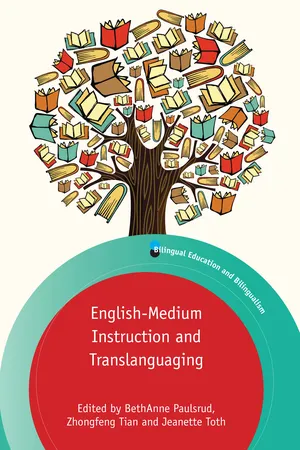
This book offers a critical exploration of definitions, methodologies and ideologies of English-medium instruction (EMI), contributing to new understandings of translanguaging as theory and pedagogy across diverse contexts. It brings together a number of conceptual and empirical studies on translanguaging in EMI at different educational levels, in a variety of countries, with different approaches to translanguaging, different named languages, and different policies. These studies include several underrepresented contexts across the globe, providing a broad view of how translanguaging in EMI is understood in these educational settings. Furthermore, this book addresses the complexities of translanguaging through a discussion of the affordances and constraints associated with the use of multiple linguistic resources in the EMI classroom.
eBook - ePub
English-Medium Instruction and Translanguaging
- 256 pages
- English
- ePUB (mobile friendly)
- Available on iOS & Android
eBook - ePub
English-Medium Instruction and Translanguaging
About this book
Information
Subtopic
Educational Policy1Problematising the E in EMI: Translanguaging as a Pedagogic Alternative to English-only Hegemony in University Contexts
Kari Sahan and Heath Rose
Introduction
Despite an increasing body of research that challenges native speaker hegemony, English-only ideologies remain strong in language policy and education, including English-medium instruction (EMI). First language (L1) use in second or foreign language (L2) classrooms has been energetically debated in the field of second language acquisition (SLA) for decades, and most language education researchers now agree on the benefits that other languages can offer learners in instructed educational contexts. This understanding, however, has yet to transfer to many EMI settings, especially those that have developed separately from language teaching curricula. Policies guiding the implementation of EMI in higher education are often motivated by top-down political ideologies that insist on English-only or English-always use in the classroom (Kirkpatrick, 2017). These policies are often driven by the belief that immersive settings better fulfil the language development aims of EMI programmes, even if such aims are not explicitly stated in EMI curricula. Rose and Galloway (2019: 195) note that ‘a language development objective is not openly declared in definitions of EMI, which makes it distinct from other forms of content-related language teaching models’, but many institutions hold an ‘expectation that English-language proficiency will develop in tandem with subject discipline knowledge’.
In this chapter, we argue that the ‘E’ in EMI should not be interpreted to mean English-only. We assert that teachers and students should be encouraged to use and embrace their multilingual resources, including the entirety of their linguistic repertoires. We support this claim by drawing first on research examining L1 use in the EMI classroom. Noting that the majority of this research has investigated code-switching, we then argue that the fluidity of language use in EMI classes may be better characterised as translanguaging. Rather than categorising languages as discrete entities, translanguaging frames language use as a performative act in which users construct and interpret meaning based on the resources available in their linguistic repertoires (Canagarajah, 2013a). Thus, multilingualism is a strength compared to monolingualism, as it multiplies the linguistic resources available to users. Given the inherently multilingual nature of the EMI classroom, translanguaging captures how teachers and students move freely across language boundaries. We also argue that translanguaging practices should be embraced as a pedagogical tool and a natural feature of multilingual communication, in order to combat ideologies of EMI as English-only and English-always. We illustrate our points by drawing upon examples from recent research, and we present examples from one of the author’s own empirical research studies on EMI practices at universities in Turkey.
L1 Use and Multilingual Practices in EMI
Research within foreign language education has suggested that L1 use has a facilitative effect on L2 learning (Anton & DiCamilla, 1998; Cook, 2001; Swain & Lapkin, 2000). Ferguson (2009: 231) proposes that the L1 serves ‘as a communicative and pedagogic resource in bilingual contexts, especially where pupils struggle to understand difficult subject matter whilst simultaneously learning a foreign language, one that is nominally the official medium of instruction’. With this in mind, previous studies have focused on the use of L1 in EMI contexts, with much of this research conducted from the perspective of code-switching (Airey, 2012; Lo & Macaro, 2012; Tarnopolsky & Goodman, 2014). Such studies have sought to analyse the purpose of switches between linguistic codes, often comparing the role of L1 with that of English. Airey (2012) describes EMI at Swedish universities as a situation of parallel language use, whereby course material is assigned in English but lectures are often given in Swedish. Similarly, drawing from the findings of an ethnographic study of EMI at a Swedish university, Söderlundh (2013) suggests that language choice is governed by emergent norms in the classroom. She found that English was typically used for ‘on-task’ discussions and the L1 was used for closed discussions between L1 speakers, and that code-switching occurred most commonly for single word translations. Tarnopolsky and Goodman (2014) found that the L1 was used in EMI classrooms in Ukraine for facilitative functions such as establishing rapport, disciplining students and improving comprehension through explanations of content-specific terminology. Similarly, in a study based in Hong Kong, Evans (2008) found that teachers used their shared L1 when talking to students individually or discussing non-academic topics, and that code-switching served to introduce and clarify new vocabulary items. These findings suggest that EMI classrooms often do not achieve ‘the English-only immersion programme envisaged by policymakers’ (Evans, 2008: 495), as L1 use appears to be a common practice across global EMI contexts.
The use of L1 in EMI classrooms should not be surprising. Li Wei and Martin (2009) argue that code-switching is a natural bilingual behaviour but attracts attention in the classroom because language education policies tend to be shaped by top-down monolingual ideologies that discourage multilingual practices (see, for example, Probyn, this volume). The literature on code-switching in EMI classrooms is valuable as it highlights the pedagogical functions of L1 and supports our assertion that the EMI classroom is inherently a multilingual space. However, this research is limited in that it analyses language use in categorical terms, which does not necessarily capture how teachers and students move freely across language boundaries in bilingual classrooms. Fitting within the multilingual turn in SLA (see May, 2014), we suggest that translanguaging is an appropriate framework to capture the range of multilingual practices in the EMI classroom.
How is Translanguaging Different from Code-Switching?
Creese and Blackledge (2015: 26) assert that a ‘translanguaging approach to teaching and learning is not about code-switching, but rather about an arrangement that normalises bilingualism without diglossic functional separation’. In other words, translanguaging is not a theoretical alternative to code-switching; rather, it proffers an ontological, epistemological and axiological shift in thinking about language use and bilingualism in the classroom. Translanguaging is norm-emergent and based in the practices of the individual rather than imposed by prescriptive standards: it ‘takes as its starting point the language practices of bilingual people’ (García & Li Wei, 2014: 22), thereby challenging assumptions of monolingual normativity. García (2009a: 45) states that translanguaging practices are the ‘multiple discursive practices in which bilinguals engage in order to make sense of their bilingual worlds’ (original emphasis). In other words, translanguaging is the practice of bringing together and enacting linguistic features that belong to multiple named languages and, in doing so, it reveals the arbitrary nature of those named language boundaries. Translanguaging ‘leads us away from a focus on languages as distinct codes to a focus on the agency of individuals engaged in using, creating, and interpreting signs for communication’ (Creese & Blackledge, 2015: 26). The distinction between code-switching and translanguaging is thus ideological (Lewis et al., 2012a) in that code-switching assumes clear boundaries between named languages, which are distinct and separate from one another. As its starting point, however, translanguaging recognises named languages as social constructs.
García and Li Wei (2014: 22–23) illustrate the difference between a traditional understanding of code-switching in bilingualism and a translanguaging perspective on language use with the example of the language function on an iPhone: the language settings on an iPhone allow users to select a particular language, such as English or Spanish. This is a code-switching epistemology whereby one language is selected at a given time and users can ‘switch’ between languages by adjusting the settings on their phone. A translanguaging epistemology, however, is more analogous to text messaging whereby users may select features from their entire linguistic repertoire, including emojis and other visual features, to encode their message. Whereas the language settings on the phone limit the user to a single named language, the language practices of the user when texting are more dynamic and fluid. A translanguaging epistemology is built on this premise: rather than being limited to the constraints of a single language, bilinguals select from their entire linguistic repertoire to construct meaning.
While traditional conceptions of bi-/multilingualism view the bilingual as an individual with the ability to communicate, to varying degrees, in two or more distinct, autonomous languages, translanguaging instead perceives of the multilingual linguistic resources of the bilingual as a single, continuous linguistic repertoire (García & Li Wei, 2014). In other words, the bilingual is not two monolinguals added together. As such, translanguaging allows for a space to overcome the notion of code-switching resulting from linguistic deficit. From a tra...
Table of contents
- Cover-Page
- Half-Title
- Series
- Title
- Copyright
- Contents
- Transcription Key
- Contributors
- Foreword
- Introduction
- 1. Problematising the E in EMI: Translanguaging as a Pedagogic Alternative to English-only Hegemony in University Contexts
- 2. Translanguaging in EMI in the Japanese Tertiary Context: Pedagogical Challenges and Opportunities
- 3. Malawian Universities as Translanguaging Spaces
- 4. Translanguaging Pedagogies in the Humanities and Social Sciences in South Africa: Affordances and Constraints
- 5. Translanguaging as a Pathway to Ethical Bilingual Education: An Exploratory Case Study from Kenya
- 6. Transcending Linguistic and Cultural Boundaries: A Case Study of Four Young Maldivians’ Translanguaging Practices
- 7. Translanguaging in Partial EMI Secondary Science Classrooms in Hong Kong
- 8. Translanguaging in a Graduate Education Programme at a Cambodian University
- 9. Student Translanguaging Practices in the EMI Classroom: A Study of Italian Higher Education
- 10. Translanguaging and Transfer of Academic Skills: Views of Kazakhstani Students in an English-Medium University
- 11. Translanguaging for Learning in EMI Classrooms in South Africa: An Overview of Selected Research
- Epilogue
- Conclusion
- References
- Index
Trusted by 375,005 students
Access to over 1.5 million titles for a fair monthly price.
Study more efficiently using our study tools.
Frequently asked questions
Yes, you can cancel anytime from the Subscription tab in your account settings on the Perlego website. Your subscription will stay active until the end of your current billing period. Learn how to cancel your subscription
No, books cannot be downloaded as external files, such as PDFs, for use outside of Perlego. However, you can download books within the Perlego app for offline reading on mobile or tablet. Learn how to download books offline
Perlego offers two plans: Essential and Complete
- Essential is ideal for learners and professionals who enjoy exploring a wide range of subjects. Access the Essential Library with 800,000+ trusted titles and best-sellers across business, personal growth, and the humanities. Includes unlimited reading time and Standard Read Aloud voice.
- Complete: Perfect for advanced learners and researchers needing full, unrestricted access. Unlock 1.5M+ books across hundreds of subjects, including academic and specialized titles. The Complete Plan also includes advanced features like Premium Read Aloud and Research Assistant.
We are an online textbook subscription service, where you can get access to an entire online library for less than the price of a single book per month. With over 1.5 million books across 990+ topics, we’ve got you covered! Learn about our mission
Look out for the read-aloud symbol on your next book to see if you can listen to it. The read-aloud tool reads text aloud for you, highlighting the text as it is being read. You can pause it, speed it up and slow it down. Learn more about Read Aloud
Yes! You can use the Perlego app on both iOS and Android devices to read anytime, anywhere — even offline. Perfect for commutes or when you’re on the go.
Please note we cannot support devices running on iOS 13 and Android 7 or earlier. Learn more about using the app
Please note we cannot support devices running on iOS 13 and Android 7 or earlier. Learn more about using the app
Yes, you can access English-Medium Instruction and Translanguaging by BethAnne Paulsrud,Zhongfeng Tian,Jeanette Toth in PDF and/or ePUB format, as well as other popular books in Languages & Linguistics & Educational Policy. We have over 1.5 million books available in our catalogue for you to explore.