The surprising similarities in the rise and fall of the Sunni Islamic and Roman Catholic empires in the face of the modern state
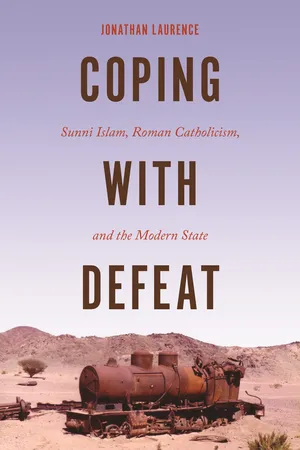
Coping with Defeat presents a historical panorama of the Islamic and Catholic political-religious empires and exposes striking parallels in their relationship with the modern state. Drawing on interviews, site visits, and archival research in Turkey, North Africa, and Western Europe, Jonathan Laurence demonstrates how, over hundreds of years, both Sunni and Catholic authorities experienced three major shocks and displacements—religious reformation, the rise of the nation-state, and mass migration. As a result, Catholic institutions eventually accepted the state’s political jurisdiction and embraced transnational spiritual leadership as their central mission. Laurence reveals an analogous process unfolding across the Sunni Muslim world in the twenty-first century.
Identifying institutional patterns before and after political collapse, Laurence shows how centralized religious communities relinquish power at different rates and times. Whereas early Christianity and Islam were characterized by missionary expansion, religious institutions forged in the modern era are primarily defensive in nature. They respond to the simple but overlooked imperative to adapt to political defeat while fighting off ideological challenges to their spiritual authority. Among Laurence’s findings is that the disestablishment of Islam—the doing away with Islamic affairs ministries in the Muslim world—would harm, not help with, reconciliation to the rule of law.
Examining upheavals in geography, politics, and demography, Coping with Defeat considers how centralized religions make peace with the loss of prestige.
eBook - ePub
Coping with Defeat
Sunni Islam, Roman Catholicism, and the Modern State
- 552 pages
- English
- ePUB (mobile friendly)
- Available on iOS & Android
eBook - ePub
About this book
Information
Publisher
Princeton University PressYear
2021Print ISBN
9780691172125
9780691220543
eBook ISBN
9780691219783
NOTES
Archives Consulted
Turkiye Diyanet Vakfi Islam Arastirmalari Merkezi (ISAM), Istanbul
Digitized Ottoman Archives, University of Marmara, Istanbul
Ottoman Archives, Yıldız Collection, Yıldız Palace Archives, Istanbul
Roman Jesuit Archives (Archivum Romanum Societatis Jesu, ARSI), Rome
Archivio Storico della Pontificia Università Gregoriana, Rome
Archivio Storico della Congregazione de’ Propaganda Fide, Rome
US Department of State (online)
Documents on British Foreign Policy and British Documents on the Origins of War (online)
Digital National Security Archive (online)
Chapter 1. Sunni Islam, Roman Catholicism, and the Modern State
- 1. “État islamique: Abou Bakr al-Baghdadi appelle les musulmans à rejoindre ‘le califat,’ ” France Soir, May 15, 2014.
- 2. “Pope Calls on Europe to Reflect on Founders’ Hopes to Create a Better Future,” Deutsche Welle, November 25, 2014.
- 3. “The Sultan and the Pope,” New York Times, October 29, 1859, p. 4.
- 4. Barkey, “Political Legitimacy and Islam in the Ottoman Empire: Lessons Learned.”
- 5. “Remarks by President Obama to the Turkish Parliament,” The White House, Office of the Press Secretary, April 6, 2009.
- 6. Haddad, Le Reformisme musulman.
- 7. Norton, On the Muslim Question.
- 8. Shaye I. D. Cohen, “The Path to Victory,” from “Legitimation under Constantine,” scholarly commentary accompanying Jesus to Christ, broadcast by PBS Frontline, April 6, 1998.
- 9. Driessen, “Religious Democracy and Civilizational Politics,” p. 11.
- 10. Bill and Williams, Roman Catholics and Shi’i Muslims, pp. 97, 142.
- 11. Huntington, “Religion and the Third Wave,” p. 42.
- 12. Helmy, “The Contrasting Fates of Middle Eastern Politicized Islam and European Politicized Christianity,” p. 6.
- 13. Durkheim, The Elementary Forms of Religious Life.
- 14. Casanova, Public Religions in the Modern World.
- 15. Driessen, “Regime Type, Religion-State Arrangements, and Religious Markets in the Muslim World.”
- 16. Thomson, “Delegitimating State-Authorized Non-State Violence.”
- 17. Martin, The Statesman’s Year-Book (1878). See figure 4.1 (“Longest-Lasting Caliphates and Sultanates”).
- 18. Monastiri, “L’Isam de M. El-Qaddhafi.”
- 19. Brown, “Is Islam Easy to Understand or Not?,” p. 199; Esposito and Voll, Islam and Democracy.
- 20. An-Na’im, “Shariʾa and the Secular State in the Middle East and Europe,” p. 110.
- 21. Asad, “Secularism, Nation-State, Religio...
Table of contents
- Cover Page
- Title Page
- Copyright Page
- Dedication
- Epigraph
- Contents
- List of Illustrations
- List of Tables
- Abbreviations
- Acknowledgments
- Introduction: Coping with Defeat
- The First Defeat: The End of Empire
- The Second Defeat: The Nation-State Era
- The Third Defeat: The Era of Believers Without borders
- Conclusion: Embracing Spiritual Power
- Regime Timelines: 1500–Present
- Glossary
- Interviews
- Notes
- Bibliography
- Illustration Credits
- Index
Trusted by 375,005 students
Access to over 1.5 million titles for a fair monthly price.
Study more efficiently using our study tools.
Frequently asked questions
Yes, you can cancel anytime from the Subscription tab in your account settings on the Perlego website. Your subscription will stay active until the end of your current billing period. Learn how to cancel your subscription
No, books cannot be downloaded as external files, such as PDFs, for use outside of Perlego. However, you can download books within the Perlego app for offline reading on mobile or tablet. Learn how to download books offline
Perlego offers two plans: Essential and Complete
- Essential is ideal for learners and professionals who enjoy exploring a wide range of subjects. Access the Essential Library with 800,000+ trusted titles and best-sellers across business, personal growth, and the humanities. Includes unlimited reading time and Standard Read Aloud voice.
- Complete: Perfect for advanced learners and researchers needing full, unrestricted access. Unlock 1.5M+ books across hundreds of subjects, including academic and specialized titles. The Complete Plan also includes advanced features like Premium Read Aloud and Research Assistant.
We are an online textbook subscription service, where you can get access to an entire online library for less than the price of a single book per month. With over 1.5 million books across 990+ topics, we’ve got you covered! Learn about our mission
Look out for the read-aloud symbol on your next book to see if you can listen to it. The read-aloud tool reads text aloud for you, highlighting the text as it is being read. You can pause it, speed it up and slow it down. Learn more about Read Aloud
Yes! You can use the Perlego app on both iOS and Android devices to read anytime, anywhere — even offline. Perfect for commutes or when you’re on the go.
Please note we cannot support devices running on iOS 13 and Android 7 or earlier. Learn more about using the app
Please note we cannot support devices running on iOS 13 and Android 7 or earlier. Learn more about using the app
Yes, you can access Coping with Defeat by Jonathan Laurence in PDF and/or ePUB format, as well as other popular books in Social Sciences & Comparative Politics. We have over 1.5 million books available in our catalogue for you to explore.