![]()
1
A LITTLE BIT OF GEOLOGY
Devon is the third largest English county and is made up of a variety of types of stone, some of which have been quarried for use as building materials, altering the landscape for thousands of years. Here are just a few of the more common ones that will feature in this Little History of Devon:
Granite – Dartmoor is famous for its extensive 300-million-year-old granite, formed by molten rock rising from deep underground. Visitors to the moor are fascinated by the weirdly shaped and weathered grey outcrops known as tors. These have given rise to a number of legends, but more of that later!
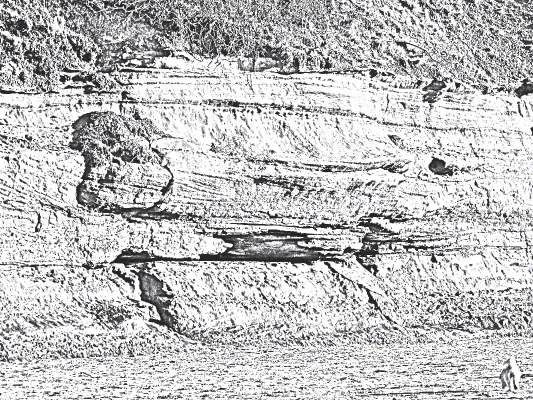
Limestone – Along parts of Devon’s coast are huge pale yellow limestone cliffs around 400 million years old. These are made up of billions of compressed layers of dead pre-historic sea creatures and plants.
Red sandstones – The striking red sandstones of Devon were laid down as sediment between 280 and 200 million years ago and can most easily be seen on Devon’s south-east coast. Perhaps its most famous location is 250-million-year-old Orcombe Point at Exmouth. Here the cliffs form the most westerly and oldest part of the Jurassic Coast.
Blame it on the USA
Only part of the Jurassic Coast is actually from the Jurassic era. Orcombe Point is Triassic and the most easterly part in Dorset is Cretaceous. The popularity of the Jurassic Park Hollywood movies is partly responsible for what amounts, in some parts of the coast, to an inaccuracy of around 150 million years!
![]()
2
KENTS CAVERN AND EARLY HUMANS
Kents Cavern at Torquay is a remarkable place to visit. The caves were formed around 370 million years ago from limestone that was eroded by water seepage. Curious stalactites hang from the caves’ roofs, and stalagmites rise up from the floor. These have been formed over hundreds of thousands of years by dripping water that contains calcites and other minerals.
No one seems to know why the cavern is called ‘Kents’. The county of Kent is over 180 miles away. An ancient story suggests that it was once believed that the cavern was connected to caves in the county of Kent and that they were used by the Devil to store evil souls. Another story suggests that Druids met there to perform sacrifices. Whatever lurid stories there are, it is a fact that Kents Cavern is very important in the understanding of early humans.
In the 1500s a man named Will Petre is said to have found his way into Kents Cavern. He picked up some odd bits of bone and flints that were actually ancient tools. Among the first and most important modern explorers of Kents Cavern was William Pengelly (1812–94). He was a geologist by trade with a fascination for archaeology. He made himself very unpopular with many Victorian people by rubbishing the idea that God created the earth in six days, ready made with all its different animals!
Kents Cavern would have been very different from the way it looks today. Pengelly and his assistants had to squeeze through tiny gaps and dig through layers of accumulated mud and stones. And all without modern lighting!
As Pengelly and later explorers dug through the mud layers of Kents Cavern and areas nearby, they discovered and began to excavate an incredible array of early man-made tools and, more importantly, human bones. These included evidence of Homo Erectus from around 350,000 years ago, Neanderthals who lived up to 40,000 years ago and Homo Sapiens – essentially the same as us. A jawbone from one individual that dates back over 30,000 years was found at Kents Cavern. Modern dating techniques suggest that this could be even earlier.
Early Devon people used Kents Cavern as a place of shelter but they were not alone. Cave bears also lived there in separate parts. The people were not in danger of being eaten though – the bears were vegetarians!
Other animal remains found at Kents Cavern include hyena, elk, horses, a species of lion, woolly rhinos and mammoths. Most of these are no longer found naturally in Britain and, in the case of mammoths and woolly rhinos, nowhere else either. Many of the bones in Kents Cavern were from animals killed and eaten by humans who lived there.
![]()
3
THE MID AND NEW STONE AGE 10,000 TO 2300 BC
Britain was once connected to Europe – and no, I don’t mean as a member of the European Union! Until around 7,000 years ago south-eastern Britain was joined to what is now the Netherlands by a land mass known as Doggerland. Rising water levels due to the end of the last ice age and resultant storms covered Doggerland and separated Britain from the European continent.
Prehistoric people lived in various areas of Devon, but it is on Dartmoor where evidence of their presence is really plentiful. It is possible to see a number of different sites in a day and many can be seen after just a short walk.
High Dartmoor is around 1,400ft above sea level and the moor covers 25 square miles. Human habitation goes back 8,000 years, though this is scarce compared with later prehistoric eras when temperatures were warmer. As the climate warmed up, more people occupied the moors for its resources – stone and wood for building and animals for food.
Dartmoor would have looked very different from how it does today as vast areas of it were covered in forests of oak, hazel and alder trees. Deforestation of Dartmoor began slowly.
Early Stone Age people were hunter-gatherers with nomadic lifestyles but by the mid-Stone Age people were changing to farming and a more settled way of surviving.
Flint stones worked into tools were left on Dartmoor by mid-Stone Age people. There is lots of evidence of this.
Dolmen
Tombs from this period are known as Dolmen. Dartmoor’s best is Spinster’s Rock in a field near Drewsteignton. Dolmen are usually made from three substantial granite slabs forming a triangle. These support an equally solid roof. Spinster’s Rock top is 14ft by 10ft and originally would probably have been covered by earth.
A legend says that the three upright stones were once evil witches. They murdered a traveller and carried him to their hovel. Evil witches used body parts in their unholy spells. They were turned to stone by a good witch who just happened to be passing.
In the Stone Age, hunters were occasionally able to hunt and kill a small type of hippopotamus in east Devon.
![]()
4
THE BRONZE AGE 2300 BC TO 700 BC
At the risk of upsetting Devon cream tea enthusiasts, clotted cream may well first have been brought to the area by Phoenician traders around 3,000 years ago! They were probably the first foreign traders to reach Devon via Hartland point, which the Romans called the Promontory of Hercules when they finally got around to conquering Britain around 1,000 years later.
Migrants and traders from Europe came to Britain. They were known as the Beaker People because of the distinctive pottery they made. This was often a reddish colour with elaborate horizontal patterns. The beakers were used for cooking and storing foods. It may have been the Beaker People who introduced bronze-making to Britain.
Bronze was probably first made in the Middle East 5,000–6,000 years ago. The knowledge spread through Europe and then Britain that copper and tin smelted together produced bronze. The metal was harder than any other available in the Bronze Age. Weapons with much sharper cutting edges could be made using liquid bronze and moulds. Bronze was hard to break and it didn’t rust. This Bronze Age technology was an important development in human history.
Today, Dartmoor can be very inhospitable, especially in the winter, but in the Bronze Age it was warmer. Much of high Dartmoor is little changed from this time. Bronze Age people began deforestation on a larger scale. People felled trees for building and began farming the cleared land. Trees once found in abundance on Dartmoor included oak, hazel and birch. Today these survive in small pockets, usually in rugged areas where felling trees was difficult.
Dartmoor granite made a very good building material for early settlers. As the stone weathers, softer parts dissolve to leave slabs that are useful as a building material.
In the Bronze Age there were more people living on Dartmoor than today. They led settled lives, grew crops such as barley and oats, and kept animals for food and clothing. Bronze Age people enclosed large fields with stone walls to keep their animals safe. Other settlements known as pounds usually had circular walls and covered large areas, often with houses inside.
Although Bronze Age people were farmers, hunting was still an important source of food. Flint tools were still made and used extensively. There is evidence that different groups on Dartmoor traded with each other, shared new ideas and possibly intermarried.
Round Houses
These were circular dwellings. The foundations and walls were made of blocks of granite. Round houses had low walls and high cone-shaped ceilings. The walls enclosed a space up to 30ft in diameter. Wooden roofs rested on top of the walls. Larger houses had a centre pole made from a tree that supported the roof, which was covered in deep layers of gorse or heather. The huts often had fireplaces and granite seats. Basic cooking pottery found by archaeologists often has patterns etched into it. People lived in communities with many huts. These were surrounded by a granite wall.
Men might have enjoyed relaxing in their huts after a day’s work, but if an ancient story can be believed, women did not relax. Apparently, after cooking, cleaning and childcare all day, the women had to hold up candles made of fat so the men could eat in light. Women also got the less appetising meat and spent much of their time in the kitchen area separate from men, showing their lower status.
Grimspound
Grimspound is Dartmoor’s most visited Bronze Age settlement. ‘Pound’ means ‘enclosure’. Grimspound is around 3,000 years old. The site is easily accessible, and there is still a lot to see. The settlement is surrounded by a wall with a circumference of around 1,500ft and there were around twenty-four huts enclosed by it.
Stone Rows
Dartmoor still has over seventy Bronze Age stone rows. Some are very long and substantial, while others are shorter with smaller stones. Menhirs are larger stones placed at the end of a row. Some rows are single while others have many rows running alongside each other leading to burial mounds known as cairns. There is probably some religious significance in stone rows.
Upper Erme Stone row is the longest on Dartmoor and probably in the world! It runs for over 2 miles and has around 1,000 stones. Following Erme Row up an incline is like approaching a ragged row of misshapen monster’s teeth. The experience is awesome and a little creepy.
Stone Circles
Some stone circles were used for religious rites. Some may well have been tribal meeting places.
Scorhill Stone Circle is arguably the most impressive on Dartmoor – one of its stones is over 8ft tall. The circle is 50ft in diameter. Today there are twenty-three upright stones with ten more lying down. Scorhill originally had around seventy stones. Unfortunately, the missing ones were probably removed in the recent past for use in building. Scorhill is dramatically beautiful, with its backdrop of stark moor. Legend said that animals won’t go through the circle because they sense its fabled power. Sadly, the author has to report that this is untrue. On an extending lead, her fri...