Because of the long-standing Canada-U.S. lumber trade dispute and the current pressure on the world's forests as a renewable energy source, much attention has been directed toward the modelling of international trade in wood products. Two types of trade models are described in this book: one is rooted in economic theory and mathematical programming, and the other consists of two econometric/statistical models--a gravity model rooted in theory and an approach known as GVAR that relies on time series analyses. The purpose of the book is to provide the background theory behind models and facilitate readers in easily constructing their own models to analyse policy questions that they wish to address, whether in forestry or some other sector. Examples in the book are meant to illustrate how models can be used to say something about a variety of issues, including identification of the gains and losses to various players in the North American softwood lumber business, and the potential for redirecting sales of lumber to countries outside the United States. The discussion is expanded to include other products besides lumber, and used to examine, for example, the effects of log export restrictions by one nation on all other forestry jurisdictions, the impacts of climate policies as they relate to the global forest sector, and the impact of oil prices on forest product markets throughout the world. This book will appeal to practising economists and researchers who wish to examine various policies that affect international trade, whether their interest is local or international in scope. Because the book provides the theoretical bases underlying various models, students and practitioners will find this a valuable reference book or supplementary textbook.
eBook - ePub
International Trade in Forest Products
Lumber Trade Disputes, Models and Examples
- 192 pages
- English
- ePUB (mobile friendly)
- Available on iOS & Android
eBook - ePub
International Trade in Forest Products
Lumber Trade Disputes, Models and Examples
About this book
Information
Topic
Scienze biologicheSubtopic
Commercio e tariffeAbstract
In this chapter, we provide a brief background to the major players in global lumber markets, both countries and companies. In addition, the four measures economists use for measuring welfare and income redistributions are described, and the remaining chapters outlined.
The Canada–United States softwood lumber dispute has a history that goes back to the late 19th century. As with many disputes related to forestry and forest product, this dispute relates primarily to institutional differences in the way Canada and the U.S. govern forestlands. In Canada, the vast majority of forestland is publicly owned, with provinces having been granted ownership over forest resources by the Constitution. As a result, provincial governments became owners of all forestlands within their jurisdiction, with some exceptions related to land under the purview of the federal government (viz. National Parks and aboriginal lands) and lands granted to the Canadian Pacific Railway in exchange for completing construction of a transcontinental railway. This constitutional arrangement is discussed in greater detail in Chapter 2.
Although there is nothing that prevented provinces from selling forestland to private holders, the public has generally opposed such sales. With the exception of lands that fell into private hands through outright sale or as a grant, transfers of public forestland to the private sector ended in the early 1900s (Marchak, 1993, 1995, pp. 85–116; Cashore, 1997). Such transfers would now be opposed by the majority of citizens who attach value to the non-commercial attributes of the land – to wildlife habitat, recreational and visual amenities, and environmental services (e.g. carbon sink, absorber of pollutants, water regulation, etc.), to name a few.
Federal and state governments in the U.S. also own vast tracts of forestland, mainly in the West, but most of the better, more productive lands are in private hands. Because more logs are harvested from private than public lands in the U.S., log prices are relatively transparent. A sawmill would have some notion of what price it would be willing to pay for logs based on market-determined prices of lumber and other wood products at the time. Logging companies compete for the right to harvest logs on both private and public lands, with stumpage prices determined through a bidding process that takes into account current market conditions for wood products.
In Canada, on the other hand, stumpage prices of logs are set by government and are not sensitive to lumber and other wood product prices. Under a variety of tenure arrangements, discussed in Chapter 2, Canadian sawmills access logs at whatever fee is set by the province. If the price is too high, fewer logs might be harvested; if the price is low, more logs might be harvested. The word ‘might’ is used to reflect regulations on the volume of timber that a tenure holder is required to harvest in a given year or over some government-approved planning period (usually 5 years). This friction between what is thought of as an open market for logs (U.S.) and a regulated market for logs (Canada) is a main reason for the softwood lumber dispute. Forestlands and forest practices in both Canada and the U.S. are affected by public attitudes to forest conservation, the need to certify sustainable forest practices (or lack thereof), tenure arrangements, governance, and other social controls. Similar factors affect forest practices and production of forest products across the globe.
In this book, the main focus is on one aspect of the forest sector, namely, how the softwood lumber dispute affects bilateral trade flows between Canada and the U.S., and between North America and the rest of the world. In doing so, we also gain some knowledge about the impacts of trade distortions on economic wellbeing in various regions, and which groups in society might gain or lose, and by how much. However, the models we consider in the chapters that follow can be used to investigate various policies related to forest sector trade; indeed, we provide examples of how the models can be expanded to examine log export restrictions, subsidies on wood biomass for generating electricity, impacts of climate change, and so on. The Canada–U.S. lumber dispute is only one example of the types of policies that can be investigated using trade models, albeit an important example.
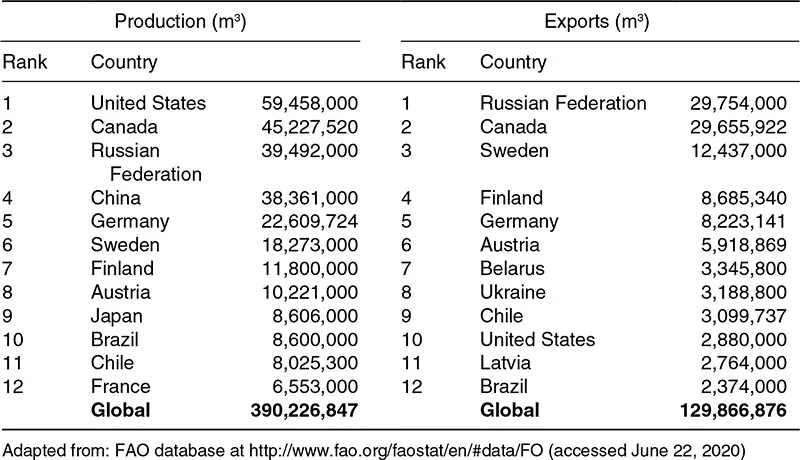
As further background to the softwood lumber trade dispute, consider the main countries that produce and export lumber. This is provided in Table 1.1. Not surprisingly, the main players are the U.S., Canada, Russia, the Scandinavians, China, and several central European countries. The top four producers are the U.S., Canada, Russia, and China, and they accounted for 47% of global production of lumber in 2018; the top four exporters are Russia, Canada, Scandinavia, and Germany/Austria, which together accounted for 73% of exports in 2018. Canada and Russia each account for about 23% of the world’s total exports of softwood lumber, with the Scandinavians contributing about 16%.
Table 1.1. Top 12 countries producing and exporting lumber, 2018 (m3 per year).
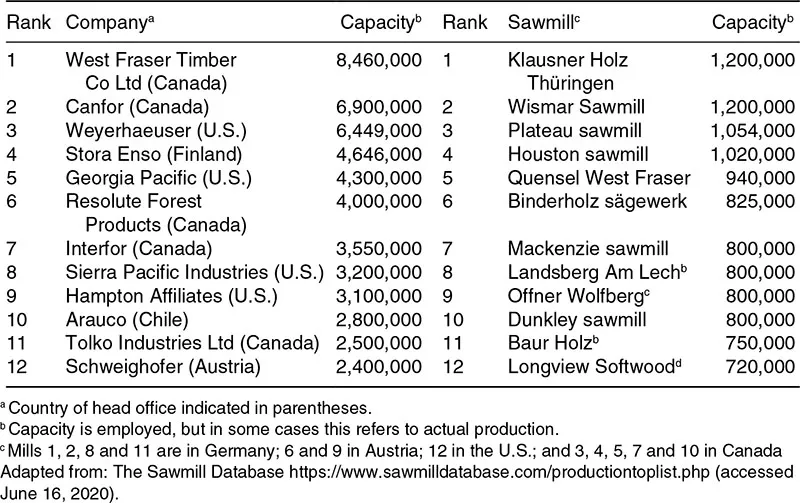
This concentration of production and exports is reflected at the company and sawmill level. ‘The Sawmill Database’ currently indexes some 1235 sawmills and 700 companies in 43 countries; these sawmills produce some 164 million m3 of softwood lumber each year, which represents approximately 44% of global production. The top 12 lumber-producing companies and their annual production capacity are found in Table 1.2, as are the top 12 producing sawmills. Five of the top 12 forestry companies are Canadian, four are American, one is Finnish, one is Chilean, and one is Austrian. Surprisingly, no German forest company is ranked in the top 12 global lumber producers, although four of the largest sawmills are located in Germany, and Germany is the fifth largest producer and exporter of lumber.
Table 1.2. Top twelve global producers of lumber by production or capacity (m3 per year).
Our interest is in the economics of wood products production and trade. Economists have the tools required to analyze public policies – to determine whether or not a policy enhances society’s overall wellbeing (or welfare), and identifying which groups in society gain and which lose from the policy, and the potential size of such gains or losses. Although the welfare measures are well known from a theoretical standpoint, economists apply a variety of empirical methods to calculate the various welfare measures. These are briefly reviewed below.
1.1 Welfare Measures
In economics, costs and benefits constitute a surplus that is either lost (cost) or gained (benefit). There are four types of economic surplus.
1. Consumer surplus is the difference between what consumers are willing to pay for goods and services and the actual expenditure required to obtain those goods and services. In essence, it is the difference between the total benefit that consumers derive from purchasing an amount Q and what they actually have to pay (which equals price times quantity, P×Q). It can be measured by the area below the marginal willingness-to-pay (demand) function minus what they actually pay, and can be represented mathematically as:

where CS refers to the consumer surplus. The integral constitutes the total willingness to pay (area under demand function) minus the total cost of production (area under supply function, or P×Q). The consumer surplus is illustrated in Fig. 1.1.
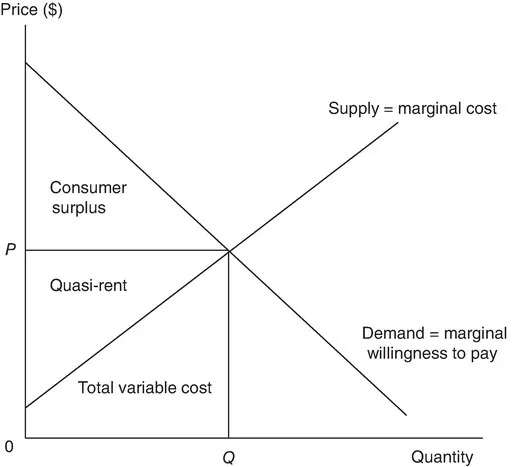
Fig. 1.1. Consumer and producer surplus. (Author’s own figure.)
Consumer surplus is not always directly measurable. Consider the case where a project does not affect consumer surplus because the market price is unaffected. For example, it is unlikely that decisions concerning the harvest or protection of a single commercial forest landscape will affect the prices of timber products. In that case, the direct consumer surplus associated with such a project is unlikely to change; indeed, unless the project lowers (raises) price, the consumer is not going to gain (lose) surplus from the project. In that case, consumer surplus becomes relevant only in some other market, but not the market for lumber. Suppose that, in addition to the market for lumber, there is a demand for an environmental amenity that is somehow impacted by a logging decision. In that case, there may be surplus that needs to be taken into account in evaluating the logging project. This would be an indirect cost or benefit associated with the project, which is discussed below as the fourth type of surplus.
2. Quasi-rent constitutes the difference between total revenue and total variable cost. It is measured by the area below price and above the marginal cost (supply) function, as indicated in Fig. 1.1. It is also referred to as producer surplus. While constituting a true welfare measure, quasi-rent (producer surplus) accrues to fixed factors of production and entrepreneurship. That is, in Fig. 1.1, the supply curve is a short-run supply function, which means that returns to the fixed factors of production must come from quasi-rent. Any attempt to tax this quasi-rent or producer surplus will disincentivize firms from investing in the production of that commodity.
Consumer surplus and quasi-rent can be considered from a perspective that ignores the utilitarian foundations of demand. Think of the supply function as the minimum amount that a seller is willing to accept (WTA), at the margin, to part with the item in question. Any amount above minimum WTA constitutes a surplus to the seller. Likewise, the demand function can be thought of as the maximum amount a buyer is willing to pay (WTP). Suppose that person A is willing to sell an article at any price above $9.50, while person B is willing to pay upwards of $17.50 for that item. If they agree to a price of $12, person A gains a surplus of $2.50 while B gains a surplus of $5.50, so the total surplus shared between them is $8. If the trade had occurred at $15, A would have realized a surplus of $5.50 and B a surplus of $2.50, but again the benefit to society (the two people) is still $8. Even if A was coerced to sell at $8, so that B gained $9.50, the total surplus of this exchange would remain $8 (= $9.50 – $1.50).
3. Resource rent accrues to natural resources and consists of two components that are often indistinguishable from each other in practice, and difficult to separate from the second type of surplus – the quasi-rent (producer surplus). We illustrate the concept of resource rent with the aid of Fig. 1.2. The supply curve in this figure is a long-run supply curve, and differs from the short-run supply curve in Fig. 1.1 because, in the long run, all factors of production are variable. In that case, there is no quasi-rent to be measured, because quasi-rent accrues only to fixed factors of production, of which there are none in the long run, except natural resources.
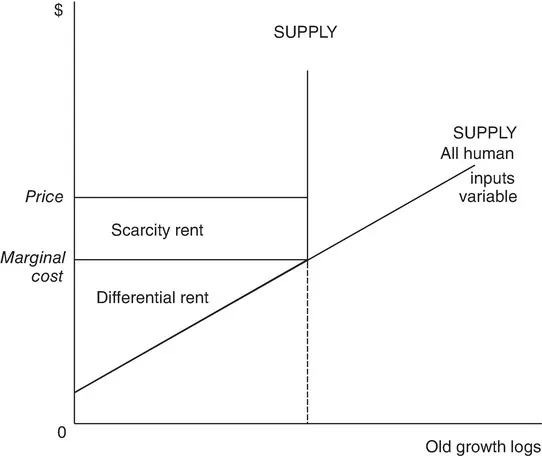
Fig. 1.2. Scarcity and differential components of resource rent. (Author’s own figure.)
The first component of resource rent is differential (sometimes referred to as Ricardian) rent that arises because of inherent or natural advantages of one location relative to another. For example, a woodlot located near a sawmill or transportation corridor (highway, water transport) earns a windfall relative to an identical woodlot that is located farther from a sawmill or transportation corridor.
A second component is referred to as scarcity rent, which results simply because there is a limit to the number of stands with commercial timber. That is, if the timber producer, despite being the highest cost producer in the world, earns a windfall over and above what could be earned elsewhere in the economy, there is a scarcity rent because price exceeds the marginal cost of production. Given that old-growth timber that produces large logs for decorative use is limited, the supply curve is vertical at that limit, thereby creating a scarcity rent.
Resource rent is the sum of the differential and scarcity rents, and is often the greatest benefit in decisions about whether to harvest a forest. The government can tax resource rents without adversely affecting private investment decisions. However, because the measurement of resource rents is difficult, governments must be careful in taxing such rents lest quasi-rents be taxed instead. If quasi-rents are taxed, returns to investors are insufficient to cover fixed costs and fewer log trucks and processing plants are built.
4. Finally, the indirect surplus refers to benefits or costs that accrue in markets for substitute and/or complementary goods and services. However, indirect benefits occur only if price exceeds marginal cost in one of the affected markets (Boadway and Bruce, 1984, pp. 252–255). Whenever price exceeds marginal cost, this implies that society values the good or amenity more than it costs to provide it. Hence, if there is an increase in the demand for the good so that more of the good or amenity is purchased, there is a benefit given by the difference between price (marginal willingness to pay) and marginal cost (willingness to accept) for each unit purchased; this occurs until the declining marginal willingness to pay equates to a rising marginal cost as more is produced. Conversely, there is a cost if the opposite is true – demand shifts inward and less is bought. Note that there is an indirect benefit only if price exceeds marginal cost and individuals are free to increase or decrease the quantity they purchase; if not, there is nothing to measure ...
Table of contents
- Cover
- Half Title
- Title
- Copyright
- Contents
- Contributors
- Acknowledgements
- 1 Introduction
- 2 Canada–U.S. Softwood Lumber Dispute: Background
- 3 Spatial Price Equilibrium Trade Modelling: Theory
- 4 Modeling Bilateral Forest Products Trade
- 5 Economic Analysis of a Softwood Lumber Quota Regime and a Policy to Subsidize Biomass Generation of Electricity
- 6 Global Forest Products Trade Model
- 7 Softwood Lumber Trade and Trade Restrictions: Gravity Model
- 8 A Global Vector Autoregression Model for Softwood Lumber Trade
- 9 Discussion
- Index
- Back
Trusted by 375,005 students
Access to over 1.5 million titles for a fair monthly price.
Study more efficiently using our study tools.
Frequently asked questions
Yes, you can cancel anytime from the Subscription tab in your account settings on the Perlego website. Your subscription will stay active until the end of your current billing period. Learn how to cancel your subscription
No, books cannot be downloaded as external files, such as PDFs, for use outside of Perlego. However, you can download books within the Perlego app for offline reading on mobile or tablet. Learn how to download books offline
We are an online textbook subscription service, where you can get access to an entire online library for less than the price of a single book per month. With over 1.5 million books across 990+ topics, we’ve got you covered! Learn about our mission
Look out for the read-aloud symbol on your next book to see if you can listen to it. The read-aloud tool reads text aloud for you, highlighting the text as it is being read. You can pause it, speed it up and slow it down. Learn more about Read Aloud
Yes! You can use the Perlego app on both iOS and Android devices to read anytime, anywhere — even offline. Perfect for commutes or when you’re on the go.
Please note we cannot support devices running on iOS 13 and Android 7 or earlier. Learn more about using the app
Please note we cannot support devices running on iOS 13 and Android 7 or earlier. Learn more about using the app
Yes, you can access International Trade in Forest Products by G. Cornelis van Kooten, Linda Voss, G Cornelis van Kooten,Linda Voss in PDF and/or ePUB format, as well as other popular books in Scienze biologiche & Commercio e tariffe. We have over 1.5 million books available in our catalogue for you to explore.