- 448 pages
- English
- ePUB (mobile friendly)
- Available on iOS & Android
eBook - ePub
About this book
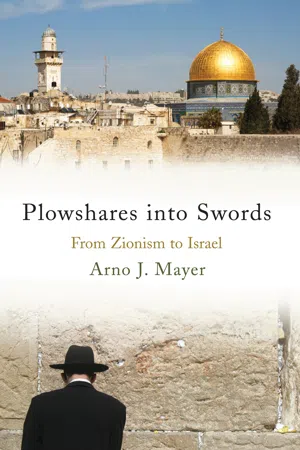
In this authoritative text, Arno J. Mayer traces the thinkers, leaders and shifting geopolitical contexts that shaped the founding and onward development of the Israeli state. He recovers for posterity internal critics such as the philosopher Martin Buber who argued for peaceful coexistence with the Palestinian Arabs. 'A sense of limits is the better part of valour', Mayer insists. Plowshares into Swords explores Israeli's indefinite deferral of the 'Arab Question', the strategic thinking behind its settlement building and border walls, and the endurance of Palestinian resistance.
Information
1
THE IMPERIAL CONTEXT:
1890 TO THE FIRST WORLD WAR
Like any civil and military struggle that entails a fight to the death over a Holy of Holies, the Arab–Israeli conflict resists sober analysis. In much of the First and Second Worlds, political opinion and public sentiment tend to be distinctly more favorable to the Israelis than to the Palestinian Arabs. Among the many reasons for this partiality, three stand out.
First: a lingering, Western-supremacist contempt for and suspicion of “natives”—non-Christian and formerly colonized peoples. Having emerged during the high noon of Western colonial imperialism, the Zionist project matured during its sunset and became its last avatar. While the Zionists did not assume the White Man’s burden in their drive to establish a Jewish commonwealth in Arab Palestine, they went in with his attitude; the state of Israel was consolidated in a region seething with anti-imperialist nationalism.
Second: displacement of a deep-seated guilt for age-old anti-Judaism, seared by the Judeocide of 1941–5. In god’s good time, in an access of New Testament charity and Old Testament reversion, the Christian nations of Europe and the Americas embraced Zionism and Israel in atonement for their persecution of Jews through the ages, of which the Final Solution was the nadir. It was for the Europeans—not the Arabs—to atone, make reparation, and provide a haven for the refugees and displaced persons of the Jewish catastrophe.
Third: a Manichaean view of the Arab–Israeli conflict. In the reigning perspective, innocent, imperiled, and peace-seeking Israelis are set against treacherous, swarming, and aggressive Arabs. Law-abiding citizens, reputable politicians, and noble citizen-soldiers confront a “beast with many heads”—devious timeservers, and barbarian terrorists. Fear of being driven into the sea eclipses any Israeli disquiet that the Palestinian Arabs might be driven into the desert. Where one right of return is consecrated, another is execrated.
The Palestinian Arabs perceived the Jewish immigrants of successive aliyahs as foreigners bent on imposing a colonial regime. In fact, by the 1920s they considered the Zionist settlers a greater peril than the British and French satraps in the Middle East: the latter understood that they were strangers in the land, certain to return to the metropolis; the former deemed Palestine their home and, until recently, neither would nor could imagine returning to the commonwealth of the diaspora.
The Zionists and the Palestinian Arabs invented their nations almost simultaneously, and ever more interactively. The Zionists adopted the liberal nationalism of nineteenth-century Europe. Forcibly exiled by the Romans in AD 70, and having wandered for nearly two millennia, they recast the mythologized and ritualized Jewish memory of the Holy Land as a presumptive right to a sovereign territorial nation-state with legendary boundaries. The Palestinian Arabs embraced the anti-imperialist nationalism of the twentieth-century Third World: the land their people had been living on continuously since the seventh century (apart from a hiatus during the Crusades) belonged to them. Each plaintiff claimed the high ground, the Zionists essentially from the common-law position “first-in-time is first-in-right”; the Palestinians, “last-in-time is first-in-right.”
Would-be nation-states, artificially contrived, are equidistant from god and the devil. Defined by contested boundaries with neighboring nations, sovereign states are finally made up by, or in accord with, the shifting will of the great powers of the day. As a ward of successive empires, Palestine lacked not only clear borders but also a vested authority to draw them. At the outset, and for years on end, the Zionists assumed that the concert of great powers would decide the fate of Palestine as it had started to decide the fate of Asiatic Turkey and of Africa at the Congress of Berlin, in 1878 and 1885 respectively: at both summits Europe’s statesmen had peremptorily delineated frontiers and bartered sovereignties. The early Zionists had good reason to assume that, should the indigenous Arabs oppose a Jewish homeland in Palestine, in due time the great European chancelleries could be prevailed upon to have that population moved across mysterious desert boundaries into Mesopotamia or Arabia.
Historically the Jews may be said to have mistimed their claim to a territorial nation in Palestine. Had they advanced it a century earlier, they could have borne down on the Palestinian Arabs as freely as the Spanish conquistadores had on the Mayans and the North American colonists on the native Indians. (Had the Zionist movement emerged a third of a century later, after Lenin and Wilson had universalized the gospel of self-determination, it would have been stillborn.) But Palestine was not “a land without a people,” and expulsion or extermination of people in peacetime was going out of favor, at least for the time being.
As might be expected, the Zionists’ legal, historical, and religious reasons for settlement were challenged by the Palestinian Arabs. By repudiating the latter-day return, they constituted their own legitimacy. In what became an all-out struggle between two increasingly irreconcilable claims that turned adversaries into enemies, one side’s lawless aggression and terrorism became the other’s self-defense and justified revenge.
There is no understanding the Israeli–Palestinian imbroglio without exploring the dialectics of the vexed “Arab Question” in the unfolding of the Zionist project. For Martin Buber, a towering internal critic of Zionism, this question concerned “the relationship between Jewish settlement and Arab life, or, as it may be termed, the intra-national [intraterritorial] basis of Jewish settlement.” From the outset, starting with Ahad Haam in the 1890s, eminent lone Zionist voices in both the diaspora and the Yishuv upbraided the principal founders and leaders of modern Zionism for their ingenuous but stubborn neglect of this crucial problem. Eventually Judah Magnes sadly concluded that the failure to make Arab–Jewish understanding and cooperation a major policy objective was Zionism’s “great sin of omission.” Instead of taking the true measure of the majority Arab-Palestinian population, most early Zionists ignored, minimized, or distorted its nature and reality. Even over time they either remained blind to the potential for an Arab awakening or dismissed Arab nationalism as an inconsequential European import.
Buber spoke for the critics who had all along insisted on the urgency of the Arab Question, and on the importance of addressing the fears of Palestinian Arabs, as well as respecting their political aspirations. He became convinced that the issue would be the “touchstone” of Zionism and its intentions. He deplored the early settlers’ “basic error”: they neglected to “gain the confidence of the Arabs in political and economic matters” and by so doing caused the Jews “to be regarded as aliens, as outsiders” uninterested in “seeking mutual trust.”
Buber took to task Zionism’s “political leadership” for “paying tribute to traditional colonial policy,” and for being “guided by international considerations” to the exclusion of attention to “intra-national” affairs. On the whole, Zionist policy not only neglected Arab–Jewish relations inside Eretz Israel, but also failed to “relate the aims of the Jewish people to the geographic reality in which these aims would have to be realized.” As a consequence, the nascent Jewish commonwealth was “isolated from the organic context of the Middle East, into whose awakening it [needed to] be integrated, in accordance with a broader spiritual and social perspective.” As early as February 1918, Buber demurred when ultra-Zionists advocated “creating a majority [of Jews] in [Palestine] by all means and as quickly as possible.” Fearing that “most leading Zionists (and probably also most of those who are led) are thoroughly unrestrained nationalists,” he predicted that unless “we succeed in establishing an authoritative [Zionist] opposition, the soul of the movement will be corrupted, maybe forever.”
This reaction was the germ of the idea that informed the foundation of Brit Shalom (Alliance for Peace) in 1925, and was carried on by Ihud (Union) in 1942. The members and fellow-travelers of these two societies of dissidents formed an influential but powerless opposition on the Arab Question, and emerged as the racked conscience first of Zionism and then of Israel. By virtue of being severely marginalized, these faithful internal critics were unable to inspire and encourage their Palestinian and Arab counterparts, who were as weak and beleaguered as they themselves.
In 1947–8, following the proclamation of the problematic and contested Jewish state, Buber reflected on the creed and role of those public intellectuals who, “equally free from the megalomania of the leaders and the giddiness of the masses, discerned the approaching catastrophe.” He claimed that, as the embodiment of Cassandra in their time, this “spiritual elite … not merely uttered warnings but tried to point to a path to be followed, if catastrophe was to be averted.” In “speeches which were so many deeds” these critics, among whom Buber was one of the most forceful, conceived of another road “to a Jewish revival in Palestine” and to the “rescue of the Jewish people.” Envisioning an alternative to the “Jewish state” promoted by Theodor Herzl and his political heirs, they put forth a farsighted program for a “binational state” aimed “at a social structure based on the reality of two peoples living together.” They cautioned that “any [Jewish] national state in vast and hostile [Middle Eastern] surroundings would be the equivalent of suicide,” largely because “an unstable international basis could never make up for the missing intra-national one.” Only an “agreement between the two nations could lead to Jewish–Arab cooperation in the revival of the Middle East, with the Jewish partner concentrated in a strong settlement in Palestine.” Buber expected the logic of multi-ethnicity to favor the reemergence of “national universalism,” the Jewish people’s “unique truth,” to inform the “struggle against the obstacles chauvinism places in our way.”
In October 1948, in the midst of the first Arab–Israeli war, Buber questioned the credo that, since the Jewish state had been attacked, it was “engaged in a war of defense.” “Who attacked us?” asked Buber, ever attentive to the Other. The aggressors were “those who felt that they had been attacked by us, namely by our peaceful conquest” under an imperial umbrella, and who “accuse us of being robbers.” Israelis and Zionists countered with the claim, as Buber put it, that “this was our country two thousand years ago and it was there that we created great things.” Though a sworn Zionist, he found their logic incredible: “Do we genuinely expect this reason to be accepted [by the Arabs] without argument, and would we accept it were we in their place?”
As Buber recalled, in their own time these loyal critics struggled to preserve their ideal against its replacement “by the Asmodeus [evil spirit] of a political chimera.” Contemptuously referred to as “certain intellectuals,” “quislings,” and “defeatists,” they overcame “despair” by keeping the faith and by invoking “the helpful power of reason.”
Two radically different, even incompatible, societies were destined to coexist in Palestine—the one dynamic, the other relatively changeless. Though coming out of the traditional shtetl life of Eastern Europe, most settlers of the first aliyahs had the advantage of formal education, openness to technology, access to capital, and ideological commitment. By comparison, the host Palestinian society was static, ritualized, and hierarchic. But whatever the hard facts of the great divide between Jewish and Arab Palestinians, they were magnified by mutual misperception and stereotyping, fed by ignorance of each other’s history, culture, and language. In this uneven encounter, Zionism was the invasive and ascendant party. The Jewish immigrants, even if only half-consciously, carried Western civilization into an Oriental world that they disdained and saw through a glass darkly; and they did so under the aegis of imperial powers. A heavily urban and manufacturing society, the Yishuv became a fast-growing center of dynamic modernity in a torpid rural society.
By 1940 one-third of the Jewish population of about 500,000 lived in greater Tel Aviv. The per capita income in the Yishuv vastly exceeded that of nearly 2 million Palestinian Arabs who still owned and worked 90 per cent of the land. Zionists scanted this reality by characterizing their mission as the redemption of the land, the revaluation of manual labor, and the recovery of an unaffected communal life. The Arcadian kibbutz, not fast-growing cosmopolitan Tel Aviv, heralded the New Jerusalem. Although many of the Arabs benefited from the modern and modernizing enterprise of the Yishuv, the greater number viewed it with a mixture of ambivalence, wariness, and ressentiment. Tensions between the Zionist and Palestinian spheres were analogous to the perennial urban–rural friction everywhere. Locally, however, they were compounded by the volcanic animus peculiar to the contemporary confrontation of imperial master and colonial subject.
Both intra-nationally and internationally, to use Buber’s terms, the conflict over Palestine was profoundly conditioned by the twilight of European imperialism and the dawn of the colonial rebellion. Both coincided, at the end of the nineteenth century, with the birth of Zionism. Just as the Balfour Declaration, the Mandate, and the Partition of 1947–8 were late expressions of imperial legerdemain, so the Palestinian resistance and clamor for a nation-state were part of the far-flung struggle of colonial peoples for self-determination and independence.
The Zionist bid for a homeland in Palestine and, later, the establishment of the state of Israel were impossible without the backing of an imperial power. Like most national liberation movements, Zionism was both liberating and repressive. The emancipation of Jews having stalled in Europe, the Zionists proposed to consummate it in the Holy Land. But to achieve their goal, they cast their lot from the start with Europe, and came to adopt elements of its colonial mindset and operating code.
The members of the first aliyah (1883–1903) settled in Palestine at a time when the Great European Powers had begun to carve up the Arab lands of the failing Ottoman empire. The founding Zionist Congress met in Basel in 1897. The following year, Theodor Herzl met the Emperor of Germany, first in Constantinople and then in the Holy Land, to urge him, unsuccessfully, to press the Sultan of Turkey to grant the Jews a charter for an autonomous precinct in Palestine. That was the year the United States took possession of the Philippine Islands, Guam, Puerto Rico, and Hawaii. Where Mark Twain took umbrage and became a founding member of the Anti-Imperialist League, Rudyard Kipling celebrated America’s joining in the parade with his rousing poem, “The White Man’s Burden,” calling on the citizens of the civilized nations to uplift “Your new-caught, sullen peoples, Half devil and half child.” He wrote this ode to empire in 1899, the year Britain secured a protectorate over an as yet oil-less Kuwait and an Anglo-Egyptian condominium over the Sudan.
In 1902 Joseph Chamberlain, colonial secretary in the cabinets of Lords Salisbury and Balfour, grudgingly offered Herzl an autonomous region for Jewish settlement in Uganda, in Great Britain’s East African protectorate. In 1905, the year following Herzl’s death, and just before the large pogroms of that and the following year in czarist Russia, the Seventh World Zionist Congress, again meeting in Basel, spurned this option as forswearing the dream of Palestine. Finally the bitter fortunes of the First World War presented the Zionists with an unhoped-for opening: trapped in a severe military and diplomatic crisis, and desperate for every scrap of support, in November 1917 Lord Arthur James Balfour, His Majesty’s foreign secretary, promised that England would “facilitate the establishment in Palestine of a national home for the Jewish people.” With the future of Turkey’s wards in Mesopotamia and Arabia undecided and contested, London did not yet wield the scepter over Palestine, putting in question its legal right to map the Holy Land’s destiny.
Britain’s policy in Palestine was an integral part of its designs on the greater Middle East. These reached their zenith between the mid 1870s and the early 1880s, when England gained control of the Suez Canal and established a protectorate over Egypt, with a view to securing a quick sea route to India. Flaunting its ambition, Britain titled Queen Victoria Empress of India in 1876. For the time being the declining Turkish empire kept a tenuous hold on Greater Syria, including Palestine, Mesopotamia, and most of the Arabian peninsula. Well before that empire collapsed, having joined the losing coalition during the First World War, England and France in particular were waiting impatiently to carve up its Asiatic provinces.
By then the geostrategic importance of the Middle East had been magnified beyond measure by the new factor of “black gold.” In the last quarter of the nineteenth century, governments and entrepreneurs began to realize the vital importance of oilfields worldwide. Although the oil rush started in America and Mexico, it had spread to the Middle East before 1914. With the growing economic and strategic importance of fuel, the Great European Powers, with no petroleum deposits of their own, woke up to a future vulnerability that would be exacerbated in times of war. They would have to secure not only their own production of oil overseas, but also the ocean lanes for its transport home. In July 1913, First Lord of the Admiralty Winston Churchill, eyeing Persia—where oil had begun flowing in 1908—and the Middle East, insisted that Britain “must become the owners, or at any rate the controllers, at the source, of at least a portion of the supply of natural oil which we require.” In 1874 Prime Minister Disraeli had bought for Britain 44 per cent of the shares of the Suez Canal Company; in 1914 Churchill purchased half the shares of the Anglo-Persian Oil Company (later British Petroleum, or BP—rival of Exxon and Shell).
The First World War confirmed the indispensability of oil for the Great Powers: French Prime Minister Georges Clemenceau declared it to be “as necessary as blood”; Marshal Ferdinand Foch insisted that “we must have oil … or we shall lose the war”; Lord Curzon, British foreign secretary and former viceroy of India, said simply that “the Allies floated to victory on a wave of oil.” Looking ahead, oil was certain to be critical to diplomacy and war, and to industry and transport.
With Russia and Germany hors de combat, it was left to England and France to wrangle over the succession of Asiatic Turkey, two regions of which, in Mesopotamia, were thought to have large oil deposits. The ground for this division of spoils was prepared during the 1914–18 war. Steeling the Entente for an unexpectedly difficult and protracted conflict, in March–April 1915 France and Britain underwrote Russia’s annexation of Constantinople (Istanbul) and control of the Bosphorus, the strait joining the Black Sea to the Mediterranean. And with the Sykes–Picot agreement of May 1916, the British and French delimited their respective spheres of influence in Asia Minor, arbitrarily allotting eastern Syria and the Mosul province of Mesopotamia to France, and southern Mesopotamia, with Baghdad and Amman, as well as the ports of Haifa and Acre, to Great Britain. In late 1918, Paris ceded oil-rich Mosul—in what is now northern Iraq—to London in exchange for a quarter share in the region’s oil deposits, to be exploited by France’s state-controlled Compagnie Française des Pétroles. The bargain of Syria for France and Iraq for England was all but consummated.
These grand imperialist transactions were typically negotiated and signed in utmost secrecy, and typified the old diplomacy about to be exposed following the Russian Revolution and America’s entry into the Great War. On November 22, 1917, the new Soviet government, having unlocked the czarist archives, published the secret wartime agreements in Izvestia as part of its call for an early negotiated end to the war. The Allied governments in vain asked their newspapers to exercise discretion. In December Lord Balfour indignantly declared in the House of Commons that “the documents in question ought not to have been published, and I do not propose to republish them.” But on January 8, 1918, Woodrow Wilson all but endorsed the insolent démarche of Lenin and Trotsky in the first of his Fourteen Points laying out the basic premises for a just and lasting peace: following the imminent peace, “there shall be no private international understandings of any kind but diplomacy shall proceed always frankly and in public view.”
While excoriating the double-dealing of both enemy camps, the Bolsheviks universalized the right of national self-determination. On December 3, 1917, the newly constituted ...
Table of contents
- Cover Page
- Halftitle Page
- Title Page
- Copyright Page
- Contents
- Dedication
- Preface
- Prolegomenon
- 1. The Imperial Context: 1890 to the First World War
- 2. Prefiguration: The 1920s
- 3. Gathering Storms
- 4. Realignments
- 5. Collision Courses
- 6. The Cold War: Israel in the World
- 7. The Iron Diplomatic Wall
- 8. The Wages of Hubris
- Bibliography
- Index
Trusted by 375,005 students
Access to over 1.5 million titles for a fair monthly price.
Study more efficiently using our study tools.
Frequently asked questions
Yes, you can cancel anytime from the Subscription tab in your account settings on the Perlego website. Your subscription will stay active until the end of your current billing period. Learn how to cancel your subscription
No, books cannot be downloaded as external files, such as PDFs, for use outside of Perlego. However, you can download books within the Perlego app for offline reading on mobile or tablet. Learn how to download books offline
Perlego offers two plans: Essential and Complete
- Essential is ideal for learners and professionals who enjoy exploring a wide range of subjects. Access the Essential Library with 800,000+ trusted titles and best-sellers across business, personal growth, and the humanities. Includes unlimited reading time and Standard Read Aloud voice.
- Complete: Perfect for advanced learners and researchers needing full, unrestricted access. Unlock 1.5M+ books across hundreds of subjects, including academic and specialized titles. The Complete Plan also includes advanced features like Premium Read Aloud and Research Assistant.
We are an online textbook subscription service, where you can get access to an entire online library for less than the price of a single book per month. With over 1.5 million books across 990+ topics, we’ve got you covered! Learn about our mission
Look out for the read-aloud symbol on your next book to see if you can listen to it. The read-aloud tool reads text aloud for you, highlighting the text as it is being read. You can pause it, speed it up and slow it down. Learn more about Read Aloud
Yes! You can use the Perlego app on both iOS and Android devices to read anytime, anywhere — even offline. Perfect for commutes or when you’re on the go.
Please note we cannot support devices running on iOS 13 and Android 7 or earlier. Learn more about using the app
Please note we cannot support devices running on iOS 13 and Android 7 or earlier. Learn more about using the app
Yes, you can access Plowshares into Swords by Arno Mayer in PDF and/or ePUB format, as well as other popular books in History & Middle Eastern History. We have over 1.5 million books available in our catalogue for you to explore.