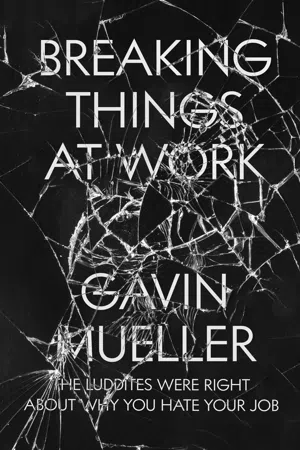
In the Nineteenth-century, English textile workers responded to the introduction of new technologies on the factory floor by smashing them to bits. For years the Luddites roamed the English countryside, practicing drills and manoeuvres that they would later deploy on unsuspecting machines. The movement has been derided by scholars as a backwards-looking and ultimately ineffectual effort to stem the march of history; for Gavin Mueller, the movement gets at the heart of the antagonistic relationship between all workers, including us today, and the so-called progressive gains secured by new technologies. The luddites weren't primitive and they are still a force, however unconsciously, in the workplaces of the twenty-first century world.
Breaking Things at Work is an innovative rethinking of labour and machines, leaping from textile mills to algorithms, from existentially threatened knife cutters of rural Germany to surveillance-evading truckers driving across the continental United States. Mueller argues that the future stability and empowerment of working-class movements will depend on subverting these technologies and preventing their spread wherever possible. The task is intimidating, but the seeds of this resistance are already present in the neo-Luddite efforts of hackers, pirates, and dark web users who are challenging surveillance and control, often through older systems of communication technology.
- 176 pages
- English
- ePUB (mobile friendly)
- Available on iOS & Android
eBook - ePub
About this book
Information
1
The Nights of King Ludd
In the second decade of the nineteenth century, the British Crown faced a problem. Discontented weavers, croppers, and other textile workers had begun a protracted insurgency against property and the state. At issue were new types of machines —the stocking frame, the gig mill, and the shearing frame— that could produce and finish cloth using a fraction of the labor time previously required, transforming a skilled profession into low-grade piecework. Wages plummeted and hunger began to set in. Communities of thousands were threatened by the upheaval.
Some of these technologies had floated around England and France for centuries, repeatedly drawing the anger of workers. Croppers had been targeting gig mills, in particular, for years: as the eighteenth century came to a close, several mills in Leeds had been publicly destroyed. (Subsequent investigations by authorities tellingly failed to find any witnesses to the events.) In some cases, weavers successfully appealed to prior government decisions protecting their livelihoods from technology. However, after just a few years, the situation was rapidly changing. Parliament’s preoccupation with the wars against Napoleon meant it had little patience for the demands of unruly craftsmen. The new Combination Laws, which outlawed trade union activity, severely limited collective action by textile weavers. Mill owners saw an opportunity, and redoubled their efforts to introduce machines and reduce wages. As tensions intensified, a new strategy emerged.
Between 1811 and 1812, hundreds of new frameworks were destroyed in dozens of coordinated, clandestine attacks under the aegis of a mythical leader called “Ned Ludd.” In addition to their notorious raids, the so-called Luddites launched vociferous public protests, sparked chaotic riots, and continually stole from mills—activities all marked by an astonishing level of organized militancy. Their politics not only took the form of violent activity but was also enunciated through voluminous decentralized letter-writing campaigns, which petitioned—and sometimes threatened—local industrialists and government bureaucrats, pressing for reforms such as higher minimum wages, cessation of child labor, and standards of quality for cloth goods. The Luddites’ political activities earned them the sympathies of their communities, whose widespread support protected the identities of militants from the authorities. At the height of their activity in Nottingham, from November 1811 to February 1812, disciplined bands of masked Luddites attacked and destroyed frames almost every night. Mill owners were terrified. Wages rose.
The weaver insurrection threatened to link up with other underground anti-government currents, such as the Jacobins— indeed, at least one Luddite signed his letter with the name of the recently deceased republican writer Thomas Paine. Parliament was now sufficiently interested. It dispatched soldiers across the country to quell the violence and passed new legislation that made frame breaking a capital offense. The poet Lord Byron gave his first speech to Parliament denouncing these measures leveled against the Luddite “mob.” “You may call the people a mob, but do not forget that a mob too often speaks the sentiments of the people,” he warned.1 As if to acknowledge Byron’s point, small mill owners were increasingly afraid to implement the machines. This also meant that owners of the larger workshops that continued to use frames knew they were likely targets.
William Cartwright was one such owner, and he was prepared for the inevitable Luddite attack. On the night of April 9, 1812, the Luddites had launched a daring raid on the massive Horbury mill complex owned by Joseph Foster, assembling a force of hundreds to successfully wreck and burn the building, after detaining Foster’s sons without bloodshed. Cartwright wouldn’t be so easy a mark. He had fortified his mill and holed up inside with several militia members. When, on April 11, the Luddites descended on his factory and began to smash apart the door with hammers, he and his men opened fire. After a gun battle, the Luddites retreated, leaving behind two wounded men who later succumbed to their injuries. In spite of intense surveillance and investigation, none of the attackers were identified, even after a series of assassination attempts on mill owners (one successful) at the end of April.
Yet eventually the spies and crackdowns had their effect, and in January 1813 authorities identified, arrested, and executed several suspected Luddite higher-ups. The most pronounced phase of machine breaking rapidly subsided. But the movement lived on in the underground, bolstered by a powerful mythology and its storied confrontation with the detested state. Sporadic outbreaks of machine breaking continued for years. It was this quality Lord Byron captured in “Song for the Luddites,” his 1816 encomium to the movement, which portrayed it as heroically doomed, but successful at laying the groundwork for future emancipatory struggles. The blood shed by the Luddites was “the dew / Which the tree shall renew / Of Liberty, planted by Ludd!”2 This mythological, subterranean character has carried forward to our own time; as E.P. Thompson says, “To this day Luddism refuses to give up all its secrets.”3
In spite of Byron’s efforts, history has not been kind to the Luddites. Their militant opposition to machines has meant that their legacy has been understood as a kind of technophobia. And because their rebellion occurred during the early days of the advent of mass production, the Luddites have become synonymous with an irrational fear of inevitable progress. Critics of technology find themselves either performatively disclaiming the Luddite legacy or professing their unbecoming sympathies. “I’m not a Luddite,” insists technology writer Andrew Keen while explaining his antipathy toward social media,4 just as “Luddite confessionals” have become an established essay genre, encompassing educators, musicians, and even information technology professionals.5
The Luddites’ association with technophobia has itself garnered them vocal sympathizers. In 1984, Thomas Pynchon dryly inquired whether it was “O.K. to be a Luddite,”6 and the nineties saw the so-called neo-Luddite movement, which brought together sundry social critics with radical environmentalists in a loose coalition opposed to contemporary technologies. While their manifesto specified that they did not oppose technology as such, the neo-Luddites’ opposition to everything from genetic engineering to television, computers, and “electromagnetic technologies” belied a debt to anti-civilization anarcho-primitivist politics.7 Odd tics, such as an identification with Unabomber Ted Kaczynski8 and the subsequent flirtations of leading figure (and author of an evocative history of the Luddites) Kirkpatrick Sale with secession movements,9 give off a distinct odor of crankishness.
It is the nature of myths to contain an element of flexibility and indeterminacy in their application. Indeed, the Luddites assumed a mythic character in their own time: they invoked the name of an imaginary king. The construction of a mythos, tied to a collective subject, is part of what has made the Luddite struggle a common turn of phrase 200 years after the fact. As media theorist Marco Deseriis argues, the rhetorical power of the Luddites lay in their articulation of otherwise loosely connected struggles into a set of linked practices and narratives, what he calls an “assemblage of enunciation”: “a network of pragmatic actions and semiotic expressions that are connected but also enjoy relative autonomy.” The function of the “improper name” of Ned Ludd is, according to Deseriis, “precisely to eschew fixation by incorporating a plurality of usages that cannot easily be reduced to one.”10
After all, the Luddites were not the first instance of an organized attack on industrial manufacturing: stocking frames, specifically, had been targeted for decades, and the British Parliament had passed an act protecting the machines in 1788. The wealthy and powerful understood machines as a method to accumulate power, and so too did the toiling classes over whom they wished to exert it. And so destruction and sabotage accompanied the introduction of machines wherever they were introduced. Marx notes the protracted hostility to wind- and waterpower stretching back to at least the 1630s.11 Industrial machines inspired a special ire, as they not only disrupted traditional ways of life, but brutally ground down their workers. London’s massive Albion Mills, the probable inspiration for William Blake’s line about “dark Satanic mills,” was burned to the ground in 1791—possibly at the hands of its workers, who cheered the blaze from the riverbanks of the Thames while ignoring authorities’ pleas to help fight the fire. Satirists of the day were quick to label the celebrants dangerous radicals and partisans for outdated machines.12 In 1805 French silk weavers greeted the arrival of the Jacquard loom by attempting to assassinate its inventor and destroying the device publicly in Lyon.13 After the brief flourishing of the Luddite rebellions, destruction of machines and factories continued in France, in the United States (where a number of textile factories went up in flames, likely from arson), and throughout Silesia and Bavaria.14
In light of a history rife with workers destroying machines, why do the Luddites cast the longest shadow? It is not only because they knew how to spin a good yarn. After all, the Crown doesn’t muster a military force of thousands to destroy a myth. The Luddites loom large because of the power of their struggle, both in literature and in their historical accomplishments. While E.P. Thompson has sought to rescue the Luddites from “the enormous condescension of posterity” through an act of radical sympathy, he still acknowledged that militant reactions against industrialism “may have been foolhardy. But they lived through these times of acute social disturbance, and we did not.”15 I admire Thompson’s ability to comprehend the Luddites from within their specific conjuncture, rather than from a point of view that sees them as a mere speed bump on the road to our inevitable present.
But we can go further. History has a shape, but it is not one that is foretold, still less one forecast by the tools and technologies at hand. Instead, the shape of history, as Marx argued, is wrought by the struggles of those who participated in it. That the Luddites were ultimately unsuccessful is not itself an indictment: final success is a poor criterion for judging an action before or during the fact. And, as I hope to demonstrate, Luddism was not altogether pointless. Our history is the Luddites’ as well, and their insight—that technology was political, and that it could and, in many cases, should be opposed—has carried down through all manner of militant movements, including those of the present. There is much to learn from this tradition, even among the most technophilic current-day radicals.
The Luddite opposition to machines was, it must be said, not a simple technophobia. As Sale notes, many of the Luddites were weavers or other skilled textile workers who operated their own complicated tools.16 Their revolt was not against machines in themselves, but against the industrial society that threatened their established ways of life, and of which machines were the chief weapon. To say they fought machines makes about as much sense as saying a boxer fights against fists. As Sale describes it, the Luddite rebellions were never simply against technology, but “what that machinery stood for: the palpable, daily evidence of their having to succumb to forces beyond their control.”17
Machine breaking was only one technique among many that the Luddites deployed, reserved for use against the most intransigent factory owners as part of a wider strategy to increase worker power.18 Weavers invoked King Ludd in their attempts to collectively bargain for piece rates that would allow them to survive, and in their petitions to government authorities for redress. One letter sent to the Home Office in 1812, signed “Ned Lud’s Office, Sherwood Forest,” stated that “all frames of whatsoever discription the worckmen of which Are not paid in the current Coin of the realm will Invarioably be distroy’d,” while vowing to protect the frames of compliant owners.19
Historian Eric Hobsbawm, in a reevaluation of the Luddites’ motivations for machine breaking, describes them as “collective bargaining by riot.” For Hobsbawm, “The value of this technique was obvious, both as a means of putting pressure on employers, and of ensuring the essential solidarity of the workers.”20 Machine breaking was one weapon among many, but it was also a technique for something else: forging a shared communal struggle. Hobsbawm views this practice as entirely appropriate for the early nineteenth century. “In those pre-socialist times the working class was a crowd, not an army,” he writes. “Enlightened, orderly, bureaucratic strikes were impossible.”21
Here, Hobsbawm suggests the most important element of the Luddites: his analysis reorients the discussion away from the movement’s quixotic outcome and toward an emphasis on class composition. The concept of class composition, an effort to grasp class in both its economic and political dimensions in tandem, was developed by Italian theorists like Raniero Panzieri, Sergio Bologna, and Mario Tronti to account for the new forms of resistance exhibited by the youthful “mass workers,” deskilled by the introduction of new machinery into factories.22 Class composition, then, is a rebuke to the notion of class as a preexisting empirical category—an idea you might encounter in a basic sociology textbook, where you simply look at someone’s job or income and determine their class. Rather, class in the Marxist sense is forged through struggle itself. As the writers of 1970s journal Zerowork put it, “For us, as Marx long ago, the working class is defined by its struggle against capital and not [merely] by its productive function.”23
In Hobsbawm’s estimation, the working-class activity of the Luddites has to be understood in terms of its existing technical composition; indeed, workers had not yet been organized into a disciplined mass, but were instead a mélange of laborers working in their own homes and shops, often with their own tools. Physically separated and without established organizations, they often related to bosses according to individualized contracts, and so it was impossible for them to engage in the kinds of militancy we associate with trade unions made up of mass workers. But Hobsbawm suggests something further: that thr...
Table of contents
- Cover Page
- Halftitle Page
- Title Page
- Dedication
- Copyright Page
- Contents
- Acknowledgements
- Introduction
- 1. The Nights of King Ludd
- 2. Tinkerers, Taylors, Soldiers, Wobs
- 3. Against Automation
- 4. High-Tech Luddism
- Conclusion
- Notes
- Index
Trusted by 375,005 students
Access to over 1.5 million titles for a fair monthly price.
Study more efficiently using our study tools.
Frequently asked questions
Yes, you can cancel anytime from the Subscription tab in your account settings on the Perlego website. Your subscription will stay active until the end of your current billing period. Learn how to cancel your subscription
No, books cannot be downloaded as external files, such as PDFs, for use outside of Perlego. However, you can download books within the Perlego app for offline reading on mobile or tablet. Learn how to download books offline
Perlego offers two plans: Essential and Complete
- Essential is ideal for learners and professionals who enjoy exploring a wide range of subjects. Access the Essential Library with 800,000+ trusted titles and best-sellers across business, personal growth, and the humanities. Includes unlimited reading time and Standard Read Aloud voice.
- Complete: Perfect for advanced learners and researchers needing full, unrestricted access. Unlock 1.5M+ books across hundreds of subjects, including academic and specialized titles. The Complete Plan also includes advanced features like Premium Read Aloud and Research Assistant.
We are an online textbook subscription service, where you can get access to an entire online library for less than the price of a single book per month. With over 1.5 million books across 990+ topics, we’ve got you covered! Learn about our mission
Look out for the read-aloud symbol on your next book to see if you can listen to it. The read-aloud tool reads text aloud for you, highlighting the text as it is being read. You can pause it, speed it up and slow it down. Learn more about Read Aloud
Yes! You can use the Perlego app on both iOS and Android devices to read anytime, anywhere — even offline. Perfect for commutes or when you’re on the go.
Please note we cannot support devices running on iOS 13 and Android 7 or earlier. Learn more about using the app
Please note we cannot support devices running on iOS 13 and Android 7 or earlier. Learn more about using the app
Yes, you can access Breaking Things at Work by Gavin Mueller in PDF and/or ePUB format, as well as other popular books in Politics & International Relations & Political Economy. We have over 1.5 million books available in our catalogue for you to explore.