Life after war is intrinsically political for former combatants. As wars end, societies and former combatants face a period of transition. This book explores the experience of coming home for former combatants, capturing the challenges and opportunities for political mobilization among former combatants as they return from three very different wars: South West Africa People's Organization combatants who participated in the Namibian War of Independence (1966–90); guerrillas from Movimiento 19 de Abril who joined the ongoing guerilla warfare conducted against the Colombian state (1974–90), and combatants from the United States who participated in the Vietnam War (1955–75).
Offering an insightful perspective on peace as a process through the long-term study of the lives of fifty former combatants, Söderström demonstrates how the process of coming home shapes their political commitment and identity. Combining detailed scholarship with interviews with former combatants, this volume serves as a powerful reminder of the legacies of war in the lives of former combatants.
eBook - ePub
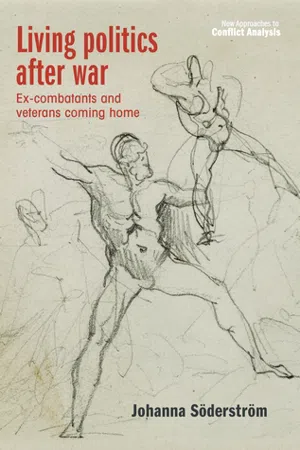
Living politics after war
Ex-combatants and veterans coming home
- 216 pages
- English
- ePUB (mobile friendly)
- Available on iOS & Android
eBook - ePub
Living politics after war
Ex-combatants and veterans coming home
About this book
Information
1
Diverse wars and combatants
Between 1816 and 2001 the world experienced 462 wars (298 of which were civil wars) in addition to two world wars (Wimmer and Min 2009). As the interviews in this chapter will show, wars come in many different forms. Past research has tried to categorize and construct various typologies of wars, sorting them into types based on their location, which actors are involved, how long they last, which means of warfare are used, their aims, who is involved in combat, how destructive they are, the total (battle) death count,1 and when they were waged, among other things. Some typologies focus on the actors’ position within the international state system (the Correlates of War), whereas others focus on the aims of the warring parties (Wimmer and Min 2009), or the type of actors involved (the Uppsala Conflict Database Program, see Allansson et al. 2017). While the three cases examined in this book are wars that were all waged at a similar time, in the context of the Cold War, they are otherwise quite diverse. This diversity provides an important backdrop to the rest of the book, particularly in relation to any similarities in the political lives of the former combatants.
First, Namibia. The conflict and war there were long. After the First World War, Namibia (then South West Africa) had been administered by South Africa, and then after the Second World War South Africa implemented apartheid rule in Namibia. There was resistance to South African rule, due in part to the system of migrant labor, and in April 1960 exiled resistance leaders (including Sam Nujoma) established SWAPO (for more on the origins of SWAPO, see Vigne 1987). In 1966, attempts to take South Africa's administration before the International Court of Justice failed and SWAPO declared war on South Africa. From 1966 to 1989, PLAN (the armed wing of SWAPO) fought various South African forces for independence. During the war it is estimated that between twenty thousand and twenty-five thousand people died.2 As early as 1976 the United Nations (UN) Security Council passed a resolution in favor of Namibian independence. In the end, Cold War politics shaped the possibilities for reaching a peace agreement. The UN Transition Assistance Group (UNTAG) was only implemented for one year, from 1989 to 1990, although it had been authorized as early as 1978. The UN mission focused on overseeing elections in an independent Namibia, and it was one of the first multi-dimensional UN missions (Dzinesa 2004, pp. 650–652). Before the election, about forty-three thousand combatants and refugees were repatriated together through the UN Refugee Agency, causing the bureaucratic lines between combatants and refugees to become blurred (Colletta et al. 1996, pp. 131–132).
The second case focuses on the conflict between M-19 and the Colombian government beginning in 1970 (the group became a publicly known entity in 1974) and ending in 1990. This conflict, however, is part of a larger conflict complex, involving many different armed groups, largely right-wing pro-government and government forces opposing left-wing guerrilla groups; these conflicts started earlier and still continue for some groups. The impetus for the formation of M-19 was the presidential election of 1970, which was perceived as fraudulent. Starting in August 1978, M-19 declared war on the government and launched multiple attacks. During the war, M-19 often focused on symbolic events and attacks, some of which have been described as “catastrophic” and “shady” (Sanin 2003, p. 7). M-19 often criticized other leftist guerilla groups in Colombia while also trying to create more unity among them. M-19 was more centrist than the other guerrilla groups, and incorporated more nationalist imagery in their struggle, as well as appealing more to the urban middle class (Bell et al. 2015; Florez-Morris 2007, 2010; García Durán et al. 2008; Sanin 2003). According to the Uppsala Conflict Data Program, there were an estimated 1,130 battle deaths directly resulting from the conflict between the Colombian government and M-19 between 1972 and 1988. The number of deaths resulting from the overall conflict between the government and the various guerilla groups is much higher.3 The internal armed conflict was largely focused on political reform, never secession. Peace talks with M-19 began during the early 1980s, and in March 1990 a peace agreement was signed, immediately followed by similar agreements with five other guerilla groups (the last being in 1994),4 and constitutional reform in Colombia.
The Vietnam War is the earliest case, starting in 1955 when Vietnam gained independence from France and was split into the Democratic Republic of Vietnam (North) and the Republic of Vietnam (South). The war became an extension of the Cold War, as the United States and other anti-communist countries supported and intervened on the side of South Vietnam against the North Vietnamese who were supported by China and the Soviet Union, among others. The war between 1955 and 1964 is categorized as an internal war, and as an interstate war between 1965 and 1975 (Gleditsch et al. 2002; see also Gleditsch 2004, pp. 245–246). The conflicts in Vietnam also had a much longer trajectory, both before and after US involvement. In total, about 2.6 million American military personnel were deployed to Vietnam during the war (the bulk between 1965 and 1972) (Kane 2004), and these are the veterans from this war that this book focuses on. Eventually, American public support for the war diminished and the United States started to withdraw their troops. The war ended in 1975 when the North won and the country was unified. In total some 58,220 American military personnel died during the war (National Archives 2013), while the total number of battle deaths in the Vietnam War is estimated at 2,097,705 (Lacina and Gleditsch 2005, p. 154). The Vietnam War is by far the deadliest conflict the world saw between 1946 and 2002, in part explained by the extremely large number of bombs dropped on Vietnam.
The Vietnam War was a much more internationalized war than the other two cases in this book, even if Cold War interests also mattered for all three. M-19 operated from within Colombia, whereas SWAPO was largely based outside of Namibian territory. The combatants in these three cases have very different relationships with the state given their role and the incompatibilities involved in each war. In addition, the wars ended very differently: SWAPO delivered independence to Namibia and ultimately became the ruling party; M-19 signed a peace agreement and became one of many political parties in Colombia; whereas the United States lost the war in Vietnam. The rest of this chapter introduces the three cases, in particular the various experiences of the former combatants who were interviewed, telling their stories from joining armed groups and their war experience to the reception they received when they came home. This chapter thus introduces the larger differences between the cases and those interviewed.
Recruitment and war experiences
Former combatants’ stories lead us to ask: what kinds of combatants are there? And how do they end up fighting? We see that individuals can be conscripted, they can volunteer, they can be hired, it may be a career choice, or they may be forcibly recruited, or they join for political reasons or personal safety. Historically, the development of mass armies, through the expansion of conscription, was also linked to the expansion of franchise and democratization (for more on this, see, among others, Diehl 1993, p. 9; Levi 1998, 1999). The use of volunteers and private security companies has further changed the dynamic between combatants and citizenship, pointing at new global inequalities (see e.g. Christensen 2017; Eichler 2014). But this relationship has always been changing, as demonstrated by the historically extensive use of buying out of conscription (Levi 1998), and use of mercenaries (Adams 1999; Luraghi 2006). Less than one-third of the world's countries were reported to use conscription to recruit for their armed forces in 2014 (Eichler 2014, p. 601). Recruitment during civil wars is, similarly, a combination of many different motives of individuals and the strategies of the armed groups (see e.g. Barrett 2011; Bosi and Della Porta 2012; Collier and Hoeffler 2004; Eck 2010; Florez-Morris 2007; Humphreys and Weinstein 2008; Muldoon et al. 2008; Podder 2011; Ulvin 2007; White 2007). Recruitment patterns and war experiences in the three cases are discussed below; the abrupt and extended exile experienced by SWAPO is contrasted with the gradual, secretive recruitment process of M-19, as well as the apolitical short tours conducted by American combatants in Vietnam. As these different recruitment patterns and combat experiences are contrasted, some of the main individuals throughout the book are also introduced.
Extended exile for SWAPO
SWAPO was an independence movement originating in 1960. Those who joined SWAPO were largely motivated by resistance to the South African regime. Interviewees explained how they committed to the cause after witnessing violence against their neighbors and family, and through listening to the radio and attending SWAPO rallies. Most kept their involvement secret from their families for as long as possible, as their participation in SWAPO put the family at risk. Some people joined very young, often together with their entire school, in which case it is less clear how voluntary or political the decision was. Sackaria (N12) was one example of this. I met Sackaria at his present home, an illegal settlement in Windhoek. He was only 9 years old when he left Namibia, and was one of those recruited through his school. Another interviewee, Memory (N3), said she was only 16 when she left for exile. She had heard about others joining to fight for freedom. Her parents were political and pro-independence, but they did not want her to leave, so she left without telling them, together with a group of other kids. She was very excited about joining SWAPO. Similarly, Mukwanambwa did not tell her parents when she left, but crossed the border with some friends. She was the only one of her mother's children who joined SWAPO. Her description of the process of joining SWAPO indicates both her ambiguity and naivety at the time:
I was not scared at all. I was just happy that I was going to SWAPO and I never knew there were people who were killing each other like at a battle field where people meet and kill each other … I never cared about that. I didn't even want to go to school, all I wanted was just to go to the frontline and kill. (N7)
Most interviewees report a sense of political purpose behind the struggle and their reason for joining SWAPO. Peter was clearly politically driven before he sought out and joined SWAPO. He noted, sardonically, “I didn't notice that I became a terrorist, an anti-gov...
Table of contents
- Cover
- Half-title page
- Series page
- Title page
- Copyright page
- Contents
- Figures
- Acknowledgments
- Introduction
- 1 Diverse wars and combatants
- 2 Coming home and living peace?
- 3 “Veteran” as a political identity
- 4 Veteran networks throughout a lifetime
- 5 Paths of mobilization
- Conclusion
- Personal interviews
- References
- Index
Trusted by 375,005 students
Access to over 1.5 million titles for a fair monthly price.
Study more efficiently using our study tools.
Frequently asked questions
Yes, you can cancel anytime from the Subscription tab in your account settings on the Perlego website. Your subscription will stay active until the end of your current billing period. Learn how to cancel your subscription
No, books cannot be downloaded as external files, such as PDFs, for use outside of Perlego. However, you can download books within the Perlego app for offline reading on mobile or tablet. Learn how to download books offline
Perlego offers two plans: Essential and Complete
- Essential is ideal for learners and professionals who enjoy exploring a wide range of subjects. Access the Essential Library with 800,000+ trusted titles and best-sellers across business, personal growth, and the humanities. Includes unlimited reading time and Standard Read Aloud voice.
- Complete: Perfect for advanced learners and researchers needing full, unrestricted access. Unlock 1.5M+ books across hundreds of subjects, including academic and specialized titles. The Complete Plan also includes advanced features like Premium Read Aloud and Research Assistant.
We are an online textbook subscription service, where you can get access to an entire online library for less than the price of a single book per month. With over 1.5 million books across 990+ topics, we’ve got you covered! Learn about our mission
Look out for the read-aloud symbol on your next book to see if you can listen to it. The read-aloud tool reads text aloud for you, highlighting the text as it is being read. You can pause it, speed it up and slow it down. Learn more about Read Aloud
Yes! You can use the Perlego app on both iOS and Android devices to read anytime, anywhere — even offline. Perfect for commutes or when you’re on the go.
Please note we cannot support devices running on iOS 13 and Android 7 or earlier. Learn more about using the app
Please note we cannot support devices running on iOS 13 and Android 7 or earlier. Learn more about using the app
Yes, you can access Living politics after war by Johanna Söderström, Emmanuel Pierre Guittet in PDF and/or ePUB format, as well as other popular books in Politique et relations internationales & Histoire de l'armée et de la marine. We have over 1.5 million books available in our catalogue for you to explore.