The tremendous growth in foreign direct investment (FDI) in Africa comes at a time when the field of international investment law and arbitration is witnessing a renewal. The investment has led to big business for law firms in the area of investment arbitration and the last decade has witnessed an increased number of investment treaties, proliferating investment disputes, the rise of mega- regional trade agreements and the negotiation of mega- regional infrastructure projects. Yet, while the argument in support of investment treaties as instruments to attract foreign direct investment is highly contested, many African countries are no doubt becoming more aware of the need to reshape the international investment architecture.
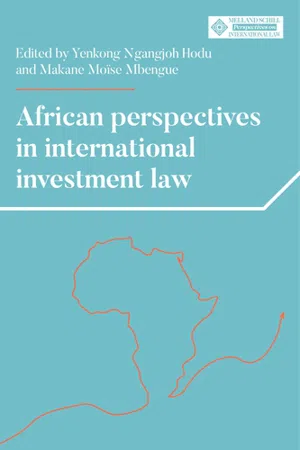
This volume explores trends in FDI on the African continent, the benefits and challenges that FDI presents for African States, and Africa's participation in the international investment law regime. Featuring contributions from leading African international lawyers, arbitrators, jurists, academics, and litigation experts, this landmark volume is the first of its kind of explore African perspectives in international investment law. Hodu and Mbengue bring together non-mainstream approaches to the debate on the nexus between foreign investment and development, addressing key conceptual issues that will define contemporary international investment law for decades to come. With insights and critical comments on the challenges of Africa's foreign investment climate and international investment law, this timely collection is essential reading for academics, students, and practitioners alike.
eBook - ePub
African perspectives in international investment law
- 286 pages
- English
- ePUB (mobile friendly)
- Available on iOS & Android
eBook - ePub
African perspectives in international investment law
About this book
Information
Topic
DirittoSubtopic
Diritto internazionale Part I
Sustainable development and the changing fundamentals of international investment law in Africa
1
The development of international investment law in Africa
Maurice Kamto
Introduction
The fast development of major countries in Asia, particularly China, has fuelled the imagination of many African countries and the expectations of their peoples.1 Each of them has set its own deadline to become an emerging economy. To meet such a target, they all expect to attract more and more foreign direct investment (FDI). There is, therefore, fierce competition to get the largest share of FDI. Taking into account this situation and the topic of this present monograph, this chapter will respond to the following fundamental questions: firstly, what is an investment in investment law?; secondly, are there justifications in support of the arguments that Africa has been unfairly treated in international investment terms since decolonisation?; thirdly, did the 1970s new international economic order bring any investment successes to Africa?; fourthly, what is the position of Africa post-1990s and beyond?
1What is an investment in investment law?
It is important to start with a definition of investment because its definition determines the jurisdiction of arbitral tribunals and any other mechanism entrusted with the jurisdiction to settle disputes between investors and the receiving State of the investment.
The term ‘investment’ seems to have appeared after the Second World War to address the foreign property contribution, either through the creation of new companies in the territory of the host State, with the foreign investor being the major shareholder, or by taking a share (generally the majority) of the capital of a company that already existed in that country.
There is no general definition of the term ‘investment’. An investigation of the codes and treaties in the domain of investment shows a ‘pragmatic’ or ‘functional’ approach, where every definition is made for the purpose of each legal instrument and is not meant to be a general definition of investment as such. For instance, the definition of investment in the Convention on the Settlement of Investment Disputes between States and Nationals of Other States (known as the Washington Convention), which created the International Centre for Settlement of Investment Disputes (ICSID), is relevant only for the purpose of assessing the jurisdiction of arbitral tribunals. These tribunals assess only the scope of the legal instrument brought to their consideration or their jurisdiction, which depends partly on the contentious operation being qualified as an investment, and is only assessed in the context of that legal instrument.2
According to traditional conception, the criteria for an investment are: the contribution of the investor in the territory of the foreign State, whether financial, material or know-how; the contribution must last a certain time, meaning that it should not be a purely financial speculation or an instant commercial transaction; there must be some economic risk for the investor who should be ready to face lost or make or maximise profit; and if it is not included in the first three criteria, the investor must be in position to influence or control the management of the economic operation, namely a local company if the investment consists of buying shares in such a company or creating a new company. However, this conception that can be found in the United States model bilateral investment treaty (BIT) is no more relevant to account accurately the definition of investment as can be derived from new treaties for protection of investments, investment codes and arbitration practice.3 Indeed, new forms of economic operations are qualified as ‘investments’. The definition has expanded beyond property investment to a series of contributions without having an interest in the company’s capital and without a minimum interest in the company. Yet, is it desirable to dilute the notion of investment in that of property, interest or whether investment is linked to a commercial transaction, for it will lead to the merging of different regimes, which might not be easy to manage in practice? Finally, the definition of investment under the ICSID Convention is not very precise.4
Although at certain periods focus has been put on the contribution of the investment to the development of the host countries, some scholars think that it is not the main purpose of the investment law.5 Roughly, there are two approaches in defining investment in the process of ascertaining jurisdiction in a particular dispute: on the one hand, the objective definition of investment, and on the other hand, the normative qualifications of investment.
It is unnecessary to delve into normative qualifications because they are subjective, meaning they depend on the parties to a particular BIT. Indeed, to overcome the hurdle of defining investment, many BITs, while refraining to state exactly what constitutes an investment – and even when they do – would define a list of operations the parties consider as ‘investment’. Normative qualifications are distinct from the definition because of their combination of concepts and concrete cases. It is a mental operation of linkage and connection of a notion with its materialisation. The qualification would set the appropriate applicable legal regime, for instance, whether the matter is one of international investment law or not. Qualification will therefore determine the jurisdiction of the arbitral tribunal.
For the Parties to the BIT to consider an operation as an investment does not prejudge the same qualification, later on, by the ICSID Tribunal.6 In Ceskoslovenska Obchodni Banka, A.S. v. The Slovak Republic (1999) the Tribunal considered that a ‘two-fold test’ ‘must ... be applied in determining whether this Tribunal has the competence to consider the merits of the claim: whether the dispute arises out of an investment within the meaning of the Convention and, if so, whether the dispute relates to an investment as defined in the Parties’ consent to ICSID arbitration, in their reference to the BIT and the pertinent definitions contained in Article 1 of the BIT’7 In MHS v. Malaysia (2007) the ICSID Arbitration Tribunal recognised that: ‘Under the double-barrelled test, a finding that the Contract satisfied the definition of “investment” under the BIT would not be sufficient for this Tribunal to assume jurisdiction, if the Contract failed to satisfy the objective criterion of an “investment” within the meaning of Article 25 … .’8
Paragraph 27 of the report of the ICSID administrators9 provides that it has not been found useful to define the term ‘investment’, since the consent of the parties are an essential condition, taking into consideration the mechanism by which the contracting parties can decide in advance, if they so wish, the categories of dispute they would be ready to submit to the ISCID. The subjective theory goes along this line. According to this theory, the definition of ‘investment’ depends only on the applicable law, as it derives from Article 25(1) of the Washington Convention on the consent to arbitration.10
It is to be noted that normative qualifications do not define investment but confine themselves to specify the legal forms that investments can have. For instance, in some cases, the purchase of shares can be considered an investment. One advantage of the subjective approach is that it can attract investments, thanks to its very broad conception of this notion.
The criteria of the objective definition of investment are rather controversial among arbitral tribunals. In Salini v. Morocco,11 Morocco argued that the road construction contracts allocated to two Italian companies were not an investment under the Washington Convention; but the BIT included the rights to a contractual service with an economic value, meaning that the contract fell within that definition of investment. In a landmark decision in that case, the Tribunal rejected this subjective definition and looked for objective criteria of investment. It stated that academics generally consider that investment supposes contributions, the execution of the contract for a certain period of time (or durability) and a participation in the risk of operation. It added that the consideration of the Preamble of the Washington Convention allows the addition of the criterion of ‘contribution to economic development’.
These criteria can be independent of each other. Thus, the risk of operation may depend on the contributions to and the duration of the execution of the contract. However, the criteria may also be considered globally even though the Tribunal considered them separately. The post-Salini jurisprudence is characterised by the will to suppress the contribution to development in the host state because it is more difficult to establish and is implicitly covered by the three other criteria.12 In Patrick Mitchell v. Congo, the issue was the contribution of a law firm to the development of the host country. The Arbitral Tribunal held that the contribution should be ‘positive and significant’; on the contrary, the Ad Hoc Committee annulled the award on the grounds that such contribution ‘shall not necessarily be important and successful’.13
Indeed, although the Ad Hoc Committee specified that the existence of a contribution to economic development of the host State is ‘an essential – although not sufficient – characteristic or unquestionable criterion of the investment’, it added that this ‘does not mean that this contribution must always be sizable or successful; and, of course, ICSID tribunals do not have to evaluate the real contribution in one way or another to the economic development of the host State, and this concept of economic development is, in any event, extremely broad but also variable depending on the case’.14
Critics of the Salini award say that its criteria are rigid and not provided by the Washington Convention; that they contradict the choice to let the parties decide in the BITs and therefore might exclude certain operations from the protection of the investments. The preference was clearly therefore to go back to a more economic-oriented conception of the investment, focused on the contribution, profit, durability and risk, but, such an approach is based essentially on the conduct of an individual, whereas from a legal perspective, an investment must be considered in terms of bilateral relationships. For instance, when an aircraft manufacturer sells an aircraft, it is true that it makes a sale, but at the same time it is an investment for the purchasing state.
In the framework of the economic approach, international economic and financial institutions like the World Bank, the International Monetary Fund (IMF) and the Organisation for Economic Co-operation and Development (OECD) promote more operative definitions of investment, putting emphasis on the notions of enterprise, financial operation, economic control, and the idea of durability. It is in this light that the notion of ‘direct investment’ has been introduced. Their preference goes clearly for a restrictive definition of ‘investment’.15 In summary, the jurisprudence retains the following criteria for the definition of ‘investment’, while qualifying some as characteristic or essential: contribution, management, profit, risk, durability and contribution to development of the host State.
•Contribution is not controversial. It can be in cash, in nature or in industry (see Bayindir v. Pakistan), and also reputation (management of luxury hotels): Holiday Inns v. Morocco; but know-how and financial contribution are considered sufficient.
•Management implies that the investor must be able to influence significantly the decisions; involvement in the decision-making depends on whether the investment is made, for instance, through a...
Table of contents
- Cover
- Half Title
- Series Information
- Title Page
- Copyright Page
- Contents
- Notes on contributors
- List of abbreviations
- Introduction
- Part I: Sustainable development and the changing fundamentals of international investment law in Africa
- Part II: Experiences of selected African countries with international investment law
- Part III: African perspectives on contemporary challenges of investment dispute settlement
- Table of cases
- Index
Trusted by 375,005 students
Access to over 1.5 million titles for a fair monthly price.
Study more efficiently using our study tools.
Frequently asked questions
Yes, you can cancel anytime from the Subscription tab in your account settings on the Perlego website. Your subscription will stay active until the end of your current billing period. Learn how to cancel your subscription
No, books cannot be downloaded as external files, such as PDFs, for use outside of Perlego. However, you can download books within the Perlego app for offline reading on mobile or tablet. Learn how to download books offline
Perlego offers two plans: Essential and Complete
- Essential is ideal for learners and professionals who enjoy exploring a wide range of subjects. Access the Essential Library with 800,000+ trusted titles and best-sellers across business, personal growth, and the humanities. Includes unlimited reading time and Standard Read Aloud voice.
- Complete: Perfect for advanced learners and researchers needing full, unrestricted access. Unlock 1.5M+ books across hundreds of subjects, including academic and specialized titles. The Complete Plan also includes advanced features like Premium Read Aloud and Research Assistant.
We are an online textbook subscription service, where you can get access to an entire online library for less than the price of a single book per month. With over 1.5 million books across 990+ topics, we’ve got you covered! Learn about our mission
Look out for the read-aloud symbol on your next book to see if you can listen to it. The read-aloud tool reads text aloud for you, highlighting the text as it is being read. You can pause it, speed it up and slow it down. Learn more about Read Aloud
Yes! You can use the Perlego app on both iOS and Android devices to read anytime, anywhere — even offline. Perfect for commutes or when you’re on the go.
Please note we cannot support devices running on iOS 13 and Android 7 or earlier. Learn more about using the app
Please note we cannot support devices running on iOS 13 and Android 7 or earlier. Learn more about using the app
Yes, you can access African perspectives in international investment law by Yenkong Ngangjoh Hodu,Makane Moïse Mbengue, Yenkong Ngangjoh Hodu, Makane Moïse Mbengue in PDF and/or ePUB format, as well as other popular books in Diritto & Diritto internazionale. We have over 1.5 million books available in our catalogue for you to explore.