![]()
1
FRANCES IN HER INGLENOOK
Sheafe Satterthwaite
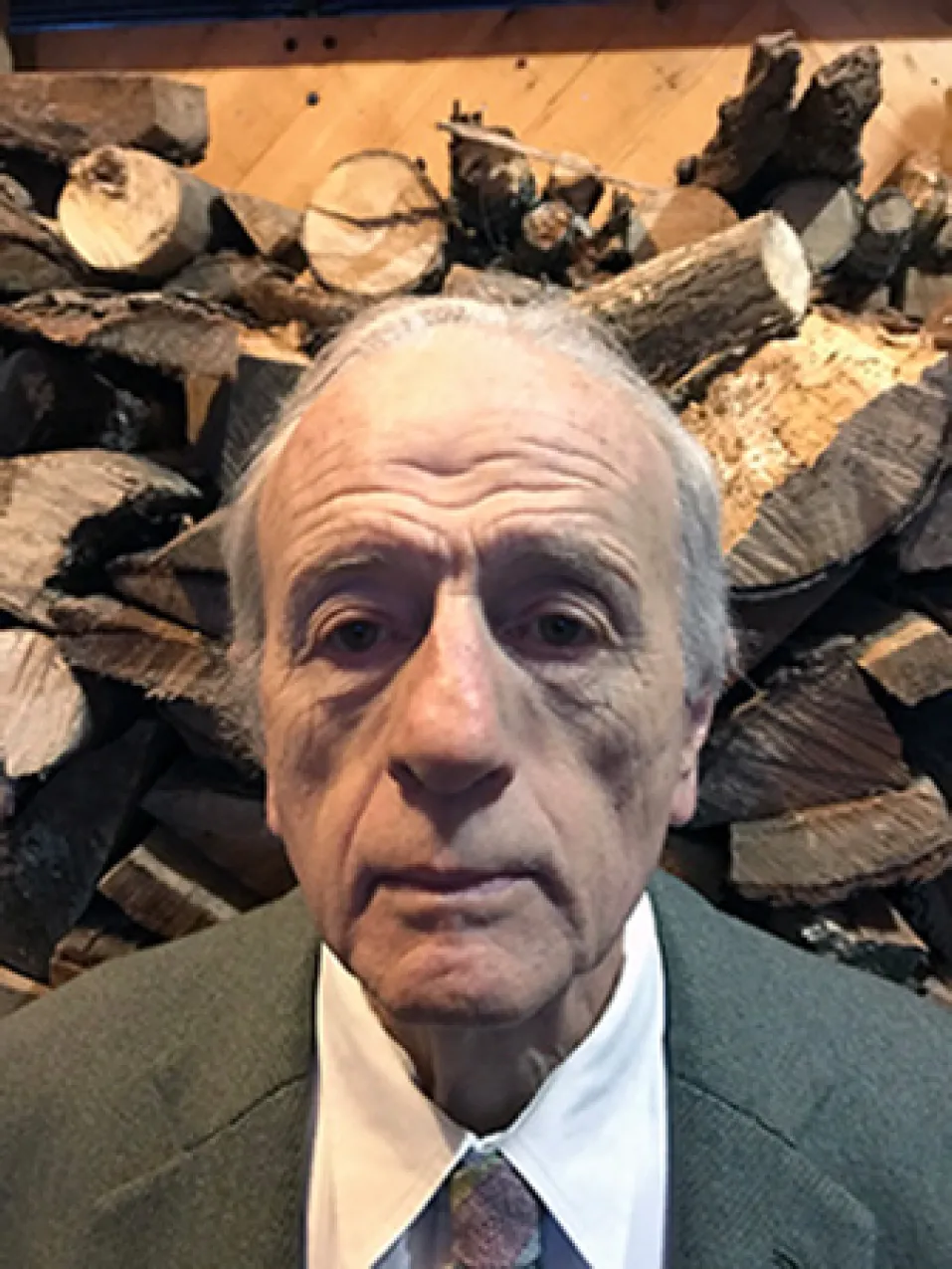
SHEAFE SATTERTHWAITE taught landscape history and design, which he studied at Harvard University under John Brinckerhoff Jackson, at Williams College for more than forty years. As a young man, he attended some of the earliest Flaherty Film Seminars, sometimes working as a gofer. He is one of the few remaining veterans of the seminars that convened at Robert and Frances Flaherty’s Black Mountain Farm. Over the following decades, he became one of the most recognizable and perceptive contributors to the Flaherty big-group discussions.
Why, when I think of the early (1957?) Flaherty seminar where I worked as an eighteen-year-old gofer, do I indelibly envision Frances Flaherty sitting high above the main floor of the barn, beside Sam Ogden’s chimney, looking down on the proceedings—while also being separate from them?
Curious, too, is how she tended, I believe, to be present at most screenings of her husband’s work whenever she had occasion to be present, as was true at her home, which was what the Dummerston setting for the seminar was—otherwise known as Black Mountain Farm, very much a hillside location, possibly deserted when the menfolk went off to war in the 1940s.
Figure 1.1. Photograph by Kenny Hersey.
(I don’t know this factually in Frances’s instance, but I do know that by 1957, there had been well over a century of hillside farm abandonment in Vermont and other New England uplands.)
I do know, both at the University of Virginia, where I founded a film society (Moving Images) around 1958 and where she appeared (and just how was that trip from Vermont financed?), and at Williams College (where I once hosted her), that she would sit through whatever Flaherty film was being screened, even though she must have seen these works hundreds of times. Could it be that tending to Bob’s work, caring for his work, was an act of devotion, even a religious observance, say like Holy Communion, to be celebrated or practiced again and again?
So I don’t have a sense of Frances’s being down on the main floor of her barn, which housed both the screening/discussion room and (was it?) two larger bedrooms on the south side—the left side, as the building was entered from the east. There must have been a bathroom, but I don’t recall it.
Confusing now to me, some sixty years later: Was there a projection booth? There must have been, but do I now also recall David Flaherty, Bob’s brother, threading 16mm projectors out in the open room?
Also, when Satyajit Ray’s Pather Panchali (1955) was screened that summer (and he himself was present as that seminar’s featured guest), surely no 16mm print existed, and just how was 35mm handled, presumably with two projectors?
Of significance in the main screening room was a grand piano. Included within the large coterie of summering artists and scholars among whom the Flahertys had settled in southern Vermont was Rudolf Serkin, who usually played at the early seminars. But I don’t recall his doing so when I was there. Of course, my gofer role did cause me to be away from the property on errands to neighboring Brattleboro and elsewhere, wielding Frances’s coupe car with a rumble seat (why the Flahertys, or why she, with such a car?).
But back to the aerie: Frances up there alone in her high-elevation inglenook. It was a balcony seat of a sort. I never recall anyone else being up there with her, and I don’t know if I myself ever went up.
And I should say, it was always difficult, however often in her later years I saw Frances, mostly in Dummerston, to know what she was thinking. There was, about her (at least for me), an air of superiority, and maybe that air has wafted through subsequent seminars over the years: here is film that, on the whole, is not blockbuster, that is the work of individuals more than companies, that may be somewhat outside the mainstream of box office successes, that is somehow special and to be savored by only the cognoscenti or self-appointed.
I also see Frances up there, hawklike. Always my sense was that some people discussing Bob’s work did not know the truth as she and Bob himself knew it, and she would silently correct them.
Excellent examples of this “correcting” mode are documented in the remarkable Louisiana Story Study Film (1960), made years back at the University of Minnesota (and, stupidly, never shown at any of the many seminars I attended—since it is so very helpful to understanding the Flaherty approach). How often in that film does she correct Bob’s cameraman, Ricky Leacock, by saying, “You know,” as if the cameraman did not know!
![]()
2
A SCREENING OF FLAMING CREATURES IN VERMONT
Jonas Mekas
JONAS MEKAS (1922–2019) was a crucial figure in the independent film world for nearly seventy years. The prime mover behind the New York Film-Makers’ Cooperative, Anthology Film Archives, and the journal Film Culture, Mekas brought attention to a broad range of independent cinema through his writing for the Village Voice and the Soho Weekly News. A poet, then writer-on-film and filmmaker, Mekas produced many films and has had considerable influence on independent filmmakers across the world. Major films include The Brig (1964), Walden (1969), Reminiscences of a Journey to Lithuania (1972), and Lost Lost Lost (1976), in which Mekas documents a visit he, Ken Jacobs, and others made to the 1964 Flaherty to show Jack Smith’s Flaming Creatures (1964); “rejected by the seminar,” they sleep outside and perform a ritual to film art in the cold morning.
I do not remember how it really came about, but it happened that in 1964, the Robert Flaherty Film Seminar that took place in Vermont every year had invited me to come and screen Jack Smith’s film Flaming Creatures (1964) as a special event of the seminar. Earlier that year, I had been arrested in New York for screening it. So I figured they wanted to find out what the fuss was all about. I agreed to come.
Our little gang consisted of Barbara Rubin, her friend Debbie, and Ken and Flo Jacobs—both of whom were also arrested that same evening with me. We drove to Brattleboro, Vermont, with a print of Flaming Creatures.
Figure 2.1.
The screening was announced for 10:30 p.m. As New York City folks, we thought that was a perfectly good time for closing an evening with a movie.
We arrived on time—actually half an hour early. We drove into the seminar grounds and were a little bit surprised to find it totally empty. As we were wandering about, someone came to us from the half darkness. I recognized the man; it was Louis Marcorelles, my good friend from Le Monde, Paris. “Where is everybody?” I asked. “They are sleeping,” said Marcorelles.
At that point, a young man appeared from the dark and introduced himself as a man in charge of the screenings. He asked us not to be so loud, people were sleeping. “How come?” I said. “What about the show?”
So the guy says, “This being the country, the sleeping time at the seminar is ten o’clock.” “But our screening was scheduled for ten-thirty,” I say. “How come?”
“Oh,” says the guy. “We told everybody about the screening. We put it in the ten-thirty slot because of the controversial nature of the movie. We have the projectionist ready for you.”
“But we have nobody here to see it,” I say.
“I want to see it,” said Marcorelles. “I came specially for it from Paris.”
“Let’s screen it!” we all said enthusiastically. And so we did. For Louis Marcorelles.
It was a cold night in Vermont. After the screening, we were ready to crash. So we asked our host to take us to our rooms. “No,” says the guy. “All rooms have been filled. Sorry guys.”
“OK, sorry to hear that,” we said. “We’ll be OK. Don’t worry about us.”
We managed. Some of us slept in our beat-up van. I slept among brooms and pails in an abandoned open country truck I found on the grounds.
No, we didn’t sleep well that night.
We all got up early.
We were surprised to see a Vermont morning emerge over the landscape. It was beautiful. It was very peaceful and serene. We stood there, still half asleep, looking at the morning, almost in ecstasy. Then Ken and I pulled out our cameras and began to film. We had to do it, we had to film; we were filled with the ecstasy of cinema. We felt we were the monks of the Order of Cinema.
Then we got into our beat-up van and began our journey back to New York. We looked at the seminar houses. Everybody was still sleeping. We thought we had a most perfect screening. We drove singing, happy, as the day was opening around us, a beautiful Vermont day.
[Thanks to Jonas Mekas for permission to reprint this piece, which originally appeared in A Dance with Fred Astaire (2017): 261–262.]
![]()
3
THE ABORTED INDIGENOUS SEMINAR
Jay Ruby
JAY RUBY, Emeritus Professor from Temple University, has been exploring the relationship between cultures and pictures for the past forty years and is considered one of the founders of visual anthropology. His research interests revolve around the application of anthropological insights to the production and comprehension of photographs, film, and television and ethnographies of American cultures. He has conducted fieldwork in Southern California; the Sudan; Utah; Juniata County, Pennsylvania; Oak Park, Illinois; and Malibu, California. The results have been published in ten books, over one hundred articles, and several films.
In 1991, Faye Ginsburg proposed a Flaherty Film Seminar that was devoted to films produced by indigenous filmmakers.
She submitted the proposal to the International Film Seminar (IFS) board, the organization that at that time ran the annual Robert Flaherty Film Seminar, and it was approved. Both Faye and...