- English
- ePUB (mobile friendly)
- Available on iOS & Android
eBook - ePub
Open Agile Architecture™ - A Standard of The Open Group
About this book
Open Agile Architecture™, a standard of The Open Group, offers an approach to architect at scale with agility. It provides guidance and best practices for Enterprise Architects seeking to transition into Agile and Digital contexts.
Empowering an Enterprise to Succeed with its Digital-Agile Transformation
Agile teams drive the enterprise's Digital Transformation by inventing new business models, delivering superior customer experiences, developing digital products, and architecting highly-automated operating systems.
The Open Agile Architecture Standard was designed keeping the needs of all business stakeholders in mind:
• Business Leaders – to drive the enterprise's Digital and Agile change journey
• Enterprise Architects – to extend their scope of influence in an Agile at scale world
• Product Managers – to help transform customer experience, innovate products, and generate growth
• Product Owners – to accelerate their transformation from managing feature backlogs to steering value delivery
• Operations Managers – to enable them to leverage Lean and automation to generate sustainable competitive advantages
• Software Engineers – to leverage the power of digital technologies to co-innovate with the business
The more Agile the enterprise, the faster the learning cycles, and faster learning cycles translate to shorter time-to-market resulting in more agility. By adopting an Open Agile Architecture approach, your organization can capitalize on this accelerated learning cycle, meaning your Agile and Digital capabilities continuously and simultaneously co-create one another.
Information
Topic
PedagogíaSubtopic
Arquitectura generalPart 1: The O-AA Core
This Part defines the fundamental concepts of Agile Architecture and describes the O-AA approach, the dual Digital and Agile Transformation, architecture development, intentional architecture, continuous architectural refactoring, architecting the Agile Transformation, and Agile governance. A set of axioms for the practice of Agile Architecture is listed in the last chapter.
Chapter 3. A Dual Transformation
The Digital Practitioner Body of Knowledge™ Standard [DPBoK™ 2020] defines Digital Transformation as:
• "A strategy and an operating model change, in which technological advancements are leveraged to improve human experiences and operating efficiencies, and to evolve the products and services to which customers will remain loyal"
It also defines the Digital Enterprise as:
• "An enterprise characterized by: 1. creation of digitalized products or services that are either delivered fully digitally (e.g., digital media or online banking), or 2. where physical products and services are obtained by the customer by digital means (e.g., online car-sharing services)"
The digital enterprise is about applying digital technology to adapt or change:
• The strategy of the enterprise
• The product or service it markets
• The experience it delivers to customers, employees, and other stakeholders
• Its operating system
The Agile enterprise senses changes in its environment early and acts upon them decisively and rapidly.
3.1. Why Organizational Agility Matters
Mike Sutcliff and his co-authors conducted a survey among 1,350 executives to discover why Digital Transformations fail [Sutcliff 2019]. The number one reason given for failure is the unspoken disagreements between top managers about goals. We recommend a need to “define and articulate not only the opportunity but also the problem it solves, and how the company will build the organization around the desired solution before investing”.
Tim Fountaine and his co-authors show that technology is not the biggest challenge when building the AI-powered organization [Fountaine 2019]: “Cutting-edge technology and talent are not enough. Companies must break down organizational and cultural barriers that stand in AI’s way”.
These two articles and surveys show that:
• Organizational agility is required to support scaling beyond the pilot stage
• Addressing the organizational and soft aspects of Digital Transformation is a key success factor
In order to become Agile, the organization must:
• Shift from siloed work to interdisciplinary collaboration, because digital technology has the biggest impact when leveraged by cross-functional teams that are aligned on outcomes
• Empower decentralized decision-making, because business agility requires vigilant organizations capable of seeing risks and opportunities sooner, and positioning themselves to act faster to address them [Day 2019]
The enterprise culture needs to shift from experience-based to fact-based decision-making. Amazon™ epitomizes this shift. Ram Charan reports that "everything that matters can be tracked, measured, and analyzed, with insights generated and routine decisions automated … It liberates Bezos, executives, and frontline employees at Amazon from managing routine daily chores and the inevitable bureaucracy associated" [Charan 2019]. The Agile Transformation of the enterprise must address the organizational and cultural dimensions of the transformation agenda; see Chapter 7. Figure 1 illustrates this.
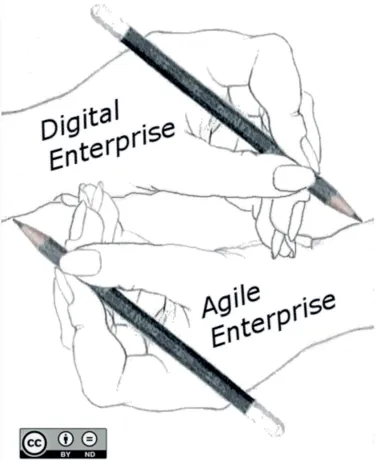
Figure 1. Architecting the Dual Digital/Agile Transformation
The digital enterprise needs to deliver a consistent user (customer, employee, or partner) experience across all touchpoints. The authors of Beyond Advertising recommend thinking about brands as touchpoint orchestrators: “the brand’s multiple touchpoints and how they interact with each other, from a digital out-of-home experience to a tablet, from mobile to the store” [Wind 2016].
3.2. Connecting Touchpoints to the Operating System
Every interaction with a brand, from the first time you become aware that it exists to every touchpoint you encounter along the way in your daily life, has an impact: “From the customer perspective, touchpoints with a brand or product are not differentiated: it is the seamless experience that matters.”
Figure 2 illustrates the variety of touchpoints that a brand has to orchestrate to deliver a positive customer experience.
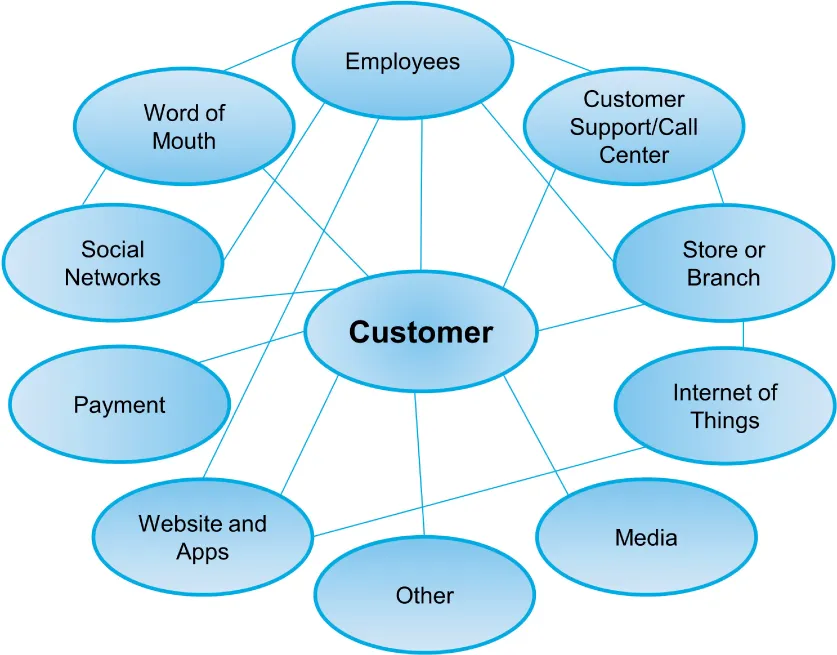
Figure 2. Touchpoints
It can be predicted that: “Touchpoints will continue to multiply as we enter an era where every object has the potential to become connected and interactive.”
This evolution impacts the enterprise as a whole: “New structures and processes will need to allow for agility and reaping the benefits both from decentralization and, when needed, the power that leveraging through centralization facilitates.”
New operating systems are required to create real-time, personalized experiences. One of their key functions is to enable touchpoint orchestration. For a definition of operating system, see Section 2.35.
3.3. Developing Business and Organizational Agility
Business agility is the ability to quickly identify and respond to market and environment changes. Enterprises develop business agility when they sense changes in their environment early and act upon them decisively and rapidly.
“Employees deep down in the organization may be closer to weak signals at the edge of the organization and must believe they will receive an open hearing when raising concerns or suggesting ideas”. [Day 2019]
— George S. Day, Think Sooner Act Faster
When Agile teams are vigilant and empowered to act, they are better at navigating digital turbulence than those at head office. When weak signals reach head office, they are filtered and cascaded down the organization. This increases the likelihood that weak signals (represented by the purple parallelograms on Figure 3) will not be seen, or that no one will respond to them. This explains why head office can be slow to identify and act upon potential threats and opportunities.
Figure 3 illustrates that Agile teams close to the field have enough autonomy to modify products or journeys in response to weak signals. Agile teams do not have to seek permission from head office before experimenting with responses to weak signals.
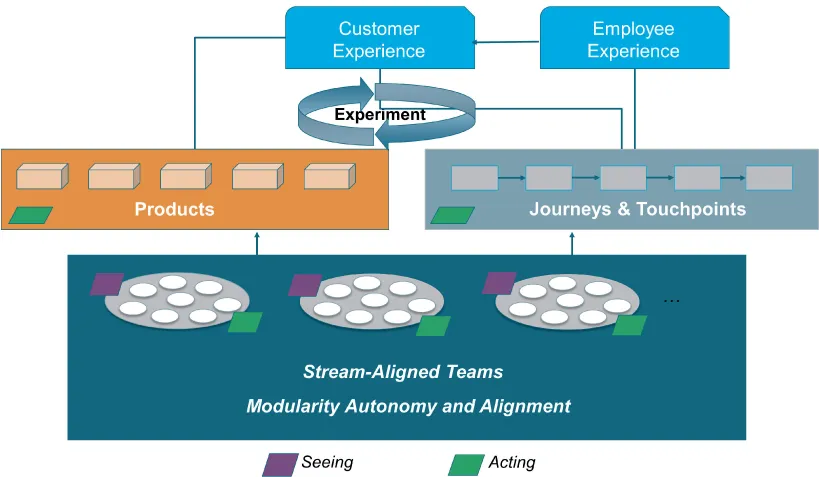
Figure 3. Business Agility
Business agility is facilitated by organizational agility because:
• Agile teams are cross-functional, which brings diverse perspectives when analyzing weak signals
• They share a common purpose and vision, which helps to put weak signals in perspective
• Most of them are stream-aligned, which means Agile teams are directly responsible for delivering products or journeys, facilitating rapid experimentation
Organizational agility was introduced in Section 3.1 and is covered by Chapter 12.
Digital Transformation does not have to be disruptive [Sutcliff 2019]. Business agility is about organizations learning to be capable of evolving rapidly.
Chapter 4. Architecture Development
This chapter defines the O-AA approach to Agile Architecture development. It is based on a set o...
Table of contents
- Cover
- Title
- Copyright
- Table of contents
- Open Agile Architecture
- Part 1: The O-AA Core
- Part 2: The O-AA Building Blocks
- Index
Trusted by 375,005 students
Access to over 1.5 million titles for a fair monthly price.
Study more efficiently using our study tools.
Frequently asked questions
Yes, you can cancel anytime from the Subscription tab in your account settings on the Perlego website. Your subscription will stay active until the end of your current billing period. Learn how to cancel your subscription
No, books cannot be downloaded as external files, such as PDFs, for use outside of Perlego. However, you can download books within the Perlego app for offline reading on mobile or tablet. Learn how to download books offline
Perlego offers two plans: Essential and Complete
- Essential is ideal for learners and professionals who enjoy exploring a wide range of subjects. Access the Essential Library with 800,000+ trusted titles and best-sellers across business, personal growth, and the humanities. Includes unlimited reading time and Standard Read Aloud voice.
- Complete: Perfect for advanced learners and researchers needing full, unrestricted access. Unlock 1.5M+ books across hundreds of subjects, including academic and specialized titles. The Complete Plan also includes advanced features like Premium Read Aloud and Research Assistant.
We are an online textbook subscription service, where you can get access to an entire online library for less than the price of a single book per month. With over 1.5 million books across 990+ topics, we’ve got you covered! Learn about our mission
Look out for the read-aloud symbol on your next book to see if you can listen to it. The read-aloud tool reads text aloud for you, highlighting the text as it is being read. You can pause it, speed it up and slow it down. Learn more about Read Aloud
Yes! You can use the Perlego app on both iOS and Android devices to read anytime, anywhere — even offline. Perfect for commutes or when you’re on the go.
Please note we cannot support devices running on iOS 13 and Android 7 or earlier. Learn more about using the app
Please note we cannot support devices running on iOS 13 and Android 7 or earlier. Learn more about using the app
Yes, you can access Open Agile Architecture™ - A Standard of The Open Group by Andrew Josey,The Open Group in PDF and/or ePUB format, as well as other popular books in Pedagogía & Arquitectura general. We have over 1.5 million books available in our catalogue for you to explore.