eBook - ePub
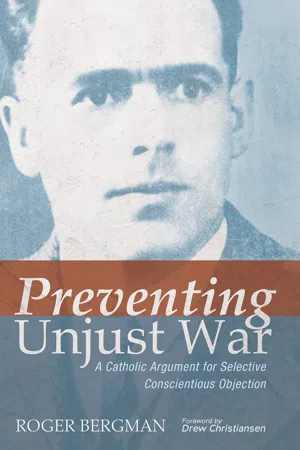
Preventing Unjust War
A Catholic Argument for Selective Conscientious Objection
- 216 pages
- English
- ePUB (mobile friendly)
- Available on iOS & Android
eBook - ePub
About this book
Catholic pacifists blame the just war tradition of their Church. That tradition, they say, can be invoked to justify any war, and so it must be jettisoned. This book argues that the problem is not the just war tradition but the unjust war tradition. Ambitious rulers start wars that cannot be justified, and yet warriors continue to fight them. The problem is the belief that warriors do not hold any responsibility for judging the justice of the wars they are ordered to fight. However unjust, a command renders any war "just" for the obedient warrior.
This book argues that selective conscientious objection, the right and duty to refuse to fight unjust wars, is the solution. Strengthening the just war tradition depends on a heightened role for the personal conscience of the warrior. That in turn depends on a heightened role for the Church in forming and supporting consciences and judging the justice of particular wars.
As Saint Augustine wrote, "The wise man will wage just wars. . . . For, unless the wars were just, he would not have to wage them, and in such circumstances he would not be involved in war at all."
Information
Topic
Theology & ReligionSubtopic
Christian Denominations1
Toward an Ecclesiology of Conscience
The Example of Franz Jägerstätter and the Legacy of Gordon Zahn
There are two reasons why men especially deviate from justice. The first is because they defer to important persons. The second is because they defer to the majority.
—Saint Thomas Aquinas1
Those who want to find the right way to eternal well-being should not walk with the majority of people who are usually timid about making sacrifices, and they should not entrust themselves to leaders whose actions differ from their words.
—Blessed Franz Jägerstätter2
Introduction
On February 22, 1943, Franz Jägerstätter, a thirty-five-year-old peasant farmer living in the Catholic village of St. Radegund, Austria, received his military induction notice from Adolf Hitler’s Third Reich. On March 2, he refused induction for reasons of conscience and was imprisoned in Linz, where he had previously sought the counsel of Bishop Joseph Fliesser regarding this very matter. As had his parish priest, the Bishop advised him to think of his wife and three daughters (six, five, and three years of age), and to do his duty for the Vaterland in a time of great national peril. On May 4, Jägerstätter had a hearing before the Military Tribunal in Berlin; on July 6, the Tribunal sentenced him to death for undermining military morale.3 He was executed by guillotine on August 9, 1943, the Feast of the Transfiguration. On October 26, 2007, Pope Benedict XVI beatified Franz Jägerstätter as a martyr of the Catholic faith.4
This recognition of Blessed Franz sixty-four years after his death came to pass only because of the discovery of the Jägerstätter story by the American Catholic sociologist Gordon Zahn in the process of researching his classic account, German Catholics and Hitler’s Wars.5 Otherwise unknown, and unheralded even in his native village, Jägerstätter was introduced to the world through Zahn’s second classic book, In Solitary Witness: The Life and Death of Franz Jägerstätter. As that title suggests, Jägerstätter was one of only a handful of Catholics throughout Germany and Austria to refuse induction into Hitler’s army. His costly refusal, if not unique, was exceedingly rare. Although a peasant farmer with only an eighth grade education, Jägerstätter, unlike the entire Catholic leadership of Germany and Austria,6 saw clearly the murderous injustice of Hitler’s imperialist wars and acted on his conscience accordingly. He would not sin against the Fifth Commandment and damn himself to Hell.
I have taught In Solitary Witness twice. The first time I paired it with Charles Curran’s excellent collection of essays, Conscience. To my astonishment, I discovered that only one of the fifteen essays by prominent Catholic moral theologians addressed even indirectly the obvious questions raised by Zahn’s two books: how could almost the entire Catholic leadership and population of Germany (and Austria) capitulate to the Nazi war machine, and how could a solitary Austrian peasant go so boldly against that machine and his own religious leadership? The essays in the Curran collection, despite the fact that the editor himself and many of their authors in other contexts demonstrate a strong commitment to Catholic social teaching, simply do not address the sociological dimension of the formation and functioning of conscience. Instead, they are almost uniformly preoccupied with the question of the relationship of personal conscience to magisterial teaching. Dissent within the church, not faithful witness over against the secular culture and the state, is the agenda-setting issue.7 Given the stakes made abundantly evident by the carnage of World War II—and the tarnishing of Catholic moral credibility during that period—this is an omission of considerable significance.
I attempted to address this omission the second time I taught the Jägerstätter story by replacing the Curran collection with Zahn’s own sociological analysis of Catholic complicity in Hitler’s wars, as presented in his first book. It became clear to me that in these two books, Zahn had contributed substantially to that sociological understanding of conscience so conspicuously absent in the Curran collection. Yet another book by Zahn, War, Conscience, and Dissent, a collection of his essays, contributes further to this understanding. The publication in 2009 of Franz Jägerstätter: Letters and Writings from Prison makes possible a deeper analysis of Jägerstätter himself and thereby of Zahn’s presentation of him. As far as I am aware, there has been no scholarly attempt to analyze and synthesize Zahn’s writings as they re...
Table of contents
- Title Page
- Foreword
- Introduction
- Chapter 1: Toward a Ecclesiology of Conscience
- Chapter 2: Conscientious Objection to Unjust War From Augustine to John Paul II101
- Chapter 3: Aquinas and Catholic Teaching on Conscience
- Chapter 4: Moral Injury and Unjust War
- Chapter 5: Preventing Unjust War: The Role of the Catholic Church
- Appendices to Chapter 5
- Chapter 6: Teaching and Forming a Just War Conscience
- Chapter 7: Presumptions and Eschatology: Legitimate Authority and Primacy of Conscience
- Epilogue
- Acknowledgments
- Bibliography
Trusted by 375,005 students
Access to over 1.5 million titles for a fair monthly price.
Study more efficiently using our study tools.
Frequently asked questions
Yes, you can cancel anytime from the Subscription tab in your account settings on the Perlego website. Your subscription will stay active until the end of your current billing period. Learn how to cancel your subscription
No, books cannot be downloaded as external files, such as PDFs, for use outside of Perlego. However, you can download books within the Perlego app for offline reading on mobile or tablet. Learn how to download books offline
We are an online textbook subscription service, where you can get access to an entire online library for less than the price of a single book per month. With over 1.5 million books across 990+ topics, we’ve got you covered! Learn about our mission
Look out for the read-aloud symbol on your next book to see if you can listen to it. The read-aloud tool reads text aloud for you, highlighting the text as it is being read. You can pause it, speed it up and slow it down. Learn more about Read Aloud
Yes! You can use the Perlego app on both iOS and Android devices to read anytime, anywhere — even offline. Perfect for commutes or when you’re on the go.
Please note we cannot support devices running on iOS 13 and Android 7 or earlier. Learn more about using the app
Please note we cannot support devices running on iOS 13 and Android 7 or earlier. Learn more about using the app
Yes, you can access Preventing Unjust War by Roger Bergman in PDF and/or ePUB format, as well as other popular books in Theology & Religion & Christian Denominations. We have over 1.5 million books available in our catalogue for you to explore.