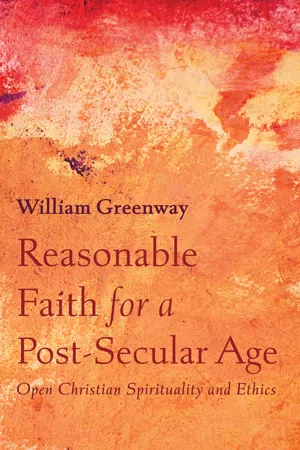
eBook - PDF
Reasonable Faith for a Post-Secular Age
Open Christian Spirituality and Ethics
- 228 pages
- English
- PDF
- Available on iOS & Android
eBook - PDF
About this book
Our global community desperately needs overt awakening to an age of reason and faith. Reasonable Faith for a Post-Secular Age meets this need by interpreting faith not in terms of belief in propositions but in terms of living surrender to having been seized by agape for every Face, including one's own. Virtually all faith traditions, from Buddhism to Humanism to Wiccan, are rooted in agape and therefore share considerable spiritual and ethical common ground (a truth long veiled). In contrast to ethically feckless secular rationality--over which a devastating, global social Darwinism currently runs roughshod--faith qua living surrender to agape grounds moral realism, awakens us to love for all creatures, and inspires struggles for justice. Inspired by the philosophy of Emmanuel Levinas and Christian spirituality, Greenway engages, on the one hand, intellectuals like Stanley Hauerwas, Richard Rorty, Gayatri Chakravorty Spivak, Jeffery Stout, Charles Taylor, and Bernard Williams, and, on the other, contemporary debates over consciousness, free will, evil, and metaethics. He details the character of secular rationality's devastating scission from moral reality and clarifies the promise of understanding faith and spirituality in terms of agape.
Information
Topic
Theology & ReligionSubtopic
Christian TheologyChapter 1
Charles Taylor on Affirmation, Mutilation, and Theism
A Retrospective Reading of Sources of the Self
Do we have to choose between various kinds of spiritual lobotomy and self-inflicted wounds? Perhaps . . . But . . . I don’t accept this as our inevitable lot. The dilemma of mutilation is in a sense our greatest spiritual challenge, not an iron fate. How can one demonstrate this? I can’t do it here. . . . There is a large element of hope. It is a hope that I see implicit in Judaeo-Christian theism (however terrible the record of its adherents in history), and in its central promise of a divine affirmation of the human, more total than humans can ever attain unaided.32
Fireworks
“Important if true,” grants Cambridge historian Quentin Skinner of Charles Taylor’s Sources of the Self.33 But, Skinner continues, since Taylor’s “final message” is that “we cannot hope to realize our fullest human potentialities in the absence of God,” all sane thinkers must conclude, not true.34 Invoking intellectuals from Hume to Russell, Skinner insists that theistic belief is “obviously self-deceiving and erroneous.”35 In fact, Skinner asserts bluntly, we may now conclude “not merely that theism must certainly be false . . . [but] that it must be grossly irrational to believe otherwise,” and thus that “anyone who continues to affirm it must be suffering from some serious form of psychological blockage or self-deceit.”36
Skinner’s blazing attack irked Taylor. In an uncompromising response, Taylor declares his intent to take “sharp issue” with Skinner’s “mounting rhetoric.” He denies linking necessarily our craving for meaning to an embrace of God, defiantly asserts that he is indeed “a believer . . . a Christian,” and suggests Skinner’s stance may betoken “an astonishing selective narrowness of spirit in an otherwise educated and open person.”37 It is paradoxical, Taylor laments pointedly, that vis-à-vis religion, elite academics often “have all the breadth of comprehension and sympathy of a Jerry Falwell, and significantly less even than Cardinal Ratzinger.”38 “The really astonishing thing,” finishes Taylor, “is that they even seem proud of it.”39
Skinner and Taylor later reengage their debate in a Festschrift for Taylor. Despite more decorous tones, their differences remain acute.40 Skinner ends contending that, in contrast to the “dangerously irrational creed” of theism, the death of God leaves us the “opportunity . . . to affirm the value of our humanity more fully than before.”41 “Great,” Taylor retorts, but then he simply reaffirms his “hunch that there is a scale of affirmation of humanity by God which cannot be matched by humans rejecting God.”42 A desire to affirm humanity clearly fuels both Skinner and Taylor’s passion for this issue. But Skinner thinks theism obstructs this affirmation, while Taylor suspects that theism alone may enable full affirmation. Taylor admits he is “far from having proof” for his hunch but, eager to spark debate, invites readers to experiment with the idea that God may facilitate fuller affirmation of humanity.43 It is unfortunate that incredulity and misunderstanding shortly smothered the discussion Taylor hoped to initiate.
It must be said that Taylor is partly responsible for all the confusion. Indeed, Taylor scatters provocative and vague appeals to God throughout Sources.44 It is not surprising, then, that Quentin Skinner is only one among a host of critics who authored essays accusing Taylor of searching for moral foundations, of attempting to prove the existence of God, or of asserting that God alone is an adequate moral source.45 In response, Taylor authored a series of replies in which he vigorously denied ever entertaining such aims.46 And with the opposing sides’ claims thus firmly staked, the debate has stalled.
But misunderstandings, not irreconcilable differences, have stalled this debate, and precluded recognition of some of Taylor’s most suggestive insights. In order to surmount this impasse, I use Taylor’s replies to illuminate a retrospective reading of Sources. In particular, the replies alert one to Taylor’s failure clearly to distinguish two distinct trajectories in his argument, for while Sources is manifestly dedicated to attacking disengaged reason and naturalistic reduction, the complex contours of Taylor’s talk of affirmation, mutilation, and theistic hope emerge in proper relief only after this initial engagement is won. One must think in terms of a second, masked trajectory, a trajectory that inquires into existential tensions that become visible only after the hypergoods are fully articulated. Only then can one comprehend fully Taylor’s re-articulation of a modern Western spiritual dilemma more commonly (and misleadingly) called a “quest for meaning.”
Prima facie, then, Taylor’s critics are right to take him to task. In the light of Taylor’s responses, however, I will attempt first to clarify the import of several critical but often misconstrued concepts in Sources: inescapable frameworks of meaning, life goods, hypergoods, constitutive goods, and moral sources. I will then detail the precise contours of Taylor’s question of affirmation, his dilemma of mutilation, and his theistic hope. After performing these two tasks, I will be in a position to explain how Taylor’s question of affirmation and dilemma of mutilation, along with his correlate openness to theism, paints with unprecedented subtlety those spiritual longings Westerners commonly struggle to articulate in terms of a “quest for meaning.” In the end, I will suggest why even those (like Quentin Skinner) who reject Taylor’s appeal to theism should—on their own terms and without changing their convictions—unhesitatingly cede the perspicuity of Taylor’s formulation of “our greatest spiritual challenge.”
Inescapable Frameworks of Meaning, Life Goods, and Hypergoods
Since humans are both physically and linguistically constituted, argues Taylor, and since languages are historical and communal (not private), selves are inescapably embedded within culturally specific, evolved webs of interlocution. Such linguistic webs frame all self-interpretation, so we cannot but understand and value ourselves vis-à-vis some cluster of webs. Thus Taylor talks of “dialogical” selves and “inescapable frameworks of meaning.” Some strive furiously to realize the Enlightenment ideal of radical autonomy by simply creating meanings and declaring significance. But attempts to extricate self-valuation from predetermined webs of interlocution are futile, for they are actually ...
Table of contents
- Title Page
- Permissions
- Acknowledgments
- Introduction
- Chapter 1: Charles Taylor on Affirmation, Mutilation, and Theism
- Chapter 2: Modern Metaphysics, Dangerous Truth, Post-Moral Ethics
- Chapter 3: Chalcedonian Reason and the Demon of Closure
- Chapter 4: Cosmodicy
- Chapter 5: The Reasonableness of Affirming Free Will
- Chapter 6: On Ted Honderich’s Actual Consciousness
- Chapter 7: Christian Ethics in a Postmodern World?
- Chapter 8: Irreducible Tensions
- Chapter 9: Jeffrey Stout, Original Sin, and the Significance of Christian Faith
- Chapter 10: On Paul’s Philosophical Spirituality
- Chapter 11: A Time for Prophets?
- Bibliography
Trusted by 375,005 students
Access to over 1.5 million titles for a fair monthly price.
Study more efficiently using our study tools.
Frequently asked questions
Yes, you can cancel anytime from the Subscription tab in your account settings on the Perlego website. Your subscription will stay active until the end of your current billing period. Learn how to cancel your subscription
No, books cannot be downloaded as external files, such as PDFs, for use outside of Perlego. However, you can download books within the Perlego app for offline reading on mobile or tablet. Learn how to download books offline
Perlego offers two plans: Essential and Complete
- Essential is ideal for learners and professionals who enjoy exploring a wide range of subjects. Access the Essential Library with 800,000+ trusted titles and best-sellers across business, personal growth, and the humanities. Includes unlimited reading time and Standard Read Aloud voice.
- Complete: Perfect for advanced learners and researchers needing full, unrestricted access. Unlock 1.5M+ books across hundreds of subjects, including academic and specialized titles. The Complete Plan also includes advanced features like Premium Read Aloud and Research Assistant.
We are an online textbook subscription service, where you can get access to an entire online library for less than the price of a single book per month. With over 1.5 million books across 990+ topics, we’ve got you covered! Learn about our mission
Look out for the read-aloud symbol on your next book to see if you can listen to it. The read-aloud tool reads text aloud for you, highlighting the text as it is being read. You can pause it, speed it up and slow it down. Learn more about Read Aloud
Yes! You can use the Perlego app on both iOS and Android devices to read anytime, anywhere — even offline. Perfect for commutes or when you’re on the go.
Please note we cannot support devices running on iOS 13 and Android 7 or earlier. Learn more about using the app
Please note we cannot support devices running on iOS 13 and Android 7 or earlier. Learn more about using the app
Yes, you can access Reasonable Faith for a Post-Secular Age by William Greenway in PDF and/or ePUB format, as well as other popular books in Theology & Religion & Christian Theology. We have over 1.5 million books available in our catalogue for you to explore.