- 80 pages
- English
- ePUB (mobile friendly)
- Available on iOS & Android
eBook - ePub
About this book
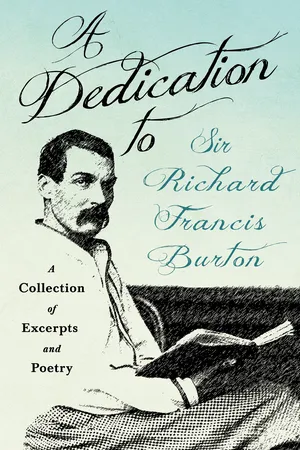
Sir Richard Francis Burton KCMG FRGS (1821–1890) was a British writer, poet, linguist, explorer, translator, geographer, ethnologist, orientalist, Freemason, diplomat, and cartographer best remembered for extensively travelling in and exploring Africa, Asia, and the Americas. An extraordinary polyglot, he spoke 29 languages and gained extensive knowledge of many different cultures and their practices. His most famous works include English translations of "One Thousand and One Nights" and the "Kama Sutra", as well as an incredible account of his incognito trip to Mecca when Europeans were strictly forbidden to do so. "A Dedication to Sir Richard Francis Burton" contains a fantastic collection of poetry and excepts by various authors concerning Burton's incredible work and accomplishments, including: "Richard Loves Me, A Memoir by Isabel Burton", "The Truth About 'The Scented Garden', by William Henry Wilkins", "A Neglected Genius: Sir Richard Burton, by Arthur Symons", "To Richard F. Burton, by Algernon Charles Swinburne", "On the Death of Richard Burton, by Algernon Charles Swinburne", and "'Honor, Not Honors', by Florence Earle Coates". Read & Co. Books is publishing this brand new collection of classic writings now complete with an introductory biography of the author by James Sutherland Cotton.
Information
ESSAYS AND EXCERPTS
RICHARD LOVES ME
(1856—1857)
A Memoir By Isabel Burton
Daughter of nobles, who thine aim shalt gain,
Hear gladdest news, nor fear aught hurt or bane.
Hear gladdest news, nor fear aught hurt or bane.
-Alf Laylah wa Laylah,
Burton's Arabian Nights
Burton's Arabian Nights
NOW this is what occurred. When Richard was well home from the Crimea, and had attended Beatson's trial, he began to turn his attention to the "Unveiling of Isis"; in other words, to discover the sources of the Nile, the lake regions of Central Africa, on which his heart had long been set; and he passed most of his time in London working it up.
We did not meet for some months after his return, though we were both in London, he planning his Central African expedition, and I involved in the gaieties of the season; for we had a gay season that year, every one being glad that the war was over. In June I went to Ascot. There, amid the crowd of the racecourse, I met Hagar Burton, the gypsy, for the first time after many years, and I shook hands with her. "Are you Daisy Burton yet?" was her first question. I shook my head. "Would to God I were!" Her face lit up. "Patience; it is just coming." She waved her hand, for at that moment she was rudely thrust from the carriage. I never saw her again, but I was engaged to Richard two months later. It came in this wise.
One fine day in August I was walking in the Botanical Gardens with my sister. Richard was there. We immediately stopped and shook hands, and asked each other a thousand questions of the four intervening years; and all the old Boulogne memories and feelings returned to me. He asked me if I came to the Gardens often. I said, "Oh yes, we always come and read and study here from eleven to one, because it is so much nicer than studying in the hot room at this season." "That is quite right," he said. "What are you studying?" I held up the book I had with me that day, an old friend, Disraeli's Tancred, the book of my heart and taste, which he explained to me. We were in the Gardens about an hour, and when I had to leave he gave me a peculiar look, as he did at Boulogne. I hardly looked at him, yet I felt it, and had to turn away. When I got home, my mind was full of wonder and presentiment; I felt frightened and agitated; and I looked at myself in the glass and thought myself a fright!
Next morning we went to the Botanical Gardens again. When we got there, he was there too, alone, composing some poetry to show to Monckton Milnes on some pet subject. He came forward, and said laughingly, "You won't chalk up 'Mother will be angry,' as you did when you were at Boulogne, when I used to want to speak to you." So we walked and talked over old times and people and things in general.
About the third day his manner gradually altered towards me; we had begun to know each other, and what might have been an ideal love before was now a reality. This went on for a fortnight. I trod on air.
At the end of a fortnight he stole his arm round my waist, and laid his cheek against mine and asked me, "Could you do anything so sickly as to give up civilization? And if I can get the Consulate of Damascus, will you marry me and go and live there?" He said, "Do not give me an answer now, because it will mean a very serious step for you—no less than giving up your people and all that you are used to, and living the sort of life that Lady Hester Stanhope led. I see the capabilities in you, but you must think it over." I was long silent from emotion; it was just as if the moon had tumbled down and said, "You have cried for me for so long that I have come." But he, who did not know of my long love, thought I was thinking worldly thoughts, and said, "Forgive me; I ought not to have asked so much." At last I found voice, and said, "I do not want to think it over—I have been thinking it over for six years, ever since I first saw you at Boulogne. I have prayed for you every morning and night, I have followed all your career minutely, I have read every word you ever wrote, and I would rather have a crust and a tent with you than be queen of all the world; and so I say now, 'Yes, yes, yes!'"
I will pass over the next few minutes. . . .
Then he said, "Your people will not give you to me." I answered, "I know that, but I belong to myself—I give myself away." "That is all right," he answered; "be firm, and so shall I."
I would have suffered six years more for such a day, such a moment as this. All past sorrow was forgotten in it. All that has been written or said on the subject of the first kiss is trash compared to the reality. Men might as well undertake to describe Eternity. I then told him all about my six years since I first met him, and all that I had suffered.
When I got home, I knelt down and prayed, and my whole soul was flooded with joy and thanksgiving. A few weeks ago I little thought what a change would take place in my circumstances. Now I mused thus: "Truly we never know from one half-hour to another what will happen. Life is like travelling in an open carriage with one's back to the horses—you see the path, you have an indistinct notion of the sides, but none whatever of where you are going. If ever any one had an excuse for superstition and fatalism, I have. Was it not foretold? And now I have gained half the desire of my life: he loves me. But the other half remains unfulfilled: he wants to marry me! Perhaps I must not regret the misery that has spoilt the six best years of my life. But must I wait again? What can I do to gain the end? Nothing! My whole heart and mind is fixed on this marriage. If I cared less, I could plan some course of action; but my heart and head are not cool enough. Providence and fate must decide my future. I feel all my own weakness and nothingness. I am as humble as a little child. Richard has the upper hand now, and I feel that I have at last met the master who can subdue me. They say it is better to marry one who loves and is subject to you than one whose slave you are through love. But I cannot agree to this. Where in such a case is the pleasure, the excitement, the interest? In one sense I have no more reason to fear for my future, now that the load of shame, wounded pride, and unrequited affection is lifted from my brow and soul. He loves me—that is enough to-day."
After this Richard visited a little at our house as an acquaintance, having been introduced at Boulogne; and he fascinated, amused, and pleasantly shocked my mother, but completely magnetized my father and all my brothers and sisters. My father used to say, "I do not know what it is about that man, but I cannot get him out of my head; I dream about him every night."
Richard and I had one brief fortnight of uninterrupted happiness, and were all in all to each other; but inasmuch as he was to go away directly on his African journey with Speke to the future lake regions of Central Africa, we judged it ill advised to announce the engagement to my mother, for it would have brought a hornets' nest about our heads, and not furthered our cause—and, besides, we were afraid of my being sent away, or of being otherwise watched and hindered from our meeting; so we agreed to keep it a secret until he came back. The worst of it all was, that I was unable, first, by reason of no posts from a certain point, and, secondly, by the certainty of having his letters opened and read, to receive many letters from him, and those only the most cautious; but I could write to him as freely as possible, and send them to the centres where his mail-bags would be sent out to him. All my happiness therefore was buried deep in my heart, but always was chained. I felt as if earth had passed and heaven had begun, or as if I had hitherto been somebody else, or had lived in some other world. But even this rose had its thorn, and that was the knowledge that our marriage seemed very far off. The idea of waiting for willing parents and a grateful country appeared so distant that I should scarcely be worth the having by the time all obstacles were removed. Richard too was exercised about how I should be able to support his hard life, and whether a woman could really do it. Another sorrow was that I had to be prepared to lose him at any moment, as he might have to quit at a moment's notice on receiving certain information.
I gave him Hagar Burton's horoscope, written in Romany—the horoscope of my future. One morning (October 3) I went to meet him as usual, and we agreed to meet the following morning. He had traced for me a little sketch of what he expected to find in the lake regions, and I placed round his neck a medal of the Blessed Virgin upon a steel chain, which we Catholics commonly call "the miraculous medal." He promised me he would wear it throughout his journey, and show it me on his return. I had offered it to him on a gold chain, but he said, "Take away the gold chain; they will cut my throat for it out there." He showed me the steel chain round his neck when he came back; he wore it all his life, and it is buried with him. He also gave me a little poem:
I wore thine image, Fame,
Within a heart well fit to be thy shrine;
Others a thousand boons may gain —
One wish was mine:
The hope to gain one smile,
To dwell one moment cradled on thy breast,
Then close my eyes, bid life farewell,
And take my rest!
And now I see a glorious hand
Beckon me out of dark despair,
Hear a glorious voice command,
"Up, bravely dare!
And if to leave a deeper trace
On earth to thee Time, Fate, deny,
Drown vain regrets, and have the grace
Silent to die."
She pointed to a grisly land,
Where all breathes death—earth, sea, and air;
Her glorious accents sound once more,
"Go meet me there."
Mine ear will hear no other sound,
No other thought my heart will know.
Is this a sin? "Oh, pardon, Lord!
Thou mad'st me so!"
-R.F.B.
The afternoon on which I last met him was the afternoon of the same day. He came to call on my mother. We only talked formally. I thought I was going to see him on the morrow. It chanced that we were going to the play that night. I begged of him to come, and he said he would if he could, but that if he did not, I was to know that he had some heavy business to transact. When I had left him in the morning, I little thought it was the last kiss, or I could never have said good-bye, and I suppose he knew that and wished to spare me pain. How many little things I could have said or done that I did not! We met of course before my mother only as friends. He appeared to me to be agitated, and I could not account for his agitation. He stayed about an hour; and when he left I said purposely, "I hope we shall see you on your return from Africa," and almost laughed outright, because I thought we should meet on the morrow. He gave me a long, long look at the door, and I ran out on the balcony and kissed my hand to him, and thus thoughtlessly took my last look, quite unprepared for what followed.
I went to the theatre that evening quite happy, and expected him. At 10.30 I thought I saw him at the other side of the house looking into our box. I smiled, and made a sign for him to come. I then ceased to see him; the minute...
Table of contents
- SIR RICHARD FRANCIS BURTON
- ESSAYS AND EXCERPTS
- POETRY
Trusted by 375,005 students
Access to over 1.5 million titles for a fair monthly price.
Study more efficiently using our study tools.
Frequently asked questions
Yes, you can cancel anytime from the Subscription tab in your account settings on the Perlego website. Your subscription will stay active until the end of your current billing period. Learn how to cancel your subscription
No, books cannot be downloaded as external files, such as PDFs, for use outside of Perlego. However, you can download books within the Perlego app for offline reading on mobile or tablet. Learn how to download books offline
Perlego offers two plans: Essential and Complete
- Essential is ideal for learners and professionals who enjoy exploring a wide range of subjects. Access the Essential Library with 800,000+ trusted titles and best-sellers across business, personal growth, and the humanities. Includes unlimited reading time and Standard Read Aloud voice.
- Complete: Perfect for advanced learners and researchers needing full, unrestricted access. Unlock 1.5M+ books across hundreds of subjects, including academic and specialized titles. The Complete Plan also includes advanced features like Premium Read Aloud and Research Assistant.
We are an online textbook subscription service, where you can get access to an entire online library for less than the price of a single book per month. With over 1.5 million books across 990+ topics, we’ve got you covered! Learn about our mission
Look out for the read-aloud symbol on your next book to see if you can listen to it. The read-aloud tool reads text aloud for you, highlighting the text as it is being read. You can pause it, speed it up and slow it down. Learn more about Read Aloud
Yes! You can use the Perlego app on both iOS and Android devices to read anytime, anywhere — even offline. Perfect for commutes or when you’re on the go.
Please note we cannot support devices running on iOS 13 and Android 7 or earlier. Learn more about using the app
Please note we cannot support devices running on iOS 13 and Android 7 or earlier. Learn more about using the app
Yes, you can access A Dedication to Sir Richard Francis Burton by Various in PDF and/or ePUB format, as well as other popular books in History & Historical Biographies. We have over 1.5 million books available in our catalogue for you to explore.