When we think about the process of European unification, our conversations inevitably ponder questions of economic cooperation and international politics. Salvatore Pappalardo offers a new and engaging perspective, arguing that the idea of European unity is also the product of a modern literary imagination. This book examines the idea of Europe in the modernist literature of primarily Robert Musil, Italo Svevo, and James Joyce (but also of Theodor Däubler and Srecko Kosovel), all authors who had a deep connection with the port city of Trieste.
Writing after World War I, when the contested city joined Italy, these authors resisted the easy nostalgia of the postwar period, radically reimagining the origins of Europe in the Mediterranean culture of the Phoenicians, contrasting a 19th-century nationalist discourse that saw Europe as the heir of a Greek and Roman legacy. These writers saw the Adriatic city, a cosmopolitan bazaar under the Habsburg Empire, as a social laboratory of European integration. Modernism in Trieste seeks to fill a critical gap in the extant scholarship, securing the literary history of Trieste within the context of current research on Habsburg and Austrian literature.
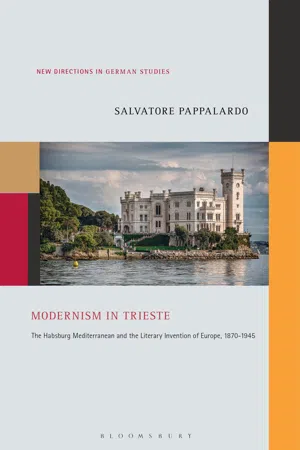
eBook - ePub
Modernism in Trieste
The Habsburg Mediterranean and the Literary Invention of Europe, 1870-1945
- 280 pages
- English
- ePUB (mobile friendly)
- Available on iOS & Android
eBook - ePub
Modernism in Trieste
The Habsburg Mediterranean and the Literary Invention of Europe, 1870-1945
About this book
Information
one The Adriatic Sea as a Phoenician Mediterranean, 1870–1925
In 1915, the journalist Amy Bernardi published a tourist guidebook of the northern Adriatic littoral, describing the regions of Istria and Dalmatia as idyllic holiday destinations for Italian travelers. Presenting them as contested border areas, Bernardi emphasized the exclusively Italian character of these Adriatic regions.
Thus all of Istria, less colorful than Dalmatia, but equally threatened by the Slavs of the mountains and the interior, sees its Italianness flourish against the background of the sea. It flourishes growing from the deep roots of imperial Rome and Latin Christianity that here happily followed the sporadic colonizations and incursions of Greeks and Phoenicians. It flourishes manifesting itself in its entirety, as could logically be expected, in Venetian forms and figures because of that unbridled political expansion that between the thirteenth and eighteenth century made the Adriatic a truly Venetian gulf.1
In an extended floral metaphor, Bernardi attributes the blossoming of Istria to its deep roots grounded in the Roman Empire and Latin Christianity. Similar to the neighboring Dalmatia, the shoreline of Istria overlooks Mare Nostrum and remains threatened by bands of undifferentiated Slavs ominously approaching from the mountains and the hinterland. In asserting ownership over the Mediterranean and describing the region as a solidly Roman province, Bernardi echoes common nationalist arguments that sought to legitimize Italy’s claims over the northern Adriatic region and Trieste by means of a classicist historicism that postulated a continuity between antiquity and the modern world.
Bernardi’s nationalist cultural geography draws from a textual archive of nineteenth-century literature and historiography. After all, her descriptions were strongly supported by the venerable literary tradition of the Italian Risorgimento, which exalted Italy’s Roman heritage while postulating a national identity in opposition to a rhetorically constructed Phoenician or Carthaginian alterity. The lyrics of Goffredo Mameli’s 1847 “Il Canto degli Italiani,” a military march that still serves as the national anthem of Italy, illustrate this tendency to define Italianness against Phoenician antagonists. In the text, a personified Italy finally awakes from a millenarian slumber and proudly girds her head with the helmet of Scipio Africanus, the Roman general who defeated Hannibal in the Battle of Zama. Scipio’s success crucially contributed to Roman triumph during the Second Punic War. The military victory was often seen as a defining moment in the history of Rome, now capable of expanding its rule in the Mediterranean Sea.2 In his famed 1877 poem “Saluto italico,” Giosuè Carducci, considered by many of his contemporaries the national poet of Italy, urged his verses of “ancient Italic fashion” to soar to the Gulf of Trieste and greet its Roman ruins, to salute the divine smile of the Adriatic Sea, and to flutter as far as the Istrian city of Pola, proudly displaying its temples to Rome and Caesar.3 Carducci’s ode to the Italian character of Trieste and the Adriatic Sea closes with a final tribute to Joachim Winckelmann, the scholar and art historian of Greco-Roman antiquity who died in Trieste. In the poem, the marmoreal and bellicose glance of Winckelmann’s statue stares down a vaguely defined invading foreigner. One can see the ideological construct that would later lead Bernardi to disparage the sporadic Greek and Phoenician colonizations, settlements that in her view did not justify any heritage claims. Her point about other prehistoric communities should not be read as a simple side note; it challenges a widespread, resilient alternative myth of origins that identified the Phoenicians as the earliest identity-shaping settlers in the region.
Various local histories and legends suggested a Phoenician origin for the northern Adriatic seaboard and the city of Trieste despite the survival of ample archeological and architectonic evidence attesting to their Roman character.4 Today, it is commonly held that the Illyrians, a motley crew of extinct Indo-European tribes, were among the first populations to occupy the northeastern Adriatic region, founding the urban center of Tergeste, the earliest settlement of Trieste. The toponym Tergeste seems to derive from the union of the Venetic root terg, meaning “market,” with the common suffix -este indicating a “place.” It is not entirely clear whether these ancient Veneti were in fact Illyrians, an association that has been made in the past. Whatever the case, this Venetic marketplace was absorbed into the Roman orbit in the second century BCE, when Rome conquered the Istrian peninsula subjugating the local populations. Subsequently, the Latin transliteration of the term Tergeste reinterpreted the morphological boundaries of the noun as ter gesta, with the meaning of “thrice founded” or “conquered three times,” attesting to the difficult process of Romanization of the area.
The Roman origin story was challenged by other accounts of the city’s foundation. Next to the Illyrian/Venetic hypothesis, a number of myths and legends compose a wide spectrum of possible origin stories, the most prominent of which imagine early Trieste as a Phoenician settlement. According to Pliny the Elder, the Argonauts returned from their mission to recover the Golden Fleece navigating on the Danube and its tributaries and then entered the Adriatic Sea via the River Timavus, not far from Trieste. The ancient Greek geographer Marcianus of Heraclea added to this story line an intriguing plot twist, namely that one of the Argonauts, the demigod Tergesto decided to settle down, becoming the founder and namesake of the city. In other accounts, Tergesto or Tergesteo is either a Phoenician seafarer struck by the beauty of the Karst landscape, or else a Trojan hero, who settled down in the northern Adriatic after fleeing the fall of Troy.
These legends started to gain currency among the proponents of what one could call the Phoenicianism of nineteenth-century Trieste, intellectuals who were invested in rewriting the origin of the city. An incorrect but widely circulated folk etymology even went so far as to identify the Phoenician term Tarshish as the origin of the toponym Tergeste, explaining the linguistic origin of the root as Semitic rather than Latin. I am less interested in the accuracy of these linguistic and ethnographic claims than in the cultural politics governing this pseudo-etymology and the push to destigmatize the Phoenicians in the context of a city pondering its Mediterranean identity. It is hard to assess whether or not the origin of northern Adriatic settlements was indeed Phoenician. The arguments, however, reveal a great deal about the scholars and antiquarians who made them.
The Phoenicians in Greek and Roman Sources
The Phoenicians do not occupy the same position of cultural prestige that Greek and Roman civilizations enjoy in modern receptions of the ancient Mediterranean, a circumstance that makes their rehabilitation in Habsburg Trieste particularly noteworthy. The Phoenicians were a Western Semitic maritime tribe, related to the ancient Hebrews, skilled in seafaring and famous for their commercial activities in the Mediterranean, where they established, over the course of centuries, a highly organized network of interconnected trading posts and colonies. Already flourishing in the third millennium BCE, the Phoenician homeland was located along the Levantine littoral, a coastal region that is now part of Lebanon, Syria, and Israel. When discussing the Phoenicians, it is useful to keep in mind the particularities of modern historical nomenclature that usually distinguishes between the Canaanite period, the history of Phoenicia proper, and the Punic age that designates the history of the Phoenicians in the western Mediterranean and their most prominent colony Carthage from the sixth century BCE onwards. The end of Phoenician history in the eastern Mediterranean is usually made to coincide with Alexander the Great’s conquest of the coastal cities in the Levant in 332 BCE.5 The Phoenicians referred to themselves as the Canaanites, which is also the terminology modern historians prefer when they discuss their civilization before the collapse of the Bronze Age in the eastern Mediterranean around 1200 BCE. After the social and political reorganization of the region, this population of merchants is known as the Phoenicians, a term that probably derives from the ancient Greek word phoínikes, which roughly translates to “the people of the reddish-purple cloth,” a reference to their prosperous textile industry that manufactured a widely valued purple dye that they exported. Between the ninth and sixth centuries BCE, the Phoenicians expanded westward, establishing trading posts and colonies in the central and western Mediterranean, in northern Africa, and on the Atlantic coast. Their emporia stretched from major cities in the Levant—Tyre, Sidon, Byblos, and Ugarit—to Kition on Cyprus; Motya, Panormus, and Lilybaeum on Sicily; Nora and Karalis on Sardinia; Melita on Malta; and to Gadir (modern-day Cádiz) on the Atlantic coast of the Iberian Peninsula. The most powerful Phoenician colony in the west was obviously Carthage, a major economic and political center that enjoyed greater independence from the Phoenician motherland and that became, together with its allies in northern Africa, Rome’s archenemy during the Punic Wars (264–146 BCE).
It is important to note that the Phoenicians did not necessarily perceive themselves as belonging to a coherent or an internally unified and recognizable culture that seamlessly encompassed the inhabitants of these cities. Citing a lack of clear evidence for a general Phoenician patriotism, Josephine Quinn has forcefully argued that the Levantine Phoenicians did not share a common history and group identity in the modern sense, and that the notion of a shared Phoenician heritage only developed in the context of Carthaginian imperial ambitions, as a way of uniting the cities of the Phoenician diaspora in the western Mediterranean.6 The concept of a Phoenician identity was constructed as a constitutive alterity, a complementary otherness, by Greeks and Romans who defined themselves in opposition to external groups.7 Even Tyrians and Sidonians used the term to designate a colonial relationship between trading outposts and Levantine mother cities rather than to describe an ethnic identity, thus imposing the category of “Phoenician” unto others rather than making a claim for their own purposes.8 Phoenicians often cultivated a metropolitan identity, embracing their local urban culture and their commercial activities at sea, defining themselves as Tyrians or Sidonians rather than Phoenicians. Maria Eugenia Aubet attributes the lack of a unified Phoenician culture to the physical geography of the Levantine shoreline.9 The cities along the coastal plain were divided by river valleys and mountainous territories that favored the separate development of individual city-states. In addition, the steep elevations of Mount Lebanon to the west discouraged the growth of extensive agricultural settlements, while the natural harbors on the coast encouraged the inhabitants to look toward the Mediterranean Sea.10
In the ancient world, the Phoenicians were known for a number of important accomplishments and contributions. In The Histories, Herodotus credits the Phoenicians with the invention of the modern alphabet, which the mythological Cadmus reportedly brought to the Greeks, who then adopted and adapted it for their use. The Phoenician origin of the Greek alphabet became an accepted model, shared also by Pliny the Elder. Whether accurate or not, Herodotus’s theory of dissemination points to the Phoenician development of a phonetic writing system in the course of the second millennium BCE in which each letter corresponded to a sound, an important innovation that diverged from the cuneiform writing of the Sumerians and from Egyptian pictographic hieroglyphs. For their writing, the Phoenicians imported considerable amounts of papyrus from Egypt to the port of Byblos, which the Greeks considered an important center of this innovative writing technology. Thanks to the Phoenicians, alphabetic writing spread across a number of ancient Mediterranean cultures.
Skillful and experienced seafarers, the Phoenicians were famous for their masterful shipbuilding, their expertise in navigation techniques, and the construction of ports. They were adept at stellar navigation, a method based on the observation of the position of celestial bodies in the night sky. Their recognized status as a Mediterranean thalassocracy, a technologically advanced sea power knowledgeable in navigation and astronomy, was so widespread that in the ancient world Polaris, the North Star, was known as the Phoenician Star. The ability to orient themselves and plot maritime itineraries following astronomical charts allowed them to navigate far from coastal shores, on open sea, and in the Atlantic Ocean, an achievement that neither Greeks nor Romans, let alone the river-navigating Egyptians could claim. Herodotus famously reported that a Phoenician crew, sponsored by the Egyptian pharaoh Necho II, circumnavigated the African continent in the sixth century BCE. A century later, the Carthaginian Hanno set sail to explore the western coast of Africa. Accounts of the navigational skills of the Phoenicians also include remarkable tales of northbound sea voyages. Himilco, another Carthaginian explorer, noted in his periplus that he reached as far north as the Irish Sea. Similarly, searching for valuable sources of amber and tin, the Phoenician sailor Pytheas of the Greek colony of Massalia (modern Marseilles) sailed northwards in the fourth century BCE, supposedly circling around the British islands and Ireland. Ancient sources believed in the alleged Phoenician circumnavigation of Africa and Great Britain, which seems to be at least plausible given their nautical capabilities and the quality of their vessels. More importantly, however, we will see how the suggestions of a Phoenician arrival on Ireland’s shores will provide a flimsy yet stubborn narrative in seventeenth- and eighteenth-century Irish Orientalist antiquarianism, an important but not exclusive source of Joyce’s reception of Phoenicio-Gaelic lore.
Phoenician shi...
Table of contents
- Cover
- Title Page
- Dedication Page
- Contents
- List of Illustrations
- Acknowledgments
- Introduction: Trieste and the European Project—Ethics, Aesthetics, Politics
- 1 The Adriatic Sea as a Phoenician Mediterranean, 1870–1925
- 2 A Mediterranean Monarchy: Robert Musil and the Politics of Nonnational Loyalty, 1913–1943
- 3 Trojan Trieste: Italo Svevo and the Aesthetics of Austro-Italian Liminality, 1890–1923
- 4 Habsburg Hybrid: James Joyce and the Ethnolinguistics of Hiberno-Punic Mythography, 1904–1939
- Conclusion: The Danube Flows into the Mediterranean
- Bibliography
- Index
- Imprint
Trusted by 375,005 students
Access to over 1.5 million titles for a fair monthly price.
Study more efficiently using our study tools.
Frequently asked questions
Yes, you can cancel anytime from the Subscription tab in your account settings on the Perlego website. Your subscription will stay active until the end of your current billing period. Learn how to cancel your subscription
No, books cannot be downloaded as external files, such as PDFs, for use outside of Perlego. However, you can download books within the Perlego app for offline reading on mobile or tablet. Learn how to download books offline
Perlego offers two plans: Essential and Complete
- Essential is ideal for learners and professionals who enjoy exploring a wide range of subjects. Access the Essential Library with 800,000+ trusted titles and best-sellers across business, personal growth, and the humanities. Includes unlimited reading time and Standard Read Aloud voice.
- Complete: Perfect for advanced learners and researchers needing full, unrestricted access. Unlock 1.5M+ books across hundreds of subjects, including academic and specialized titles. The Complete Plan also includes advanced features like Premium Read Aloud and Research Assistant.
We are an online textbook subscription service, where you can get access to an entire online library for less than the price of a single book per month. With over 1.5 million books across 990+ topics, we’ve got you covered! Learn about our mission
Look out for the read-aloud symbol on your next book to see if you can listen to it. The read-aloud tool reads text aloud for you, highlighting the text as it is being read. You can pause it, speed it up and slow it down. Learn more about Read Aloud
Yes! You can use the Perlego app on both iOS and Android devices to read anytime, anywhere — even offline. Perfect for commutes or when you’re on the go.
Please note we cannot support devices running on iOS 13 and Android 7 or earlier. Learn more about using the app
Please note we cannot support devices running on iOS 13 and Android 7 or earlier. Learn more about using the app
Yes, you can access Modernism in Trieste by Salvatore Pappalardo in PDF and/or ePUB format, as well as other popular books in Literature & German Literary Criticism. We have over 1.5 million books available in our catalogue for you to explore.