In early 1936, a German film team arrived in Japan to participate in a film coproduction, intended to show the 'real' Japan to the world and to launch Japanese films into international markets. The two directors, one Japanese and the other German, clashed over the authenticity of the represented Japan and eventually directed two versions, The Samurai's Daughter and New Earth, based on a common script. The resulting films hold a firm place in film history as an exercise in - or reaction against - politically motivated propaganda, respectively.
A Foreigner's Cinematic Dream of Japan contests the resulting oversimplification into nationalised and politicised dichotomies. Drawing on a wide range of Japanese and German original sources, as well as a comparative analysis of the 'German-Japanese version' and the elusive 'Japanese-English version', Iris Haukamp reveals the complexities of this international co-production. This exclusive research sheds light not only on the films themselves, but also on the timeframe of its production, with both countries at the brink of war.
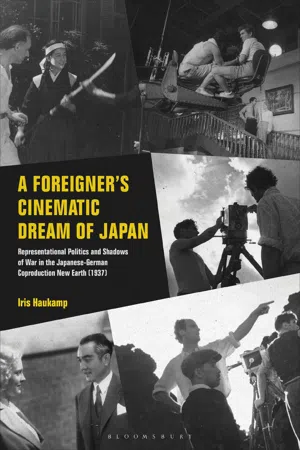
eBook - ePub
A Foreigner’s Cinematic Dream of Japan
Representational Politics and Shadows of War in the Japanese-German Coproduction New Earth (1937)
- 272 pages
- English
- ePUB (mobile friendly)
- Available on iOS & Android
eBook - ePub
A Foreigner’s Cinematic Dream of Japan
Representational Politics and Shadows of War in the Japanese-German Coproduction New Earth (1937)
About this book
Information
1
Film export and international (mis-)understanding
The cinematograph is international in the deep sense of being universally human.
(Moreck 1929: 40–1)
Kurosawa’s Rashomon (Rashōmon, 1950) winning the Golden Lion at the 1951 Venice Film Festival is often considered to be the pivotal point for Japanese film export (Iwasaki 1961: 1; Nygren 2007; Yomota 2000). This approach, however, tends to see pre-war efforts to realize the dream of export as isolated, eccentric events. New Earth originates in this dream, and looking behind its representation as ‘the first’ brings into focus the largely neglected area of previous contacts. About fifteen years before New Earth’s grand premieres in Tokyo and Berlin, its producer Kawakita Nagamasa experienced the joys and woes of a foreign language student in a rural part of northern Germany. While not unfriendly, the small town’s population was as curious as uninformed about their guest’s exotic home country in the Far East (Kawakita N. 1988: 5–7). A pivotal moment was his visit to a performance of Puccini’s Madame Butterfly in Hamburg. He was looking forward to familiar sights, but everything he ‘saw on the stage – sets, costume, make-up, acting – [were] all so far removed from things Japanese and unbearable to look at’ (Kawakita N. 1988: 7). Kawakita started thinking about ways to ‘let the West know who we really are in terms of emotions, customs, manners and culture’, and he also wanted for Japan to learn from the ‘rationality’ of Western life and culture. Film appeared to him as the appropriate means for such cultural cross-fertilization because of its popularity and because ‘even if people could not travel very far in those days, motion pictures could’ (Kawakita N. 1988: 7). His recognition would lead to a lifelong career dedicated to cultural exchange through film, a mission that his later wife Kashiko kept pursuing after his death. More immediately, however, it was one of the main factors behind the co-production with Arnold Fanck of New Earth, hailed as ‘the first German-Japanese co-produced film’.
This label, in connoting a beginning of collaboration, fits in well with the political situation that developed during the production period. And therefore, it has remained firmly in place and disguises the project’s embeddedness in an ongoing discourse on cultural representation, international recognition and authenticity. For the Japanese producers, promoters and commentators, however, the word ‘first’ attached to ‘German–Japanese film’ or to ‘Japanese international film’ not only expressed the anticipated success of Japanese film exports, but it also triggered flashbacks to earlier attempts that had been both unsuccessful enterprises and inadequate representations of their country. The inequality that was felt on a cultural level – foreign productions, after all, were very popular in Japan – found its mirror image in unpleasant political realities: the Triple Intervention of 1895 forcing Japan to recede the Liaodong peninsula to China, the rejection of indemnity demands against Russia despite the victory in the war of 1904–05, the denial of influence in China after having fought German colonial forces in the First World War, the rejection of Japan’s proposed ‘racial equality clause’ by the League of Nations in 1919 and the United States’ 1924 ‘Exclusion Act’ prohibiting further immigration from Japan (see Krebs 2009; Young 1998). The question of Japan’s place in the modern world concerned political and cultural power, as both were seen as reflections of – or at least heavily impacting – one another. Therefore, the national image became a matter of great concern, on the cinema screen and in the international arena. Before this background, New Earth’s label as ‘the first co-production’ emerges as nothing more, and nothing less, than a marketing tactic. The film also inherited thematic and stylistic similarities from a series of related undertakings that were concerned with an authentic representation of Japan and intertwined with the question of international recognition.
In 1928 Japan was the largest producer of films per year (Richie 2001: 44) and could have satisfied the local demand by local productions. But foreign films also enjoyed great popularity, with Hollywood films accounting for the vast majority of imported films, followed by German films in a distant second place.1 On the other hand, very few Japanese films were exhibited in the West,2 and consequently, the ‘dream of export’ was directed towards Western markets as yet another means to prove national equality, after having emerged victorious out of three international wars and successfully pursuing modernization and industrialization. A case in point is the discourse on A Page of Madness: Film critic Iwasaki Akira praised it as ‘the first international film made in Japan’ and ‘the first film-like film born in Japan’ (cited in Gerow 2001: 23). To others it represented ‘the first stage in ascending to leadership in the world market’, reflecting a growing confidence in the Japanese film industry (Gerow 2008: 57), but also the perception that exportable films were a step on an evolutionary ladder of cinematic proficiency. The quest for recognition by the outside world was coupled with issues of power: the power to represent Japan and Japanese cinema – truthfully and successfully – on international screens and markets. Power was also implied in the question of which ‘Japan’ was represented in such a work.
The Japanese film world was far more knowledgeable about the foreign film industry than vice versa, and they closely observed the trend to produce films about ‘Japan’, especially with regard to the representation of their country: The Cheat (1915, DeMille), with Japan-born actors Sessue Hayakawa and Tsuru Aoki, seriously damaged Hayakawa’s reputation (Miyao 2007): he was criticized as a ‘traitor’, and this ‘national disgrace film’ (kokujoku eiga) – a term that would come up again and again in this discourse – was never released in Japan (Bernardi 2001: 1, 23; Yomota 2000: 33). Later, unsuccessful Japanese efforts to put their films on Western screens, such as Nippon (1932, Koch), which will be discussed in this chapter, were also labelled a ‘national disgrace’ because of their twofold failure to succeed commercially and to convey an authentic image of Japan (Honma 1933; Yomiuri Shinbun 24.07.1935). Matters of national image and film export were intermingled with the notion of national esteem:
Though handicapped by imperfect equipment these studios [Nippon Katsudo Kaisha, Tokyo, Shochiku Cinema Kaisha, Tokyo, Teikoku Cinema Engei Kaisha, Cinema Kaisha] are producing picture plays almost as good as in other countries, only they have not attained the exportable stage, chiefly because films of Japan produced abroad, despite their absurd representation of Japanese manner and custom, are acceptable to ignorant spectators. Pictures made in Japan are much better than ‘La Bataille’ [The Danger Line, 1923, Édouard Émile Violet] with Sessue Hayakawa, a Japanese picture player who has risen to notoriety abroad. (Foreign Affairs Association of Japan 1926: 324)
Germany – where Hayakawa and his films were also well known – had its own tradition of cinematically interpreting Japan.3 One of the earliest films documents The March of the Japanese Second Army to the Battle of Liaoyang in 1904 (Das 2. Kaiserlich-Japanische Regiment auf dem Weg nach Liaoyang, 1904, Greenbaum). Various geisha-themed works followed in rapid succession, and the fascinating custom of ritual suicide was displayed in two films titled Harakiri, by Harry Piel in 1913, and just after the First World War by Fritz Lang in 1919. The strained Japanese–German post-war relations – following a sense of betrayal after Japan’s declaration of war and the taking over of German concessions in China (Horne and Austin 1998: 402–3) – were not left unacknowledged. One critic of Lang’s Harakiri asserts that the land of cherry blossoms ‘despite all that and all that can rest assured of German sympathy’ (Flüggen 1920: 2). This sympathy, however, had less to do with cautious political reconciliation than with the appeal of exotic images. The film – somewhat predictably – based on Madame Butterfly was shot in Hamburg’s famous Hagenbeck zoo. ‘Ethnographic counsellor’ Heinrich Umlauff’s ‘rich ethnographic expert knowledge’ and his museum’s ‘extensive exotic collection’, which was used for set dressings, props and costumes, authenticated its representation of Japan ( Der Film 1919; Erste Internationale Filmzeitung 17.08.1918; see also Thode-Arora 1992: 149). For German film to once more ‘take up the fight’ against foreign competitors after the destructions of the First World War, the contemporary taste for the exotic was a fruitful field (B 1919: 19).
The producers cleverly combined the public demand for exotic subjects with the educational claim of using expert knowledge to authentically represent ‘foreign people and their manners and customs’ (L. B. 1919). ‘Ethnographer’ Umlauff added to the production value, and Lang himself had likely visited Japan on his world tour in 1910 (McGilligan 2013 [1997]: 32), an impression reflected in the nightclub Yoshiwara in his epic Metropolis (1926). For Harakiri, a critic claimed, Lang ‘successfully studied the idiosyncrasies, the temper, of this foreign yellow race that is highly cultured but maintains age-old customs and manners’ (B. 1919: 19). Authenticity loomed large in the film’s evaluation, and the splendid costumes and props were unanimously praised. One critic, however, pointed out that ‘almost all, even beautiful Lil [Dagover], were lacking typical Japanese appearance and bearing’ (P. 1919: 40). But still, O-Take-San’s (Dagover) childlike nature, graceful daintiness and courage ‘in the face of death’ were received as the archetype of Japanese womanhood (B. 1919; L. B. 1919; Flüggen 1920). The critics used a fixed image of Japan in German representational traditions as a point of reference. Almost twenty years later, these archetypes had not changed much; the description of O-Take-San could also be that of Yamato Mitsuko, the ‘samurai’s daughter’ in New Earth.
In the year of Harakiri’s release, then scriptwriter and film critic Mori Iwao (1899–1979) reviewed the Japanese image in Western films and ‘was offended by the tendency to depict the Japanese as a semi-barbaric race with a propensity toward self-sacrifice – the most extreme expression of which was ritual suicide, a key ingredient in nearly all of these plots’ (Bernardi 2001: 133). Closely connected to the notion of self-sacrifice was another attractive motif, bushidō. 4 The ‘way of the warrior’ had been made widely known in the West at the beginning of the century by Nitobe Inazō’s westward-directed interpretation of Bushido: The Soul of Japan (1899), translated into German in 1901 (Bushido: Die Seele Japans).
Bushido
The label ‘Japan’s first international co-production’ likely should be given to Bushido: The Iron Law (Bushido: Das eiserne Gesetz, 1926, Heiland and Kako), produced in Japan by German and Japanese film-makers (Ogawa 2005: 235). The German press initially referred to Bushido when reporting on Samurai’s Daughter (Schu. 1937), only to adopt the advertising slogan ‘the first German-Japanese co-production’ shortly before the premiere.
During an extended journey through Japan, China and India between 1924 and 1926, German travel writer, director, producer and cameraman Karl Heiland (or Heinz Carl Heiland) co-directed Bushido with prolific Shōchiku Studios director Kako Zanmu. Heiland’s preferred actors, Carl ...
Table of contents
- Cover
- Half-Title
- Title
- Epilogue
- Contents
- List of figures
- Acknowledgements
- Note on sources and translation
- Timeline of related cinematic and political events
- Introduction
- 1 Film export and international (mis-)understanding
- 2 Producing New Earth: People, stories, inconsistencies
- 3 A pact of the silver screen
- 4 The politics of authenticity: Representing others, recognizing selves
- 5 International stars and national landscapes: Authentic star personas?
- 6 Itami’s version of Fanck’s dream
- 7 Repercussions: Coming to terms with New Earth
- Conclusion
- Appendix 1: Plot summary and credits
- Appendix 2: Feature films shown to Fanck in Japan (February–March 1937)
- Appendix 3: Filmography Arnold Fanck
- Appendix 4: Filmography Itami Mansaku
- References
- Filmography
- Index
- Copyright
Trusted by 375,005 students
Access to over 1.5 million titles for a fair monthly price.
Study more efficiently using our study tools.
Frequently asked questions
Yes, you can cancel anytime from the Subscription tab in your account settings on the Perlego website. Your subscription will stay active until the end of your current billing period. Learn how to cancel your subscription
No, books cannot be downloaded as external files, such as PDFs, for use outside of Perlego. However, you can download books within the Perlego app for offline reading on mobile or tablet. Learn how to download books offline
Perlego offers two plans: Essential and Complete
- Essential is ideal for learners and professionals who enjoy exploring a wide range of subjects. Access the Essential Library with 800,000+ trusted titles and best-sellers across business, personal growth, and the humanities. Includes unlimited reading time and Standard Read Aloud voice.
- Complete: Perfect for advanced learners and researchers needing full, unrestricted access. Unlock 1.5M+ books across hundreds of subjects, including academic and specialized titles. The Complete Plan also includes advanced features like Premium Read Aloud and Research Assistant.
We are an online textbook subscription service, where you can get access to an entire online library for less than the price of a single book per month. With over 1.5 million books across 990+ topics, we’ve got you covered! Learn about our mission
Look out for the read-aloud symbol on your next book to see if you can listen to it. The read-aloud tool reads text aloud for you, highlighting the text as it is being read. You can pause it, speed it up and slow it down. Learn more about Read Aloud
Yes! You can use the Perlego app on both iOS and Android devices to read anytime, anywhere — even offline. Perfect for commutes or when you’re on the go.
Please note we cannot support devices running on iOS 13 and Android 7 or earlier. Learn more about using the app
Please note we cannot support devices running on iOS 13 and Android 7 or earlier. Learn more about using the app
Yes, you can access A Foreigner’s Cinematic Dream of Japan by Iris Haukamp in PDF and/or ePUB format, as well as other popular books in History & German History. We have over 1.5 million books available in our catalogue for you to explore.