Stanley Kubrick is one of the most revered directors in cinema history. His 13 films, including classics such as Paths of Glory, 2001: A Space Odyssey, A Clockwork Orange, Barry Lyndon, and The Shining, attracted controversy, acclaim, a devoted cult following, and enormous critical interest. With this comprehensive guide to the key contexts - industrial and cultural, as well as aesthetic and critical - the themes of Kubrick's films sum up the current vibrant state of Kubrick studies.
Bringing together an international team of leading scholars and emergent voices, this Companion provides comprehensive coverage of Stanley Kubrick's contribution to cinema. After a substantial introduction outlining Kubrick's life and career and the film's production and reception contexts, the volume consists of 39 contributions on key themes that both summarise previous work and offer new, often archive-based, state-of-the-art research. In addition, it is specifically tailored to the needs of students wanting an authoritative, accessible overview of academic work on Kubrick.
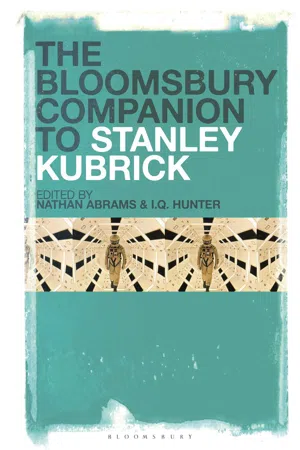
eBook - ePub
The Bloomsbury Companion to Stanley Kubrick
- 396 pages
- English
- ePUB (mobile friendly)
- Available on iOS & Android
eBook - ePub
The Bloomsbury Companion to Stanley Kubrick
About this book
Information
Part One
Industry
Introduction
This opening section considers how Stanley Kubrick managed to carve out a distinctive place within the American film industry both as a powerful auteur but also one of its most independent figures. Emerging as the old studio system was dying, as a forerunner of New Hollywood cinema, Kubrick made highly personal films that cut across mainstream genre filmmaking and art cinema but were always designed for commercial success. He was fortunate in becoming a director at a transitional moment in Hollywood, when the classical studio system was weakening in favor of independent producers, stars, and directors who were gaining more power and creative autonomy.
In a rare move, James Fenwick focuses on Kubrick’s role as a producer (rather than just as a director). He shows how becoming a producer was essential to Kubrick’s achieving what he called “annihilating control” (Krämer 2015b: 50) over his films and career, an aspiration that followed his frustrating experience on Spartacus. Especially important was seizing control of publicity, which enabled Kubrick to promote what would become his brand. A deal with Warner Bros. in 1970 won him unprecedented leverage, which he increased through obfuscation, limiting information, and not cooperating with studio executives. This power, however, as Fenwick suggests, was ultimately a self-defeating strategy. It not only left Kubrick unable to decide among projects and caught up in micromanaging preproduction, but it also so engaged him in postproduction tasks (checking prints, managing marketing and publicity, translation) that his role as producer took over from that of director, which further increased the gaps between his films.
Kubrick’s desire for autonomy and his vertically integrated oversight of his projects made him the very model of an auteur, a term popularized in the 1960s when directors were emerging as “superstars” (Gelmis 2001). Indeed, if Kubrick does not count as an auteur, it is hard to imagine any director who does. Rod Munday’s chapter surveys how critics have judged Kubrick’s claims as an auteur against the background of changing ideas of auteurism, noting that the first wave of auteurist critics, like Jean-Luc Godard (1968) and Andrew Sarris (1968a: 196), did not especially value his films. As auteurism became an aspect of marketing, Kubrick’s auteur status enabled his films increasingly to be sold by his name. At the same time, Kubrick consciously promoted his public image as an all-powerful, perfectionist genius, and he became a legend without becoming a conventional celebrity or media figure.
The next two chapters modify the idea of auteur by emphasizing the importance of collaboration to Kubrick, even if creative decisions would always ultimately rest with him. Possibly undercutting the link between auteurism and originality, Kubrick’s films from The Killing onwards were all adaptations of previously existing fictional material, usually novels or short stories (Jenkins 1997; Pezzotta 2013). (Only once did he plan a nonfictional film, Napoleon.) These sources were rarely classics with a significant cultural footprint (Nabokov’s Lolita is an exception) and often quite obscure. Although Traumnovelle (Rhapsody: A Dream Story), the source of Eyes Wide Shut, was a passion project for Kubrick, most of his sources were seemingly chosen as representative of a genre or for their commercial possibilities rather than for their high qualities and exploitable profile. This is standard practice in filmmaking whereby most films, in both the mainstream and art cinema, are adaptations designed to repurpose presold intellectual property. What is significant about Kubrick, however, is that, like John Ford, Alfred Hitchcock, and Steven Spielberg, he was an auteur of adaptation. Unlike with many adaptations, the fact that his films are adaptations is not the most important discursive frame for understanding them—nor was it how they were promoted. They were generally promoted as the latest Kubrick film rather than as adaptations. Graham Allen’s chapter shows how Kubrick often radically transformed his literary sources so that they worked as visual and aural experiences rather than imitations of the original. His later films in particular became postmodern reflections on the epistemology of cinema and film as dreamscape.
Typically, when adapting a source text, Kubrick worked closely with others, usually creative writers rather than professional screenwriters. In only two cases, A Clockwork Orange and Barry Lyndon, Kubrick adapted the books himself and is the only writer credited as the screenwriter. Manca Perko’s chapter examines Kubrick’s collaborative practices in detail. Like European directors such as Ingmar Bergman, Kubrick repeatedly employed the same personnel on his films, using small crews to keep costs down; it was almost an artisanal approach to filmmaking. Kubrick’s co-workers commented on his openness to collaboration, which was part of his exploratory attitude towards production and direction. Encouraging creativity in others played the same role as allowing for multiple takes: it maximized the possibilities of generating choices. As Peter Krämer has said, he would “select collaborators and establish work procedures which were likely to produce results he could not have come up with on his own” (2015b: 61). Working for Kubrick was often difficult but rewarding, and he seemed to mentor some of his collaborators who regarded the experience as an apprenticeship in filmmaking. Many stuck with him for years, like Leon Vitali, whose time with Kubrick is recorded in Filmworker (2017). Numerous of Kubrick’s collaborators won Oscars, too, generally for technical achievements (Barry Lyndon won four), though Kubrick was accused of stealing credit, for example from Douglas Trumbull for the special effects on 2001 (Child 2014).
Matthew Melia looks at the relationship between Kubrick and Britain, where he moved with his family in the early 1960s to make Lolita and maintain an independent distance from the studios. This enabled Kubrick to make use of British talent, and to take advantage of tax breaks such as the Eady Levy, which used box office takings to subsidize production (Fenwick 2017). As Melia shows, Kubrick was only one of several expatriate directors and other film workers who, in a significant transatlantic exchange of talent, moved to the UK in the 1950s and 1960s, some because of the blacklist in Hollywood. Melia also considers whether Kubrick’s films were “British” in a wider sense. Though none was set in contemporary Britain, A Clockwork Orange, with its location shooting at such places as Thamesmead and Brunel University, and Barry Lyndon, mostly set and filmed in England and Ireland, are arguably the most British in their themes and references to British science fiction and television, exploitation cinema, colonialism, and class. Because Britain often stands in for somewhere else, as in Lolita, Full Metal Jacket, and Eyes Wide Shut, the films’ “trans-Atlanticism” results in a sense of dislocation, which further enhances their dreamlike qualities. Much of the films’ Britishness rests with their use of British character actors, often familiar from television; Kubrick showed a preference for British actors as early as Spartacus.
Serenella Zanotti considers how Kubrick’s control over his films extended to translation of dialogue, dubbing, and subtitling. Kubrick had a varying but often close involvement with the production of foreign language versions. He selected translators and dubbing directors, giving them notes and setting out his intentions. As with his input into marketing, the aim was to aid box office success. He saw translation as intrinsic to the creative process, and often chose outsiders to the dubbing and subtitling industries to bring a freshness of approach. His preference for hiring voice actors with no previous experience of dubbing and established film directors rather than dubbing specialists helped to ensure that their work was not routinized.
One aspect Kubrick didn’t have control over was the critical response to his films. Gregory Frame looks at what was the often difficult reception of his films, many of which did not initially meet with universal critical acclaim (though it is a myth that 2001 was poorly received (Krämer 2010: 92–3)). There has been a continuous process of reevaluation of the films by critics and academics. Once marginalized films like Lolita and Barry Lyndon have become more central to his reputation, and scholars and critics have begun relooking at his earliest efforts. Archival research into Kubrick’s input into Spartacus has prompted reevaluation of a film often seen as marginal (Radford 2015). Frame argues that the expectations raised by Kubrick’s brand as an auteur came to suffocate the response to his films. There still remains critical disagreement about his films, especially Eyes Wide Shut, though that has achieved academic and some popular critical acclaim years after its initial release (Chion 2008; Kolker and Abrams 2019). The enthusiastic reception of Barry Lyndon on its 2016 may even have been influenced by academic reappraisal (Pramaggiore 2015a).
1
Kubrick and Production
James Fenwick
Across the thirteen feature films that Stanley Kubrick directed, he received the credit of producer on nine of them. Moreover, if one considers the partnership with James B. Harris between 1955 and 1963, during which Harris produced three films as part of their Harris-Kubrick Pictures Corporation, Kubrick was arguably involved as a producer on twelve of his own feature films. He was very much his own producer throughout most of his career, though with varying degrees of creative and business control at specific time periods. In the earliest years as a producer, Kubrick operated at a low-budget level of independence, with little influence over the way his films were handled by the studios to which he sold them. By the late 1960s, following the critical and commercial success of 2001: A Space Odyssey, Kubrick had established himself as one of the most powerful and potent producing brands in Hollywood. However, Kubrick’s output slowed considerably in the ensuing decades and, despite the extent of the producing control he had managed to obtain, he seemingly found it harder to produce and release a feature film.
Consider the fact that Kubrick directed and produced nine feature films in the twenty-two-year period between 1953 and 1975, in contrast to directing and producing only three feature films in the twenty-three-year period between 1976 and 1999. Kubrick’s output significantly reduced during his Warner Bros. (WB) years, a company with which he had struck a three-picture contract in 1970 and a further three-picture contract in 1984. During these years Kubrick apparently had unprecedented levels of producing authority, with almost total executive control of his films, but he was somehow unable—maybe even struggling—to move his pictures out of development and into production. Kubrick worked on various projects that consumed his energy in the 1980s and 1990s, including A.I. Artificial Intelligence and Aryan Papers among others, only to abandon them despite extensive research and financial investment.
This chapter explores Kubrick’s role as a producer, analyzing how he was able to secure the levels of autonomy that he did by the 1970s, before moving on to evaluate his role as a producer during the years. The chapter will argue that Kubrick’s success in obtaining the levels of producing control that he did was ultimately self-defeating, with WB enabling Kubrick’s decline in output by the levels of autonomy they granted him. The chapter serves as a comprehensive overview of Kubrick as a producer, but by no means discusses in-depth every facet of his career. Instead, the chapter argues that there are three key phases to understanding Kubrick’s career as a producer. First, the phase between 1951 and 1961 in which Kubrick sought to obtain autonomy as a producer. Second, the phase between 1962 and 1968 in which Kubrick sought to consolidate his autonomy. And third, his career from 1970 onwards when he worked exclusively with WB and was allowed unyielding levels of control to the point it crippled his ability to operate. Taken together, these three phases begin to reveal the industrial contexts of producing autonomy and the impact they had on Kubrick’s creative output.
Obtaining Autonomy
Throughout the 1950s Kubrick was a producer operating with various forms of independence from the major studios, which provided spaces of autonomy, particularly over areas of creative control. This allowed Kubrick to develop an innovative aesthetic approach to his work between his first feature, Fear and Desire, and his final collaboration with producing partner James B. Harris, Lolita. Across this roughly decade-long period, from the early 1950s to the early 1960s, Kubrick directed six feature films, making it one of the most productive periods of his career, with nearly half of all his feature films produced during this time frame. Yet, ironically, this is the period that Kubrick was most restricted in his powers as a producer, at least when it came to his position as a producer in relation to the studios financing his productions.
Postwar Hollywood was undergoing rapid transformations in its mode of production, moving toward a form of semi-independent producing, in which independent producers were subcontracted for one-off projects, or on nonexclusive contracts. These producers formed their own production companies, sourced a script or story material, brought together a cast and crew, and sought a budget. The number of independent production companies incorporated in the United States rose rapidly throughout the 1950s. Actors, writers, and directors were looking to become their own producers and take control of their own careers. This is not to suggest that Hollywood studios no longer had any creative control, but rather that levels of control and autonomy were now open for negotiation.
Kubrick’s first forays as a feature film producer, working...
Table of contents
- Cover
- Half-Title Page
- Title Page
- Contents
- Illustrations
- Notes on Contributors
- Acknowledgments
- Introduction
- Part I Industry
- Part II Sound and Image
- Part III Gender and Identity
- Part IV Thematic Approaches
- Part V Researching Kubrick
- Bibliography
- Filmography
- Index
- Copyright Page
Trusted by 375,005 students
Access to over 1.5 million titles for a fair monthly price.
Study more efficiently using our study tools.
Frequently asked questions
Yes, you can cancel anytime from the Subscription tab in your account settings on the Perlego website. Your subscription will stay active until the end of your current billing period. Learn how to cancel your subscription
No, books cannot be downloaded as external files, such as PDFs, for use outside of Perlego. However, you can download books within the Perlego app for offline reading on mobile or tablet. Learn how to download books offline
Perlego offers two plans: Essential and Complete
- Essential is ideal for learners and professionals who enjoy exploring a wide range of subjects. Access the Essential Library with 800,000+ trusted titles and best-sellers across business, personal growth, and the humanities. Includes unlimited reading time and Standard Read Aloud voice.
- Complete: Perfect for advanced learners and researchers needing full, unrestricted access. Unlock 1.5M+ books across hundreds of subjects, including academic and specialized titles. The Complete Plan also includes advanced features like Premium Read Aloud and Research Assistant.
We are an online textbook subscription service, where you can get access to an entire online library for less than the price of a single book per month. With over 1.5 million books across 990+ topics, we’ve got you covered! Learn about our mission
Look out for the read-aloud symbol on your next book to see if you can listen to it. The read-aloud tool reads text aloud for you, highlighting the text as it is being read. You can pause it, speed it up and slow it down. Learn more about Read Aloud
Yes! You can use the Perlego app on both iOS and Android devices to read anytime, anywhere — even offline. Perfect for commutes or when you’re on the go.
Please note we cannot support devices running on iOS 13 and Android 7 or earlier. Learn more about using the app
Please note we cannot support devices running on iOS 13 and Android 7 or earlier. Learn more about using the app
Yes, you can access The Bloomsbury Companion to Stanley Kubrick by I.Q. Hunter, Nathan Abrams, I.Q. Hunter,Nathan Abrams in PDF and/or ePUB format, as well as other popular books in Media & Performing Arts & Film & Video. We have over 1.5 million books available in our catalogue for you to explore.