Vs. is the sound of a band on fire. The same confluence of talent, passion, timing, and fate that made "grunge" the world's soundtrack also lit a short fuse beneath Pearl Jam. The band combusted between late 1992 and mid-1994, the span during which they planned, recorded, and supported their sophomore record. The spotlight, the pressure, the pace-it all nearly turned the thriving act to ash.
Eddie Vedder, the reluctant public face of the band, responded by lashing out lyrically. Jeff Ament, Mike McCready, and Stone Gossard, who beheld success with varying degrees of anxious satisfaction, attacked their instruments in solidarity. Dave Abbruzzese welcomed the rock-star lifestyle, and left his mark on the record with more than just potent percussion.
Vs. roils with fury-and at times, gently steams-over the trappings of fame, human faults, and societal injustice. The record is a thrashing testament to Pearl Jam's urgent creativity and greater-good interests, and the band's logistical calculations behind it drew a career-defining line in the sand. It promised the world that Pearl Jam would neither burn out nor fade away. This book weaves research, little-known details, and band members' memories into a definitive account of how Vs. set them on a path toward enduring integrity and relevance.
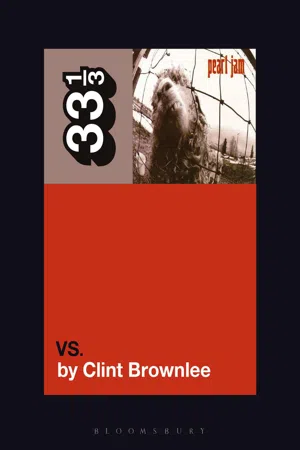
- 160 pages
- English
- ePUB (mobile friendly)
- Available on iOS & Android
eBook - ePub
Pearl Jam's Vs.
About this book
Information
3
Five Against One
“Go” ● “Leash”
Success breeds higher expectations. Once you set the bar, you want to raise it, not make it your status quo, certainly not bring it down a peg. It’s as true for musicians as it is for carpenters, accountants, teachers, scientists, or customer service agents. When you find that sound, that formula, that email tone that just clicks—you can’t continue to aim right at or below it. You refine, try to improve, to do better. Anything less successful the next time would, reasonable or not, feel like a failure.
There’s an inverse aspect to this, too: “success” in the eye of the beholder. The kid who bonds with a teacher wishes more educators would take the same approach. The couple who furnishes their bedroom with the custom dresser now wants a matching headboard. The music fan who plays her favorite record until she knows every vocal tic, can hum every bassline—she can’t wait until the act puts out another album. She expects it, of course, to be even better. It’ll be her new favorite record.
That’s how I think, how you think, how everyone thinks. It’s not that what we’ve already heard isn’t good enough. It’s that the threshold for “good enough” only moves one direction. And, actually, it’s not thinking at all. It’s emotion—which, by definition, irrationally makes the listener, and the artist, expect ever better. The sky’s the limit. Why would you aim below the horizon?
That question complicated Pearl Jam’s follow-up to Ten. The expectations were massive. The world had by then made the band and several of its brethren—Nirvana, Soundgarden, Alice in Chains—household names. Seemingly every record from a rock band in Seattle was greeted with radio airplay, magazine love, boosted sales, and listener adulation. Bands from other cities (and countries) were also taking up the guitar-heavy approach and pounding out their takes of what had been labeled grunge, widening the malleable definition of “alternative rock.” The world banged its collective head to heavy chords and sang along with big choruses. Millions were eager to do the same to Pearl Jam’s next effort.
That fact was all too obvious to Eddie Vedder, Stone Gossard, Jeff Ament, Mike McCready, and Dave Abbruzzese—and the pressure was intense. If they recorded something less listener-friendly, people would consider it a miss, even conclude that Pearl Jam was a one-hit act that had been in the right place at the right time. If they made a record vastly different from Ten, they might alienate a large swath of fans. And retreading the same territory would beget zero creative satisfaction.
That last point might have been the toughest part—because Pearl Jam’s members held their craft sacred. Those who said Ten reflected a “corporate” or “sellout” approach to rock and roll, who believed the band was focused on making mainstream hits rather than authentic art, couldn’t have been more wrong. The bandmates had a coalescing vision of what Pearl Jam should be, and a skin-deep chart-chaser wasn’t it.
In a 1992 interview for MTV Japan, Gossard emphasized their approach to making art in the towering shadow of their initial effort. He stated that in looking toward a second album, the band was “trying to understand the intangible things about the first record . . . stuff that we didn’t even think about or realize that people really responded to. [We’ll] try to retain those elements, but at the same time do something new, something different. Try to keep, from our own perspective, growing musically and growing emotionally.”1
The band’s label, Epic Records, might have appreciated the act’s integrity but was, predictably, focused on the bottom line: sales. Epic pressed Pearl Jam’s manager, Kelly Curtis, to keep the Ten hits coming into late 1992. As Curtis put it in Everybody Loves Our Town, “There were some great people at the label that were really supportive, and then there were people that didn’t understand. Tommy Mottola, the CEO of Sony Music [owner of Epic], told me . . . that if we didn’t release ‘Black’ as the next single, it would be the single hugest mistake I’ve ever made in my life and my career.”2
Pearl Jam, testing its budding strength, refused to commercialize “Black.” But by early 1993, a perfectly arduous storm had descended upon the band. Every day, the hungry masses were clamoring louder for more. Articles about the Seattle Sound and its twin champions, Pearl Jam and Nirvana, were piling up and tightening the screws. Plus, there was the band’s contract with Epic to record more material. The pressure was omnipresent.
Perhaps most crushing was Pearl Jam’s very hometown. Seattle was ground zero for a cultural movement the band had helped create and, therefore, had become as overbearing as its fabled misting gray skies. The Emerald City had transformed into a microscope and the five musicians were bugs pinned beneath its lens. It was anything but an ideal environment for fostering creative integrity and solidifying a fragile, fomenting aesthetic. “We just needed to get out of Seattle. [It] was starting to feel a little weird,” Ament recalled, in what may be the understatement of his career.3
So when they were ready to record new music—the bassist, for one, inspired by his own curveball “mixtape of Police, Peter Gabriel, and reggae”4 —they hit the road. Pearl Jam packed their gear and headed for a remote studio in California’s Bay Area. New setting. New headspace. And a new producer, for good measure.
The band would quickly find that change is not inherently good.
●
Vedder, as the most objectified member of Pearl Jam, was also the most wary of the spoils of his band’s success. So upon realizing that the space he and his bandmates would use to record their follow-up to Ten was a posh accommodation boasting, among other things, a dedicated chef, he bristled.
The Site, set in the picturesque San Rafael foothills thirty miles outside of San Francisco, could have been the final factor that vaporized Pearl Jam before the band found its identity and its way. The name itself suggested entitlement, bore a “you have arrived” con notation. And in addition to the chef, there was a basketball court, a sauna, a pool, space to sleep, space to roam. All impressive amenities that had been previously enjoyed by the likes of Keith Richards, Dolly Parton, and Huey Lewis and the News, but when compared to the band’s spare experience recording Ten, were wild, disorienting—and to Vedder, ridiculous.
“I fucking hate it here,” he admitted to Rolling Stone writer and Singles director Cameron Crowe at the time. “How do you make a rock record here? Maybe the old rockers, maybe they love this. Maybe they need the comfort and the relaxation. Maybe they need it to make dinner music.”5
In the Pearl Jam Twenty tome, Vedder reflected, “On the first record, we were living in a basement, and I was pissing in Gatorade bottles and putting quarters in the parking meter so my truck wouldn’t get tickets.” While working at the Site, he “felt too far away from the basement. It was a hard place for me at that point to write a record. Especially with lyrics, I didn’t want to be writing about hillsides and trees among luxurious surroundings. I was more into people and society, chaos and confusion, and answering the question, ‘What are we all doing here?’”6
Ascending producer Brendan O’Brien, who’d engineered the Black Crowes’ first two records and the Red Hot Chili Peppers’ Blood Sugar Sex Magic and had been introduced to Pearl Jam by the latter band, did his best to help Vedder answer that both personal and existential question by harnessing the positives of the studio and sidestepping what some of the band saw as negatives (or at least excessives). A musician himself, O’Brien understood the situation, saw that Pearl Jam was under immense pressure, and initiated a routine to build, and maintain, momentum.
“They had just blown up with popularity out of nowhere,” the producer said. “My role at the time was really getting those guys in a room and getting them in a head space to record. I encouraged us to meet every morning. It was like, ‘OK. Tomorrow, 9:30, pep talk in the kitchen, and then we’re going to play softball.’”7
O’Brien’s regimen was part diversionary tactic, part classic creative redirection—encouraging artistic thinking by leading the mind’s shallower layers elsewhere. He and the band followed the morning games with studio time where the majority of Vs.’s songs were incubated from start to finish. They’d only brought a few solid compositions with them and agreed to the producer’s suggestion that they work through and record each song completely before moving on to the next. The approach ran counter to typical rock recording sessions—in which bands capture separate vocal and guitar and rhythm tracks for various songs, in whatever order whims strike, and then mix the pieces together either on the spot or at a later date—and it was a stroke of genius.
Taping and mixing each song to completion before moving on allowed Pearl Jam to capture and convey the authenticity that they’d become known for on stage, to achieve the “raw and live-sounding” energy Ament later said the band was looking for. Ample volume was an important ingredient, too. The bassist noted that he “recorded all [of his] parts live with the drums, amps in the room full-blast.”8
As McCready attested, the thorough-and-loud approach “kept us focused, kept the basic tracks more live, and kept us working.”9 It’s what gave the heady songs such punch, and the slower-burning tracks lived-in depth. It’s also what enabled the band to record “Go,” “Blood,” and “Rats” in their first week at the Site.
Those three songs are some of the hardest-charging of the record, and their lyrical topics indicate Vedder’s antagonized headspace. They are the sound of a band on fire—in all senses of the phrase. Pearl Jam, kicking off the Vs. sessions, was clicking as creatively as they had in their first few weeks together. Yet at the same time, fame and their (mainly Vedder’s) rage against it had created an explosive friction.
Evidence is in the first words sung on the album: “Oh please don’t go out on me, don’t go out on me now.” The practical interpretation is that Vedder was imploring, even if only metaphorically, his new band—and perhaps himself—not to go off the rails, not to crash and burn. The singer and his four bandmates had much at stake with their second record. Its reception could spell more fame, fan disappointment, a breakup, who knows? Anything was possible, but one thing was certain: the lyricist was barely holding on, and those words opening the record—accompanied by the breakneck pace and raw aggression catapulting “Go” into listeners’ ears following a near-thirty-second warming primer—set the stage in a hurry.
Pearl Jam has asserted that “Go” is “about a car on the verge of breaking down,”10 but it’s hard to believe Vedder didn’t have Pearl Jam’s perilous trajectory in mind when he wrote the lyrics shortly after arriving at the Site—a setting which reflected the band’s success in every luxurious touch.
While there are lines that support the breakdown explanation (“Moving oh so swiftly / With such disarm”), there are others in the song that suggest Vedder might have been seeing himself in a mirror, from someone else’s point of view, or projecting personal emotions (via an automotive parallel)—regret, anger—onto a character also on the verge of shutting down, at risk of failing under immense and constant pressure.
I pulled the covers over him
Should have pulled the alarm
Turned to my nemesis
A fool, not a fucking God
Whatever Vedder’s true intent—and he has never been exactly forthright in explaining—those are not lighthearted lines. Something, be it a vehicle or a human being, is in a bad place. The one clear element is that the observer has perspective, and a certain distance from the hurtling, seemingly doomed subject in question. Which might just be the frontman im agining a version of himself stepping back to take it all in, crying out a warning—and hoping for the best.
Iro...
Table of contents
- Cover
- Series
- Dedication
- Title
- Contents
- Introduction: My Generation Loved Their Town
- Band versus Fame
- Band versus World
- Band versus Self
- Band versus Future
- Thanks
- Notes
- Copyright
Trusted by 375,005 students
Access to over 1.5 million titles for a fair monthly price.
Study more efficiently using our study tools.
Frequently asked questions
Yes, you can cancel anytime from the Subscription tab in your account settings on the Perlego website. Your subscription will stay active until the end of your current billing period. Learn how to cancel your subscription
No, books cannot be downloaded as external files, such as PDFs, for use outside of Perlego. However, you can download books within the Perlego app for offline reading on mobile or tablet. Learn how to download books offline
We are an online textbook subscription service, where you can get access to an entire online library for less than the price of a single book per month. With over 1.5 million books across 990+ topics, we’ve got you covered! Learn about our mission
Look out for the read-aloud symbol on your next book to see if you can listen to it. The read-aloud tool reads text aloud for you, highlighting the text as it is being read. You can pause it, speed it up and slow it down. Learn more about Read Aloud
Yes! You can use the Perlego app on both iOS and Android devices to read anytime, anywhere — even offline. Perfect for commutes or when you’re on the go.
Please note we cannot support devices running on iOS 13 and Android 7 or earlier. Learn more about using the app
Please note we cannot support devices running on iOS 13 and Android 7 or earlier. Learn more about using the app
Yes, you can access Pearl Jam's Vs. by Clint Brownlee in PDF and/or ePUB format, as well as other popular books in Media & Performing Arts & Music. We have over 1.5 million books available in our catalogue for you to explore.