Upon its initial release in 1977, many critics regarded Star Wars as a childish retort to the mature American cinema of the seventies. Though full of sound and fury, some felt that it signified nothing. Four decades later, the significations are multiple as interpretations of the film's strange imagery and metaphoric potential continue to pile up.
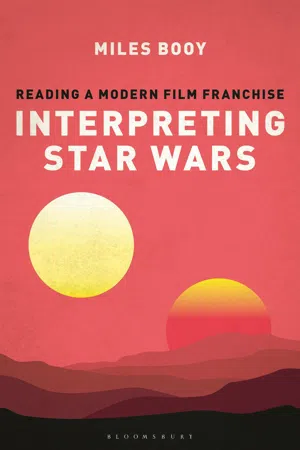
Interpreting Star Wars analyses and contextualises the dominant trends in Star Wars interpretation from the earliest reviews, through Lucasfilm's attempts to use its position as copyright holder to promote a single meaning, to the 21st century where the internet has rendered such authorial control impossible and new entries to the canon present new twists on old hopes.
- 200 pages
- English
- ePUB (mobile friendly)
- Available on iOS & Android
eBook - ePub
About this book
Information
1
Star Wars versus secularity
George Lucas’s early outlines for what became Star Wars foresaw that it and any hypothetical spin-offs would be part of a wider text, The Journal of the Whills. This book would possibly be seen on screen at the beginning, opening up to reveal the narrative action just as a book of fairy tales began a number of Disney films.1 Although this never happened, some have concluded that Whills was itself to have been a sacred text. This would not have been inappropriate. What finally emerged after multiple drafts was a film heavily invested in the contrast between a rebellion defined in terms of faith and an Empire which, with the Emperor only present as a passing reference, was run by secular technocrats who sneered at the Force. Later films would change this. The Emperor would be revealed as perhaps the most powerful Force-user of all, and as Jedi skills and combat became both more spectacular and closer to the heart of the story, disbelief in the power of the Force ceased to be a real option. The reading which follows is my own. It traces the opposition of secularity with faith in the film of 1977. I offer it to point up those elements which became important in generating religious interpretations in the 1970s and 1980s as well as outlining some elements which were dispensed with in subsequent films. It will be familiar in outline, but not, I hope, in detail.
Star Wars – A reading
Although the Emperor is only referred to twice in Star Wars (1977), the first occurrence is in an important and well-known scene (the second is when Tarkin orders Alderaan destroyed). In a conference room on the Death Star, a number of Imperial officials are arguing over the danger presented by the rebellion:
Admiral Tagge: The rebellion will continue to gain sympathy in the Imperial Senate –
Governor Tarkin: (Entering with Vader) The Imperial Senate will no longer be of any concern to us. I have just received word that the Emperor has dissolved the council permanently. The last remnants of the Old Republic have been swept away.
Admiral Tagge: That’s impossible! How will the Emperor maintain control without the bureaucracy?
Governor Tarkin: Regional governors now have direct control over their territories.
The first reference to the Emperor seems narratively important. Lucas would later claim that the inspiration was Richard Nixon, but for historically informed viewers, the abolition of the Republic cues a certain reading: events here are based on the fall of Republican Rome. Indeed, Rome hangs at the edge of the film as its foremost real-world example of what it means to be an empire. The film’s novelisation and other early spin-off novels were chapterised with Roman numerals – as later, of course, were the films themselves. Palpatine’s name is not given onscreen, but it appears in the novelisation and was subsequently used in the prequel trilogy. Perhaps it recalls Palatine, the central of the seven hills of Rome, and by Return of the Jedi, he has his own equivalent of the Praetorian guard.
For all viewers, historically informed or not, the line establishes that galactic democracy has reached a new low with the complete abolition of a senatorial system. As befits a film celebrated for the offering of hope, Star Wars is a movie about a crisis point. Things will get worse before they get better, and later in the film, Vader is in a position to gloat: ‘This will be a day long remembered. It has seen the end of Kenobi. It will soon see the end of the rebellion.’ It is often said that The Empire Strikes Back is a film which sees our heroes harried and constantly on the run (which is true), and the Emperor will boast in Jedi that his plan will destroy the rebellion this time, but the rebels really reach their lowest ebb five or six minutes before the end of this first film. Kenobi is apparently dead, the Senate is abolished, the rebel base is within range of the Death Star’s planet-destroying weaponry, and their X-Wing fleet has been decimated. The darkest hour falls in the minutes before Luke learns to deploy the Force for strategic ends. Once he does that, however bad things get, there is always (a new) hope.
So, we learn nothing about the Emperor here. He is a narrative function, mentioned simply to enable the plotpoint of the Senate’s abolition. The Grand Moff Tarkin is the focus of the scene at this point. His entry silences the squabbling officers. As with Leia’s later line about his holding Vader’s leash, it is clear that Tarkin is the centre of authority here. Moreover, there are significant positions of local authority – regional governors. The vision of the Emperor and Vader forming the heart of a dark empire is later revisionism. A whole language of politics peppers this film. Senate, bureaucracy, council, regional governors: these terms imply a whole political system, as does the language used during Vader’s interrogation of the rebel he kills and then Princess Leia in the film’s opening sequence: ambassador, consular, diplomatic. These concerns vanish in the sequels – though they return with a vengeance in the prequels – and we will pay attention to the impact of this elision upon the themes and plot as they come and go.
Vader’s lowly status in the Imperial hierarchy as seen here has caused Star Wars fans some sleepless nights down the years (google a phrase such as ‘Why does Darth Vader defer to Tarkin?’ to find the debates), but rather than trying to reconcile the conflicting arrangements of different films, we might productively look again at the characterisation of Vader in the film. His entry into the film in black armour through the white smoke of battle is iconic, but his behaviour is very different from what becomes the norm. In subsequent films, Vader keeps his own council, issuing orders to subordinates only after he has thought actions through in the privacy of his own mind. This contrasts with his behaviour on the rebel ship early in Star Wars. In this film, he does his thinking aloud (‘She must have hidden the plans in the escape pod’) and accepts the views of others as worth listening to (‘Holding her is dangerous. If word of this gets out it could generate sympathy for the rebellion in the Senate’). In the course of early sequences, he becomes both visibly frustrated (‘There’ll be no one to stop us this time!’) and angry when impotent (‘You are part of the rebel alliance and a traitor – take her away!’). This visibly emotional Vader has a frenetic body language. Later films would depict him as essentially still, unmoving except when necessary. This is sometimes the case here, but in emotional moments he is mobile, as when he looks from side to side, clearly frustrated while he gives orders to ‘tear this ship apart, and bring me the passengers. I want them alive,’ before angrily exiting screen left.
The abolition of the Senate established, the meeting on the Death Star continues, containing the famous sequence of Vader Force-choking Admiral Motti.
Motti: This station is now the ultimate power in the universe. I suggest we use it.
Vader: Don’t be too proud of this technological terror you’ve created. The ability to destroy a planet is insignificant next to the power of the Force.
Motti: Don’t try to frighten us with your sorcerer’s ways, Lord Vader. Your sad devotion to that ancient religion has not helped you conjure up the stolen data tapes. Or given you clairvoyance enough to help you find the rebels’ hidden fortr –
(With a gesture, Vader begins to Force-strangle Motti.)
(With a gesture, Vader begins to Force-strangle Motti.)
Vader: I find your lack of faith disturbing.
Tarkin: Enough of this. Vader, release him.
Return of the Jedi would later lead Robin Wood to argue that the Death Star ‘was created by the Force’,2 but in this film the two are constructed as distinct opposites. Vader, taking a stand against the omnipotence of technology, is clearly at odds with the military commanders. His major ally at this point is Tarkin. The governor calls him ‘my friend’ (something no one other than the Emperor would dare to claim in the sequels) and publically supports him: ‘Lord Vader will provide us with the location of the rebel fortress by the time this station is operational.’ Even he, however, has his doubts about the Dark Lord’s strategy. ‘I’m taking an awful risk, Vader,’ he says after the Millennium Falcon has been allowed to escape the Death Star with a homing beacon planted aboard, ‘This had better work.’
The antagonism between Motti and Vader opposes a faith in material causality and military power to one in belief/‘religion’. The same positions are taken in later discussions between Ben Kenobi and Han Solo on the Millennium Falcon. Ben is teaching Luke the ways of the Force, and Solo sneers.
Solo: Hokey religions and ancient weapons are no match for a good blaster at your side, kid.
Luke: You don’t believe in the Force, do you?
Solo: Kid, I’ve flown from one side of this galaxy to the other. I’ve seen a lot of strange stuff. But I’ve never seen anything to make me believe there’s an all-powerful Force controlling everything. There’s no mystical energy-field controls my destiny.
Both sequences end with an act of the Force (Vader’s strangulation of Tagge, Luke successfully hitting the flying orb despite being blindfolded) which effectively ends the debate for viewers and foreshadows the film’s conclusion. The sequences use another vocabulary – religion, hokey, conjure, devotion, ancient, faith, sorcerer’s – which is almost without equivalence in the later films. These words are mostly used to characterise Force-believers as misguided and/or outdated. However, the film settles the debate decisively on their side, so the sequels have no real use for them, and religious terminology is subsequently almost wholly avoided. Han Solo’s ‘Then I’ll see you in Hell’ and Vader’s ‘I am altering the deal. Pray that I do not alter it any further’ (both from Empire) are rare later uses of that vocabulary. Pray particularly stood out in 1980. It would not have done so in 1977.
Though later films take different tacks, the universe of Star Wars, the film of 1977, experiences a religious divide not unlike the modern Western world. Older beliefs, once dominant, are giving way to a new secularity. The film is rich with the sense of an old order almost completely passed. Kenobi calls it ‘a more civilised age’, and the language (of sabres, knights and republic) makes it sound archaic but also more virtuous than the technocratic materialism which has replaced it. Solo calls it ‘ancient’, an odd word to use in this context if one does some very basic math. Luke is roughly aged twenty, so the Clone Wars, in which his father fought, cannot be much more than two decades earlier. Leaving aside the question of why there wasn’t twenty-four-hour news coverage of the combat (and, thus, easily accessed proof of Jedi abilities), this is well within the lifetimes of both Tagge and Solo, but neither appears to have any memory of the Jedi. In the real world, the events of the world’s sacred texts happened centuries ago, so it is easy to disregard them as mythology. Star Wars constructs the same opposition, but in a timeline so compressed as to make little literal sense. The deployment of the word ‘ancient’, I would suggest, is an attempt to paper over this.
A Force which could be doubted to even exist could not be represented as it would be later. When Jedi leap acrobatically beyond human abilities, levitate objects at will, and sense each other across major distances in space, scepticism becomes untenable. An intelligent person might, however, reasonably disbelieve in the Force as it is shown in Star Wars. The small and subtle acts undertaken in its name mainly concern perception. Luke’s ability to ‘see’ his targets when he is blindfolded or turns off his targeting computer; Kenobi’s manipulation of the soldiers manning the roadblock into Mos Eisley; Vader’s sensing Kenobi’s presence on the Death Star – none of these works on the physical plane, just the psychic/spiritual. General Motti’s strangulation, small in comparison to later excesses, is as physical as the Force gets, and even this incident is ambiguous: is Vader manipulating Motti’s throat or his mind? Is the man being strangled, or does he simply think that he is? Note that when Vader wants to actually kill someone in this film – the rebel whom he briefly interrogates in the opening sequence – he does so physically, snapping his neck with the strength of his grasp rather than via the Force.
There is nothing here that a sceptic couldn’t de...
Table of contents
- Cover
- Halftitle Page
- Title Page
- Contents
- Acknowledgements and Housekeeping
- Introduction: Possibilities of interpretation
- 1 Star Wars versus secularity
- 2 Star Wars and the Reagan revolution
- 3 The first interpreters
- 4 The trilogy and the myth reading
- 5 The progressives strike back:
- 6 New twists on old hopes:
- Conclusion:
- Notes
- Bibliography
- Index
- Copyright Page
Trusted by 375,005 students
Access to over 1.5 million titles for a fair monthly price.
Study more efficiently using our study tools.
Frequently asked questions
Yes, you can cancel anytime from the Subscription tab in your account settings on the Perlego website. Your subscription will stay active until the end of your current billing period. Learn how to cancel your subscription
No, books cannot be downloaded as external files, such as PDFs, for use outside of Perlego. However, you can download books within the Perlego app for offline reading on mobile or tablet. Learn how to download books offline
Perlego offers two plans: Essential and Complete
- Essential is ideal for learners and professionals who enjoy exploring a wide range of subjects. Access the Essential Library with 800,000+ trusted titles and best-sellers across business, personal growth, and the humanities. Includes unlimited reading time and Standard Read Aloud voice.
- Complete: Perfect for advanced learners and researchers needing full, unrestricted access. Unlock 1.5M+ books across hundreds of subjects, including academic and specialized titles. The Complete Plan also includes advanced features like Premium Read Aloud and Research Assistant.
We are an online textbook subscription service, where you can get access to an entire online library for less than the price of a single book per month. With over 1.5 million books across 990+ topics, we’ve got you covered! Learn about our mission
Look out for the read-aloud symbol on your next book to see if you can listen to it. The read-aloud tool reads text aloud for you, highlighting the text as it is being read. You can pause it, speed it up and slow it down. Learn more about Read Aloud
Yes! You can use the Perlego app on both iOS and Android devices to read anytime, anywhere — even offline. Perfect for commutes or when you’re on the go.
Please note we cannot support devices running on iOS 13 and Android 7 or earlier. Learn more about using the app
Please note we cannot support devices running on iOS 13 and Android 7 or earlier. Learn more about using the app
Yes, you can access Interpreting Star Wars by Miles Booy in PDF and/or ePUB format, as well as other popular books in Media & Performing Arts & Film & Video. We have over 1.5 million books available in our catalogue for you to explore.